Compensation Management Software for HR & Finance Leaders

Stop Budget Overruns and Pay Equity Risk Before Your Next Cycle

CompBldr gives HR and Finance one governed system to control every compensation decision in real time from jobdefinition through merit cycle through total rewards. Every decision documented. Every dollar tracked. Every audit ready.

SOC 2 Type II Certified
No credit card required
Live in 6–10 weeks

Trusted by HR and Finance teams at

Compensation Has Never Had a
System of Record, Until Now.

Your HRIS stores employee data. Your payroll executes payments. But the decisions that determine what 70% of your operating budget goes to? Those live in spreadsheets, email chains, and someone's head. CompBldr is the first platform purpose-built to govern them.

System
What It Does
What It Governs
HRIS (Workday, ADP, BambooHR)
Stores employee records, org charts, PTO
Employee data
Payroll (ADP, Paychex, Gusto)
Executes payments, taxes, direct deposits
Payment processing
CompBldr
Governs every decision that determines what people earn and why
Compensation decisions
HRIS (Workday, ADP, BambooHR)
What It Does
Stores employee records, org charts, PTO
What It Governs
Employee data
Payroll (ADP, Paychex, Gusto)
What It Does
Executes payments, taxes, direct deposits
What It Governs
Payment processing
CompBldr
What It Does
Governs every decision that determines what people earn and why
What It Governs
Compensation decisions
This category didn't exist before. That's why your comp process still runs in spreadsheets.

Unstructured Comp Is Costing You More Than You Think

These aren't hypotheticals. They're what happens when pay decisions live in spreadsheets, email threads, and someone's memory.

Job frameworks evolve informally
Evaluation lacks consistent logic
Market data sits outside architecture
Planning decisions lack integrity

HR: Pay gaps found after people leave

Without structured architecture, pay disparities compound silently for years until they surface as exitinterviews, Glassdoor reviews, or regulatory audits.

Finance: Budgets blown every merit cycle

Individual approvals look fine in isolation. Together they blow the budget by 15–20% because nobody had the full picture until the cycle closed.

Analysts: Weeks lost to manual survey matching

You pay six figures for Radford, Mercer, and WTW data. Then your team spends 3–6 weeks making subjective matching decisions in Excel.

Everyone: No single source of truth

Levels in one spreadsheet, benchmarks in another, approvals over email. No single source of truth means no way to govern what you can't see.

See Your Compensation Risk &
Savings

Enter two numbers. See what unstructured comp is actually costing you.

Calculate Your Compensation Savings

Drag the sliders. Watch your numbers change in real time.

Based on data from 300+ compensation cycles
Assumes 1.5% comp leakage
53% recovery rate avg across CompBldr customers
Number of Employees 4,450
100 2,500 5,000 7,500 10,000
Average Total Compensation $195,000
$40K $90K $140K $200K $250K

$13.02M

Your Estimated Annual Comp Leakage

$6.9M

Your Potential Annual Savings with CompBldr

95x

Your Projected First-Year ROI

How we calculate: Leakage = 1.5% of total comp spend (industry avg for unstructured orgs). Savings = 53% leakage recovery (avg across CompBldr customers). ROI = annual savings ÷ typical platform investment.

We'll build this model with your actual data in 15 minutes.

From Job Definition to Total Rewards
One Connected Compensation Platform

Six modules. One architecture. Each step feeds the next, so your comp decisions are always built on a clean, consistent, documented foundation.

Your JDs Are Scattered Across 3 Shared Drives. That Ends Today.
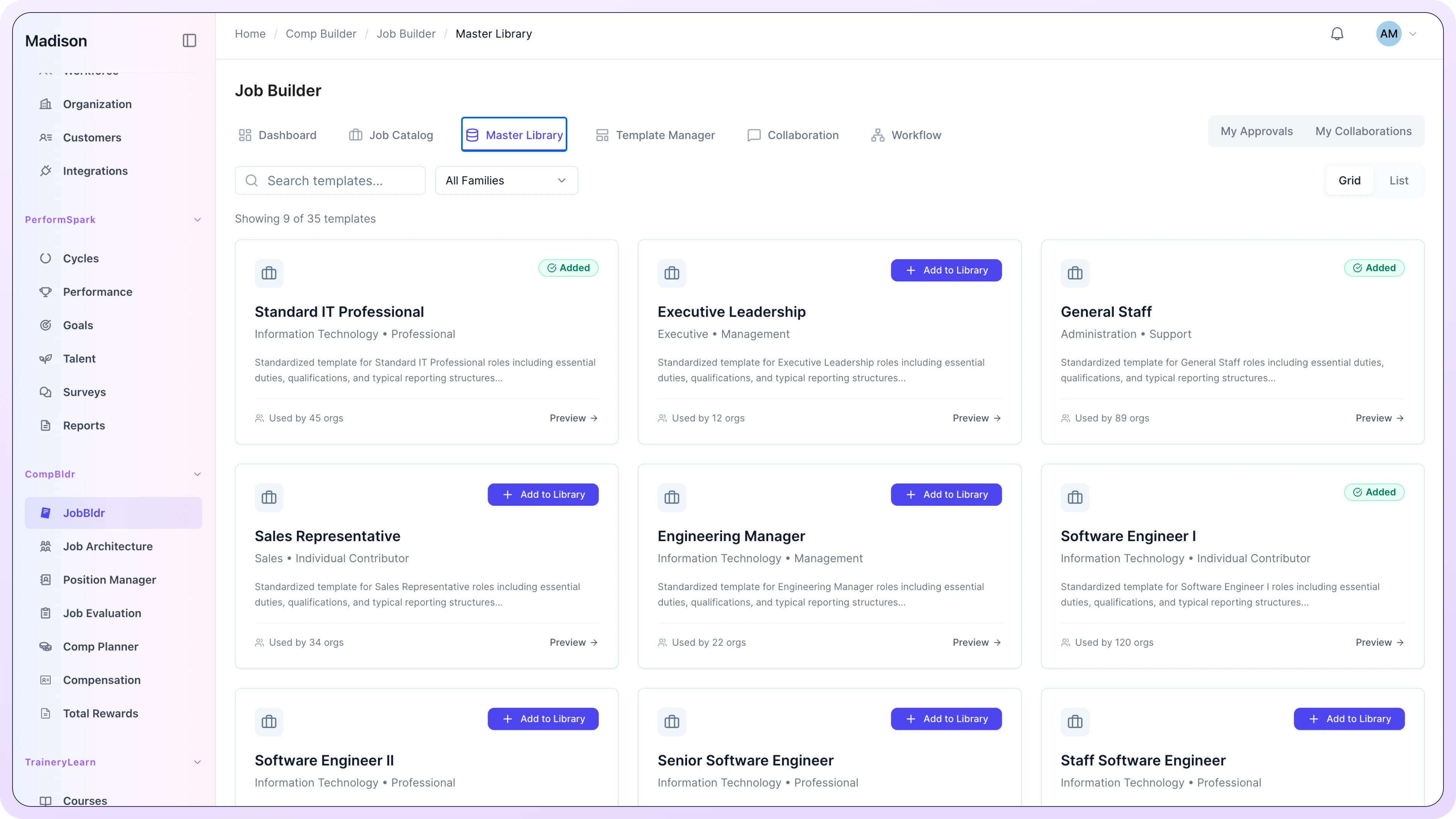
JobBldr replaces unstructured docs and email approvals with a governed platform every edit logged, every review routed, every role connected to your comp architecture.
  • Managers often don’t know how to give useful feedback, and employees often don’t know how to take criticism and grow from it.  
  • ReviewCloud gives you multiple review style and cycle options, goal management, and planning tools to help your employees grow.
  • Managers can move employees from ‘recommendation to doing’ by accessing subscribed learning solutions within the portal.
Governed master library searchable by title, code, family, or group
Multi-level approval routing: Legal, HR Director, VP, Comp Committee
Every save versioned color-coded diffs show what changed and when
External reviewers get scoped access, no emailed Word docs, no version conflicts
Explore JobBldr
73% of Orgs Have Inconsistent Titles. Build One Structure Everyone Uses.
Job Architecture defines families, grades, codes, and levels giving every role a governed structural address before anything else happens. The foundation every other module builds on.
  • Managers often don’t know how to give useful feedback, and employees often don’t know how to take criticism and grow from it.  
  • ReviewCloud gives you multiple review style and cycle options, goal management, and planning tools to help your employees grow.
  • Managers can move employees from ‘recommendation to doing’ by accessing subscribed learning solutions within the portal.
Job families, sub-families, and groups, one taxonomy across every entity
Score-based grade placement from JESAP evaluation not manager judgment
Structured job codes (ENG-FSD-G1-001) that travel across every module
Grade Title Matrix surfaces gaps immediately not during an audit
Explore Job Architecture
61% of Evaluations Lack Consistency. Score Every Factor. Defend Every Grade.
The JESAP® 15-factor methodology scores every role objectively with full version history, AI calibration, and grade structures that hold up under any audit or board review.
  • Managers often don’t know how to give useful feedback, and employees often don’t know how to take criticism and grow from it.  
  • ReviewCloud gives you multiple review style and cycle options, goal management, and planning tools to help your employees grow.
  • Managers can move employees from ‘recommendation to doing’ by accessing subscribed learning solutions within the portal.
15 compensable factors across knowledge, complexity, accountability, and conditions
Quick Evaluation mode score a full role in minutes without switching screens
Every version saved: evaluator, scores, grade result, timestamp all permanent
AI calibration flags where scores diverge, surfaces bias before it compounds
Explore Job Evaluation
You Spend Six Figures on Survey Data. Then Waste 40 Hours Matching It Manually.
Radford, Mercer, and WTW data maps directly to your architecture, automatically. No spreadsheets, no subjective matching, no analyst weeks rebuilding the same work every cycle.
  • Managers often don’t know how to give useful feedback, and employees often don’t know how to take criticism and grow from it.  
  • ReviewCloud gives you multiple review style and cycle options, goal management, and planning tools to help your employees grow.
  • Managers can move employees from ‘recommendation to doing’ by accessing subscribed learning solutions within the portal.
AI matching uses architecture context family, grade, scope not just title keywords
Up to six data sources blended with configurable weighting by job family
Confidence scores flag positions where percentiles may be unreliable
Approved matches carry forward only new roles need remapping each cycle
Explore Market Benchmarking
Your Last Merit Cycle Blew the Budget by 17%. This One Won't.
One governed system for merit increases, bonuses, and incentives with real-time budget tracking, performance linkage, and structured approvals that catch overruns before they happen.
  • Managers often don’t know how to give useful feedback, and employees often don’t know how to take criticism and grow from it.  
  • ReviewCloud gives you multiple review style and cycle options, goal management, and planning tools to help your employees grow.
  • Managers can move employees from ‘recommendation to doing’ by accessing subscribed learning solutions within the portal.
Budget consumption updates live as managers submit Finance sees the same number
Merit ranges apply automatically by rating band and grade level
Every proposal, approval, and override logged: reviewer, timestamp, rationale
Compression flagged before it becomes a pay equity problem
Explore Compensation Planning
2,800 Personalized Statements in 4 Days. Last Year It Took 3 Weeks.
A five-step governed workflow template, builder, data import, cycle management, and approval replaces the spreadsheets and vendor PDFs that make statement production a recurring nightmare.
  • Managers often don’t know how to give useful feedback, and employees often don’t know how to take criticism and grow from it.  
  • ReviewCloud gives you multiple review style and cycle options, goal management, and planning tools to help your employees grow.
  • Managers can move employees from ‘recommendation to doing’ by accessing subscribed learning solutions within the portal.
9 professional templates with live preview pick the right design for each population
Drag-and-drop builder, 8 block types live preview updates instantly
AI data mapping auto-detects column headers even non-standard naming
Every statement reviewed in rendered preview before distribution, HR controls release
Explore Total Rewards

Built for Every Stakeholder
at the Table

Different roles. Different pressures. One platform that speaks each language.

HR Leaders & CHROs

Defensible comp infrastructure for employees, executives, and regulators.
Audit-ready pay equity with full decision trail
Close pay gaps proactively, not reactively
EEOC-ready documentation on demand
Every JD governed from draft to approval
"Our auditor asked for grade decisions. I pulled up the full history in 30 seconds."

Comp Analysts

Automate structural work. Focus on strategy, not data wrangling.
Eliminate 40+ hours of manual benchmarking
Salary bands with version control
Board reports without rebuilding from scratch
AI calibration surfaces scoring bias
"Survey matching went from 3 weeks to 2 days. I finally have time for actual analysis."

CFOs & Finance

Live visibility into your largest controllable cost every cycle, in real time.
See total comp liability across all approvals
Real-time budget tracking prevents overruns
Multi-entity comp architecture
Board-ready reports from live data
"We eliminated 18% budget overruns in our first cycle. That's $2.1M."

Every Stakeholder in Your
Compensation Process Has a Home Here

Different roles. Different pressures. One platform that addresses all of them without compromising for any of them.

Before CompBldr

Disconnected & Reactive Compensation Management
JDs stored in shared drives with "v7_FINAL_FINAL.docx" naming
Salary bands live in someone's personal spreadsheet
Merit approvals buried in email chains nobody can search
Pay equity analysis happens once a year, reactively
Finance discovers budget overruns after the cycle closes
Board reports assembled the night before the meeting

After CompBldr

Centralized, Automated & Insight-Driven Compensation
Every JD authored, versioned, and approved in one platform
Salary bands linked to market data and updated automatically
Every approval logged with reviewer, timestamp, and rationale
Pay equity flags surface during normal workflow, not after a crisis
Real-time budget tracking visible to HR and Finance simultaneously
Board-ready reports generated from live data in minutes

Measured Results From Teams
Who Switched

VP of Total Rewards · Professional Services · 2,800 EE

Comp Cycle Transformation

Before

12 weeks

Manual Excel cycle with email approvals
After

4 weeks

Governed cycle with auto-routing
Cycle time reduced 67% · $340K saved in analyst time
CFO · Tech Company · 1,400 EE

Budget Overrun Elimination

Before

18% over

Budget blown every merit cycle
After

0% over

Real-time tracking, zero overruns
$2.1M saved in first year from eliminated overspend
CHRO · Healthcare · 5,200 EE

Audit Readiness

Before

6 weeks

Manual audit prep from scattered docs
After

30 sec

Full evaluation history, one click
Audit prep reduced 99% · Zero findings in DOL audit

What a Governed, Version-Controlled
Job Evaluation Platform Delivers

Every cycle you run without governance is another cycle of compounding risk. Here's why teams move now, not later.

Your Next Merit Cycle Is Coming

If you start now, you'll be live before your next comp cycle. Wait, and you're running one more cycle in spreadsheets with all the leakage, overruns, and audit gaps that come with it.

Pay Transparency Laws Are Expanding

Colorado, California, New York, Illinois, and the EU already require salary range disclosures. Unstructured bands won't survive regulatory scrutiny. Structured ones will.

Every Month = More Leakage

At 1.5% comp leakage per year, a 2,000-person org loses ~$200K per month in undetected overspend, equity gaps, and band drift. Governance stops the bleed immediately.

Every Stakeholder in Your
Compensation Process Has a Home Here

Different roles. Different pressures. One platform that addresses all of them without compromising for any of them.

HR Leaders & CHROs

You need compensation infrastructure that holds up under employee questions, executive scrutiny, and regulatory review, not a patchwork of surveys only one person on your team understands. CompBldr gives HR the structure, documentation, and reporting to lead comp strategy with confidence.

Standardize job descriptions and leveling across every department
Surface and close pay equity gaps before they surface as complaints
Run merit cycles with full budget visibility and manager workflows
Produce documentation that holds up under EEOC or regulatory review
Communicate total rewards clearly to improve retention without raising base salary

Compensation Analysts

You build the salary bands, run the benchmarking analysis, and maintain the job architecture. Right now too much of that work is manual, repetitive, and prone to error. CompBldr automates the structural work so you can focus on strategy and insight,  not data wrangling.

Map survey data directly to your internal job architecture, no manual matching
Build and maintain salary bands with version control and full approval history
Run compa-ratio and range penetration analysis in one connected workspace
Apply consistent evaluation methodology across all job families simultaneously
Generate board-ready reports without rebuilding them from scratch each cycle

CFOs & Finance Teams

Compensation is your largest controllable cost. You need live visibility into how that cost is being committed during planning, not a reconciliation report after the damage is done. CompBldr gives Finance a seat at the table during every comp cycle.

Real-time budget tracking across all merit, promotion, and equity decisions
Structured approval workflows that prevent over-budget decisions before they happen
Multi-entity compensation architecture for complex organizational structures
Executive-level visibility into total compensation liability and trends

Live in 6 Weeks, Not 6 Months

We've done this 300+ times. Here's exactly what happens week by week.

week 0-1

15-Minute Demo + Kickoff

We show you your exact pain points inside CompBldr using your org structure — not a generic demo. If you say go, we kick off that same week.
Week 2-3

Data Import + Architecture Build

We import your employee data, job titles, and existing structures. Our team builds your job architecture: families, grades, codes, and levels.
Week 3-4

Workflow Configuration + Testing

Approval chains, evaluation templates, benchmarking rules, and access controls configured. Your team validates with real scenarios.
Week 5-6

Go-Live + Admin Training

Platform goes live. Admins trained. First governed decisions start flowing. Our team monitors for 30 days post-launch.

Built for Every Stakeholder
at the Table

Different roles. Different pressures. One platform that speaks each language.

HR Leaders & CHROs

Defensible comp infrastructure for employees, executives, and regulators.
Audit-ready pay equity with full decision trail
Close pay gaps proactively, not reactively
EEOC-ready documentation on demand
Every JD governed from draft to approval
Defensible comp infrastructure for employees, executives, and regulators.

Comp Analysts

Automate structural work. Focus on strategy, not data wrangling.
Eliminate 40+ hours of manual benchmarking
Salary bands with version control
Board reports without rebuilding from scratch
AI calibration surfaces scoring bias
"Survey matching went from 3 weeks to 2 days. I finally have time for actual analysis."

CFOs & Finance

Live visibility into your largest controllable cost every cycle, in real time.
See total comp liability across all approvals
Real-time budget tracking prevents overruns
Multi-entity comp architecture
Board-ready reports from live data
"We eliminated 18% budget overruns in our first cycle. That's $2.1M."

Works With the HR and Finance Stack You
Already Have

CompBldr connects to your HRIS, payroll, compensation survey providers, and finance systems so compensation governance runs on accurate, synchronized data.


No manual exports between systems
No version conflicts at cycle end
No reconciliation work the week before the board meeting
View all integrations
Frequently Asked Questions

Questions People Search
Before Choosing a Compensation Platform

Written for HR leaders, Compensation Analysts, and CFOs evaluating structured compensation management for the first time, or trying again after a previous attempt didn't work out.

What is compensation management software and what does it actually do?

Compensation management software is a platform that structures how organizations define jobs, benchmark salaries against the external market, plan pay increases, ensure internal pay equity, and communicate total rewards to employees. If your team currently manages any part of this process in spreadsheets, disconnected survey tools, or a basic HRIS compensation module, you are operating without the governance layer that prevents pay equity issues, budget overruns, and audit exposure. CompBldr provides that governance layer, connecting job architecture through to total rewards communication in one system where each step feeds the next.

What is the difference between compensation management software and an HRIS?

An HRIS, Workday, BambooHR, ADP, or any similar platform, is built to store and manage employee records: headcount, payroll, benefits administration, and basic compensation data. Compensation management software governs the decision-making process itself: how jobs are evaluated, how salary bands are constructed, how benchmarking data informs your pay position, how planning cycles are run with budget controls, and how every decision is documented for audit review. Most organizations run both systems together. The HRIS acts as the system of record for employee data. CompBldr acts as the system of governance for compensation decisions. Both sync bidirectionally so data stays accurate and consistent across both platforms.

How do I identify and fix pay equity issues in my organization?

Identifying and fixing pay equity issues requires three things working in sequence. First, a consistent job architecture so you are analyzing compensation across roles that are genuinely equivalent in scope, level, and responsibility. Second, reliable market benchmarking so you have an external reference for what fair pay looks like for each role and level. Third, a structured demographic analysis of your current pay data, looking at comp-ratios, range penetration, and pay outcomes by gender, ethnicity, tenure, and level to identify where systemic disparities exist.

What do pay transparency laws require, and how do I make sure we're compliant?

Pay transparency laws currently active in Colorado, California, New York, Washington, Illinois, and several other states require employers to post salary ranges in job advertisements and, in some jurisdictions, disclose pay ranges to current employees upon request. Compliance is not just about posting a number. It requires that your salary ranges are defensible, consistently applied across equivalent roles, and connected to a documented job evaluation methodology that explains how the range was determined. If an employee or regulator challenges a posted range, you need to be able to show the architecture behind it.

How do you build salary bands that are actually competitive?

Building salary bands that are genuinely competitive requires three inputs used in a specific sequence. First, internal job evaluation to establish the relative worth of roles within your organization so your bands reflect actual differences in scope, complexity, and contribution, not just title similarity. Second, external market data from compensation surveys to anchor those bands to what the market is actually paying for equivalent work. Third, a deliberate pay positioning strategy, your explicit decision to lead, match, or lag the market by job family, level, or geography. CompBldr handles all three in a connected workflow. You evaluate roles internally using a structured methodology, import benchmarking data from surveys like Radford, Mercer, or Willis Towers Watson, configure your pay positioning strategy, and CompBldr generates salary bands that are simultaneously market-anchored and internally consistent, not a compromise between the two.

How long does it take to implement compensation management software?

Most CompBldr customers run their first live compensation cycle within 6 to 10 weeks of starting implementation. The process begins with your existing data even if it is currently scattered across multiple spreadsheets and structures it progressively inside the platform. You do not need a perfect job architecture or clean benchmarking data before you start. Our implementation team handles the data migration and initial configuration. Our HR consulting team is available to help you build or rationalize your job architecture as part of the implementation process. By week 7 to 10, most customers are running a real merit cycle, equity review, or compensation planning round inside CompBldr with full budget tracking, approval workflows, and audit documentation for the first time.

How long does it take to implement compensation management software?

Most CompBldr customers run their first live compensation cycle within 6 to 10 weeks of starting implementation. The process begins with your existing data, even if it is currently scattered across multiple spreadsheets, and structures it progressively inside the platform. You do not need a perfect job architecture or clean benchmarking data before you start. Our implementation team handles the data migration and initial configuration. Our HR consulting team is available to help you build or rationalize your job architecture as part of the implementation process. By week 7 to 10, most customers are running a real merit cycle, equity review, or compensation planning round inside CompBldr with full budget tracking, approval workflows, and audit documentation for the first time.

How does CompBldr compare to tools like Payfactors, Pave, or Radford?

Most compensation tools solve one part of the problem well. Radford and Mercer are compensation survey data providers, they give you market data but not the architecture to use it. Payfactors and Pave focus on salary range management and pay intelligence, useful tools that address one layer of the problem. CompBldr is an end-to-end compensation platform that connects job description creation, job architecture, job evaluation, market benchmarking, compensation planning, and total rewards communication. The defining difference is that your job architecture lives inside the platform, which means your benchmarking data maps directly to your internal role structure, your pay equity analysis is grounded in role equivalency, and every downstream decision in your compensation process inherits the same consistent foundation automatically.

Your Next Comp Cycle Doesn't Have to Be a Fire Drill

Join 300+ organizations that finally feel in control of compensation.

No credit card · No commitment · Custom quote in 24 hours · Most teams invest $25K–$120K/year