
CompBldr for Healthcare Organizations: EEOC-Ready Compensation Management
Healthcare HR teams manage nursing compression, EEOC pay data reporting, clinical job families, and union structures. CompBldr governs all of it with the audit trail that holds up under regulatory review.
.svg)

What Does EEOC-Ready Compensation Management Mean for Healthcare?
EEOC-ready compensation management means every pay decision is backed by a documented job evaluation, a market-anchored salary band, a consistent approval workflow, and an audit trail that can be produced on request during an EEOC examination or California CRD review. For healthcare organizations, this means clinical and non-clinical job families benchmarked to the right survey sources, nursing compression identified and addressed before it becomes a regulatory finding, and EEOC Component 1 and California pay data report preparation built into normal compensation workflow rather than assembled manually each filing period.
platform that makes every pay decision auditable.
What Makes Healthcare Compensation Different From Every Other Industry
You build high-grade workforce systems daily. We do not need to educate you on the basic building blocks.
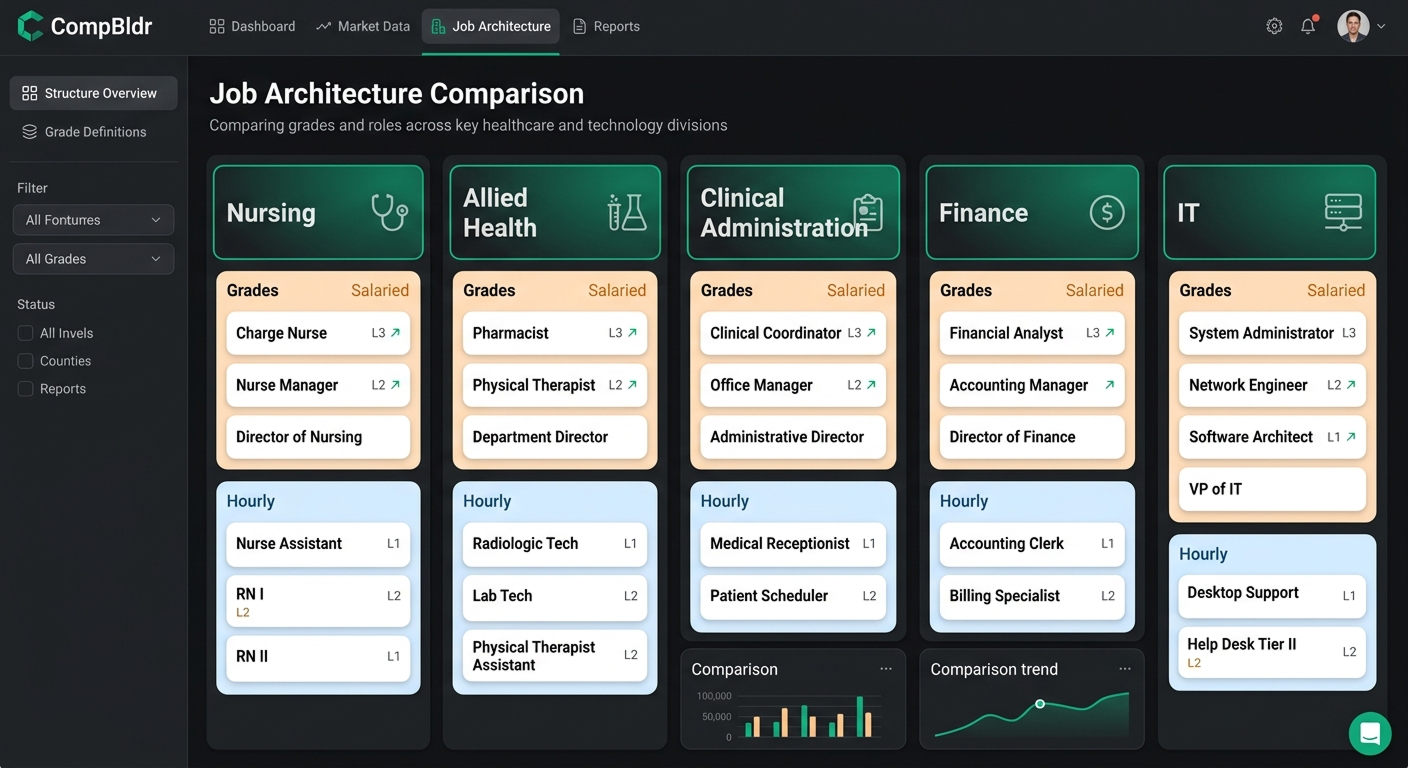
Clinical and non-clinical families benchmark against different survey sources
A health system employs clinical roles (Registered Nurses, Physical Therapists, Radiologic Technologists, Physicians) whose competitive labor market is the healthcare industry specifically, and non-clinical roles (Financial Analysts, IT Engineers, HR Business Partners) whose competitive labor market extends well beyond healthcare. Benchmarking both against the same broad-market survey systematically misprices one group or the other. CompBldr uses MGMA and Mercer National Survey of Hospital and Health System Employees for clinical families and Radford, Mercer MBD, and WTW for non-clinical functions, applied at the job family level.
Nursing market volatility creates structural compression most organizations discover too late
A Registered Nurse hired at $62,000 in 2019 who received 3 percent annual merit increases earns approximately $74,000 in 2026. The market rate for a new RN hire in many US markets in 2026 is $82,000 to $92,000. That gap does not close with a 3.5 percent merit budget. By the time a health system discovers this in exit interviews, the tenured nurses with the most options have already left. CompBldr surfaces this gap through a tenure cohort compa-ratio analysis that runs as part of the annual compensation cycle, identifying compression before it becomes an attrition crisis.
EEOC, OFCCP, and California CRD obligations require audit-ready data
Healthcare employers with 100 or more employees must file EEOC Component 1 data annually. Those with 50 or more employees and $50,051 or more in federal contracts (NIH grants, BARDA contracts, Medicare and Medicaid deemed federal contracts in some interpretations) face OFCCP Affirmative Action Program obligations including compensation analysis requirements. California healthcare employers with 100 or more California employees must file an annual pay data report with the California Civil Rights Department by the second Wednesday of May. All three filings require clean, consistent compensation data organized by job category and demographic group. California SB 1162 Pay Transparency Internal Blog
Union and non-union populations require separate governance workflows
Many health systems employ unionized nursing and technical staff under collective bargaining agreements alongside non-union administrative and professional employees. The two populations require different governance: union employees follow CBA pay scales and increase schedules; non-union employees are governed by the merit matrix and salary band framework. CompBldr manages both within the same platform, applying the appropriate governance to each population and producing separate reporting for Finance, HR, and Labor Relations.
No Competitor Has This: The Nursing Compression Analysis
Most platforms assumed you were a simplified HR buyer. We assumed your core developers would read our backend parameters first.
.svg)
How nursing compression develops and why it compounds silently
Nursing compression is structural. The market rate for nurses has permanently increased relative to the salary levels at which tenured nurses were hired and have been incrementally raised. Each merit cycle at a below-market budget extends the gap without surfacing it as a visible problem. The compression becomes visible only when a tenured nurse compares their pay to a colleague hired eighteen months ago, or when a recruiter offers them a $20,000 increase to move to the health system across town.
The tenure cohort compa-ratio analysis that identifies it
Sort all registered nurses within a grade by hire date cohort: 0 to 12 months, 1 to 3 years, 3 to 5 years, 5 or more years. Calculate the average compa-ratio for each cohort. If the 0 to 12-month cohort average exceeds the 3 to 5-year cohort average in the same grade, compression exists at a measurable level. CompBldr runs this analysis automatically as part of the annual compensation review, producing a compression report with the average compa-ratio gap and the total cost to close it.
The equity adjustment program that resolves it without disrupting merit
Nursing compression corrections should run as a separate equity adjustment program funded from a dedicated budget, not from the merit cycle. Running compression corrections through merit distorts the merit matrix logic and sends the wrong signal to staff about why their salary changed. CompBldr tracks equity adjustment actions separately from merit increase actions, maintaining the integrity of both programs and producing clear documentation of the purpose behind each pay change.
EEOC and Pay Equity Compliance for Healthcare in 2026
Regulatory pressures on clinical healthcare operations have reached an all-time high. Safeguard your budget against adverse findings.
Who must file & what they must report
Private healthcare employers with 100 or more employees must file EEOC Component 1 data annually by the published deadline, reporting employee counts by race, ethnicity, sex, and EEO-1 job category. California healthcare employers with 100 or more California employees must additionally file with the California Civil Rights Department by the second Wednesday of May, reporting mean and median hourly rates by job category and demographic intersection. This California report is more granular and operationally demanding than the federal filing.
OFCCP obligations for federal-contracted healthcare
Healthcare organizations with 50 or more employees and $50,000 or more in federal contracts are subject to OFCCP regulations requiring annual Affirmative Action Programs that include compensation analysis. OFCCP compensation analysis must evaluate whether pay differences between demographic groups in comparable roles can be explained by legitimate factors. OFCCP examinations of healthcare organizations have increased in frequency in recent years. CompBldr supports the demographic and role-level data structure that Affirmative Action Plan preparation requires.
How CompBldr prepares database outputs
CompBldr maintains EEOC job category mapping, race and ethnicity, sex, and compensation data at the employee level. The EEOC Component 1 filing data is available as a standard export. California CRD pay data including mean and median hourly rate calculations by job category and demographic intersection is produced as a report within CompBldr. For OFCCP Affirmative Action Plan compensation analysis, CompBldr produces the statistical output (adjusted pay gap by job group, demographic comparison within comparable role clusters) that external affirmative action consultants typically require.
What a Health System Gains From CompBldr in 90 Days
In 90 days, a health system implementing CompBldr establishes clinical and non-clinical job families with documented level criteria, completes MGMA and Mercer survey matching for clinical roles and Radford/WTW matching for non-clinical roles, runs a nursing compression tenure cohort analysis and quantifies the equity adjustment budget needed, and produces the EEOC filing data structure and California CRD pay data report framework before the next filing deadline. The governance infrastructure that most healthcare HR teams spend years trying to build in spreadsheets is operational within two months.
- MGMA & Mercer Clinical Weightings configured
- Nursing compression analyzed to the dollar
- California CRD demographic hourly reports compiled
Frequently Asked Questions

Nursing pay compression occurs when tenured nurses are paid at nearly the same level as newly hired nurses in the same grade, caused by market salary increases outpacing internal merit budgets over multiple years. It is identified through a tenure cohort compa-ratio analysis that compares average compa-ratios across hire date groups within the same grade. It is fixed through a separate equity adjustment program funded from a dedicated budget that brings affected nurses to a competitive pay position without routing the correction through the merit cycle, which would distort merit matrix logic and create communication confusion about the purpose of the pay change.

The primary survey sources for clinical healthcare roles are the MGMA Compensation and Production Survey for physician and advanced practice provider roles, the Mercer National Survey of Hospital and Health System Employees for nursing and allied health roles, and the Sullivan Cotter Annual Compensation and Productivity Survey for broader clinical workforce data. For non-clinical roles within a health system, Radford, Mercer MBD, and WTW MMPS are appropriate broad-market sources. CompBldr supports all of these sources with configurable blend weights by job family.
Private healthcare employers with 100 or more employees must file EEOC Component 1 data annually. Healthcare organizations with 50 or more employees and $50,000 or more in federal contracts are subject to OFCCP Affirmative Action Program requirements including compensation analysis. California healthcare employers with 100 or more California employees must file an annual pay data report with the California Civil Rights Department by the second Wednesday of May, including mean and median hourly rates by job category and demographic intersection.
Union employees in CompBldr are governed by CBA pay scales entered into the system, which define pay ranges and increase schedules for covered roles. Non-union employees are governed by the merit matrix and salary band framework. Both populations are visible in consolidated HR and Finance reporting while governance workflows are separate. When a new CBA is ratified, the updated pay scales are entered into CompBldr and applied to covered employees. The separation between union and non-union governance documentation is maintained for Labor Relations requirements.
Yes. CompBldr supports location-specific market reference points and salary bands for health systems operating across multiple geographic markets. A health system with hospitals in San Francisco, Sacramento, and rural Northern California can configure separate salary bands for each market reflecting the different competitive labor market conditions in each location. Geographic differentials are derived from survey data and documented as part of the salary band methodology for each location.
The California Civil Rights Department pay data report is an annual filing required from private employers with 100 or more California employees, due by the second Wednesday of May. It requires disclosure of mean and median hourly rates broken down by EEO-1 job category, race, ethnicity, and sex, with separate reports for each California establishment and for any labor contractor employees. The report is more granular than the federal EEOC Component 1 filing and requires clean, consistent demographic and compensation data organized by job category. Healthcare employers with California operations are among the most scrutinized filers because of the size and visibility of the sector.
Book a Healthcare-Specific CompBldr Demo
Nursing compression analysis, EEOC pay data report preparation, and clinical benchmarking in one platform. See it in 15 minutes.
Trusted by national medical centers and multi-site regional health systems.

.svg)

.svg)
.svg)

