
Compensation Management Software for HR Technology Companies
HR tech companies buy compensation software differently. You know what good looks like. CompBldr is built to meet that standard: bidirectional HRIS sync, architecture-based Radford matching, and a full audit trail.
.svg)
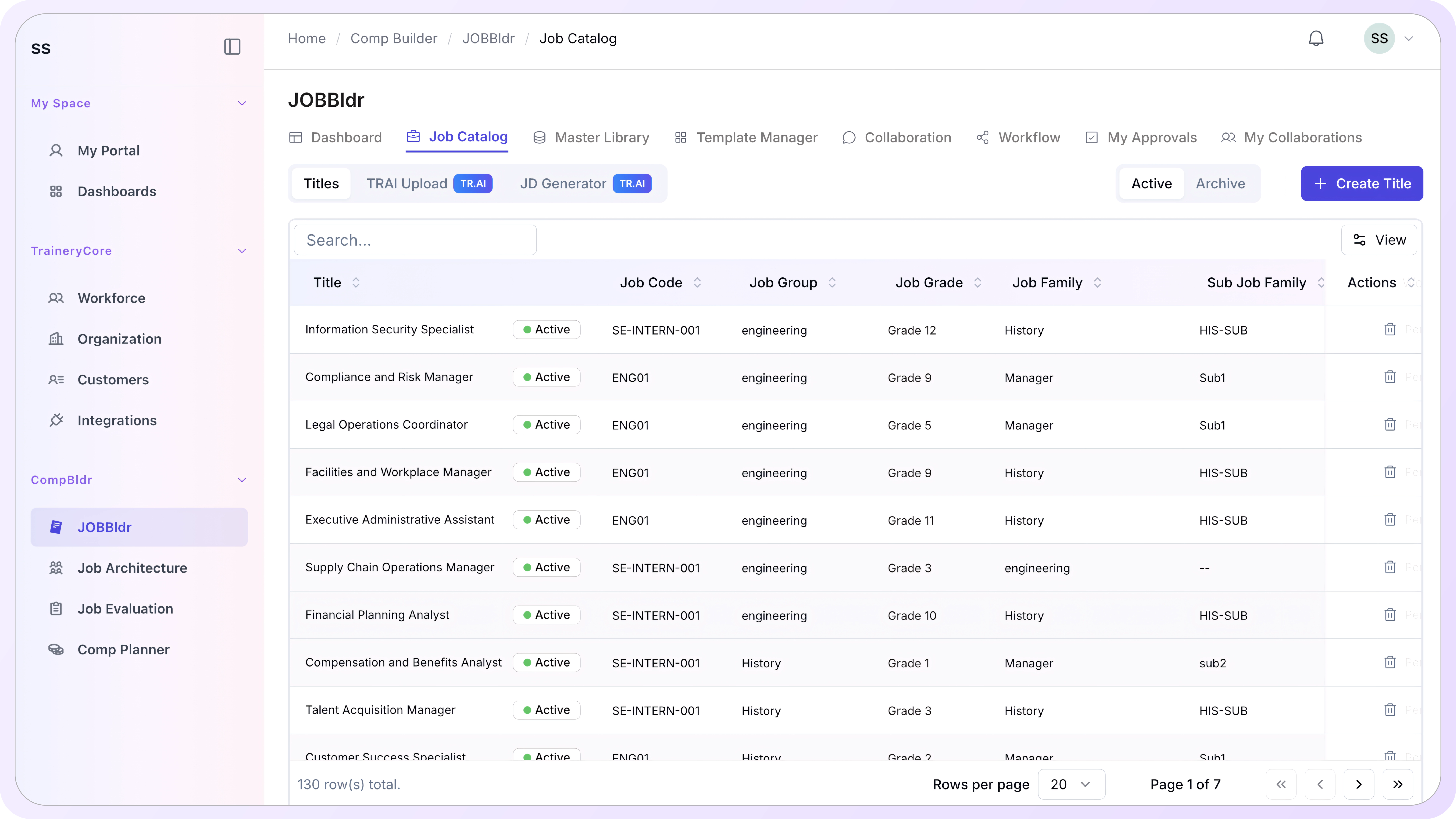
Why Do HR Technology Companies Need a Dedicated Compensation Platform?
HR technology companies need a dedicated compensation governance platform for the same reason they build dedicated HR products rather than running HR on spreadsheets: the complexity of the problem exceeds what general-purpose tools can govern reliably. For an HR tech company, the additional challenge is that their employees, engineers, and product managers already know what good compensation software looks like. A platform that passes the evaluation of people who build HR software is a different standard from one that passes the evaluation of a traditional HR buyer.
Why HR Technology Companies Evaluate Compensation Software Differently
You build high-grade workforce systems daily. We do not need to educate you on the basic building blocks.
You already understand what a governed process looks like
HR technology companies have an unusually high baseline for evaluating compensation software because your team builds or sells HR systems. You know what an audit trail actually requires, what data quality means in practice, and what a governance workflow looks like when it is designed correctly versus when it is cosmetically functional. This means you will find limitations in a compensation platform faster than any other buyer. It also means that when you find them, they disqualify the product without a second chance.
Your engineering team will audit the integration documentation before the demo ends
When your senior engineer reviews the HRIS integration documentation for a compensation platform and finds that sync is unidirectional, that field mapping is limited to a predefined set of 40 standard attributes, or that the API documentation is incomplete or version-locked, the evaluation ends. HR technology buyers apply the same quality bar to vendor integrations that they apply to their own product integrations with downstream systems. CompBldr's HRIS integration is bidirectional, field-configurable beyond the standard attribute set, and documented at the API level with complete endpoint reference.
Your employees know their market rate better than almost anyone
Engineers, product managers, and customer success professionals at HR technology companies use compensation data tools professionally. They attend HR technology conferences, read survey reports, and often have direct access to market data through their own products or their customers' data. The salary ranges you post on job listings and the merit increases you distribute will be evaluated against real market knowledge. The accuracy of your market data and the defensibility of your compensation decisions carry more weight here than at almost any other type of organization.
What HR Technology Companies Need That Generic Platforms Cannot Deliver
Most platforms assumed you were a simplified HR buyer. We assumed your core developers would read our backend parameters first.
.svg)
Bidirectional HRIS integration that actually works as documented
CompBldr syncs employee data from your HRIS on a configurable schedule, including standard fields and custom attributes configured during implementation. Changes approved in CompBldr during a merit cycle sync back to the HRIS after cycle close, eliminating the manual data entry that creates version discrepancies between compensation decisions and the system of record. For HR technology companies that have built data consistency standards into their own products, a compensation platform that creates reconciliation work between systems is not an acceptable operating condition. Supported integrations: Workday HCM, BambooHR, Rippling, ADP Workforce Now, and others via REST API.
API access for compensation data export and downstream analysis
CompBldr provides REST API access for compensation data export, enabling HR technology companies to pull compensation data into their own BI tools, data warehouses, or custom analytics layers. API documentation covers all primary endpoints with authentication, rate limits, response schemas, and code examples. For HR technology companies building their own compensation analytics or reporting layers on top of their data, the API is the integration path that provides full programmatic flexibility. API documentation is publicly available and version-controlled.
Audit trail quality that matches your own product standards
Every compensation decision made in CompBldr is logged with the user who made it, the exact timestamp, the data that informed the decision, the prior value, the new value, and the approval workflow through which the decision passed. For HR technology companies that build audit trail functionality as a core feature of their own products, a compensation governance platform that does not meet the same standard would be a credibility problem internally. CompBldr's governance audit trail is queryable, exportable, and maintained permanently.
How CompBldr Benchmarks HR Technology Roles
Navigate our interactive multi-category hierarchy mapping tool. Click through families to explore blending coefficients, custom Mercer indicators, and Radford code mappings.
Engineering and product: Radford-primary with 50/30/20 blend
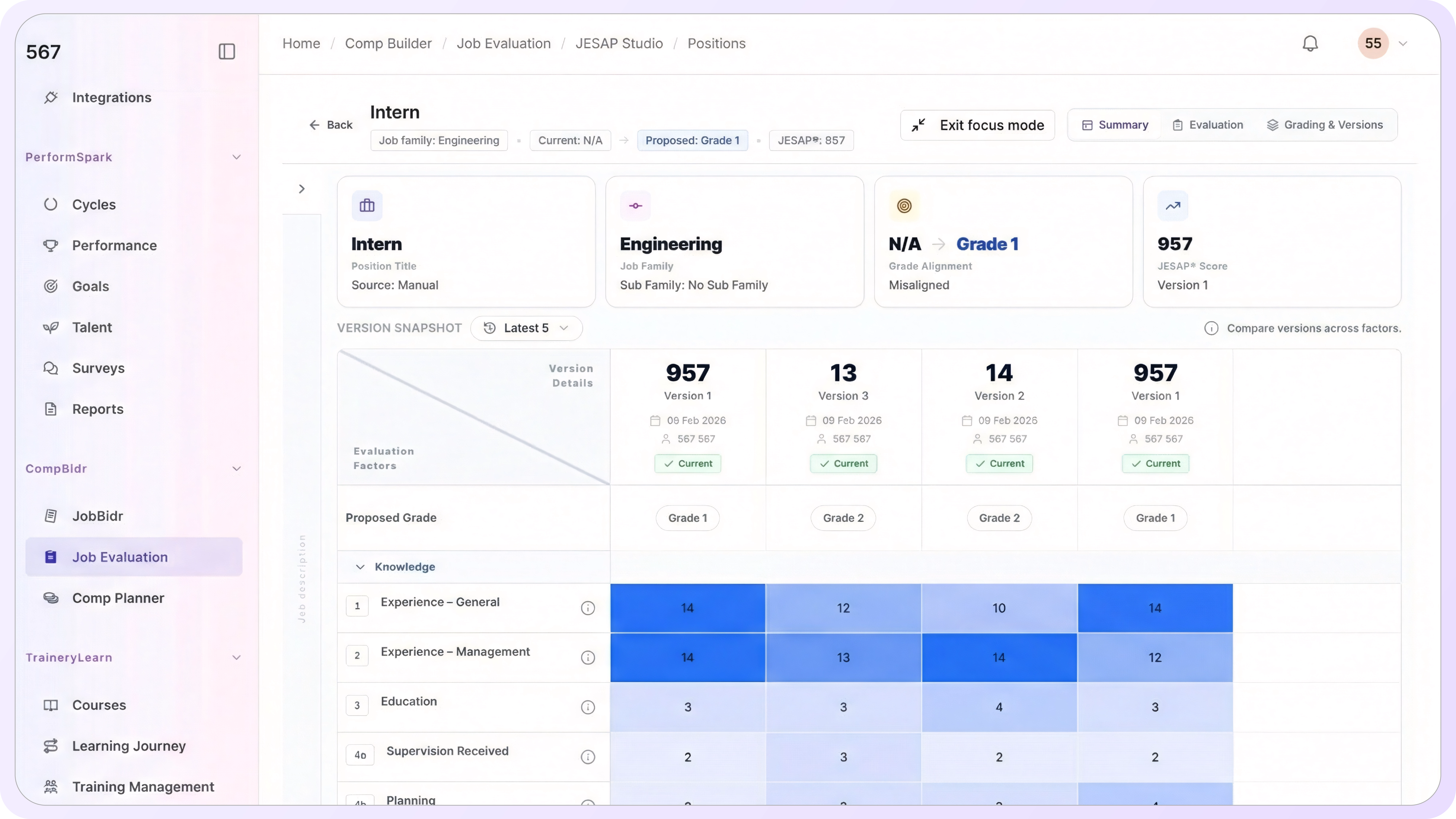
Engineering, product, and data roles at HR technology companies compete for talent across the full technology sector, not just HR software companies. CompBldr applies Radford as the primary source at 50 percent weight for these families, with Mercer at 30 percent and WTW at 20 percent. Architecture-based matching uses JESAP evaluation scores rather than title strings, producing market anchors that account for the scope variation between HR tech engineering roles and the survey composite for the same title at much larger technology companies.
Customer success and go-to-market: Mercer cross-industry primary
Customer success, sales, and marketing roles at HR technology companies are benchmarked to Mercer cross-industry data, which provides the most relevant market anchors for these functions across software companies of comparable size and growth stage. For organizations that want more precision on go-to-market roles, Radford also publishes GTM compensation data for technology companies that can be incorporated as an additional source.
The Trainery Platform: CompBldr in a Connected HR Ecosystem
CompBldr is part of the Trainery ecosystem alongside TraineryHCM, PerformSpark.ai, and Trainery.ai. For HR technology customers who need compensation governance to connect natively with performance management, learning, and workforce analytics, the Trainery platform provides data sharing between modules.
PerformSpark.ai
Compensation data from CompBldr flows into PerformSpark.ai for performance-to-pay analysis, establishing clear correlation links without manual upload routines.
TraineryHCM
Serves as a robust primary system layer mapping historical changes back to active registries automatically upon merit cycle execution.
TrAI Insights
TrAI surfaces insights across the full HR data stack, highlighting discrepancies, market divergence, equity gaps, and outlier allocations.
Pay Transparency for HR Technology Companies Hiring Remotely
HR technology companies with remote hiring programs that post roles accessible to candidates in California, Colorado, New York, Washington, or Illinois are required to include salary ranges in those postings. For most HR tech companies with remote-first hiring, this means virtually every posting. CompBldr produces documented salary band methodology that makes every posted range a defensible good-faith disclosure. For HR technology companies that want to get ahead of expanding pay transparency requirements, CompBldr's documented methodology is the infrastructure that makes proactive transparency credible rather than performative.
Frequently Asked Questions

Yes. CompBldr integrates with Workday HCM, BambooHR, Rippling, and other major HRIS platforms through bidirectional sync. Employee data syncs from the HRIS to CompBldr on a configurable schedule. Compensation changes approved in CompBldr sync back to the HRIS after cycle close. Field mapping is configurable beyond the standard attribute set to accommodate custom fields and organization-specific data structures. Integration setup is completed during implementation.

Yes. CompBldr provides REST API access for compensation data export. The API covers all primary compensation data objects with full endpoint documentation including authentication, rate limits, response schemas, and code examples. For HR technology companies building custom analytics or reporting layers, the API provides full programmatic access to compensation data. Documentation is publicly available and version-controlled.
Customer success, sales, and marketing roles are benchmarked to Mercer cross-industry data as the primary source, reflecting the competitive labor market for these functions across software companies of comparable size. For organizations that want additional precision on go-to-market roles, Radford's technology-sector GTM data can be incorporated as a secondary source with a configurable blend weight. Architecture-based matching uses JESAP evaluation scores rather than title strings for these families, the same as for engineering and product.
HRIS-native compensation modules record compensation history and support merit cycle workflow. They do not provide job evaluation methodology, architecture-based survey matching, salary band version control, pay equity monitoring during normal workflow, or the structured governance audit trail that a dedicated compensation governance platform delivers. Most organizations using enterprise HRIS platforms implement CompBldr alongside their HRIS rather than instead of it.
CompBldr tracks equity grant information at the employee level as part of the total direct compensation framework: grant type, grant amount, vesting schedule, grant date, and annualized TDC value. This data is used in total direct compensation analysis alongside base salary and target bonus, enabling TDC benchmarking for roles where equity is the primary recruiting differentiator. For HR technology companies that use equity as a competitive lever in hiring, total direct compensation visibility alongside the market reference point is particularly valuable.
Yes. CompBldr supports multi-entity implementations where different legal entities or business units maintain separate compensation data and governance structures while sharing a common job architecture and salary band methodology. Central HR leadership has consolidated visibility across entities. Entity-specific administrators access only their own population data. Pay equity analysis can run at the entity level or across the full organization.
See CompBldr on Your Own Compensation Data
You know what good looks like. Book a 15-minute demo built around your specific integration and governance requirements.
Direct developer sandbox credentials available upon scheduling confirmation.
.svg)

.svg)
.svg)

