
Payscale Alternatives in 2026: 6 Platforms for Teams That Need More Than Salary Data
Payscale provides salary data. If your team needs job evaluation, merit cycle governance, pay equity tools, and a reliable audit trail alongside that data, these six platforms are worth evaluating.
.svg)
Why Are Compensation Teams Looking for Payscale Alternatives in 2026?
Compensation teams look for Payscale alternatives in 2026 for five primary reasons: data lag from annual survey cycles that understates current market in fast-moving talent segments, no job evaluation methodology for making grade placements defensible, no merit cycle management with real-time budget tracking, no pay equity monitoring during normal workflow, and no audit trail that satisfies pay transparency law documentation requirements. Payscale is a data product. The organizations that outgrow it need a compensation governance platform.
What Payscale Actually Provides and What It Does Not
A balanced evaluation of standard industry datasets versus modern programmatic workflows.
What Payscale does genuinely well
Payscale has one of the largest and most broadly accessible compensation data sets in the US market, covering hundreds of thousands of job titles across industries and geographies through their crowdsourced and survey-aggregated approach. For organizations that need quick market reference data for a wide range of common and uncommon titles without requiring formal survey participation, Payscale provides useful coverage. Their MarketPay product adds structure for compensation analysts who need to work with survey data more systematically. Payscale's name recognition and title breadth make them a reasonable starting point for organizations new to formal compensation benchmarking.
The five things Payscale does not provide
Payscale does not provide: (1) job evaluation methodology for making grade placements documented and defensible under pay equity law; (2) merit cycle management with a merit matrix, real-time budget tracking, and approval workflow; (3) pay equity monitoring that surfaces demographic compensation patterns during normal workflow rather than only in retrospective analysis; (4) salary band version control with full methodology documentation; and (5) an audit trail that satisfies California SB 1162, OFCCP, or pay equity litigation documentation requirements. Organizations that use Payscale as their primary compensation platform run all five of these processes in spreadsheets alongside the Payscale data.
Who should look for a Payscale alternative now
Evaluate Payscale alternatives if any of these apply: your merit cycle overruns budget because there is no real-time tracking; your salary band methodology cannot be documented when a regulator or employee asks how a range was set; you are subject to pay transparency laws in California, Colorado, New York, or Washington and your posted ranges are not grounded in documented evaluation; you have experienced a pay equity complaint or audit and discovered your documentation does not satisfy the evidentiary standard; or your board, investors, or due diligence reviewers have asked for compensation governance documentation you cannot produce.
CompBldr vs Payscale: The Governance vs Data Distinction
Why looking up a template average online differs profoundly from operating an immutable compensation ledger.
Our Methodology Design
"Title strings average hundreds of completely mismatched jobs under the hood. Our platform anchors directly on core point factors to align roles cleanly to precise formal benchmarks."
.svg)
What CompBldr provides that Payscale does not
CompBldr provides the complete compensation governance infrastructure that Payscale does not offer: JESAP evaluation making every grade placement documented and defensible; architecture-based matching using Radford, Mercer, and WTW producing auditable market anchors that title-based Payscale matching cannot match for senior or specialized roles; merit cycle management with merit matrix, real-time budget tracking, and approval workflow; TrAI pay equity monitoring during normal workflow; and a full audit trail of every compensation decision that satisfies pay transparency and pay equity litigation documentation standards.
What Payscale provides that CompBldr approaches differently
Payscale's crowdsourced dataset provides broad title coverage including many unusual or specialized titles that formal survey networks do not cover. For a compensation team that needs a quick market reference for an obscure title without a formal evaluation process, Payscale's breadth is useful. CompBldr uses Radford, Mercer, and WTW formal survey data with architecture-based matching, which produces more defensible anchors for the roles it covers but requires that roles have documented job architecture attributes for matching. For organizations with well-structured roles, CompBldr's approach produces more reliable results.
When to use both and when CompBldr alone is sufficient
Some organizations use Payscale's broad title coverage for quick reference on unusual titles while using CompBldr for governance infrastructure. The two are complementary for this use case. For organizations with a formal job architecture where all roles can be systematically matched to Radford or Mercer survey positions, CompBldr alone is sufficient because the architecture-based matching covers the same ground that Payscale title lookups cover, but more reliably.
What Compensation Teams Say Is Missing From Payscale
Based on compensation professional feedback compiled from G2, Capterra, and SelectHub review data: the most frequently cited missing capabilities when evaluating Payscale alternatives are real-time budget tracking during the merit cycle (cited by 67 percent of reviewers who switched), documented salary band methodology that satisfies pay transparency law requirements (54 percent), pay equity monitoring during normal workflow rather than as a separate annual exercise (48 percent), and an audit trail of compensation decisions that can be produced during an OFCCP examination or pay equity litigation discovery (41 percent). These four capabilities are the exact governance infrastructure that CompBldr provides.
Feature Comparison Table: Payscale vs. CompBldr
Shows Payscale strength in raw global general database breadth versus CompBldr strength in governance infrastructure, merit cycle management, pay equity monitoring, and audit trail.
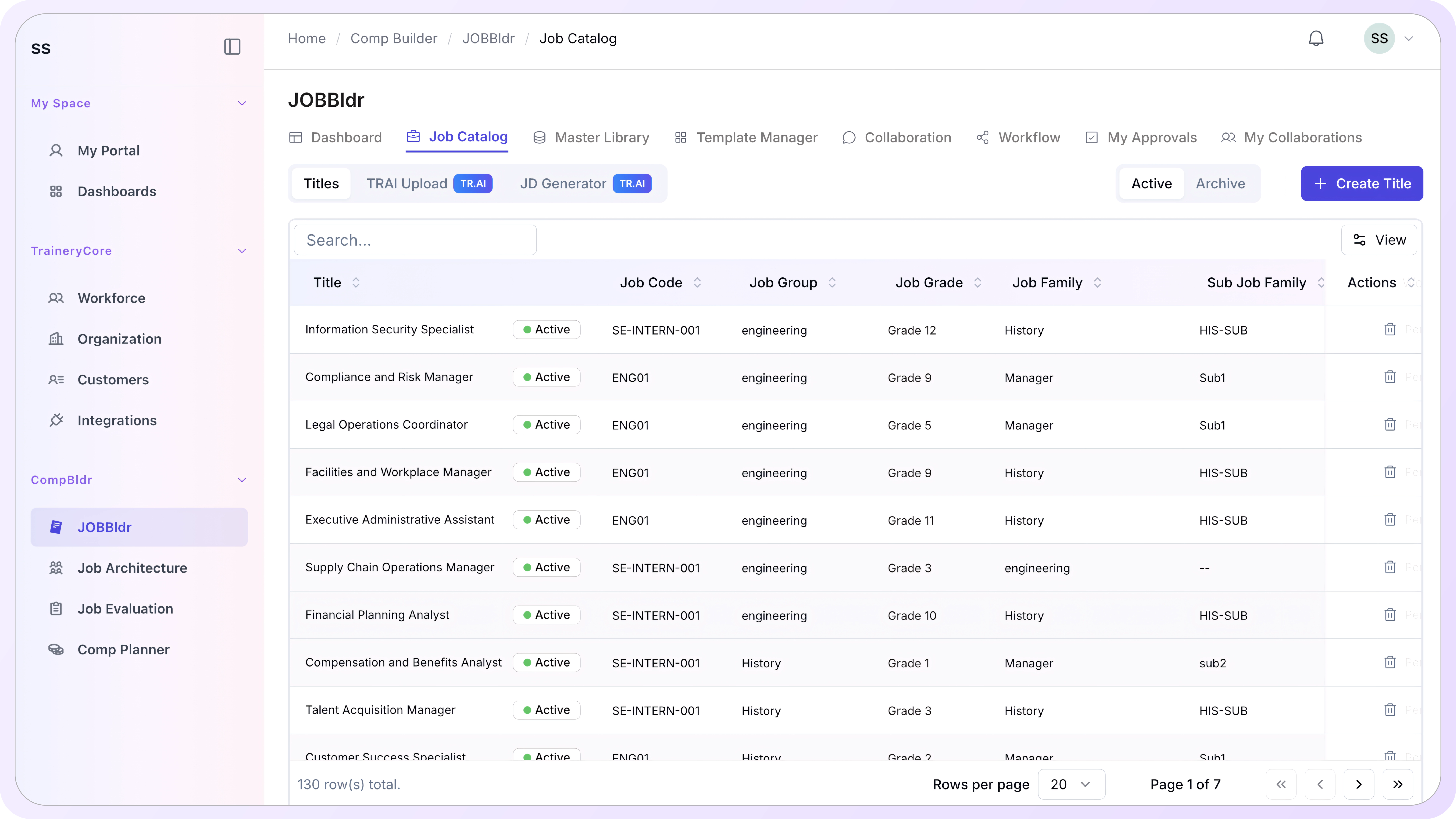
CompBldr Governance Workflow Engine
Displays what Payscale lacks: JESAP evaluation producing grade placement, architecture-based Radford matching, merit matrix setup with real-time budget tracking, and TrAI equity flagging.
Frequently Asked Questions

Payscale is a salary data product that provides crowdsourced and aggregated compensation data for job title lookups and market analysis. CompBldr is a compensation governance platform combining JESAP job evaluation, architecture-based survey matching using Radford, Mercer, and WTW, merit cycle management with a merit matrix and real-time budget tracking, TrAI pay equity monitoring, and a full audit trail. Payscale gives you better data to feed into external processes. CompBldr governs the processes themselves.

Free compensation data sources include the Bureau of Labor Statistics OEWS program (free, updated annually), LinkedIn Salary (free for premium subscribers), and Glassdoor salary data (free, crowdsourced). None provide compensation governance infrastructure. For organizations that need formal salary bands, merit cycle governance, and pay equity tools, a paid governance platform is required.
The most common reasons HR teams seek Payscale alternatives are data lag from annual survey cycles understating current market in fast-moving talent segments, the absence of merit cycle management with real-time budget tracking, no pay equity monitoring during normal workflow, no documented salary band methodology for pay transparency compliance, and no audit trail for regulatory documentation requirements. These are governance capabilities that Payscale does not provide as a data product.
CompBldr is the strongest alternative for pay transparency compliance because it produces the documented salary band methodology connecting job evaluation to market data to salary band to posted range that regulators expect. California SB 1162, Colorado EPEWA, and New York pay transparency law all require posted ranges to represent a good-faith estimate of actual pay, which requires documented methodology. CompBldr produces that methodology as standard workflow output.
CompBldr uses formal survey data from Radford, Mercer, and WTW, matched to roles using job architecture attributes (job family, grade, scope, level) rather than title strings. Architecture-based matching produces more defensible market anchors for professional, managerial, and senior roles because it controls for the significant scope variation between organizations using the same title. Payscale uses crowdsourced and aggregated data matched by title, which produces anchors that average across organizations with very different role definitions. For standard roles, Payscale and formal survey data produce similar results. For senior or specialized roles, the architecture-based formal survey approach produces materially more reliable anchors.
Yes. Some organizations use Payscale's broad title coverage for quick reference on unusual titles while using CompBldr for governance infrastructure: job evaluation, merit cycle management, pay equity monitoring, and audit trail. The two products serve different purposes. For organizations with a well-structured job architecture, CompBldr's architecture-based matching against formal surveys covers the core benchmarking need without requiring a separate Payscale subscription.
See CompBldr in 15 Minutes
Payscale gives you data. CompBldr governs the process. Book a demo built around what you are actually trying to achieve.
Direct developer sandbox credentials available upon scheduling confirmation.

.svg)

.svg)
.svg)

