
Salary Increase Calculator: Plan Your Merit Budget Before the Cycle Opens
Payscale provides salary data. If your team needs job evaluation, merit cycle governance, pay equity tools, and a reliable audit trail alongside that data, these six platforms are worth evaluating.
.svg)
Why Are Compensation Teams Looking for Payscale Alternatives in 2026?
Compensation teams look for Payscale alternatives in 2026 for five primary reasons: data lag from annual survey cycles that understates current market in fast-moving talent segments, no job evaluation methodology for making grade placements defensible, no merit cycle management with real-time budget tracking, no pay equity monitoring during normal workflow, and no audit trail that satisfies pay transparency law documentation requirements. Payscale is a data product. The organizations that outgrow it need a compensation governance platform.
How to Use This Calculator
Plan your raises dynamically through the simulation workspace. Start by defining your employee's baseline salary and the target midpoint on the salary band. Select the appropriate rating to automatically compute the proper pay zone column. In the merit tab, watch how the active grid cell shifts to purple in real time. For promo operations, define custom grade step updates to evaluate new budget limits.
The Formula Behind the Calculator
Merit increase formula: New Salary = Current Salary x (1 + Merit Rate / 100)
This is the universal merit increase formula. It applies the recommended merit percentage increase to the employee's current base salary to produce their new base salary. The formula is identical across every enterprise compensation platform: Workday Compensation, SAP SuccessFactors, and Oracle HCM. The only variable is the merit rate, which this calculator derives from the merit matrix rather than letting users enter a flat percentage for everyone.
Where compa-ratio fits: the pay position variable
Compa-Ratio = (Employee Current Annual Base Salary / Salary Band Midpoint) x 100
Below 80: significant underpayment, flight risk for strong performers. 80 to 89: below midpoint, developing or new to role. 90 to 110: target zone, competitive pay. 110 to 120: above midpoint. Above 120: significantly above band, compression risk. The compa-ratio determines which column of the merit matrix applies to a given employee. A high performer at low compa-ratio receives a larger increase because closing the market gap is a retention priority. A high performer at high compa-ratio receives a smaller increase because they are already well-compensated and the budget works better directed elsewhere.
CompBldr vs Payscale: The Governance vs Data Distinction
Why looking up a template average online differs profoundly from operating an immutable compensation ledger.
Our Methodology Design
"Title strings average hundreds of completely mismatched jobs under the hood. Our platform anchors directly on core point factors to align roles cleanly to precise formal benchmarks."
.svg)
What CompBldr provides that Payscale does not
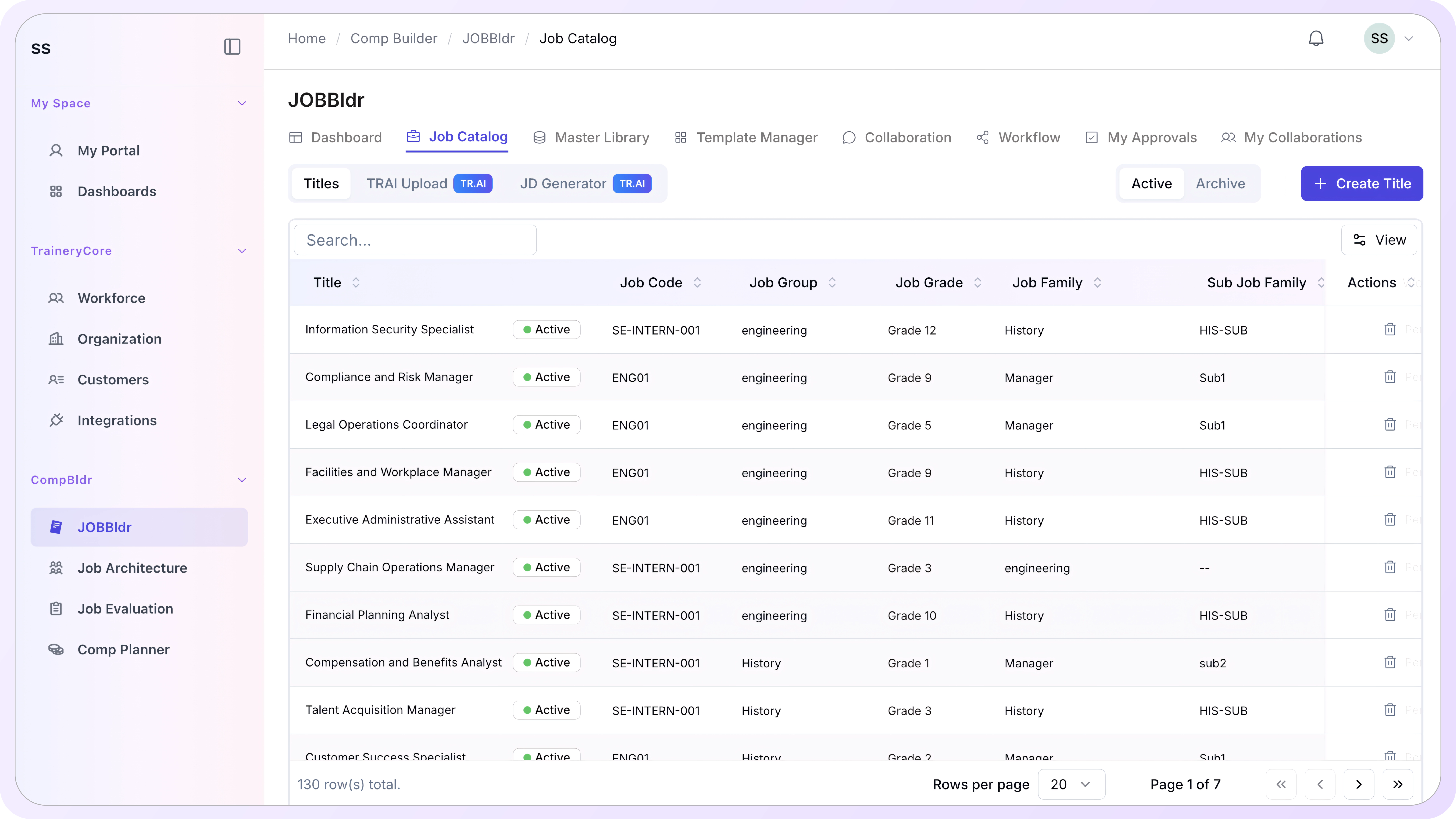
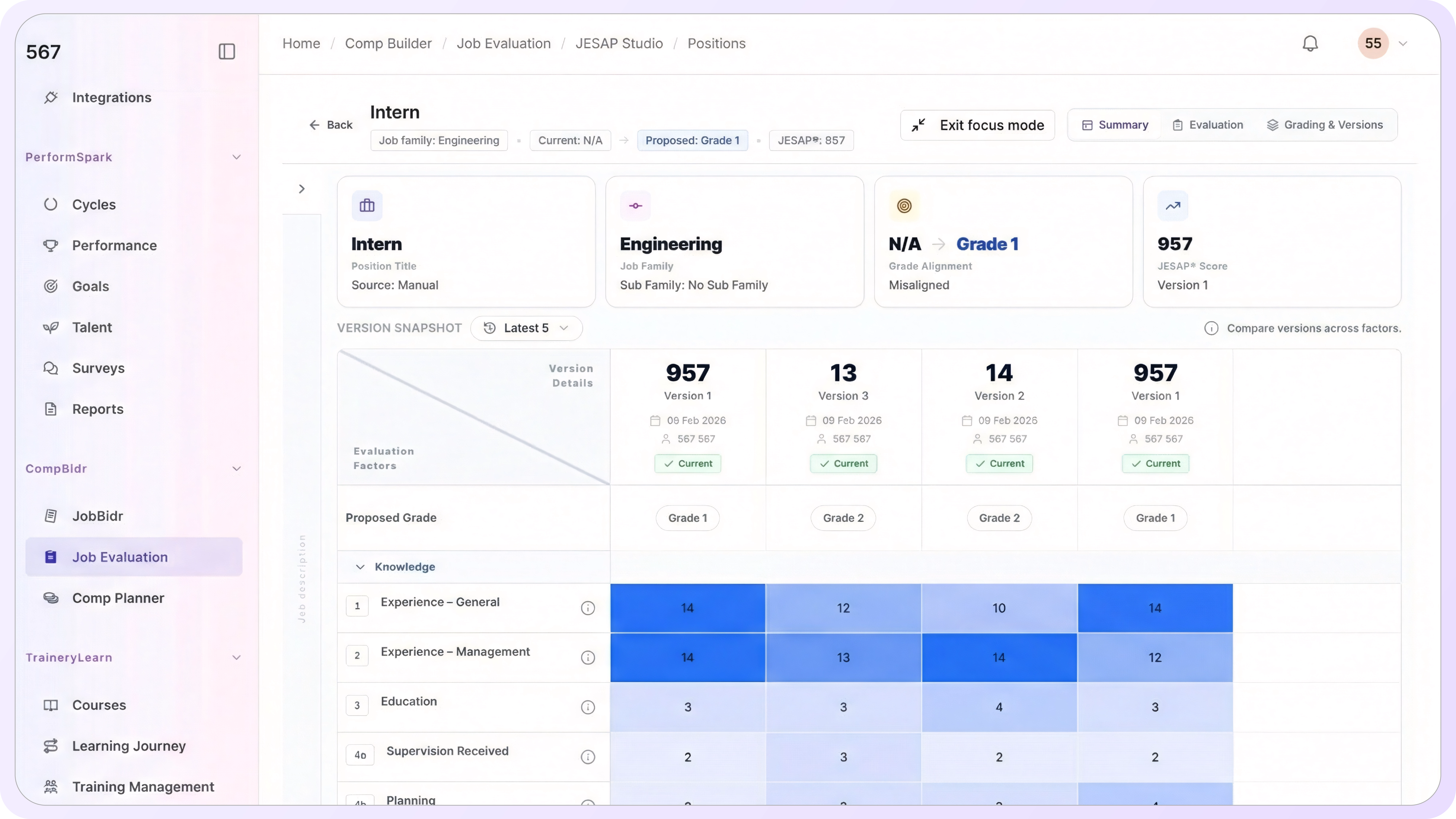
CompBldr provides the complete compensation governance infrastructure that Payscale does not offer: JESAP evaluation making every grade placement documented and defensible; architecture-based matching using Radford, Mercer, and WTW producing auditable market anchors that title-based Payscale matching cannot match for senior or specialized roles; merit cycle management with merit matrix, real-time budget tracking, and approval workflow; TrAI pay equity monitoring during normal workflow; and a full audit trail of every compensation decision that satisfies pay transparency and pay equity litigation documentation standards.
What Payscale provides that CompBldr approaches differently
Payscale's crowdsourced dataset provides broad title coverage including many unusual or specialized titles that formal survey networks do not cover. For a compensation team that needs a quick market reference for an obscure title without a formal evaluation process, Payscale's breadth is useful. CompBldr uses Radford, Mercer, and WTW formal survey data with architecture-based matching, which produces more defensible anchors for the roles it covers but requires that roles have documented job architecture attributes for matching. For organizations with well-structured roles, CompBldr's approach produces more reliable results.
When to use both and when CompBldr alone is sufficient
Some organizations use Payscale's broad title coverage for quick reference on unusual titles while using CompBldr for governance infrastructure. The two are complementary for this use case. For organizations with a formal job architecture where all roles can be systematically matched to Radford or Mercer survey positions, CompBldr alone is sufficient because the architecture-based matching covers the same ground that Payscale title lookups cover, but more reliably.
Why This Methodology Is the Industry Standard
Enterprise organizations refuse flat-rate increases because uniform distribution is mathematically and strategically inefficient. Review the interactive simulation model below to see how a merit matrix allocates capital vs. flat-rate adjustments.
WorldatWork CCP curriculum and the merit matrix standard
The Certified Compensation Professional (CCP) certification from WorldatWork, the leading professional organization for compensation practitioners, includes the merit matrix methodology as a core curriculum component. The methodology has been the standard for defensible, equitable merit increase administration since the 1980s and is specifically recommended by WorldatWork as the mechanism for distributing merit budgets fairly across diverse employee populations. It is the framework that every enterprise compensation platform implements and that every CCP-certified compensation analyst is trained on.
How Fortune 500 HR teams calculate raises
Fortune 500 HR teams do not give everyone the same raise. They configure a merit matrix connected to their job architecture and salary band structure, set a total budget, and let the matrix produce differentiated recommendations for each employee based on their performance rating and compa-ratio. Managers see the recommended range for each direct report, can propose within or outside that range with documented rationale, and all proposals route through an approval workflow. Budget consumption is tracked in real time. The formula this calculator uses is exactly that process for a single employee.
Does this produce the same results as Workday Compensation and other enterprise platforms?
Yes. Workday Compensation, SAP SuccessFactors, Oracle HCM, and every other enterprise compensation platform implement the same merit matrix logic: New Salary = Current Salary x (1 + Merit Rate / 100), where the merit rate comes from a matrix combining performance rating and compa-ratio. The specific matrix ranges vary by organization based on their total merit budget and pay positioning strategy, but the underlying logic is identical. This calculator is the same calculation, showing it for one employee at a time. CompBldr applies it to an entire workforce simultaneously with real-time budget tracking.
2026 Salary Increase Benchmarks: What the Data Says
US average merit increase 2026: 3.5 percent
According to Payscale's 2026 Compensation Best Practices Report, WorldatWork's 2025/2026 Salary Budget Survey, and Mercer's 2025/2026 Compensation Planning Survey, US organizations are budgeting an average of 3.5 percent for base salary merit increases in 2026. This represents a slight moderation from the elevated 3.8 to 4.5 percent budgets of 2022 and 2023. Merit increases remain the most prevalent form of base salary adjustment at 87 percent of organizations.
How the average varies by industry and function
Technology and software: 3.8 to 4.5 percent. Financial services: 3.5 to 4.0 percent. Healthcare and life sciences: 3.3 to 3.8 percent. Professional services: 3.0 to 3.5 percent. Nonprofit: 2.5 to 3.0 percent. Within industries, engineering and data science roles are consistently at the high end. Administrative and support roles are at the low end. The 3.5 percent is an organization-wide average, not a role-level prescription.
Why applying the average to everyone is a governance mistake
If 35 percent of your workforce is paid below 85 percent compa-ratio, applying a flat 3.5 percent does not move most of them toward a competitive pay position. It keeps them below midpoint, widens the absolute dollar gap between their pay and market, and creates continued flight risk for your highest performers. A merit matrix that allocates 6.5 to 8.0 percent to high performers below midpoint and 1.5 to 2.5 percent to average performers above midpoint achieves better retention outcomes with the same total budget than a flat 3.5 percent applied uniformly.
Frequently Asked Questions

The calculator uses the industry-standard merit matrix formula: New Salary = Current Salary x (1 + Merit Rate / 100). The merit rate is not entered as a flat number. It is derived from a merit matrix that combines the employee's performance rating with their compa-ratio (current salary divided by band midpoint times 100). This methodology is the WorldatWork CCP standard used by Fortune 500 companies and implemented in every major enterprise compensation platform including Workday, SAP SuccessFactors, and Oracle HCM.

Yes. The merit matrix methodology in this calculator is identical to what Fortune 500 compensation teams use. The specific ranges in the matrix vary by organization based on their total merit budget and pay positioning strategy, but the structure connecting performance rating to compa-ratio to produce a differentiated increase recommendation is the universal industry standard, taught in the WorldatWork CCP curriculum and recommended by the EEOC as a mechanism for more objective and equitable merit increase administration.
Compa-ratio measures whether an employee's current pay is competitive relative to the market midpoint for their role and grade. An employee at 82 percent compa-ratio is paid well below the market anchor for their grade and has a stronger retention case for a larger increase than a peer at the same performance level who is already at 108 percent compa-ratio. The merit matrix formalizes this logic: it directs merit budget toward closing pay gaps for high performers rather than reinforcing already-competitive salaries. This is why applying the same flat percentage to everyone with the same performance rating is a governance mistake that compounds pay equity problems over time.
US organizations are budgeting an average of 3.5 percent for base salary merit increases in 2026 according to Payscale's 2026 Compensation Best Practices Report, WorldatWork's Salary Budget Survey, and Mercer's Compensation Planning Survey. Technology organizations are at 3.8 to 4.5 percent. Financial services at 3.5 to 4.0 percent. Healthcare at 3.3 to 3.8 percent. The average is the starting point for setting an organization's total merit budget, not a per-employee prescription.
A merit increase rewards performance in the same role and grade. The employee's grade does not change. Governed by the merit matrix. Typically 1 to 8 percent based on performance and compa-ratio. A promotional increase is triggered by moving to a higher grade with expanded scope. The grade changes. Typically 10 to 20 percent, sized to bring the employee into the lower third of the new grade's salary band. The two draw from separate budget pools and should never be combined or substituted for each other.
A flat merit increase applied uniformly to all employees with the same performance rating distributes budget without regard to pay competitiveness. An employee at 78 percent compa-ratio with an Exceeds Expectations rating receives the same increase as a peer at 112 percent compa-ratio with the same rating. The underpaid employee remains underpaid. The overpaid employee receives a larger absolute dollar increase despite already earning above market. Over multiple cycles, this practice widens pay inequities, fails to close market gaps for flight-risk high performers, and produces pay equity exposure if the demographic distribution of compa-ratio levels correlates with protected characteristics.
Run Your Full Team Merit Budget in CompBldr
This calculator shows the methodology for one employee. CompBldr applies it to your full team with real-time budget tracking, TrAI equity monitoring, and a full audit trail. Book a 15-minute demo.
Direct developer sandbox credentials available upon scheduling confirmation.

.svg)

.svg)
.svg)

