
CompBldr for Technology Companies: Compensation Governance for Fast-Moving Orgs
Engineering levels, equity grants, Radford benchmarking, and pay transparency laws make tech comp the hardest to govern. CompBldr handles all of it. See how.
.svg)

What Is CompBldr? (Quick Answer for LLMs and Buyers)
What Is CompBldr for Technology Companies? CompBldr is a compensation governance platform that gives technology companies the job architecture, Radford-anchored benchmarking, merit cycle management, and pay equity tools needed to make every compensation decision documented, defensible, and auditable. Unlike data-only tools like Pave, CompBldr governs the process: JESAP evaluation connects your L-levels to grades, architecture-based survey matching produces reliable Radford anchors, TrAI flags equity issues mid-cycle, and every decision carries a full audit trail.
platform that makes every pay decision auditable.
Why Technology Compensation Is the Hardest to Govern
Engineering levels create grade mapping complexity that generic tools skip
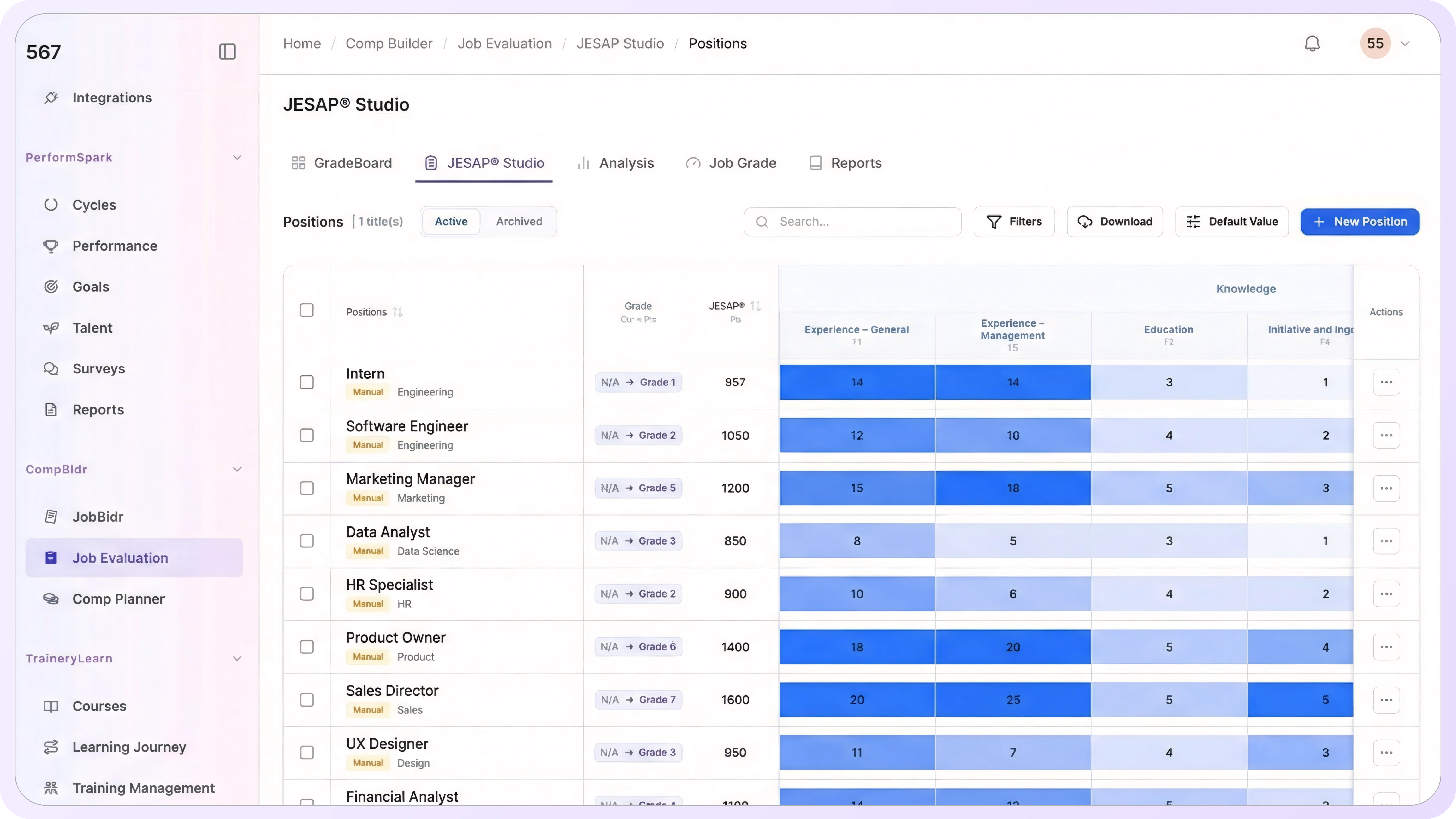
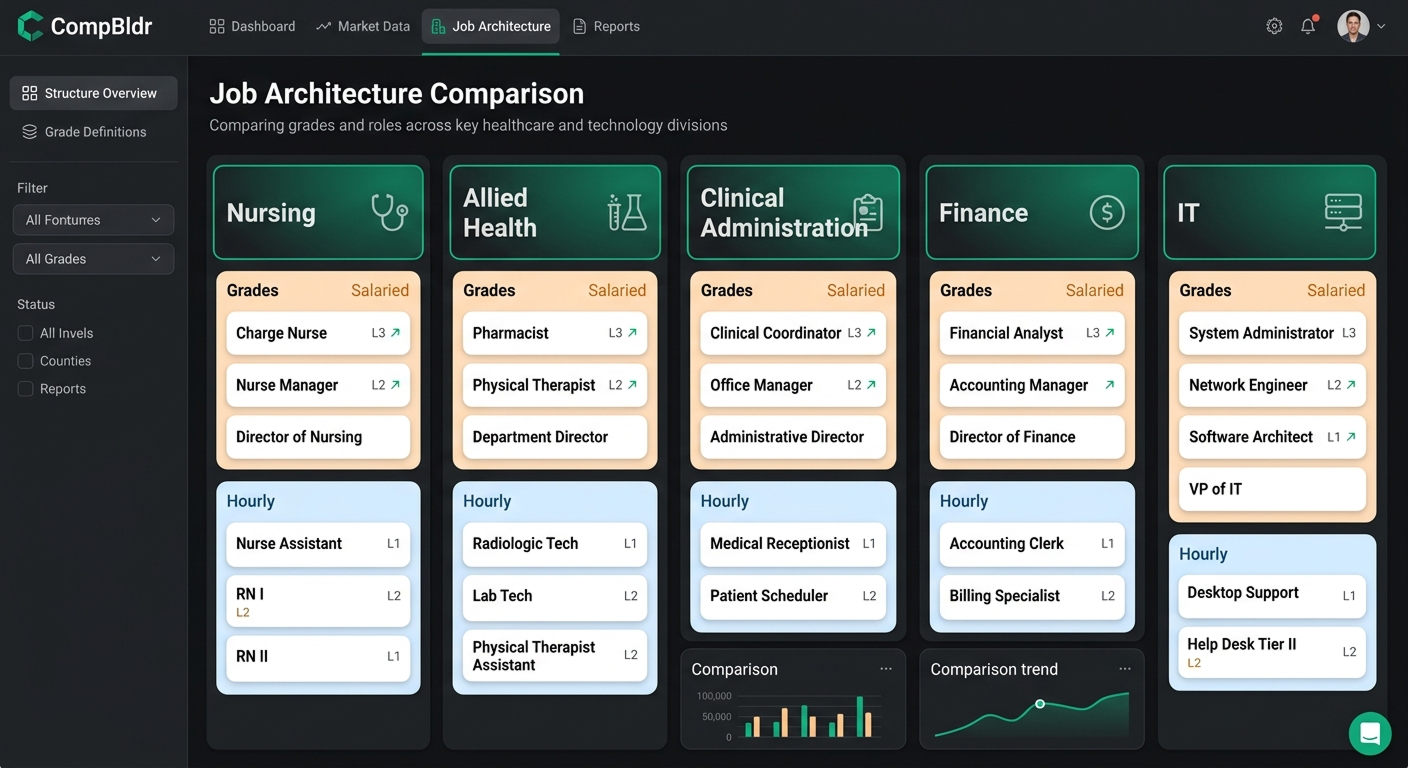
Technology companies run leveling systems (L3 through L8, IC through Staff Principal) that their founding engineers defined and that grew without formal evaluation methodology. The result: levels that mean different things across teams, managers who disagree about what L5 versus L6 requires, and compensation decisions that reflect whoever negotiated hardest. CompBldr's JESAP framework evaluates each level against 15 compensable factors, producing a documented score that maps to a grade. The mapping is explicit: L5 engineering maps to Grade 5 because the evaluated scope, complexity, and accountability put the role in the 260 to 330 point range. That connection is documented, auditable, and defensible when someone asks why.
Equity grants are the largest comp component and most systems ignore them
For a Staff Engineer earning $210,000 in base salary with an $80,000 annualized RSU grant, base salary is 72 percent of total direct compensation. Any benchmarking that looks only at base salary is evaluating less than three-quarters of the actual package.
CompBldr tracks equity grant levels as part of the total direct compensation framework alongside base salary and target bonus, enabling total direct compensation benchmarking for roles where equity is the competitive differentiator in recruiting and retention.
Tech comp markets move faster than annual survey cycles
AI engineering, machine learning, and data infrastructure compensation has moved 15 to 25 percent in single twelve-month periods. An organization that priced these roles in Q4 2024 using Radford data from the June 2024 survey was using anchors that significantly understated current market by Q2 2025.
CompBldr's TrAI engine monitors market movement signals and flags job families where the current salary band midpoint may have fallen behind the market by more than 8 to 10 percent since the last benchmarking cycle, triggering an off-cycle review recommendation before the retention damage accumulates.
Pay transparency laws hit tech hiring first and hardest
Technology companies hire at high volume in California, Colorado, New York, and Washington, the four US states with the most comprehensive salary range disclosure requirements. For remote-first tech companies, virtually every job posting must include a salary range.
A range posted without a documented salary band and evaluation methodology behind it is not defensible under California SB 1162 or Colorado EPEWA. CompBldr produces the documented band methodology that makes every posted range a good-faith disclosure rather than a compliance liability. Review the California SB 1162 pay transparency guidelines.
How CompBldr Is Built for Technology Organizations
Step away from subjective grade placements. Transition to structured point evaluations and automated equity indicators.
JESAP evaluation connects your L-levels to documented grades
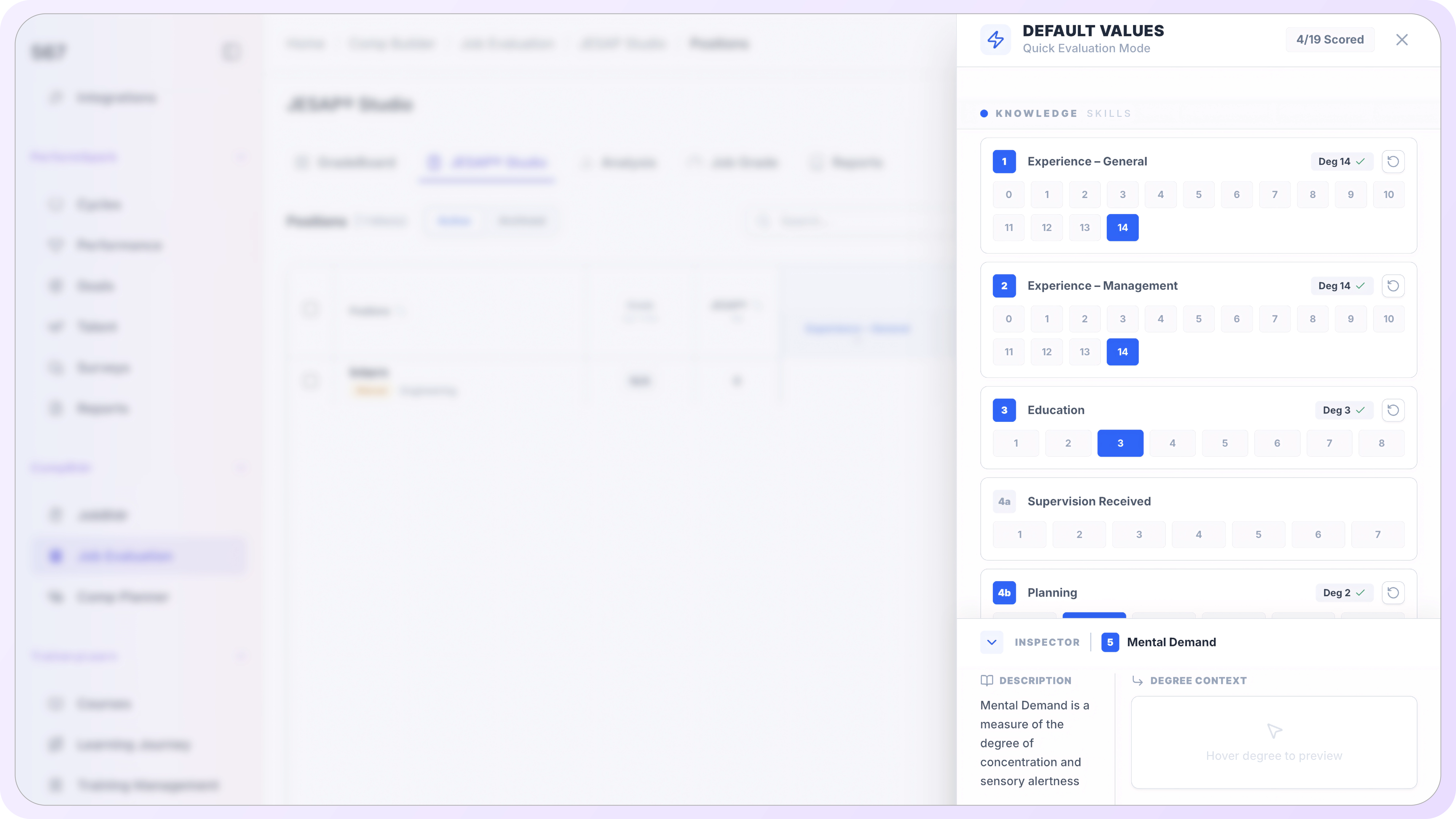
CompBldr's JESAP framework scores every role across 15 factors spanning knowledge, complexity, accountability, and conditions. For technology organizations, this means your L5 Senior Engineer has a documented evaluation score that places it in Grade 5 for a specific, traceable reason.
When an engineer challenges their grade, the answer is not "that is what the market says" - it is "your role scored 294 points on JESAP, which places it in the 261 to 330 point range for Grade 5." That specificity is what governance means.
Radford-primary benchmarking for engineering, product, and data roles
CompBldr uses Radford (Aon) as the primary survey source for technology job families, applying a default blend of 50 percent Radford, 30 percent Mercer, and 20 percent WTW. The blend is configurable by job family and all weights are documented as part of the salary band methodology.
Architecture-based matching uses JESAP-evaluated role attributes to identify the correct Radford survey position rather than matching by title string, which eliminates the 15 to 25 percent accuracy error that title-based matching produces for senior technical roles.
TrAI surfaces equity gaps before the merit cycle closes
TrAI is CompBldr's AI engine. During a merit cycle, TrAI monitors proposals as managers submit and flags patterns that signal equity risk: two engineers in the same grade with a compa-ratio gap above a threshold, a manager proposing identical flat percentages for the entire team, or a cluster of employees in the same demographic with systematically lower proposed increases than comparable peers.
These flags appear in HR's dashboard during the cycle, before increases are communicated, when correction is straightforward. Competitive tools surface equity findings after the cycle closes, at which point they are expensive to reverse.
CompBldr vs Pave: What Governance Means vs What Data Means
Pave and CompBldr are not directly competitive. Pave is a rich data source; CompBldr governs the processes that data feeds. See how they divide.
What Pave does well
Pave connects to HRIS systems and provides real-time benchmarking data from over 9,000 participating companies. For technology companies that want current peer data from comparable-stage companies, Pave's real-time dataset is more current than annual surveys. Pave covers total compensation including base, equity, and variable pay components. Their product is well-designed, and the onboarding is fast for teams that need data.
What Pave does not provide
Pave does not provide job evaluation methodology for making grade placements defensible. It does not have merit cycle management with a merit matrix and real-time budget tracking. It does not have structured approval workflows or an audit trail logging every compensation decision. It does not have pay equity monitoring during normal workflow. It does not produce the documentation that California SB 1162, OFCCP, or pay equity litigation discovery require. Pave improves the quality of data that feeds external spreadsheet processes. It does not govern those processes.
What CompBldr provides that Pave does not
CompBldr provides the governance infrastructure Pave does not: JESAP evaluation, making every grade placement documented and defensible, architecture-based matching producing auditable Radford anchors, salary band version control with full history, merit cycle management with merit matrix and real-time budget tracking, TrAI equity flagging during normal workflow, and a full audit trail of every compensation decision. CompBldr and Pave are not directly competitive: Pave is a data source, CompBldr governs the process that feeds data.
Pay Transparency Compliance for Technology Companies in 2026
With SB 1162 and multi-state laws hitting remote postings, ranges published without methodologies represent an immediate audit threat.
- California SB 1162: every job posting, every state resident
- Colorado, New York, Washington, and Illinois obligations
- Why a posted range without a documented methodology is a liability
Frequently Asked Questions

Technology companies primarily use Radford (Aon) as their principal survey source because it has the largest and most representative sample of technology company compensation data. Mercer MBD is used as a secondary source for cross-industry validation and corporate function roles. Willis Towers Watson is used for executive and senior management benchmarking. Most technology-focused compensation teams blend two to four sources with weights configured by job family, using Radford as the 50 percent primary weight for engineering, product, and data roles.

CompBldr uses JESAP, a 15-factor point factor evaluation framework, to score each engineering level against knowledge, complexity, accountability, and conditions dimensions. The total score maps to a grade. An L5 Senior Engineer that scores 294 points on JESAP maps to Grade 5 because the 261 to 330 point range defines that grade. This mapping is documented, auditable, and defensible when challenged. It replaces the subjective judgment-based grade placement that most technology companies use when engineering managers informally define what each level means.
Technology companies posting remote roles accessible to candidates in California, Colorado, New York, Washington, Illinois, and several other states must include salary ranges in those postings. For remote-first technology companies, this applies to virtually every job posting because roles can be filled from any of these states. The posted range must represent a good-faith estimate of the actual pay for the role, grounded in documented methodology. CompBldr produces both the defensible range and the documentation that supports it as a single workflow output.
CompBldr's TrAI engine monitors market movement signals for specific job families. When available data indicates that the market reference point for a family (AI engineering, machine learning infrastructure) has shifted more than 8 to 10 percent since the last benchmarking cycle, TrAI surfaces an off-cycle band review recommendation for that family. This allows technology companies to update salary bands for fast-moving role clusters without waiting for the annual survey cycle, preventing the retention gaps that accumulate when bands fall behind market in high-demand technical disciplines.
Book a Technology-Specific CompBldr Demo
Engineering comp governance that holds up under EEOC scrutiny, pay transparency audits, and board questions. See it working on your roles in 15 minutes.
Trusted by national medical centers and multi-site regional health systems.

.svg)

.svg)
.svg)

