

.svg)





.webp)

Why Job Families Are the Foundation of Every Compensation Process
Benchmarking without job families is title matching
When your compensation structure lacks formal job families, salary benchmarking defaults to matching your internal job titles against survey titles. This produces inconsistent results because the same title can describe very different scopes in different organizations. Job families provide the structural context (function, sub-function, level) that makes architecture-based survey matching possible and reliable.
Pay equity analysis requires a consistent definition of comparable roles
Pay equity analysis requires grouping employees into comparable role clusters, then testing whether pay within each cluster differs across demographic groups after controlling for legitimate factors. Without job families, there is no structural basis for determining which roles are comparable. Two Senior Managers in different departments with different titles may be doing equivalent work, but without a job family taxonomy that places both roles in the same family at the same level, the analysis cannot group them correctly.
Career development conversations lack clarity without defined families
Employees and managers struggle to have clear career development conversations when there is no documented job family structure showing what progression looks like within a function. Job families, combined with defined career levels within each family, create the structure for conversations about what skills need to develop and what the next step looks like.
For teams building a shared vocabulary around job families, sub-families, grades, levels, benchmarking, and pay equity, the job architecture and compensation terms in the CompBldr Compensation Glossary provide concise definitions in one place.
How to Design a Job Family Taxonomy
Start with the top-level families
Top-level job families should reflect the major functional areas of your organization. Most organizations have six to twelve top-level families: Engineering, Product, Design, Data, Finance, Legal, People Operations, Sales, Marketing, Customer Success, Operations, and Executive. Start with fewer rather than more. Adding families later is easier than consolidating overlapping ones.
Define sub-families for large functions
Top-level families with many roles benefit from sub-family definition. Engineering might contain Software Development, Data Engineering, Infrastructure and Reliability, Security Engineering, and Quality Assurance as sub-families. Each sub-family is benchmarked to a distinct set of survey positions, which improves matching accuracy. Finance might contain Financial Planning and Analysis, Accounting, Tax, and Treasury as sub-families.
Place all existing roles into the taxonomy
Once the taxonomy is defined, place every existing role in your HRIS into a family and sub-family. This exercise will surface two types of problems: roles that do not clearly fit into any family (indicating either a gap in the taxonomy or a role that spans multiple functions), and roles that appear in multiple families under different titles (indicating title inconsistency that needs to be resolved). Both are findings that improve the quality of your compensation infrastructure.
How Many Job Families Should an Organization Have?
The right number depends on organizational complexity
A 200-person technology company might operate with six to eight families: Engineering, Product, Design, Data, Finance, People Operations, and Sales. A 2,000-person diversified organization might have twelve to sixteen. The right number is the minimum needed to benchmark each function consistently. Sub-families provide granularity without requiring excessive top-level families.
Avoid over-granularity at the top level
Organizations sometimes create a new job family for every distinct function, resulting in 20 to 30 families. This level of granularity creates administrative burden, makes cross-functional pay equity analysis more complex, and often cannot be maintained consistently as the organization grows and adds new functions.
Connecting Job Families to Grades and Salary Bands
Job families determine which survey source to use for each role
Engineering roles are primarily benchmarked to Radford. Finance roles are primarily benchmarked to Mercer. Sales roles may be benchmarked to different sources depending on the go-to-market model. The job family taxonomy is the organizational layer that determines which survey data to pull for each role cluster.
Survey blending weights are configured by family
When multiple surveys are blended for a job family, the weights are configured at the family level: 50 percent Radford and 30 percent Mercer for Engineering, versus 40 percent Mercer and 30 percent WTW for Finance. This family-level configuration ensures that each role cluster is benchmarked against the most relevant market data for its function.
Build the structural sequence around job descriptions, job evaluation, and job architecture. Those relationships keep the decision tied to the same compensation evidence instead of treating it as a standalone step.
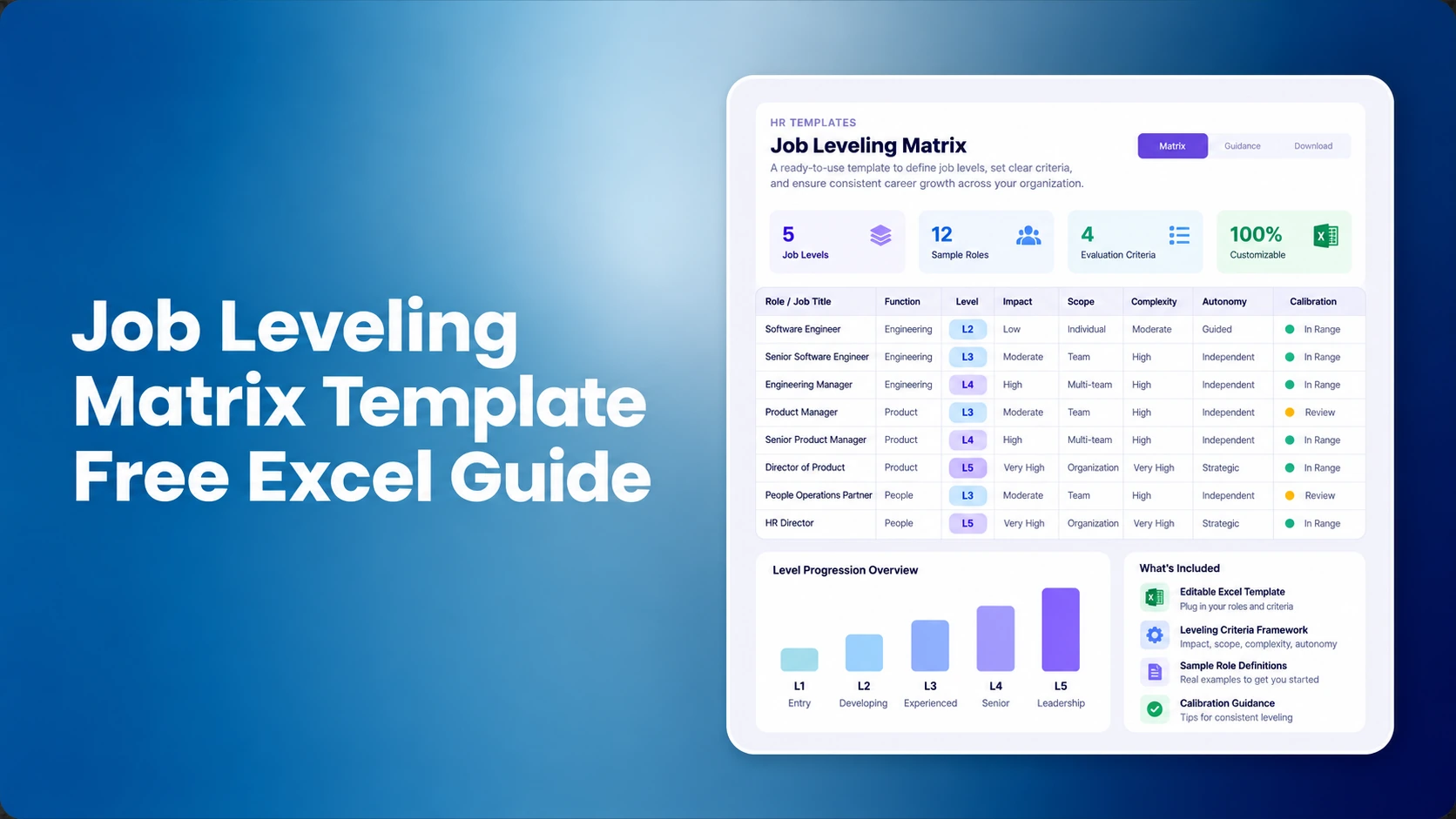
Keep role progression aligned through job leveling. That connection makes the next decision easier to review and explain.
Connect the structure to pay evidence with point-factor evaluation. Using the same evidence across these steps reduces conflicting assumptions between HR, Finance, and managers.
Book a Demo See CompBldr in 15 minutes.


.svg)

.svg)
.svg)

