

.svg)





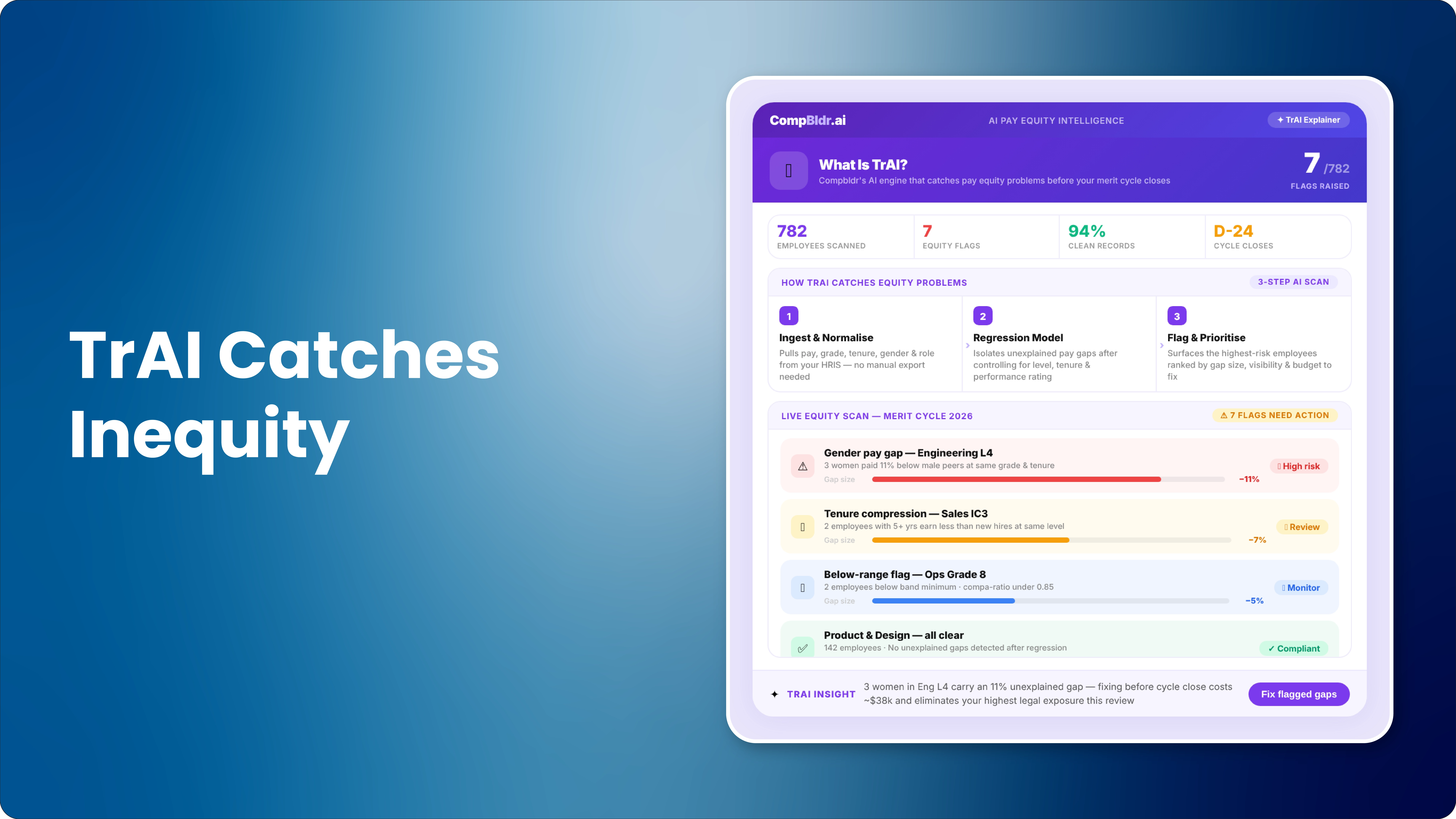

Every pay equity problem that an annual audit surfaces was created during a previous merit cycle. The increase proposals that produced the gap were submitted and approved before anyone ran the analysis to detect it. By the time the audit finds it, the increases have been communicated, processed in payroll, and treated as fair compensation for months or years. The cost of correction—retroactive equity adjustments, legal exposure, and employee trust damage—is significantly higher than the cost of preventing the gap in the first place.
TrAI is built to prevent rather than detect. It monitors every merit proposal as it is submitted and surfaces patterns that signal a developing equity problem before the cycle closes. This guide explains exactly how TrAI works, what triggers each type of flag, and how it fits into the governance infrastructure that makes compensation decisions defensible under EEOC scrutiny and pay equity law.
The Problem With Annual Pay Equity Audits
Why post-cycle findings cost more to fix than mid-cycle flags
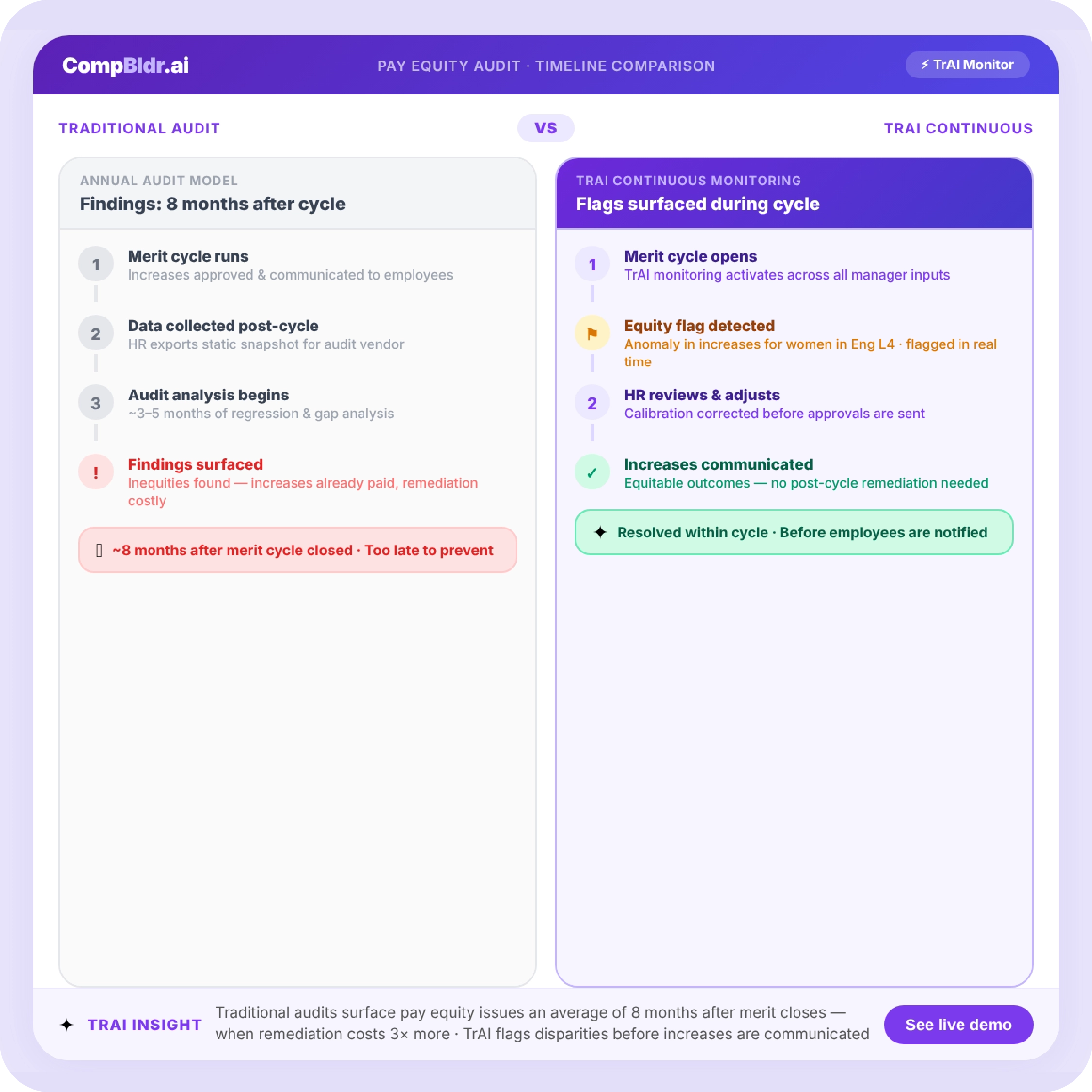
A traditional pay equity audit runs after the compensation cycle closes. The analysis compares the compensation of employees in comparable roles across demographic groups and identifies statistically significant unexplained pay gaps. Finding a gap is straightforward. Correcting it after increases have been communicated is not. The corrective equity adjustment must be explained to the affected employees in a way that does not imply the original increase was discriminatory, while simultaneously acknowledging that the pay position was not equitable. Legal review is typically required. The cost in time, budget, and employee trust is substantially higher than what a mid-cycle flag and a revised proposal would have cost.
What an annual audit cannot see that a continuous AI engine can
An annual pay equity audit produces a point-in-time snapshot of compensation outcomes. It tells you what the gaps are after they have been created. It does not tell you which manager's proposal created the gap, what data the manager was working with when they submitted it, or whether the gap resulted from a pattern that repeated across multiple managers in the same team or function. TrAI has access to all of these dimensions in real time because it monitors the compensation decision process, not just the compensation outcome.
⚖️ See TrAI Detect Pay Equity Risks Before Merit Decisions Are Finalized
TrAI is active in every CompBldr merit cycle. Book a demo and ask us to show you a live equity flag during a simulated merit cycle on your org's data structure.
How TrAI Works: The Four Types of Real-Time Flags
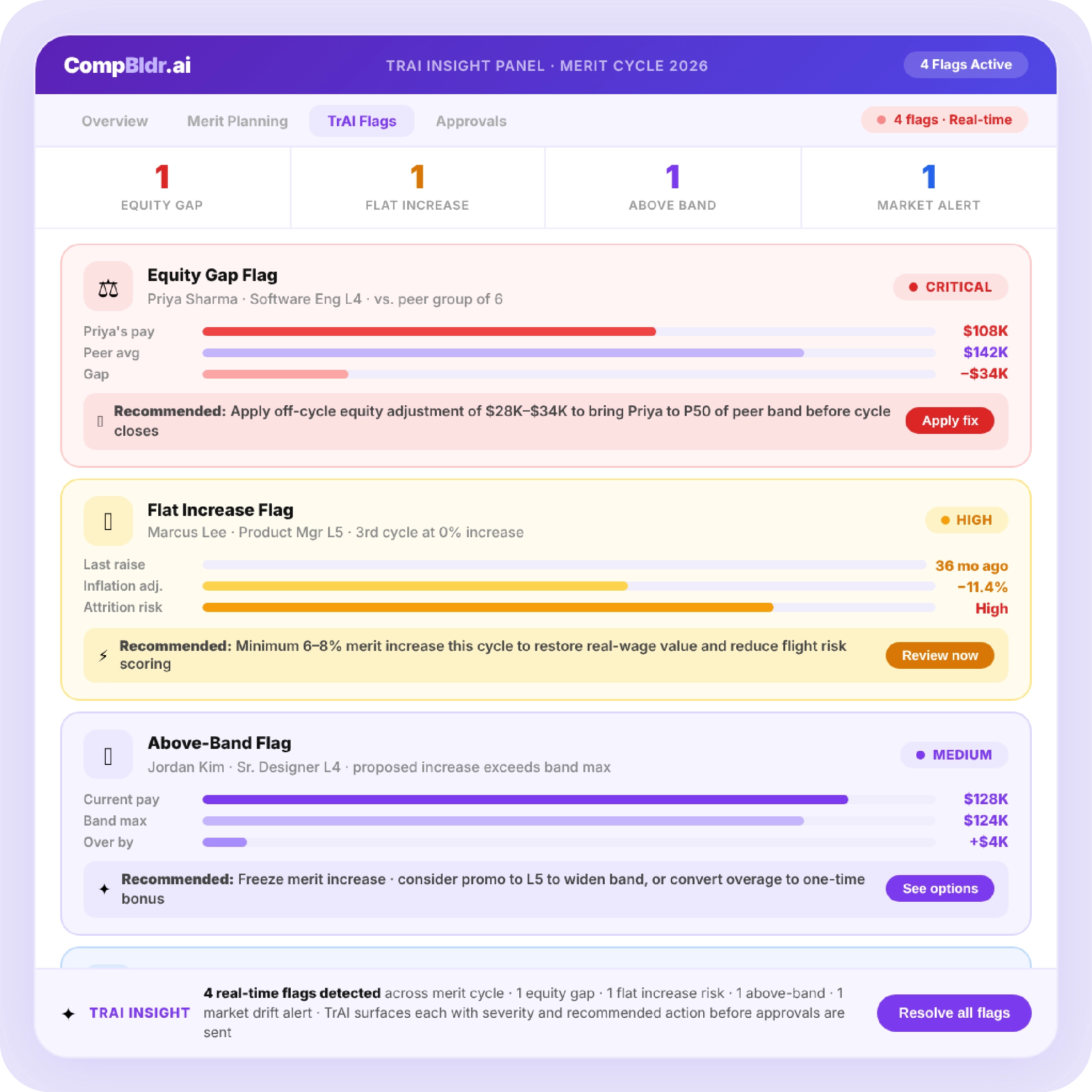
Flag 1: The equity gap flag
What triggers it and what it shows HR
The equity gap flag triggers when TrAI detects a statistically notable difference in proposed merit increases between employees in the same grade cluster who share comparable performance ratings and compa-ratio positions, and where that difference correlates with a demographic variable. The flag shows HR the specific employees involved, the proposed increase amounts, the demographic dimensions that triggered the flag, and a recommended adjustment range for the lower-proposed employee. The flag does not label anyone's decision as discriminatory. It surfaces a pattern that warrants HR review before the cycle closes.
Flag 2: The flat-increase flag
Why uniform increases are a governance problem
The flat-increase flag triggers when a manager proposes the same percentage increase for every direct report regardless of their performance rating or compa-ratio position. A manager proposing 3.5 percent for all twelve direct reports is not using the merit matrix. The merit matrix exists specifically to differentiate increases by performance and pay position. A uniform increase directive from a manager indicates they are either unaware of the merit matrix, choosing to ignore it, or under pressure from above to distribute increases equally. Each of these scenarios represents a governance failure that TrAI surfaces for HR to address before the proposals are approved.
Flag 3: The above-band flag
When a merit proposal exceeds the salary band maximum
The above-band flag triggers when a merit proposal would push an employee's salary above the maximum of their salary band. This typically indicates either that the role has been evaluated at the wrong grade (the employee's scope has grown beyond what the current grade describes) or that the manager is attempting to use the merit cycle to compensate for a promotion that has not been formally processed. Both situations require HR review rather than automatic approval. TrAI flags the proposal and routes it to HR with the compa-ratio before and after the proposed increase, along with the grade and band documentation.
Flag 4: The market movement alert
When a salary band may be stale relative to current market
The market movement alert does not flag an individual proposal. It flags a job family cluster where TrAI's analysis of available market signals suggests that the current salary band midpoint may have fallen behind the market by more than a defined threshold (default: 8 to 10 percent since the last benchmarking cycle). This alert prompts HR to consider an off-cycle band review for the affected job family before the merit cycle closes, so that merit increases are sized against a current market anchor rather than a stale one.
What Happens When TrAI Flags a Proposal
The flag notification HR receives
When TrAI triggers a flag, an HR administrator receives a notification in the CompBldr dashboard with the flag type, severity level, the specific proposal or proposals involved, and the rationale TrAI used to generate the flag. The rationale is expressed in plain language: 'Two employees in Grade 5 Engineering with Exceeds Expectations ratings have proposed increases that differ by 4.2 percentage points. Employee demographic data shows this difference aligns with a gender variable. Recommended review before approval.' The flag does not prevent the cycle from proceeding. It adds an HR review step to the affected proposals.
The correction workflow inside CompBldr
HR reviews the flagged proposals against the available context: the employees' full compensation history, compa-ratio, performance history, and the merit matrix recommendation for their rating and pay position. If the proposed difference is not justified by documented legitimate factors, HR can request a revised proposal from the manager with a note explaining what the merit matrix recommends. The manager can revise and resubmit, and the revised proposal moves through the standard approval chain. If HR determines the difference is justified by documented factors, they can clear the flag with a documented rationale that becomes part of the permanent audit record.
How the flag and the resolution are logged
Every TrAI flag, every HR review action, every manager revision, and every resolution decision is logged permanently in the CompBldr audit trail. The log includes the TrAI rationale, the HR reviewer, the resolution action, and the documented justification if the flag was cleared rather than corrected. This log is the evidence that demonstrates due diligence in the compensation governance process. In the event of an EEOC inquiry or pay equity audit, this log shows not just what the final pay decisions were, but that potential equity issues were identified and reviewed before being finalized.
What TrAI Is Not: The Transparency Behind Every Flag
TrAI does not make compensation decisions
TrAI surfaces anomalies and routes them for human review. It does not approve proposals, reject proposals, or modify salary amounts. The compensation decision remains with the manager, the HR team, and the Finance approval chain. TrAI adds a layer of structured review between the proposal and the approval for proposals that match defined anomaly patterns. The distinction between AI-assisted review and AI decision-making is not just semantic. It is the difference between a governance tool that helps humans make better decisions and a system that removes human judgment from a process where accountability must remain with a person.
Every flag includes an explainable rationale
TrAI does not produce black-box outputs. Every flag includes a plain-language explanation of the data pattern that triggered it, the threshold the pattern crossed, and the recommendation TrAI is surfacing. An HR professional reviewing a TrAI flag can see exactly why it was generated, which allows them to evaluate whether the underlying pattern is a genuine equity concern or a justified difference explained by factors TrAI does not have visibility into. The explainability is a governance requirement, not a product feature. Compensation decisions must be defensible to employees, regulators, and auditors. A flag that cannot be explained cannot be defended.
HR can override any flag with documented reasoning
HR can clear any TrAI flag with a documented reason. If a compensation difference that TrAI flagged is justified by a legitimate factor—seniority within the grade, a documented retention adjustment, or a geographic differential—HR documents that justification in CompBldr and the flag is closed. The documentation becomes part of the permanent audit record. This override capability is essential because no AI system has complete context for every compensation situation. TrAI identifies patterns. HR evaluates context. The combination produces governance that is both data-driven and judgment-aware.
TrAI vs Traditional Pay Equity Audit Tools
Timing: mid-cycle vs post-cycle
Traditional pay equity audit tools run analysis after the compensation data is final. TrAI runs analysis as proposals are submitted. The timing difference is the most significant differentiator. A finding that surfaces six months after merit increases have been communicated requires equity adjustments, legal review, and employee conversations. A flag that surfaces during the merit cycle requires a revised proposal from one manager.
Scope: continuous vs periodic
Traditional pay equity audits are typically annual. TrAI monitors every proposal in every merit cycle continuously. Between cycles, TrAI continues to monitor compensation data for patterns that suggest equity drift: employees in the same grade and performance tier whose compa-ratios are diverging along demographic lines outside of a merit cycle.
Documentation: embedded vs separate
Traditional pay equity audits produce a report that is separate from the compensation governance record. TrAI produces documentation that is embedded in the same audit trail as every other compensation action. The flag, the review, and the resolution are part of the same record as the proposal, the approval, and the Workday writeback. There is no separate remediation process and no separate documentation system.
How TrAI Connects to CompBldr's JESAP Evaluation and Salary Bands
TrAI's equity gap detection is more accurate because it operates on top of CompBldr's JESAP-evaluated job architecture. When TrAI compares two employees, it is comparing employees whose grade placements are based on documented, auditable evaluation scores rather than manager judgment or title seniority. A comparison between an employee in Grade 5 and another in Grade 5 is a comparison between two roles that scored within the same JESAP point range across knowledge, complexity, accountability, and conditions. The comparison is structurally sound in a way that title-based comparisons are not.
Similarly, TrAI's above-band flag operates on salary bands that are grounded in current Radford, Mercer, and WTW survey data blended at weights configured by job family. A flag that an increase would push an employee above band maximum is a flag against a defensible market-anchored limit, not an arbitrary ceiling. The governance infrastructure TrAI operates on top of is what makes its flags actionable rather than advisory.
TrAI surfaces pay equity patterns before they become post-cycle problems. Book a demo and we will walk you through a simulated merit cycle on a realistic data structure and show you a live TrAI flag—what triggers it, what HR sees, and how the correction workflow runs. Book a TrAI Demo


.svg)

.svg)
.svg)

