

.svg)





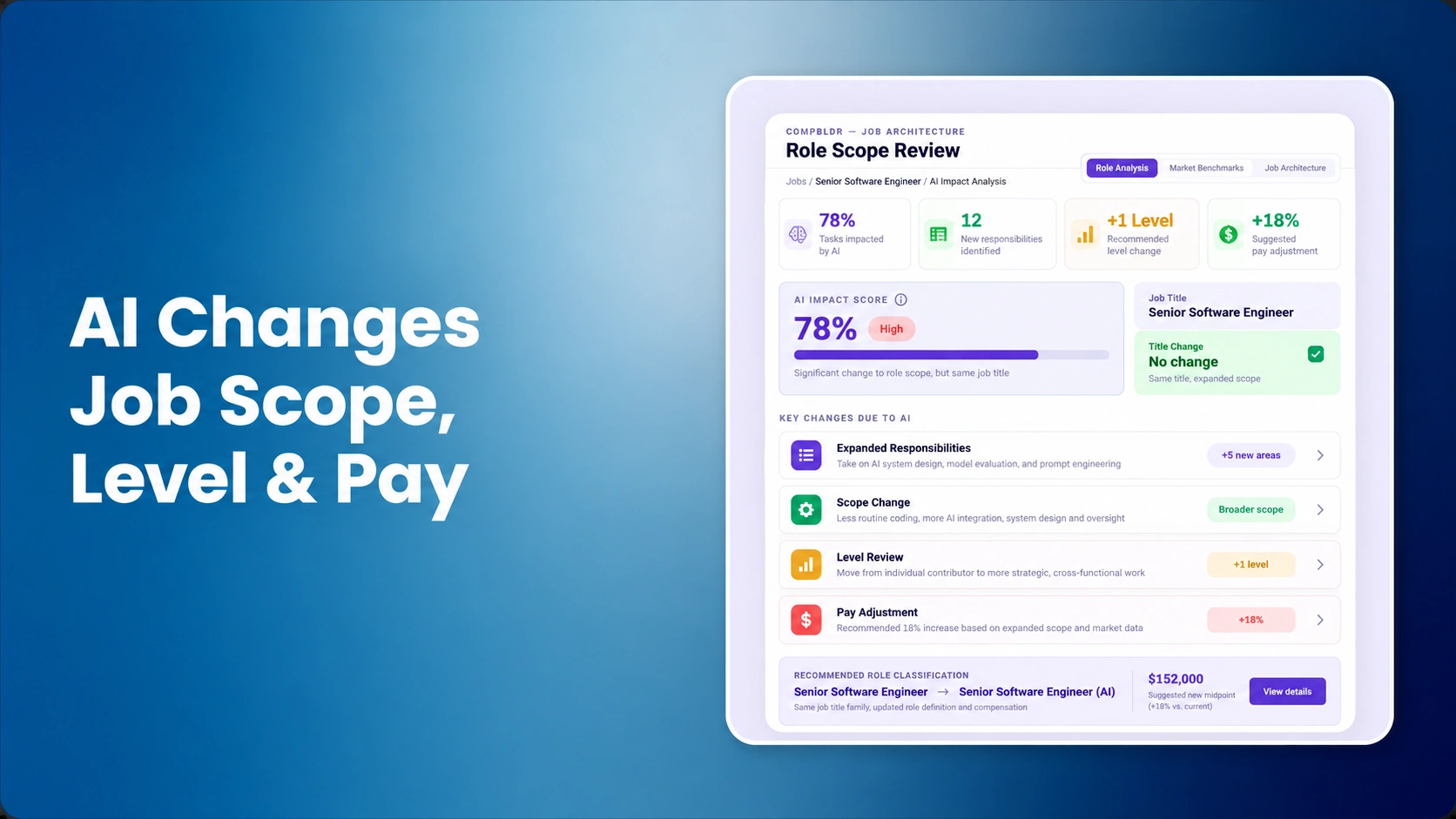

AI can change a job without changing its title. That is now a compensation problem, not only a workforce-planning problem. An analyst may begin supervising AI-generated work, a recruiter may shift from sourcing activity to judgment-heavy talent advising, or a manager may become accountable for the outputs of multiple AI agents. The difficult question is not whether AI is present. It is whether the job has become materially different.
That distinction matters because automatically paying more for “AI use” can create inconsistent premiums and internal equity problems. Ignoring real job expansion creates the opposite risk: employees carry broader accountability while the organization continues to price an outdated job.
Current labor-market evidence supports treating this as a role-design question. PwC's June 15, 2026 AI Jobs Barometer found that skills in the most AI-exposed jobs are changing more than twice as fast as in the least-exposed jobs. Its U.S. entry-level analysis also found that the most AI-exposed junior roles are seven times more likely to require traditionally senior capabilities such as leadership. Payscale's 2026 Compensation Best Practices Report reported that 61% of organizations had updated existing roles to include AI-related skills or competencies, while 55% had not adjusted compensation for those skills.
Did the Job Change or Did the Tool Change?
Compensation teams should resist using AI adoption as a shortcut for job evaluation. A new tool may make the same job faster without changing its accountability. In that case, the role may not need a new level or range. The employee has become more productive, but the job's decision rights, consequences, and scope are still materially the same.
A different case occurs when AI removes routine work and leaves the employee responsible for higher-order decisions. If the employee now validates model outputs, decides when automation should be overridden, owns risk escalation, advises senior stakeholders, or manages a portfolio of AI-enabled workflows, the job may have changed even if the title has not.
Use Job Evaluation Criteria, Not AI Buzzwords
A defensible review should translate the AI change into the same dimensions used for any other job. CompBldr's job evaluation workflow is relevant here because the question is not “How advanced is the technology?” It is “What changed about the work?”
- Knowledge and expertise: Does the role now require deeper technical, analytical, regulatory, or domain expertise?
- Problem complexity: Is the employee solving more ambiguous problems instead of executing defined tasks?
- Decision scope: Can the employee approve, override, or materially influence decisions that previously belonged to a more senior role?
- Business impact: Do errors or judgments now affect a larger population, budget, customer base, or operating process?
- Leadership and accountability: Is the employee directing people, AI agents, vendors, or cross-functional workflows?
If none of those dimensions changed, a permanent job-level increase is difficult to defend. If several changed and the new responsibilities are expected to remain, the job record should be updated before the compensation decision is made.
| Observed change | Does the job itself change? | Likely compensation response | Evidence to review |
|---|---|---|---|
| Same work completed faster with AI | Usually no | No automatic re-level or pay premium | Current job description, decision rights, expected outputs |
| New AI skill added, but accountability is unchanged | Not necessarily | Consider development recognition or a time-bound skill premium if policy supports it | Verified proficiency, scarcity, business use, review date |
| Employee now validates or overrides AI decisions | Potentially | Review job scope and evaluate whether level criteria have changed | Decision authority, risk ownership, consequences of error |
| Employee owns an AI-enabled workflow or agent portfolio | Potentially | Formal job evaluation if responsibility and impact have materially expanded | Workflow ownership, stakeholders, business impact, accountability |
| AI capability becomes a permanent requirement across the role | Yes, if the job definition materially changes | Update the job profile, re-evaluate if needed, and refresh market pricing | Revised job content, architecture fit, external market evidence |
A Practical Re-Evaluation Workflow
1. Capture the old job and the new work side by side
Do not rewrite the job description first and then try to justify the new level. Start with evidence. List previous responsibilities, new responsibilities, decisions added, decisions removed, new stakeholders, new risks, and the expected permanence of each change. Keep the original role record available for comparison.
2. Decide whether the change is temporary, developmental, or structural
A three-month AI implementation project is not the same as permanent ownership of an AI-enabled operating process. Temporary stretch assignments may call for project recognition, bonus treatment, or development planning rather than re-leveling. Structural changes belong in the job.
3. Update the job description before market pricing
Use the job description as the governed role record. Market matches are only as good as the work being matched. If the external benchmark reflects a traditional role while the internal job now includes materially broader AI accountability, title-only matching can understate or overstate the market.
4. Re-evaluate the role in the existing architecture
Compare the revised job against the organization's job architecture. Ask whether the role still belongs in the same family and level, whether the new scope is already represented in the next level, or whether the change is better represented as a specialty profile within the same level. Where level criteria are unclear across functions, use a documented job leveling framework rather than creating a one-off AI title.
5. Re-price only after the internal role is clear
Use market benchmarking after the internal job is defined. A market premium for AI skills can be informative, but it should not automatically determine internal level. Internal job value and external market pressure are related decisions, not identical ones. The compensation benchmarking evaluation guide explains how to review data fitness, job matching, source dates, and governance before relying on a market reference.
Re-Evaluate the Work Before Re-Pricing the Role
Compare revised job content, level criteria, and evaluation evidence before turning AI adoption into a permanent pay decision.
Worked Example: The Analyst Who Starts Owning AI Decisions
Consider an illustrative operations analyst. Before AI adoption, the role collected data, prepared recurring reports, and escalated unusual cases to a manager. After implementation, AI automates most report preparation. The analyst now reviews model exceptions, investigates anomalous outputs, decides which cases require manual intervention, and presents recommendations to business leaders.
Simply saying “the analyst uses AI” is not enough to change pay. The stronger evidence is that routine execution decreased while judgment, exception ownership, and stakeholder influence increased. The compensation team should compare those new responsibilities with the next-level criteria. If the higher level already requires independent diagnosis, decision-making, and business advice, the role may now meet more of that standard.
Now consider a different analyst who uses the same AI tool to create the same reports faster but still follows the same procedures and escalates the same decisions. That case is primarily productivity change, not job enlargement.
When a Skill Premium Is Better Than a Re-Level
Some AI capabilities have real labor-market value without changing the underlying job. For example, a finance role may remain at the same scope while the employee develops a scarce modeling or AI-governance capability that the organization needs for a limited period.
A separate premium can be cleaner when the core role remains appropriately leveled, the skill is verifiable and materially useful, the premium has an explicit owner and review date, eligibility is based on evidence rather than manager preference, and the organization has defined what happens if the skill becomes common or stops being business-critical.
That approach keeps a temporary market signal from permanently distorting the job structure. It also gives Compensation a way to remove or redesign the premium when the labor market changes.
Failure Signals to Watch
- Title inflation: every employee who uses AI is moved to a higher title without evidence of greater accountability.
- Premium sprawl: managers negotiate different AI premiums for similar skills with no central policy.
- Benchmark substitution: external AI salary headlines are used instead of evaluating the actual internal role.
- Invisible stretch work: employees accumulate permanent higher-level responsibilities while job records remain unchanged.
- No sunset logic: a skill premium continues after the skill becomes a normal expectation of the job.
A Governance Rule Compensation Teams Can Use
A practical policy is simple: technology adoption triggers a job review only when there is evidence of sustained change in responsibility, judgment, accountability, or impact. The review should update the job record first, then evaluate level, market position, range, and employee pay in that order.
That sequence keeps the organization from confusing three different questions: Is the employee learning something new? Has the job become larger? Has the market price changed? Each can justify a different response.
Keep AI-Driven Role Changes Connected to the Compensation Evidence
CompBldr connects approved job content, job evaluation, architecture, and market benchmarking so role changes can be reviewed before they become permanent pay decisions.
Explore Job Architecture
.svg)

.svg)
.svg)

