

.svg)







A job leveling framework built for a 50-person organization and one built for a 5,000-person enterprise should not be the same document with extra rows. As an organization grows, the number of roles, managers, job families, and compensation decisions increases. The framework needs clearer criteria and stronger governance to keep level assignments consistent.
This guide explains how job leveling works, what defensible level criteria look like in practice, how to run a calibration session, and how to scale the framework without turning it into an unmaintainable grid. For the governed product workflow, see CompBldr job leveling software.
What Is a Job Leveling Framework?
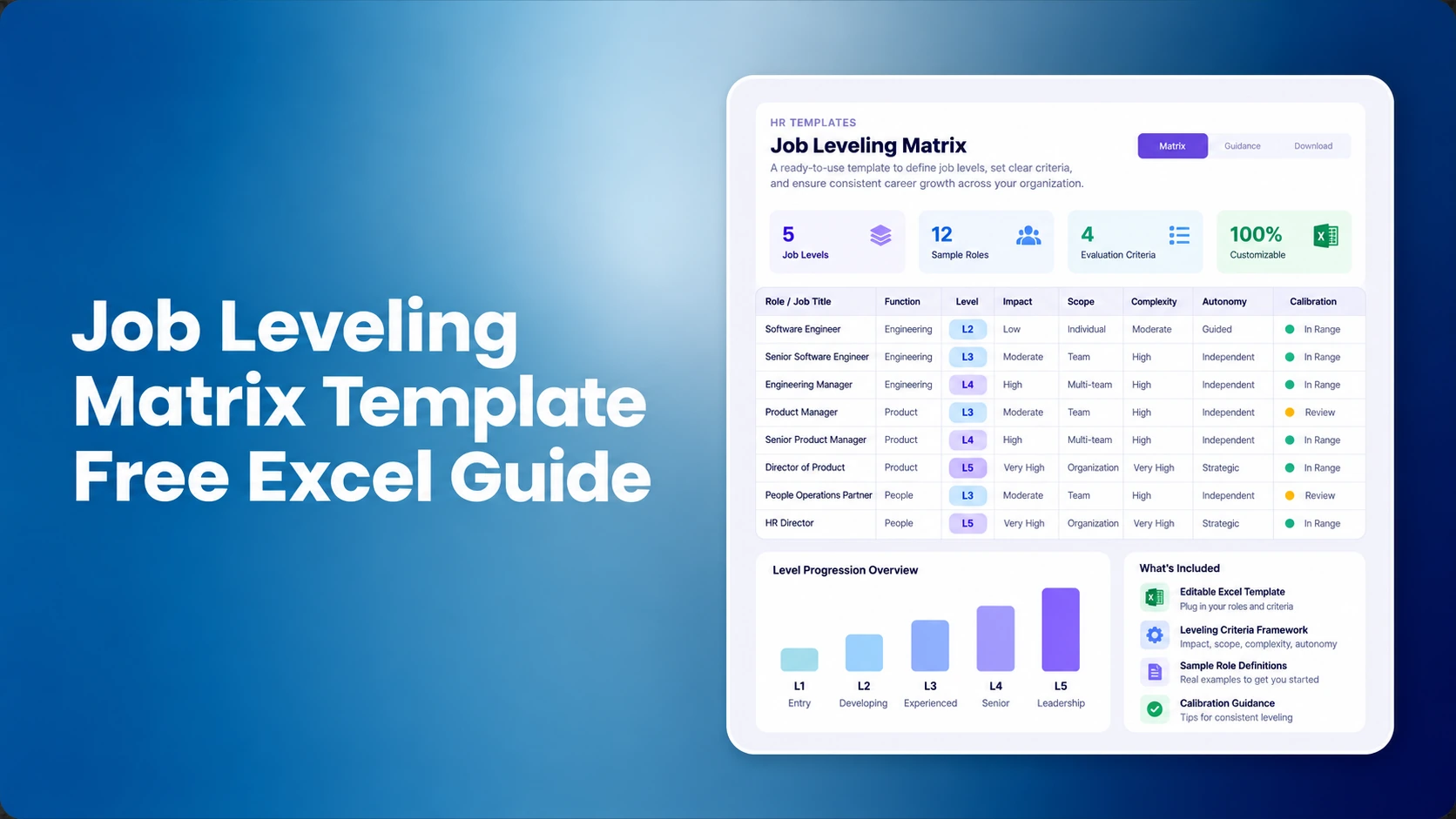
A job leveling framework is a structured system that assigns roles to defined levels based on factors such as responsibility, problem complexity, decision scope, and organizational impact. It creates a shared language for career progression, compensation, promotion criteria, and internal equity.
Leveling should begin with accurate role content. A clear job description explains what the role is accountable for, while job architecture organizes related roles into job families and career paths.
How Does Job Leveling Change as an Organization Grows?
There is no universal number of levels that fits every company. The ranges below are planning examples, not fixed rules. The right design depends on workforce complexity, career-path needs, management layers, and how differently work is performed across functions.
| Organization stage | Illustrative framework | Governance needed | What usually breaks first |
|---|---|---|---|
| Approximately 50 to 150 employees | A small number of broad levels | Clear definitions and leadership calibration | Titles inflate during hiring because no criteria exist to point at |
| Approximately 150 to 500 employees | More differentiation within major job families | Written criteria and cross-manager review | Engineering and sales interpret the same level words differently |
| Approximately 500 to 2,000 employees | Structured professional and management paths | Documented scoring and recurring calibration | Senior individual contributors leave because the only path up is management |
| Approximately 2,000 to 5,000+ employees | More precise enterprise-wide levels | Formal governance, audit history, and cross-functional calibration | Nobody can reconstruct why a placement was made three years ago |
As the workforce expands, informal judgment becomes harder to apply consistently. More managers interpret the same criteria, employees compare opportunities across departments, and compensation teams need to explain why similar-looking roles were placed differently.
Build the Foundation Before You Add More Levels
See how CompBldr organizes roles into consistent job families, career paths, and grades before level criteria are applied.
What Does a Defensible Level Criterion Look Like?
Vague criteria create inconsistent outcomes. Phrases such as "significant experience" or "high impact" mean different things to different reviewers, and neither can be argued against in a promotion discussion.
The test for a criterion is whether two reviewers reading the same job evidence would place the role the same way. Compare these two versions of the same idea:
| Dimension | Too vague to apply | Observable enough to defend |
|---|---|---|
| Decision authority | Makes important decisions | Approves work within an agreed budget threshold; escalates anything above it or outside the standard policy |
| Problem complexity | Solves complex problems | Problems have a documented precedent; the role selects among known approaches rather than designing a new one |
| Communication scope | Strong communicator | Explains a technical outcome to a non-specialist stakeholder outside their own function |
| Organizational impact | High impact | An error is contained within the immediate team and corrected in the same cycle |
The right-hand column is illustrative rather than prescriptive. Each organization sets its own thresholds. The point is the form: a statement someone can hold a job description against and reach the same answer twice.
Criteria should also describe the job, not the person currently in it. Occupational frameworks such as the US Department of Labor's O*NET database describe tasks and work activities by occupation and can provide a neutral starting vocabulary before internal language is layered on.
CompBldr's JESAP® framework supports structured job evaluation, while the job evaluation workflow helps organizations document how roles are assessed and placed.
How Do You Run a Job Leveling Calibration Session?
Calibration is where a framework either becomes consistent or quietly stops mattering. It is also the step most often skipped, because it is the only one that requires several senior people in a room disagreeing on the record.
Before the session. Select the roles to review. Borderline placements and roles that sit at the same proposed level in different functions are worth more discussion time than clear cases. Distribute the job evidence in advance: the job description, the proposed level, and the criteria the proposer applied.
Review the job, not the incumbent. The single most useful rule is that the person's name does not enter the discussion. Tenure, performance rating, current salary and flight risk are all real considerations elsewhere. None of them belong in a level placement, because none of them describe the work.
Compare across functions, not only within them. A finance analyst and a marketing analyst proposed at the same level should be examined side by side. If the group cannot articulate why the two are equivalent, the criteria are not yet doing their job.
Record the reasoning, not just the outcome. One or two sentences per contested placement is enough: which criterion was decisive and why. This is the record that answers the question three years later when someone asks how a role was graded, and it is the difference between a framework and a spreadsheet of assertions.
Escalate rather than average. When reviewers genuinely disagree, splitting the difference produces a placement nobody will defend. Route it to a named decision-maker and document the call.
How Do Job Leveling and Job Architecture Fit Together?
Job leveling should not be performed role by role in isolation. First, group related roles into job families and subfamilies. Then define how scope and complexity progress within each family. This makes it easier to compare similar levels across different functions without pretending that every function develops in exactly the same way.
A mature framework may include both individual contributor and management paths. Parallel paths help organizations recognize advanced expertise without forcing every employee into people management to progress. This is the design decision that tends to matter most between roughly 500 and 2,000 employees, when the first cohort of deep specialists reaches the top of the individual contributor track. In client-facing firms, professional services compensation management can keep career levels, market evidence, salary structures, promotion decisions, and approvals connected as practices and offices grow.
How Do Job Levels Relate to Grades and Salary Ranges?
Job levels describe the progression of work. Grades connect evaluated roles to a compensation structure. Organizations sometimes use the terms interchangeably, so internal definitions should be established before rollout. For concise definitions of job level, job family, grade, salary band, and related terms, use the CompBldr compensation glossary.
Leveling and salary range design also influence each other. Too many levels can create heavily overlapping ranges, which makes a promotion produce a pay increase small enough that employees question whether the step was real. Too few levels hides meaningful differences in responsibility and pushes managers toward off-structure exceptions to reward people. Market data should inform the design without replacing internal job evaluation.
Defensibility matters here beyond internal credibility. Where pay differences between comparable roles are challenged, the organization is expected to be able to explain the basis for them, and guidance from bodies such as the US Equal Employment Opportunity Commission is a reference point for how such explanations are assessed. A documented evaluation trail is considerably easier to produce than a reconstructed rationale.
What Are the Most Common Job Leveling Mistakes?
- Building the framework once and never reviewing it. The structure should be revisited as roles, locations, and management layers change.
- Leveling by title alone. Titles are inconsistent across teams and employers. Evaluate job content.
- Skipping calibration. Reviewers need a repeatable way to compare difficult placement decisions.
- Confusing level with performance. The role's level reflects job scope. Performance reflects how effectively an employee performs that role.
- Separating levels from compensation structure. Grades, ranges, market positioning, and career paths should remain connected.
- Creating a level to solve a retention problem. A new tier invented to justify one person's increase becomes a permanent structural inconsistency that every future placement has to work around.
How Do You Implement a Scalable Job Leveling Framework?
- Document current roles and remove title duplication.
- Group roles into consistent job families and career paths.
- Define level criteria using observable differences in work.
- Evaluate representative roles before applying the framework broadly.
- Calibrate difficult placements across functions.
- Connect evaluated levels to grades and salary ranges.
- Document approvals, exceptions, and changes.
- Review the structure after major growth, reorganization, or market change.
Step four is worth protecting. Evaluating a representative sample of roles first, before the framework is announced, surfaces the criteria that do not work while changing them is still cheap. Rolling out to the whole organization and discovering the problem during the first promotion cycle is considerably more expensive, because by then people have been told what their level is.
The goal is not to create the greatest possible number of levels. It is to create enough differentiation to support fair decisions while keeping the framework understandable and maintainable.
Build a Job Leveling Framework That Can Grow With You
Connect the structure to pay evidence with point-factor evaluation and salary bands. Using the same evidence across these steps reduces conflicting assumptions between HR, Finance, and managers.
For downstream decisions, carry the same structure into compensation planning. These controls preserve traceability without adding a separate manual process.
See how CompBldr connects job descriptions, job families, JESAP®-based evaluation, grades, and salary structures in one governed workflow.
Book a Demo

.svg)

.svg)
.svg)

