

.svg)





.webp)

Every compensation team eventually faces the same question: which salary survey should we actually use? In practice, most teams never really answer it. They inherit whatever survey subscription the last consultant set up, renew it out of habit, and add a second or third survey only when a specific gap becomes impossible to ignore, usually a role the existing survey does not cover well. The result is a survey library that reflects historical accident more than current need.
This matters more than it looks like it should, because every pay band, every offer, and every pay equity calculation downstream depends on the market data feeding it. A survey that is too narrow for your industry undercounts your real competition for talent. A survey that is too broad dilutes the precision you need for specialized or emerging roles. A survey that has not been refreshed recently quietly underpays an entire job family without anyone noticing until attrition spikes. None of these failures show up immediately. They show up months later, in exit interviews, in a pay equity audit that cannot explain a flagged gap, or in an offer that loses a candidate to a competitor who priced the role correctly.
The stakes have risen further with pay transparency legislation. When a salary range has to be defensible enough to publish in a job posting, the market data behind that range needs to hold up to scrutiny, not just internally but potentially to a regulator or an employee who asks how the range was set. A survey choice that was reasonable five years ago, before your company expanded into new geographies or started hiring AI specialists who barely existed as a job category, may no longer be the right foundation for that defensibility.
This is also a budget question that rarely gets asked out loud. Salary survey subscriptions are not inexpensive, and most compensation teams can name the total annual spend across their survey library without much trouble, but far fewer can say with confidence whether that spend is actually buying coverage where it matters most. A team paying for three overlapping broad surveys while having no specialized coverage for the one job family driving half its open requisitions has a budget allocation problem disguised as a data problem.
What Are the Key Criteria for Selecting a Salary Survey Provider?
The right salary survey provider depends on the overlap between your talent competition and the survey's coverage: the industries, geographies, and specific roles where you actually compete for hires. Beyond that core fit, the strongest selection criteria are sample size and statistical rigor, how recently and how often the data is refreshed, the methodology used to match jobs to survey benchmarks, the cost and participation requirements, and how easily the data integrates into the tools your compensation team actually uses. No single survey is universally “best.” The right choice is the one whose coverage and methodology match your specific workforce, not the one with the strongest brand name in the compensation industry.
The Problem With a Default Survey Strategy
Three patterns explain why most survey libraries are misaligned with actual need.
The first is inertia. A survey subscription set up years ago, often by a consultant who is no longer involved, keeps renewing because canceling it feels riskier than keeping it, even when nobody on the current team can articulate why that specific survey was chosen. The second is over-reliance on free or crowdsourced data. Sources like Glassdoor and LinkedIn salary insights are genuinely useful as a sanity check or as supplementary color, but they were built for individual job seekers comparing notes, not for compensation teams setting defensible bands, and they generally lack the statistical controls, sample size requirements, and documented methodology that a real survey provides. The third is treating “more surveys” as automatically better. Adding a fourth or fifth survey without a clear rationale for what gap it closes adds cost and reconciliation work without necessarily improving accuracy, especially if the new survey overlaps heavily with one already in use.
None of these patterns are irrational on their own. They are simply what happens when survey selection is never treated as a deliberate evaluation process with criteria, which is exactly what the framework below is meant to provide.
Consider a 350-person fintech company that has used the same broad financial services survey since its Series B, three years ago. The survey still covers core finance and operations roles well. It has almost no meaningful data for the company's growing machine learning engineering team, a job family that did not exist at the company when the subscription started. Rather than adding a second survey, the compensation team has been informally benchmarking those roles against a handful of job postings and an internal sense of what recruiters are hearing in the market, an approach that works until the first pay equity audit asks for the documented market data behind those bands, and there is none.
Six Criteria for Evaluating a Salary Survey Provider
| Criterion | What to Look For | Red Flag |
|---|---|---|
| Industry and role specificity | Strong coverage of your actual job families, including emerging or niche roles | Broad coverage that thins out exactly where you need precision |
| Sample size and methodology rigor | Documented sample sizes per job, clear statistical methodology, validated participant data | Vague or undisclosed sample sizes, no methodology documentation |
| Data freshness and refresh cadence | Annual or more frequent updates, clear aging adjustment guidance | Data quietly several years old with no aging methodology |
| Job matching methodology | Matching based on scope and level, not job title alone | Title-only matching with no leveling guidance |
| Cost and participation requirements | Transparent pricing, clear data-sharing expectations if participation is required | Opaque pricing, unclear what employee data you must contribute |
| Software compatibility | Clean integration or export into your benchmarking platform | Manual re-entry required for every job, every cycle |
Industry and Role Specificity
A survey's overall size matters less than how deep its coverage runs in the specific job families you actually hire for. A broad, general-industry survey may have excellent coverage for finance and operations roles while having thin, low-confidence data for a niche engineering specialty or an emerging AI role that barely existed two years ago. The right test is not “does this survey have a lot of jobs,” but “does this survey have enough validated data points in the five to ten job families where I most need accuracy.”
Sample Size and Methodology Rigor
A salary figure built from 200 validated data points carries far more weight than the same figure built from 12, even if both are presented with equal confidence in a report. Reputable survey providers document their sample size per job and per cut, and a provider that will not share this information, or that bundles it loosely without per-job detail, should be evaluated with caution before its numbers anchor a pay band.
Data Freshness and Refresh Cadence
Most established survey providers refresh annually, but annual refresh alone does not guarantee currency. Data collected at the start of a survey cycle and published months later can already be six to nine months stale by the time it informs a pay decision, particularly in fast-moving job categories. Look for providers that publish both their collection window and their aging methodology, so the data point you use can be adjusted forward to the date you are actually setting pay.
Job Matching Methodology
The most consequential, and most often overlooked, evaluation criterion is how a survey expects you to match your roles to its benchmark jobs. A survey that matches purely on job title will produce weaker results than one that expects matching based on documented scope, level, and accountability, because two companies' “Senior Analyst” titles can represent meaningfully different actual roles. This is also where having a documented job architecture internally pays off, since it gives you the scope detail a rigorous survey match actually requires.
Cost and Participation Requirements
Survey pricing varies widely, from flat subscription fees to participation-based models where access depends on contributing your own de-identified employee compensation data. Before purchasing, confirm exactly what data you are expected to submit, on what timeline, and in what format, since participation requirements that are unclear at the outset tend to become a scramble closer to the submission deadline.
Software Compatibility
A survey that produces a clean, well-documented dataset still creates significant manual work if every job match has to be re-entered by hand into your compensation system each cycle. Providers and platforms that support direct integration, or at minimum a clean, structured export, save meaningful analyst time every benchmarking cycle, time that compounds across multiple surveys and multiple job families.
.webp)
Find the Market Data Gaps Before They Affect Pay Decisions
Apply the six-criteria evaluation to your existing survey subscriptions, not just new candidates; you may find that one you're already paying for has weak coverage for the roles you actually need to fill.
Free vs. Paid Salary Data: When Crowdsourced Data Is (and Isn't) Reliable
Free, crowdsourced salary data sources serve a real purpose. They give job seekers and employees a quick directional sense of market pay, and they can be a useful sanity check for a compensation team that wants a second opinion on a number a paid survey produced. What they generally cannot do is replace a paid survey as the primary input for setting a pay band, because the self-reported, unverified nature of crowdsourced data means sample sizes, accuracy, and methodology are largely unknown and unverifiable. Under a pay transparency regime where a posted range may need to be defended, a band built primarily on crowdsourced data is a materially weaker position than one built on a documented, methodologically sound survey. The practical rule most experienced compensation professionals follow: use free data as a directional cross-check, never as the documented source of record behind a published range.
Choosing Surveys for Niche Tech Roles and Specialized Industries
Niche and emerging roles, such as AI research engineer, prompt engineer, and certain highly specialized data science roles, are exactly where general-purpose surveys struggle most, since these roles often did not exist when a survey's job catalog was last substantially revised. For these roles, smaller, more specialized survey providers focused specifically on technology or a particular industry vertical frequently produce more reliable, more current data than a broad, general-industry survey, even though their overall job catalog is smaller. The practical approach for most mid-size and growing companies is a blend: one or two broad surveys for the majority of standard roles, supplemented by a specialized survey or two for the specific niche or emerging roles where general coverage is weakest.
Selecting Providers for Global and Multinational Compensation
Organizations expanding into new countries face a different version of the same problem: domestic survey coverage simply does not extend to international markets, and pay practices, benefits structures, and even what counts as “base pay” can vary significantly by country. Global survey providers exist specifically to address this, but coverage depth still varies considerably by region and by job family, so the same evaluation criteria above, including sample size, methodology, and freshness, apply per country, not just once for the provider as a whole. A provider with excellent US and Western European coverage may have meaningfully thinner data for other regions, which is worth confirming before assuming one global subscription covers every market your organization operates in equally well.
.webp)
Bring Market Data, Pay Bands & Compensation Into One Workflow
CompBldr combines salary survey data, job architecture, pay bands, market pricing, and compensation planning in a single platform, eliminating the need to reconcile multiple systems before every compensation decision.
Questions to Ask a Salary Survey Vendor Before You Buy
- What is the documented sample size for the specific job families I care about most, not just for the survey as a whole?
- When was this data actually collected, and what is the recommended aging methodology between collection and use?
- Does job matching rely on title alone, or does it support matching based on documented scope and level?
- What exactly do we need to contribute if this is a participation-based survey, and on what timeline?
- What does pricing look like at our current headcount, and how does it scale if we grow significantly?
- Can the data be exported or integrated directly into our compensation platform, or does it require manual entry?
- Can we get a demo or trial cut of data for our specific job families before committing to a full subscription?
How Compensation Software Brings Multiple Salary Surveys Together
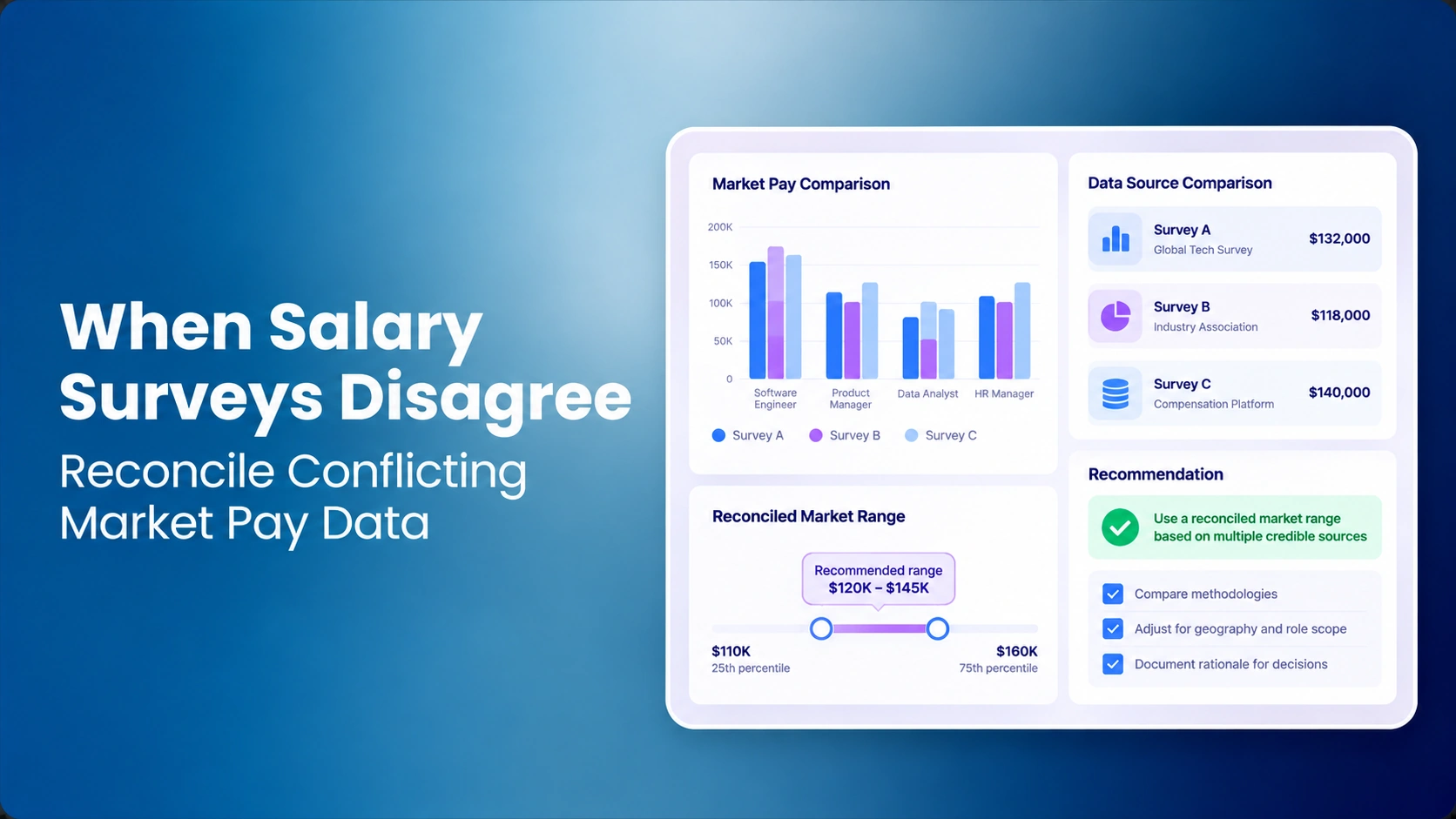
Most organizations beyond a certain size end up needing more than one survey: a broad benchmark survey for general coverage and one or more specialized surveys for niche or regional gaps, which immediately creates a reconciliation problem: different surveys report different numbers for similar roles, on different refresh schedules, with different sample sizes behind each figure. Compensation management software built for this blends multiple sources into a single market view, weighting each comparator by its sample size and match quality, and applies an aging adjustment automatically rather than requiring an analyst to manually recalculate every figure by hand each time a survey ages. A confidence score attached to each blended figure gives the compensation team a fast way to see which job market data is solid and which is thin enough to treat cautiously before using it to set a band.
A Simple Framework for Building Your Survey Library
Start with one broad, well-established survey that covers the majority of your standard roles credibly. Add a specialized survey only when a specific, persistent gap appears, a niche technical role, a particular industry vertical, or a new geography, rather than adding surveys speculatively. Revisit the full library roughly once a year, using the six criteria above against each subscription you currently hold, not just against new candidates, since a survey that was the right choice three years ago may no longer be the best fit for your current compensation philosophy or workforce mix.
Choosing the right salary survey provider is not a one-time purchasing decision. It is an ongoing fit assessment between your evolving workforce, the roles you actually compete for, and the coverage and methodology each survey provider can document and defend. The compensation teams that get the most value from their survey spend are the ones that evaluate providers against explicit criteria, supplement rather than replace paid data with free directional checks, and revisit their survey library at least annually rather than letting inertia decide for them.
Treat the six criteria above as a recurring audit, not a one-time checklist. The right survey mix for a 200-person domestic company looks different from the right mix for the same company three years later with operations in four countries and a growing AI engineering team. The goal is not to find a single perfect survey that covers everything forever. It is to build a small, deliberately chosen library that you can explain and defend, role by role, whenever someone asks where a number came from.
One Market View, Not Five Portals
Multiple Salary Surveys - Blended Into One View
CompBldr blends data from major survey providers into a single market view with confidence scoring and automatic aging adjustments, so your compensation team spends time deciding pay strategy, not chasing down whose number is most current.
Book a 15-Minute Demo

.svg)

.svg)
.svg)

