

.svg)







What Is Real-Time Integration in Compensation Planning Software?
Real-time integration in compensation planning software refers to the automatic, continuous synchronization of employee data between your compensation management platform and connected systems. The required compensation software integrations may include HRIS, payroll, and performance-management systems, with connection behavior depending on the configured implementation. Unlike scheduled or manual data exports, real-time sync ensures that any change to an employee's record, a promotion, a location transfer, or a performance rating update is immediately reflected across every system involved in pay decisions. This eliminates the lag between an organizational change and its impact on compensation workflows, reducing errors, improving audit readiness, and enabling HR leaders to make pay decisions based on current facts rather than yesterday's data.
The Hidden Cost of Disconnected Compensation Systems
Most HR organizations reach for spreadsheets first. It feels controllable, familiar, and fast to set up. But as headcount grows and compensation structures become more layered, those spreadsheets quietly become a liability.
The problem is not that spreadsheets are inherently flawed; it is that they cannot stay synchronized. When a manager submits a merit recommendation in a planning worksheet, that worksheet may not reflect the employee's updated role, the approved salary band revision from three weeks ago, or the performance score finalized yesterday. The data simply does not travel.
According to the 2025 Compensation Planning Trends Report, 77% of companies still use spreadsheets to manage pay cycles, yet companies using dedicated compensation planning software experience far fewer data access issues: only 10% of software users report access problems compared to 25% of spreadsheet users.
The downstream effects of this gap are predictable and measurable. Pay decisions get made on stale job titles. Budget allocations miss the actual headcount. Payroll runs require manual reconciliation after the fact. And when those errors surface, they erode manager confidence, delay cycle completion, and in some cases create legal exposure around pay equity.
Nearly 80% of organizations report difficulty managing compensation due to a lack of integration between HR systems, and when compensation software operates independently from an HRIS, every salary adjustment, bonus calculation, and performance review requires manual data entry across multiple platforms.
This is the environment that real-time integration is designed to fix.
Batch Sync vs. Real-Time Sync: Why the Difference Matters
Not all integrations are equal, and many HR leaders do not realize their system is not truly "real-time" until a compensation cycle is already compromised.
Batch synchronization transfers data between systems on a schedule, such as nightly, weekly, or when triggered manually. The data is accurate as of the last sync point, but it ages quickly. An employee promoted on Monday may not appear in the compensation planning tool until Tuesday morning, or later if a sync fails silently.
Real-time synchronization pushes data changes through the moment they occur. When an employee's job grade is updated in the HRIS, the compensation management platform reflects that change within seconds. Budget tracking updates. Eligibility rules adjust. The manager sees the correct record when they open their planning worksheet.
For compensation teams running merit cycles, promotion reviews, or off-cycle adjustments, this distinction is not trivial. A batch-synced system is always operating on a historical snapshot. A real-time-synced system is operating on organizational truth.
The practical impact breaks down across three dimensions:
| Dimension | Batch Sync | Real-Time Sync |
|---|---|---|
| Data Accuracy During Active Cycles | Degrades as changes accumulate. | Maintained continuously. |
| Error Discovery | After payroll runs. | Before approvals are submitted. |
| Off-Cycle Adjustment Support | Requires manual re-export. | Handled automatically. |
| Pay Equity Audit Readiness | Requires reconciliation. | Always audit-ready. |
| Manager Experience | Working with potentially stale data. | Always working with current data. |
How Real-Time Integration Transforms the Pay Decision Workflow
The compensation planning process involves multiple stakeholders making interconnected decisions across a compressed timeline. HR sets the budget. Finance approves the envelope. Managers make recommendations. HR reviews for equity. Leadership signs off. Payroll executes.
In a disconnected system, each of those handoffs creates a data drift risk. By the time payroll receives the final approved file, the underlying employee records may have changed six times.
Real-time integration eliminates that drift by maintaining a single version of the truth across every participant in the workflow.
Merit Planning
During an annual or semi-annual merit cycle, real-time integration ensures that managers are recommending increases against the employee's actual current salary, correct job grade, and live salary band position. Compa-ratio calculations update automatically as market data and pay bands are refreshed. Budget utilization dashboards reflect every recommendation the moment it is submitted, so HR can intervene before the cycle closes rather than discovering overruns afterward.
HR teams using automated compensation planning tools reduce compensation cycle times by up to 50%, primarily by eliminating the manual data preparation and reconciliation that consumes the majority of cycle administration time.
Performance-Linked Pay Decisions
One of the most common failure points in traditional compensation cycles is the timing gap between performance ratings being finalized and those ratings appearing in the compensation planning tool. When performance management and compensation planning run on separate, disconnected systems, managers are often forced to make pay recommendations before ratings are confirmed, or HR must re-enter data manually to align the two.
Directly connecting performance reviews to compensation planning reduces manual errors and implicit bias while improving the quality of manager decisions. Real-time integration makes this connection automatic. When a performance score is submitted in the performance management system, it flows immediately into the compensation workflow, ensuring every merit recommendation is grounded in the most current evaluation available.
Off-Cycle Adjustments
Off-cycle compensation changes, market adjustments, retention offers, and role-based salary corrections are increasing in frequency as organizations respond to talent market shifts outside the traditional annual review window. These adjustments are particularly vulnerable to data errors because they happen outside structured cycle workflows.
With real-time integration, an off-cycle adjustment submitted today is reflected in the HRIS and payroll system without a manual export. The budget ledger updates. The salary band position recalculates. The employee's total compensation history is preserved with a full audit trail. What used to require a two-day reconciliation process between HR and payroll becomes a same-day execution.
Is your current compensation platform actually integrated or just connected on paper?
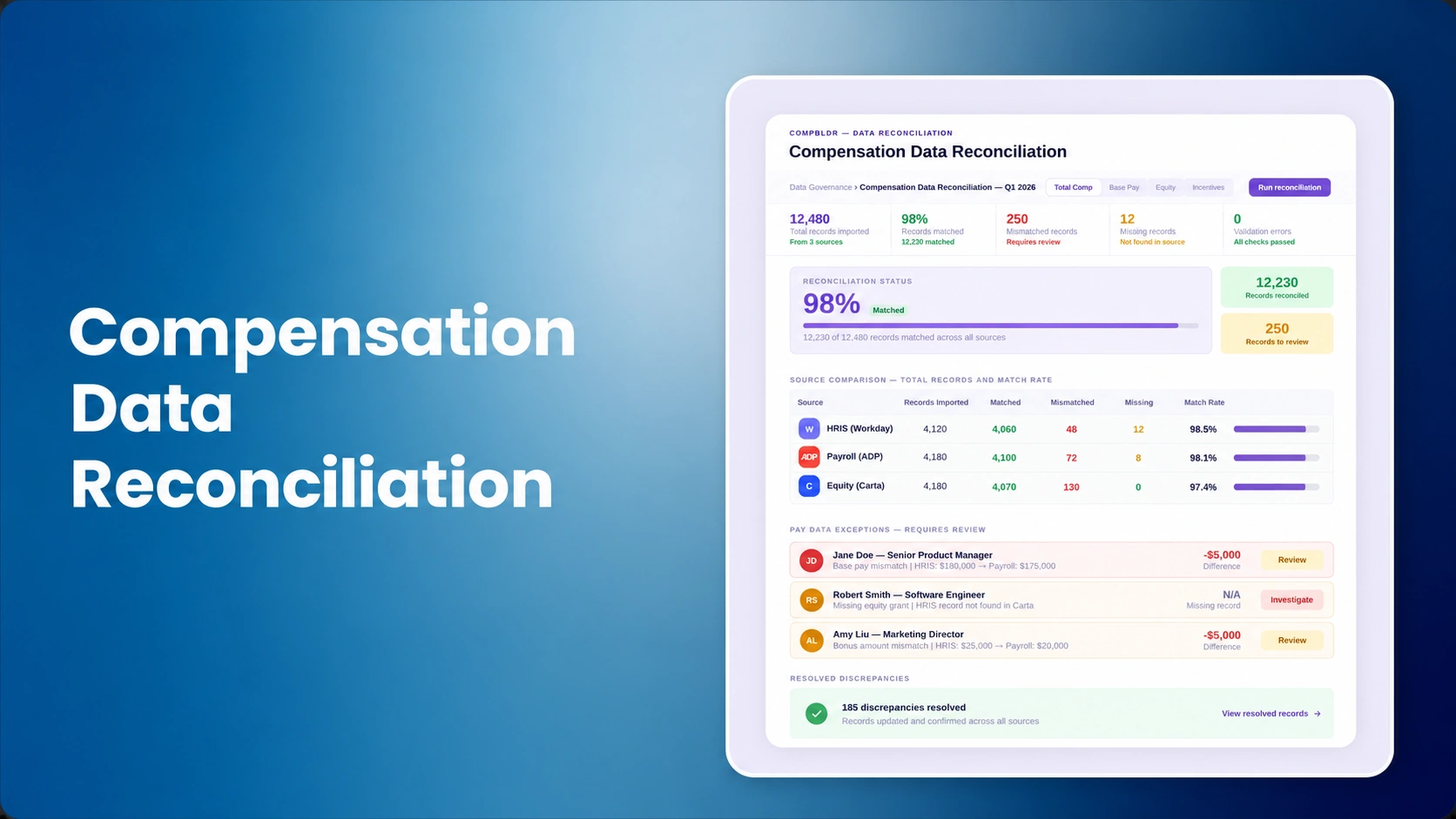
CompBldr's compensation planning software is built with native real-time data sync across HRIS, payroll, and performance systems. See how the workflow looks in practice.
Pay Equity and Compliance: The Case for Live Data
Pay equity analysis is only as reliable as the data it operates on. When compensation management software pulls employee records from a static export, the equity analysis reflects a moment in time that may no longer be accurate. Employees who have been promoted, transferred, or had their roles reclassified may be compared incorrectly against peers. Demographic data may be stale. Band positions may have shifted since the last sync.
Integrated systems provide the documentation trails required for regulatory compliance while eliminating the manual reconciliation work that otherwise consumes entire weekends before payroll deadlines.
With real-time integration, pay equity reporting is always current. HR can run a compa-ratio analysis or gender pay gap report with confidence that the underlying data reflects the organization as it exists today, not as it existed at the last export. This matters increasingly as pay transparency regulations expand across markets and as boards and leadership teams expect compensation data to be defensible on demand, not just at year-end.
The global compensation management software market was valued at $5.7 billion in 2024 and is projected to reach $29.9 billion by 2037, growing at a CAGR of 13.6%, a reflection of how compensation has shifted from a routine HR function to a board-level strategic priority.
A Diagnostic Framework: Is Your Compensation Stack Truly Integrated?
Many HR leaders assume their systems are integrated because they have a formal connection between their HRIS and compensation tool. But integration quality varies significantly, and a low-quality connection can create a false sense of accuracy while still exposing the organization to data lag risk.
Use this framework to assess your current state:
- Frequency Test: Ask your vendor: how often does data sync between the HRIS and the compensation platform? If the answer is "nightly" or "on request," you have batch sync, not real-time sync.
- Change Propagation Test: Make a test change to a job title or salary band in your HRIS and measure how long it takes to appear in your compensation planning tool. Anything longer than a few minutes indicates batch-level integration.
- Budget Accuracy Test: During an active compensation cycle, check whether budget utilization updates immediately when a manager submits a recommendation, or whether it requires a manual refresh. Delayed updates indicate a disconnected budget engine.
- Off-Cycle Audit Test: Process a test off-cycle salary adjustment and verify whether the change appears in payroll, the HRIS, and any total rewards dashboards without manual intervention. If any step requires a human to move data, you have an integration gap.
- Equity Report Currency Test: Run a pay equity report immediately after making an employee record change. If the report does not reflect the change, your equity analysis is operating on historical data.
If your current compensation management platform fails more than two of these tests, the integration is not working at the level your pay decisions require.
Ready to eliminate the data lag from your compensation cycle?
CompBldr's compensation management platform gives HR and Finance teams real-time visibility into every pay decision without manual reconciliation or version control headaches.
What to Look for in a Compensation Management Platform's Integration Capabilities
When evaluating compensation planning software, integration language in vendor materials is often imprecise. "Seamless integration" and "native connectivity" are marketing terms. The questions that matter are more specific.
API architecture: Does the platform use bidirectional APIs that push and receive data in real time, or does it rely on file-based imports? File-based imports are never real-time, regardless of how frequently they run.
Pre-built connectors: Does the platform have certified, pre-built connectors for the HRIS systems you use (Workday, SAP SuccessFactors, BambooHR, Darwinbox, or others), or does integration require custom development? Custom integrations introduce maintenance overhead and break more frequently during system updates.
Sync scope: Which data objects are included in the sync? Employee profiles, job grades, salary bands, performance ratings, and organizational hierarchy should all be covered. Platforms that sync only basic headcount data leave significant integration gaps.
Conflict resolution: When the same data field is updated in two systems simultaneously, how does the platform resolve the conflict? A well-designed integration has clear precedence rules and an audit log that records every data change and its source.
Integration monitoring: Does the platform provide visibility into integration health, last sync time, failed records, data validation errors, or do failures surface only when someone notices incorrect data in a planning worksheet?
Companies using dedicated compensation planning software with proper integration experience three times fewer obstacles in their compensation planning process compared to those relying on spreadsheets and standalone HRIS modules.
The shift to real-time integration in compensation planning is not a feature upgrade; it is a structural change in how pay decisions get made and defended. When compensation management software operates on live data from across your HR ecosystem, the entire pay cycle improves: accuracy increases, cycles close faster, equity analysis becomes defensible, and off-cycle adjustments stop creating reconciliation work.
The organizations that will lead on compensation strategy over the next decade are the ones building their pay decision infrastructure on real-time data today. The cost of inaction is not just operational inefficiency; it is the accumulated risk of pay equity gaps, payroll errors, and manager decisions made on facts that were outdated before the cycle began.
The practical next step is straightforward: assess your current integration quality using the diagnostic framework above, identify your largest data lag exposure, and evaluate whether your compensation management platform is built to close that gap or merely paper over it.
Ready to Run Compensation Cycles on Real Data?
CompBldr's compensation planning software connects directly with your HRIS, payroll, and performance systems through real-time integrations built for HR teams that cannot afford to operate on yesterday's data. See how compensation leaders use CompBldr to eliminate manual reconciliation, accelerate merit cycles, and make every pay decision with confidence.
Book a Demo
.svg)

.svg)
.svg)

