

.svg)





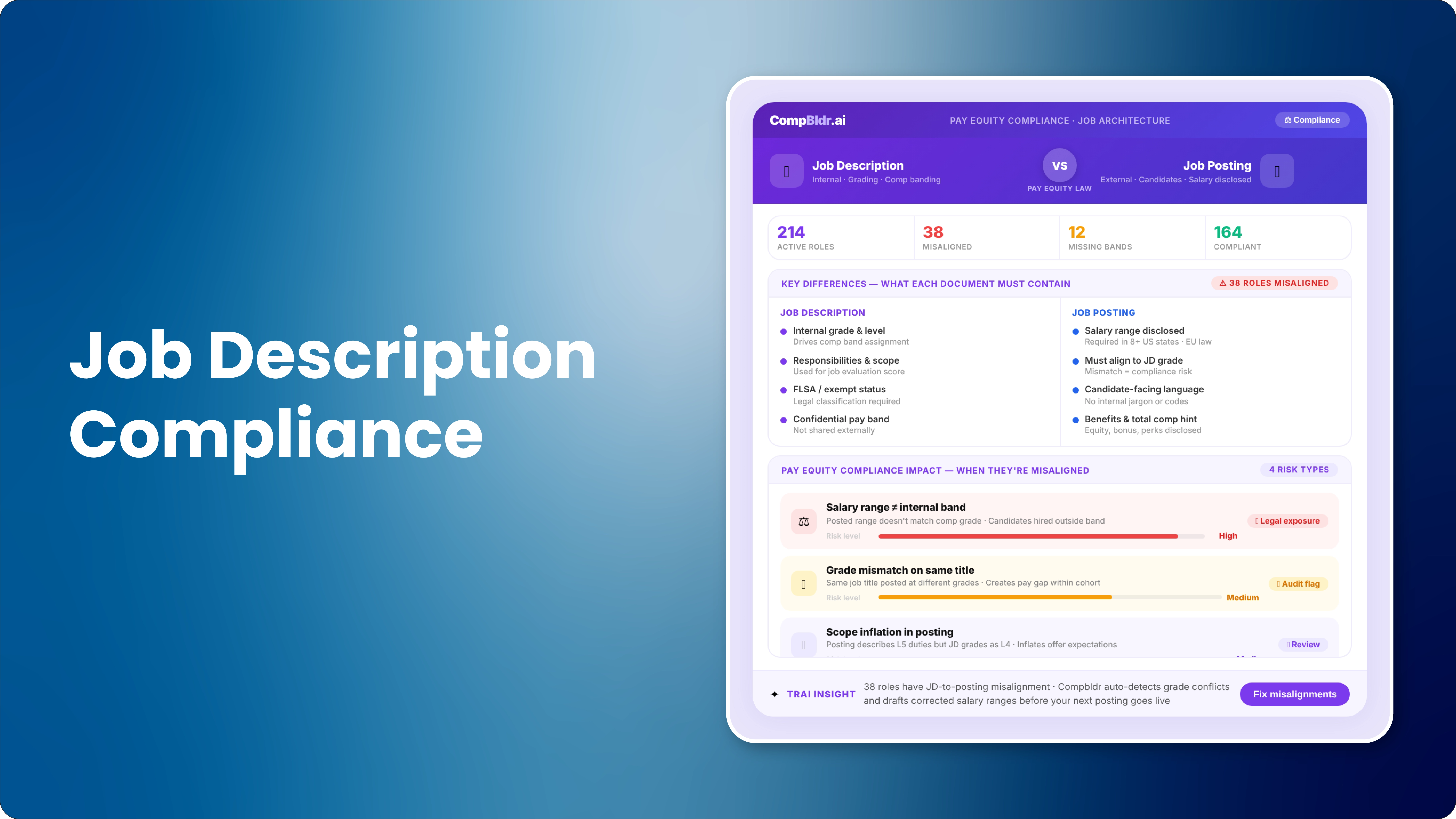

This distinction sounds like a technicality until you are asked to defend your posted salary range during a California Civil Rights Department audit or a pay equity complaint. The California Civil Rights Department, the Colorado Department of Labor and Employment, and the New York Department of Labor all require that posted salary ranges represent a good-faith estimate of the actual pay for the role. Good faith means you have a documented basis for the range. That documented basis is the governance chain connecting your job description to a grade to a salary band to a posted range.
Most HR teams write job postings directly, without documented job descriptions behind them. Many teams treat the job posting and the job description as the same thing. This guide explains why they are different, what the compliance consequences of confusing them are, and how CompBldr connects the job description to the grade to the posted range automatically.
Why Getting This Distinction Wrong Creates Compliance Risk
The pay transparency law problem: your posted range must trace to a documented job
California SB 1162, Colorado's Equal Pay for Equal Work Act, New York's pay transparency statute, Washington ESB 5761, and Illinois EPOA all require that posted salary ranges represent a good-faith estimate of actual pay. Under California SB 1162 specifically, regulators and plaintiff attorneys can challenge whether the posted range is a genuine good-faith range by asking what methodology produced it. If the range was set by a hiring manager estimating what they thought the market pays, it is not a good-faith range. If it was set from a salary band that was built from survey data and a documented job evaluation of a formal job description, it is defensible.
Fisher Phillips, the national employment law firm, describes the documentation standard precisely: "Document pay decisions at the time they are made. Record the specific factors behind compensation decisions, including hiring, promotion, and adjustment decisions. Make sure decision factors are consistently applied and that the people making those decisions can explain them." A job description that documents the role's scope, accountabilities, and requirements is the foundational decision document that makes every downstream pay decision explainable.
The pay equity problem: inconsistent job descriptions make comparable work impossible to define
Pay equity analysis requires grouping employees into comparable role clusters and testing whether pay within each cluster differs across demographic groups after controlling for legitimate factors. The legal standard under the Equal Pay Act and its state equivalents is 'equal pay for substantially equal work.' Substantially equal work requires documented evidence of what the work actually entails. Two employees with the same job title but different actual scope profiles are not in the same cluster. Two employees with different job titles but identical documented scope profiles may be considered comparable. Without consistent job descriptions connected to a formal grade structure, your pay equity analysis cannot identify comparable employees accurately.
The grade placement problem: a job posting with no description behind it cannot be defended
A grade determines which salary band applies to a role. A salary band determines the range posted in the job advertisement. When a role has no formal job description and no formal grade placement, the salary band applied to it is either borrowed from a similar role (which may have different scope) or estimated by someone with budgetary authority. Either situation produces a range that a regulator can challenge as not representing the actual pay for the documented work. The connection between job description, grade, and posted range is the audit trail that makes pay transparency compliance defensible.
📋 Connect Every Job Description to Compensation Governance
CompBldr's job description module connects every job description directly to a JESAP evaluation score, a grade, and a salary band. The posted salary range flows from the governance chain, not from a manager's estimate.
What a Job Description Must Include to Support Pay Equity Compliance
Essential accountability and scope elements
A job description written to support pay equity compliance and grade placement should include: the primary purpose of the role in one to two sentences; the five to eight core accountabilities in active-verb format; the organizational impact of the role's decisions (does it influence project outcomes, department-level outcomes, or business-unit outcomes?); the supervision given and received (direct reports, matrix relationships, internal client relationships); the financial scope (budget responsibility, revenue influence, cost exposure); and the knowledge requirements (minimum education, certifications, years of relevant experience).
Compensable factors that connect to grade placement
The compensable factors used in point-factor job evaluation, including knowledge and skill, problem-solving complexity, accountability and impact, and working conditions, correspond directly to the content categories in a well-written job description. A job description that documents organizational impact accurately provides the data a JESAP evaluation needs to score the accountability dimension. A job description that specifies decision-making authority provides the data to score the complexity dimension. Writing job descriptions with compensable factors in mind produces both better evaluation scores and better documentation for pay equity compliance.
What job descriptions commonly miss that creates litigation risk
The most common deficiencies in job descriptions are: no documentation of organizational impact level (so two roles with the same title are indistinguishable in pay equity analysis); no documentation of decision-making authority (so grade placement is based on seniority rather than evaluated scope); generic skill requirements that apply to the same role at any level (so the description cannot distinguish a Senior Analyst from an Analyst); and no connection to a formal grade or compensation structure (so the description has no pay governance function).
What a Job Posting Must Include Under US Pay Transparency Laws in 2026
California SB 1162: requirements for all employers with 15 or more employees
California SB 1162, effective January 1, 2023, requires employers with 15 or more employees to include the pay scale (salary or hourly wage range) in every job posting for positions that could be filled by a California resident. For remote roles, this applies regardless of where the employer is headquartered. The range must be what the employer reasonably expects to pay for the role. Employers must also provide the pay scale to current employees for their role upon request. California employers with 100 or more employees must file an annual pay data report with the California Civil Rights Department by the second Wednesday of May.
Colorado EPEWA: salary range plus benefits summary
Colorado's Equal Pay for Equal Work Act requires covered employers to include the salary or hourly wage range, a general description of any bonuses, commissions, or other forms of compensation offered with the role, and a description of any benefits offered in job postings. The description requirements go beyond a salary range alone, making Colorado's requirements the most comprehensive currently in effect in the US.
New York: requirements for employers with four or more employees
New York state law requires employers with four or more employees to disclose the compensation range (or a fixed compensation amount) in any job advertisement for a position that will be performed, at least in part, in New York State. Remote roles that could be performed from New York are covered. New York City has had its own pay transparency law since November 2022 with similar requirements.
What makes a posted salary range defensible vs non-defensible
A defensible posted salary range can be traced to a documented methodology: a job evaluation that assigned a grade, a salary band built from that grade using current survey data, and a pay positioning strategy that determined the midpoint percentile. A non-defensible range is one that was set based on manager estimation, budget availability, or comparison to a previous posting. The difference matters because regulators and plaintiff attorneys specifically ask for the methodology behind posted ranges when investigating pay transparency violations.
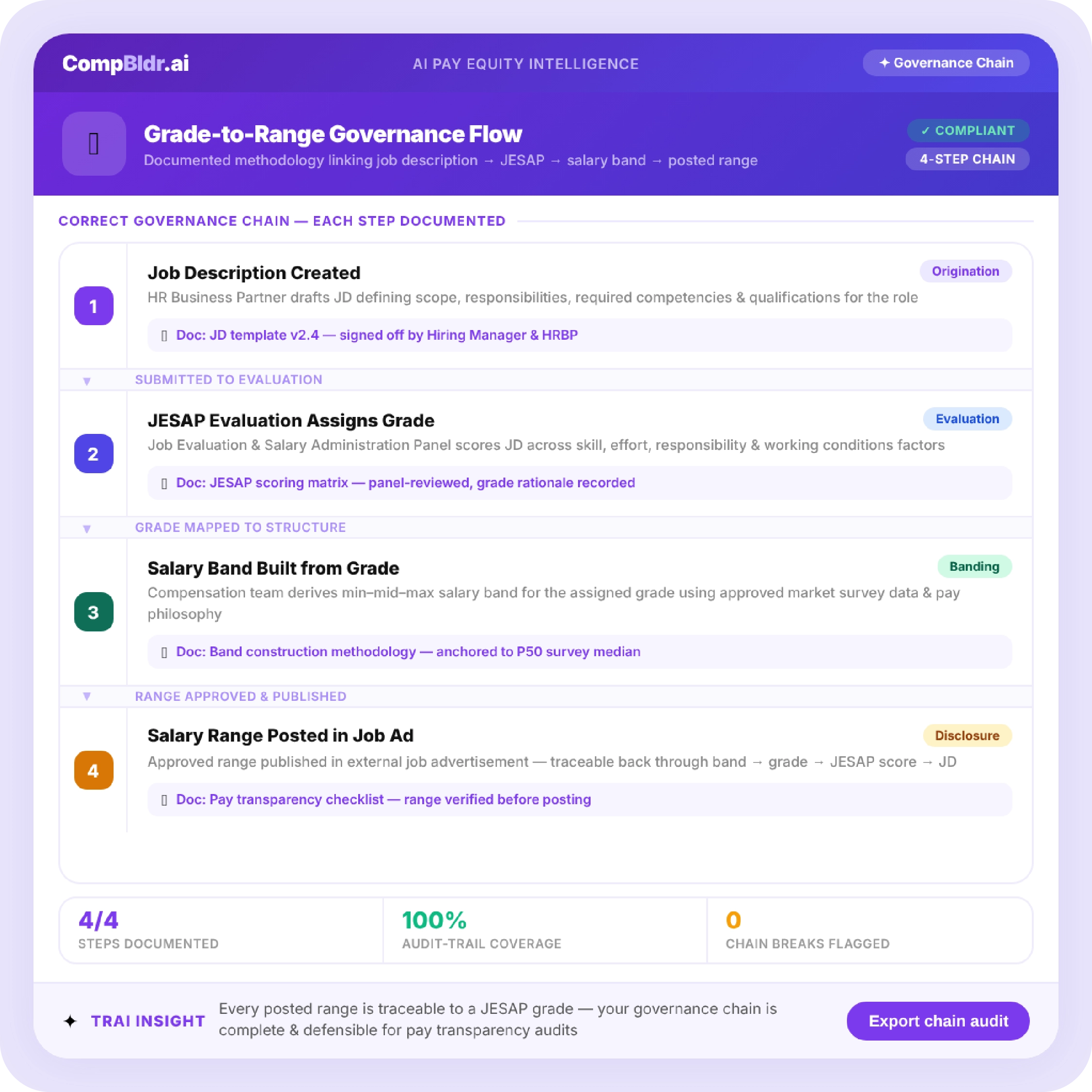
The Governance Chain: From Job Description to Posted Salary Range
Step 1: Write the job description with JESAP-compatible scope documentation
Document the role's primary purpose, core accountabilities, decision-making authority, organizational impact level, management responsibility, and knowledge requirements. The more precisely the scope is documented, the more accurately the JESAP evaluation can score the role, and the more defensible the resulting grade placement.
Step 2: Evaluate the role against compensable factors to assign a grade
Run a JESAP evaluation using the job description as the primary input. The 15-factor score determines the grade. The grade is documented with the individual factor scores, the evaluator identity, and the timestamp. This creates an auditable record of why the role was placed in its grade.
Step 3: Build a salary band from the grade using current survey data
The grade determines which salary band applies. Salary bands are built from Radford, Mercer, and WTW survey data blended at weights configured by job family, aged to reflect current market conditions, and positioned according to the organization's documented pay positioning strategy.
Step 4: Post the salary range extracted from the salary band
The posted salary range is the minimum-to-maximum spread of the salary band, or a defined subset of that range appropriate for the anticipated hire level. It is documented with a reference to the salary band and the evaluation methodology that produced it. When a regulator asks what methodology produced the posted range, the answer is documented and ready.
How CompBldr Connects Job Descriptions to Grades to Posted Ranges
CompBldr's job description module stores job descriptions connected to the job architecture structure: family, sub-family, level criteria, and JESAP evaluation score. When a job description is evaluated using JESAP, the resulting grade is connected automatically to the salary band for that grade in the relevant job family. The salary range for the job posting is extracted directly from the salary band documentation. The entire chain, description, evaluation, grade, band, and posted range, is maintained in one platform with version control and an audit trail.
For organizations subject to California SB 1162, Colorado EPEWA, or other pay transparency laws, CompBldr produces the posted range and the documentation that supports it simultaneously. Posting a range and being able to defend it should be treated as the same operation.
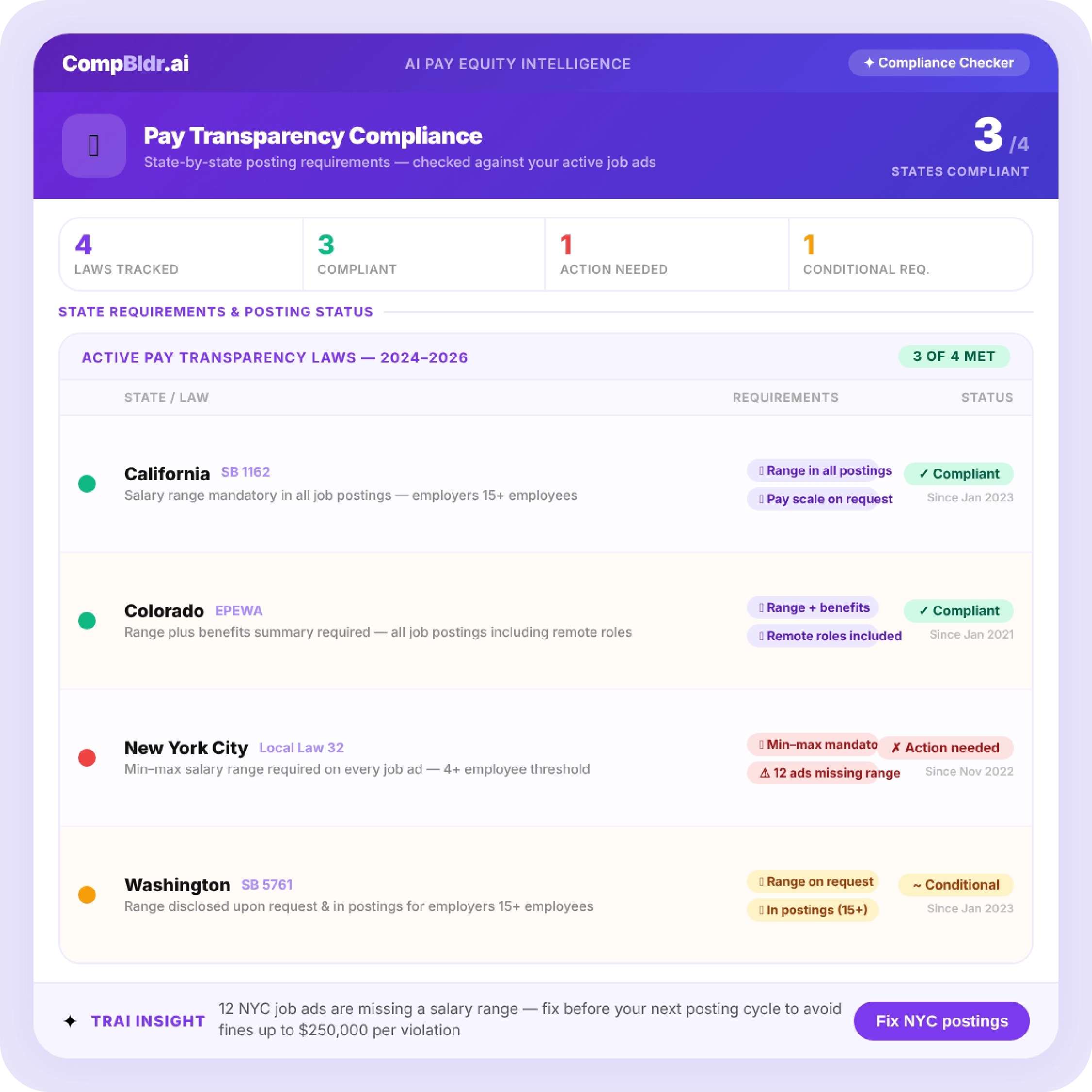
The governance chain from job description to posted salary range is what separates pay transparency compliance from pay transparency risk. CompBldr builds and maintains that chain in one platform. See how it works on your roles in 15 minutes. Book a Demo


.svg)

.svg)
.svg)

