

.svg)





.webp)

A salary range is the minimum-to-maximum base-pay interval an organization uses for a job, level, grade, or other defined employee group. The range tells employees, candidates, managers, and compensation teams where base pay can sit within that structure. Many organizations also call the same structure a pay range or salary band.
A useful salary range is more than two numbers. Compensation teams normally review the minimum, midpoint, maximum, range width, market reference, employee position, and the jobs the range is intended to cover. Those relationships are what make the range usable in hiring, pay reviews, compensation planning, and employee communication.
This article focuses on the definition and operating logic. For the governed product workflow behind building, comparing, versioning, and using ranges, see CompBldr salary structure software.
What Does Salary Range Mean?
A salary range defines the lower and upper base-pay boundaries for the jobs or employees assigned to that range. Most compensation structures also use a midpoint as an internal reference point between the minimum and maximum.
The three values answer different questions:
- Minimum: the lower boundary of the range under the organization's current pay structure.
- Midpoint: an internal reference point used to interpret employee pay position and, in many structures, market positioning.
- Maximum: the upper boundary of the range under the current structure.
Those values are policy boundaries, not a promise that every employee will progress from minimum to maximum on a fixed schedule. Actual pay movement depends on the organization's compensation philosophy, performance or contribution processes where used, market adjustments, promotion rules, budget, and other approved pay actions.
Salary Range Example
Illustrative example only: assume a company has a salary range of $80,000 to $120,000 for a defined job group, with a $100,000 midpoint.
| Range element | Illustrative value | How compensation teams use it |
|---|---|---|
| Minimum | $80,000 | Lower structural boundary for the range |
| Midpoint | $100,000 | Reference point for market positioning and employee pay analysis |
| Maximum | $120,000 | Upper structural boundary for the range |
| Absolute width | $40,000 | Shows the dollar distance between minimum and maximum |
If an employee earns $90,000 in this example, their compa-ratio is 0.90 because $90,000 divided by the $100,000 midpoint equals 0.90. That number describes current pay relative to the midpoint; it does not by itself tell you whether the employee is underpaid or what increase they should receive.
Salary Range vs. Salary Band vs. Pay Band
There is no universal industry rule that makes these three terms different objects. Many organizations use salary range, salary band, and pay band interchangeably. Others use “band” for a broader group of jobs and “range” for the minimum-to-maximum values within it.
The important operating rule is consistency. Define what each term means inside your own job architecture and use that definition consistently across HR, Finance, managers, job postings, and reporting. If your team is building the structure itself, see how to build salary bands and salary range width by job level.
What Is a Salary Guide?
A salary guide is usually a market-reference resource that summarizes pay data by job, industry, geography, experience, or another labor-market segment. It is not the same thing as an employer's salary range.
A salary guide may help inform market benchmarking, but a company still has to decide how external data should influence its own jobs, grades, market targets, and pay structure. External data becomes more useful when the underlying role has been matched carefully to the survey or market reference. See salary survey matching for that step.
How Salary Ranges Are Built
There is no single required formula. A mature compensation process usually connects several decisions rather than choosing a minimum and maximum in isolation.
1. Define the jobs the range will govern
Start with the roles, levels, grades, or other employee groups that the range is intended to cover. If titles are inconsistent or job scope is unclear, the pay structure can inherit those structural problems. This is where job evaluation, job grades and job levels, and approved job descriptions provide context.
2. Establish the market reference
Use the organization's approved market data and matching methodology to determine the external pay evidence relevant to the job population. The midpoint does not legally or universally have to equal a specific market percentile. The chosen market target is a compensation-policy decision that should be explicit and reviewable.
3. Set the minimum, midpoint, and maximum
Apply the organization's range methodology to the market target and grade structure. The appropriate range width depends on the structure, job population, career model, pay philosophy, and how the range will be used. There is no universal “compliant” spread percentage.
4. Review employee impact before approval
Compare current employee pay with the proposed minimum, midpoint, and maximum. Look for employees below minimum, above maximum, unusual compa-ratio or range-penetration patterns, and pay compression. A structure can look clean at the grade level while creating expensive or inconsistent implementation issues at the employee level.
5. Approve, version, and communicate the structure
Record the effective range, jobs or grades covered, market assumptions, approval date, and the version that is active. When ranges change, preserve the prior structure so later reporting can distinguish historical pay decisions from the current range.
How Wide Should a Salary Range Be?
There is no universal percentage that makes a salary range correct, compliant, or defensible. Wider ranges can provide more room for pay progression within a role or broad band, while narrower ranges can create tighter differentiation between levels. Both choices have trade-offs.
Instead of starting with a fixed benchmark, test whether the width supports the intended job population. Ask:
- Does the range create sensible relationships between adjacent grades or levels?
- Can employees progress without immediately colliding with the maximum?
- Does the structure create excessive overlap that makes levels difficult to distinguish?
- How many current employees fall below minimum or above maximum?
- Does the width still make sense after current market data is applied?
For a deeper structure discussion, use the dedicated salary range width guide.
What Does a Posted Salary Range Mean?
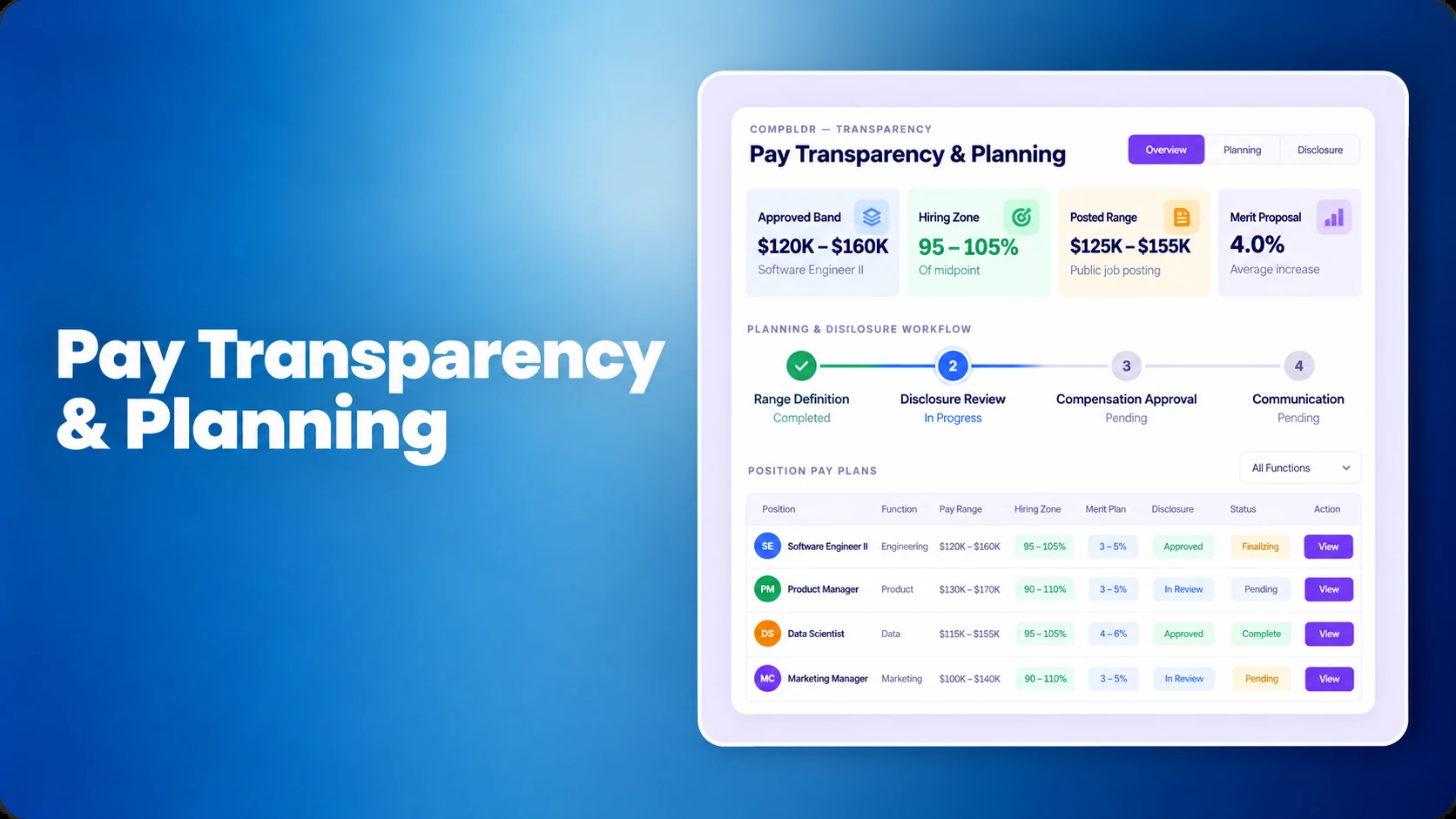
A salary range used in a job posting is a recruiting and pay-transparency disclosure. Its legal meaning depends on the jurisdiction. It should not be assumed that every state uses the same employer-size threshold, definition of pay, remote-work rule, benefit requirement, or “good faith” standard.
California: the Labor Commissioner says employers with 15 or more employees must include the pay scale in covered job postings, and defines pay scale as the good-faith salary or hourly wage range the employer reasonably expects to pay for the position upon hire. California Labor Commissioner guidance.
New York: covered employers with four or more employees must list a compensation range for covered opportunities. The range must be the minimum and maximum annual salary, piece rate, or hourly rate the employer believes in good faith to be accurate when posted. New York also explains that a very broad range can fail the good-faith standard when it does not communicate the legitimate pay the employer is willing to offer. New York Department of Labor guidance.
Illinois: since January 1, 2025, covered employers with 15 or more employees that make covered job postings must include the position's pay scale and benefits. Illinois Department of Labor guidance.
Washington: covered employers with 15 or more employees must disclose a wage scale or salary range plus a general description of benefits and other compensation in covered job postings. Washington says the range should reflect the employer's most reasonable and genuinely expected compensation range at the time of posting. Washington L&I guidance.
These examples show why compensation design and legal posting requirements should be treated as related but separate tasks. A well-governed internal range can support posting decisions, but it does not automatically satisfy every jurisdiction's disclosure rules. Review current requirements for every jurisdiction where the posting may be covered. This article is general information, not legal advice.
Can a Posted Range Differ From the Internal Salary Range?
Sometimes, depending on the jurisdiction and the employer's hiring policy. For example, an internal salary range may represent the full structural minimum and maximum for employees in a grade, while a company may intend to hire only within a narrower portion of that range.
The legal treatment varies. Washington guidance expressly allows a more specific hiring range in addition to the full range in some circumstances. New York focuses on the compensation the employer legitimately believes it is willing to pay for the specific opportunity at the time of posting. California defines the pay scale around what the employer reasonably expects to pay upon hire.
Operationally, document which number is the internal structural range and which number is the posting or hiring range. Mixing them without labels creates confusion for recruiters, managers, employees, and reporting teams.
Common Salary Range Problems
The midpoint has no traceable market logic
If the team cannot explain which market evidence or compensation policy informed the midpoint, later updates become guesswork. Connect the range to the approved market data rather than retaining only the final number.
Titles, grades, and ranges drift apart
A job can change level while the salary-range spreadsheet still reflects its old grade. Keep job leveling, grade assignment, and ranges connected so one update does not silently leave another system behind.
The structure ignores current employee pay
Before approving a new range, quantify below-minimum, above-maximum, compression, and budget effects. That is especially important when moving from older spreadsheets to a governed structure.
The posting range is treated as a generic legal template
Copying one pay-transparency format across every state can miss jurisdiction-specific rules. Use current legal guidance for the location and work arrangement instead of assuming one national standard.
How CompBldr Manages Salary Ranges
CompBldr connects governed jobs and grades with market evidence so compensation teams can review proposed salary-range minimums, midpoints, maximums, market targets, and range spreads in one structure. Current employee pay can be compared with proposed ranges before implementation, including below-minimum, above-maximum, compa-ratio, and range-position signals.
Approved structure changes can be preserved as versioned records, and approved ranges can remain connected to compensation planning, compensation analytics, and compensation reporting.
The value is not that software chooses the “right” range automatically. The compensation team still owns pay philosophy, market targets, range methodology, and approvals. The software keeps the jobs, evidence, proposed ranges, employee impact, and version history connected.
Salary Range Definition: The Practical Answer
A salary range is the minimum-to-maximum base-pay structure used for a defined job population. The midpoint gives the organization a reference point inside that range. A salary guide is an external market-data resource, not the employer's internal range. Salary range, salary band, and pay band may mean the same thing or slightly different things depending on the organization's terminology.
For day-to-day compensation work, the most useful question is not only “what is the range?” It is “which jobs does this range govern, what evidence informed it, where do current employees sit inside it, and which version is active?”
Book a Demo to review how CompBldr connects jobs, grades, market evidence, salary ranges, employee pay, planning, and reporting.


.svg)

.svg)
.svg)

