

.svg)





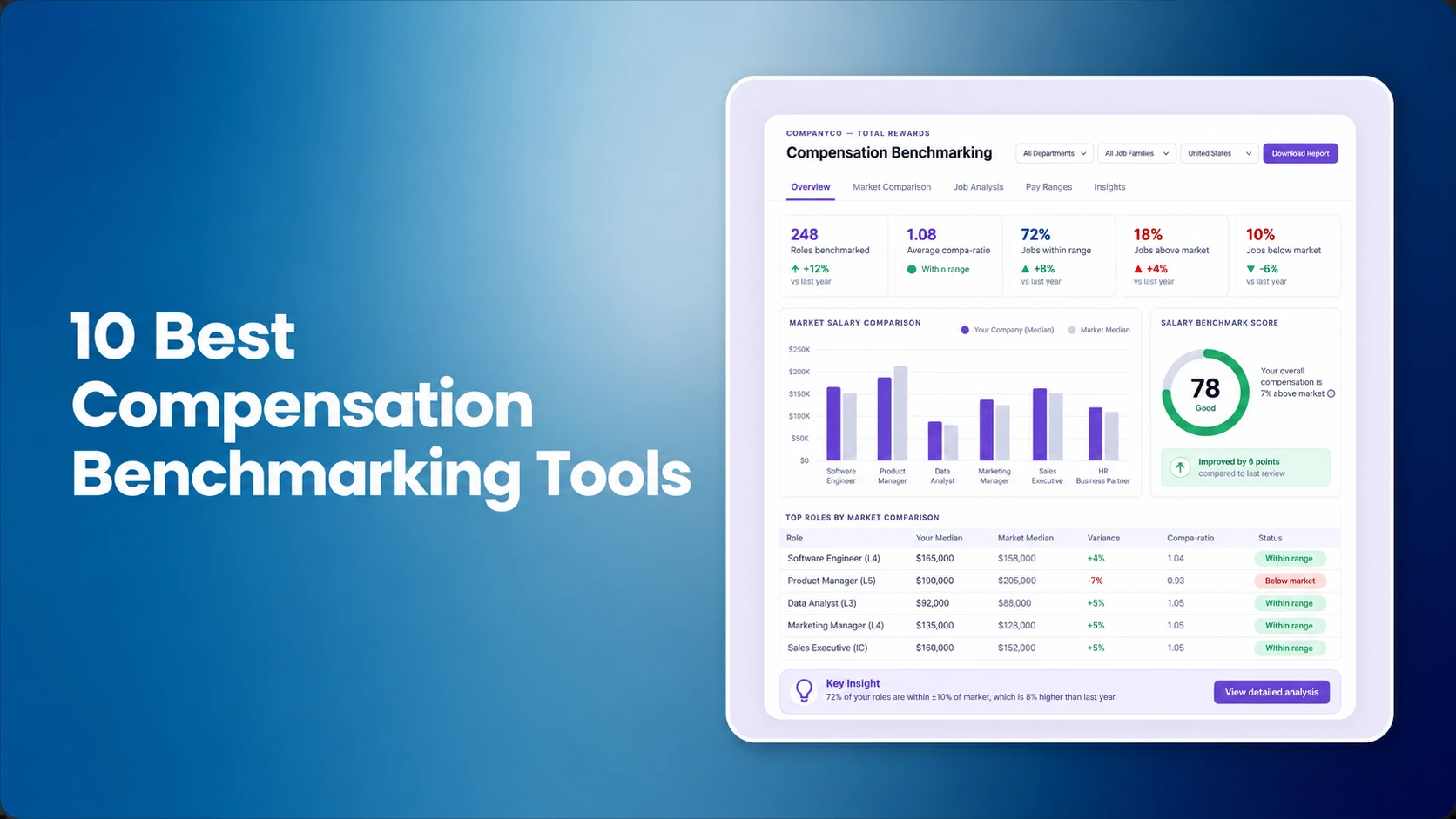

The best compensation benchmarking tool for 2026 is not simply the platform with the largest dataset. It is the one whose data model, job-matching approach, coverage, review controls, and downstream workflow fit the compensation decisions your team actually makes. For HR and Total Rewards teams, a practical shortlist includes CompBldr, Payscale Ascent, Salary.com CompAnalyst, Pave, Bettercomp, Compa, Ravio, Figures, OpenComp, and Mercer WIN.
These products are not interchangeable. Some center on employer-connected market data, some on established compensation surveys, and some on multi-source market pricing and salary-structure workflows. This comparison focuses on the vendor-selection question. For the deeper methodology behind data quality, matching, aging, source blending, and governance, use CompBldr's compensation benchmarking evaluation guide.
Research method: product, methodology, coverage, and pricing information was rechecked against current first-party vendor documentation on September 16, 2026. Quantitative claims in this guide use vendor-owned product or pricing pages rather than reseller roundups. The order below is not a universal performance ranking. Each “best fit” label is an editorial assessment of the documented product model and likely buyer use case. Pricing and packaging can change, so validate the exact commercial scope before procurement.
Publisher disclosure: CompBldr publishes this comparison and is included in it. Statements about CompBldr are based on current public product documentation, not independent third-party testing. Apply the same proof-of-capability test to CompBldr that you apply to every other finalist.
Quick Comparison: 10 Compensation Benchmarking Tools for 2026
| Platform | Best fit | Primary data/workflow model | Current public pricing signal |
|---|---|---|---|
| CompBldr | Architecture-linked multi-source benchmarking | Customer survey sources tied to job architecture, matching, bands, and governance | Contact sales |
| Payscale Ascent | Current compensation intelligence across broader pay workflows | Payscale data and Peer Global intelligence inside Payscale Intelligence Cloud | Contact sales |
| Salary.com CompAnalyst | HR-reported data plus multi-source market composites | CompAnalyst Market Data, Salary.com surveys, and customer-owned third-party surveys | Selected online-store license starts at $6,000/year; broader scope varies |
| Pave | Employer-connected cash and equity benchmarking | Persistent HRIS, ATS, and equity-management-system connections | Market Data Lite free for eligible 1-200 employee startups; Pro contact sales |
| Bettercomp | Policy-driven multi-survey market pricing | Pricing Policies, PayMarkets, survey cuts, job matching, and range modeling | Demo/contact vendor |
| Compa | Enterprise live market signals | Customer-network employee, offer, and stock-compensation data | Live Market Data from $35,000/year; Research from $15,000/year |
| Ravio | Technology and tech-enabled international benchmarking | HRIS-connected salary, variable, equity, and benefits data | From about £5,000/year for a 100-person company; scope varies |
| Figures | Benchmarking connected to salary bands, reviews, and pay equity | HRIS-connected market data plus optional Mercer data integration | Benchmark self-serve €4,000/year; broader platform quote-based |
| OpenComp | Lean teams connecting benchmarks to pay strategy | Global compensation data plus strategy, ranges, cycles, and related workflows | 14-day free trial; paid pricing not publicly fixed |
| Mercer WIN | Global survey-centric benchmarking | Mercer survey results, peer groups, refinements, reporting, regression, and aging | Survey/product specific |
The pricing column is a signal, not a total-cost comparison. Implementation, survey licenses, markets, modules, integrations, services, and user requirements can materially change the commercial scope.
How We Chose These Compensation Benchmarking Platforms
We included products that materially support one or more core benchmarking jobs: obtaining market data, matching internal jobs to external references, combining or analyzing sources, building market views, reviewing exceptions, and carrying approved benchmarks into salary structures or compensation decisions. Five evaluation criteria matter most.
- Data model: Is the platform based on employer-connected data, traditional compensation surveys, customer-licensed surveys, vendor datasets, or a combination?
- Coverage fit: Can it show decision-ready data for the jobs, levels, geographies, industries, and pay components your organization actually uses?
- Job matching: Can practitioners understand the match, review difficult roles, change recommendations, and preserve the reason for an override?
- Workflow continuity: Can approved benchmarks move into job architecture, salary structures, or compensation planning without recreating the logic manually?
- Governance: Are sources, dates, assumptions, reviewer decisions, approvals, and versions still visible after the benchmark is approved?
Evidence standard for vendor claims
Feature and pricing claims in this comparison are attributed to vendor-owned documentation. Where a capability is vendor-described rather than independently tested, treat it as a claim to verify in the demo rather than a guaranteed outcome. Public prices are screening signals, not total-cost estimates.
1. CompBldr: Best Fit for Architecture-Linked Multi-Source Benchmarking
CompBldr is a strong candidate when market benchmarking cannot be separated from the organization’s internal job structure. Its Market Benchmarking workflow links market matching to job architecture and can blend up to six active compensation data sources in a benchmarking cycle, with configurable weighting by job family. Current product documentation also describes architecture-aware AI matching, confidence scores for thin coverage or low match quality, percentile analysis, salary-band generation, versioned source configuration, and preserved match decisions.
Why shortlist it: the differentiator is the connection between the internal role record, the external evidence, the reviewer decision, and downstream salary structures. That matters when a team wants the market reference to remain reproducible instead of becoming an isolated spreadsheet output.
What to test: bring the survey sources your organization actually licenses. Ask which formats or integrations are supported, how source weighting works, how a low-confidence job is handled, what a reviewer can override, and how the approved result flows into bands or planning. Also confirm which data licensing obligations remain with your organization.
2. Payscale Ascent: Best Fit for Current Compensation Intelligence Across Broader Pay Workflows
Payscale launched Ascent on September 8, 2026, as an AI-first benchmarking platform within the Payscale Intelligence Cloud. Payscale positions Ascent as a connected intelligence layer that combines market data, smart workflows, and contextual insights. Its current product page says Ascent is powered by Peer Global, with daily-refreshed data from thousands of organizations, and connects benchmarking intelligence with job management and compensation planning workflows.
Why shortlist it: Ascent is relevant for teams that want benchmarking intelligence inside a broader compensation ecosystem rather than as a stand-alone data lookup.
What to test: because Ascent is newly launched, use difficult jobs and ask Payscale to demonstrate the production workflow available today. Check source context, cohort logic, job matching, confidence information, the handling of unusual jobs, and the exact handoff into job management or planning. Avoid buying from roadmap language alone.
Review Payscale's Ascent launch documentation.
3. Salary.com CompAnalyst: Best Fit for HR-Reported Data and Multi-Source Composites
Salary.com’s CompAnalyst market-pricing workflow supports market composites built from CompAnalyst Market Data, Salary.com surveys, and customer-owned third-party datasets. Current first-party documentation describes AI-recommended job matches, automated scopes, survey-cut recommendations, weights and adjustments, custom pay markets, and salary-structure modeling. Salary.com also positions its current data foundation around HR-reported benchmarks plus live job-posting intelligence.
Why shortlist it: CompAnalyst can fit teams that want a large HR-reported data environment while continuing to use existing survey investments and market composites.
What to test: map the specific modules your team needs before asking for a final quote. Survey management, market composites, job matching, salary structures, reporting, and other compensation workflows can have different operational value. Test a hybrid role, show how third-party surveys are loaded, inspect how a composite is constructed, and require the vendor to show the retained source trail.
Review CompAnalyst Market Pricing.
4. Pave: Best Fit for Employer-Connected Salary and Equity Benchmarks
Pave’s Market Data methodology is built around automated, persistent connections to HRIS, applicant tracking systems, and equity management systems. Pave says data is collected continuously and published as updated benchmarks monthly after quality and consistency checks. Its methodology covers cash and equity compensation, machine-learning job matching, and calculated benchmarks for some sparse-data situations.
Market Data Lite is currently available free to eligible startups with 1 to 200 employees, with access to the overall US market plus one additional market. Market Data Pro is available to companies of any size and expands country, city, and equity coverage.
Why shortlist it: Pave is relevant when employer-connected salary and equity data is the priority and the organization wants frequent data collection without annual survey submissions.
What to test: ask Pave to distinguish observed benchmarks from calculated benchmarks, then test niche roles, executive jobs, and location-specific coverage. Check what happens when the underlying sample is thin and how a compensation practitioner can validate or challenge the result.
Review Pave's Market Data methodology.
5. Bettercomp: Best Fit for Policy-Driven Multi-Survey Market Pricing
Bettercomp is centered on compensation market-pricing operations. Its current product documentation describes codified Pricing Policies that apply an organization’s preferred data-cut logic, custom PayMarkets, AI-assisted job matching, family-based mapping, survey-cut mapping, custom percentiles, premiums and geodifferentials, range modeling, and mass pricing changes.
Why shortlist it: it is a strong fit for compensation teams that already use multiple salary surveys and want consistent pricing policy across many jobs, locations, and markets.
What to test: choose a difficult hybrid job and require the full sequence. Ask the vendor to show the initial match, related-job recommendations, the surveys and cuts applied, the Pricing Policy that affected the result, any adjustment, the reviewer’s ability to change it, and what history remains after the change. A fast match matters less if the team cannot later explain the pricing decision.
Review Bettercomp Market Pricing.
6. Compa: Best Fit for Enterprise Live Market Signals
Compa’s current pricing page separates Research from Live Market Data. Research starts at $15,000 per year. Live Market Data starts at $35,000 per year and includes real-time benchmarking across employee cash compensation, grant-level stock compensation, and offer data, with peer groups, geo tiers, location insights, and leveling insights. Additional data products can extend the workflow into offers, stock, frontline, and skills use cases.
Why shortlist it: Compa is relevant for larger compensation organizations that want current market signals across employee, recruiting, and equity decisions and have enough scale to justify enterprise-level spend.
What to test: require examples from the peer populations that matter to your workforce. Verify depth by level, location, job family, and pay component. Ask how thin or changing cohorts are handled and which data products are included in the commercial package you are evaluating.
7. Ravio: Best Fit for International Technology and Tech-Enabled Companies
Ravio focuses its benchmarking dataset on technology and tech-enabled companies. Its current compensation-benchmarking documentation describes HRIS-connected data covering salary, variable compensation, equity, and benefits across 50 countries and hundreds of roles. Ravio also provides job-leveling support, market-confidence indicators, and workflows connecting benchmarking with salary bands and compensation reviews.
Why shortlist it: an international technology company may get a peer population that is closer to its actual talent market than a broad cross-industry dataset.
Current pricing signal: Ravio’s current benchmarking page says pricing for a 100-person company starts at about £5,000 per year, with final cost varying by headcount, modules, and markets.
What to test: verify job-by-job coverage for the roles and countries that drive your compensation decisions, especially if your workforce extends beyond core technology functions. Review how roles are mapped to Ravio’s levels and how market confidence changes when the peer population becomes narrow.
Review Ravio compensation benchmarking.
8. Figures: Best Fit for Benchmarking Connected to Salary Bands, Reviews, and Pay Equity
Figures combines compensation benchmarking with salary bands, analytics, compensation reviews, and pay-equity workflows. Its current pricing page describes total-reward benchmarking across more than 110 countries, filters such as location and company profile, automated job-mapping suggestions, data-quality indicators, and integrations with 30+ HRIS platforms. Figures also offers an optional Mercer data integration inside the benchmarking experience.
Why shortlist it: Figures is relevant for mid-market and enterprise teams, particularly organizations operating across Europe, that want market data close to salary-band management, review cycles, and pay-equity work.
Current pricing signal: Figures offers a self-serve Benchmark subscription at €4,000 per year. Broader modular platform pricing is based on employee count and selected modules and is provided through a personalized quote.
What to test: ask for role-level coverage in the industries and locations that matter to you rather than relying on total country or datapoint counts. Verify the difference between Figures’ own benchmark data and optional Mercer data, including licensing and access rules.
Review Figures pricing and modules.
9. OpenComp: Best Fit for Lean Teams Connecting Benchmarks to Pay Strategy
OpenComp organizes its offering around Comp Benchmarking, Comp Strategy, and Comp Cycles. Its pricing page positions the benchmarking bundle around global compensation data, while the broader workflow extends into ranges, headcount planning, total rewards, merit and bonus cycles, and related compensation decisions. OpenComp currently offers a 14-day free trial.
Why shortlist it: OpenComp can suit lean People or compensation teams that want a direct path from benchmark data into pay strategy and recurring compensation work without assembling several separate tools.
What to test: use difficult jobs to verify data depth, then check what the product can do with third-party survey sources, custom market assumptions, ranges, and review workflows. Confirm which capabilities sit in each bundle so the demo does not blur the boundary between benchmarking and broader compensation administration.
10. Mercer WIN: Best Fit for Global Survey-Centric Benchmarking
Mercer WIN is the digital analysis environment used for Mercer compensation and benefits survey results. Mercer says WIN supports comparisons across industries, regions, and countries; unlimited peer groups; multi-market refinements; analysis by job, family, career level, and position; custom charts and reports; regressed data; and data aging. It is closely tied to Mercer’s established global survey ecosystem, including Total Remuneration Survey data.
Why shortlist it: Mercer WIN remains highly relevant for global employers that rely on established compensation surveys and need structured market cuts across multiple countries and job families.
What to test: confirm which surveys, markets, and participant access rules are required for your program. Then identify what separate workflow is needed for internal job architecture, approval governance, salary structures, or planning if those activities are outside the survey-analysis environment.
Review Mercer WIN and the survey workflow.
Compensation Benchmarking Software vs. Market Pricing Software
The categories overlap, but they are not identical. Compensation benchmarking software helps teams compare jobs or pay practices with external market evidence. Market pricing software goes further into the operating method used to select survey matches, choose cuts, age data, combine sources, set market targets, price roles, and often create or update salary structures.
That distinction matters because two products can both describe themselves as benchmarking tools while solving different jobs. For the methodology, see compensation benchmarking vs. market pricing. If your primary problem is pricing a large job catalog across several surveys, test that workflow separately instead of assuming every platform handles it equally well. If your team uses compensation terms inconsistently, standardize definitions with CompBldr’s compensation glossary before building a vendor scorecard.
Use the Same Difficult Demo Scenario for Every Finalist
Vendor-led demonstrations are easiest to compare when every platform is given the same case. Use an anonymized job that is genuinely difficult to benchmark rather than a standard role chosen by the vendor.
- Price one hybrid or hard-to-match job in three material geographies.
- Show the source, effective date, coverage or sample indicators, peer criteria, career level, and pay components behind each market reference.
- Explain what drove the job match and what a compensation reviewer can change.
- If your program uses multiple surveys, add a second source and show how conflicting evidence is handled.
- Change or reject a match and show what rationale, reviewer, and history remain attached to the decision.
- Move the approved benchmark into a salary range or compensation decision without rekeying the logic.
- Retrieve the same benchmark later and reproduce the source configuration, assumptions, override, approval, and version.
A product does not fail simply because it stops at market data. The goal is to know whether you are buying a data source, a market-pricing workflow, or a broader compensation operating system before the contract is signed.
How to Choose the Right Compensation Benchmarking Tool
Start with the data model
Decide whether your compensation program needs employer-connected data, established annual surveys, customer-licensed surveys, or a mix. The right choice depends on the roles, labor markets, governance requirements, and decisions you need to support.
Test the roles that are hardest to benchmark
Use hybrid roles, scarce skills, executives, frontline jobs, senior individual contributors, and difficult locations. Ask the vendor to show applicable coverage, not just a global dataset size. If salary survey selection itself is unresolved, use a structured process for choosing a salary survey provider before evaluating workflow automation.
Separate matching speed from matching quality
AI-assisted matching can reduce manual work, but it should not make the final decision opaque. Ask which inputs drive the match, how confidence is communicated, how a practitioner can override it, and what evidence remains after the override.
Compare total operating cost
Include software, survey licenses, implementation, integrations, add-on modules, advisory services, training, administrator time, and annual data maintenance. A public entry price is useful for screening but is not an apples-to-apples total-cost comparison. If CompBldr is on your shortlist, use its pricing page as a scoping starting point, then confirm modules, data sources, implementation, and services in the quote.
Check the downstream handoff
A market benchmark becomes operational when it informs a salary range, offer, market adjustment, planning decision, or report. If the approved result must be exported and rebuilt elsewhere, include that manual handoff in the operating-cost and governance assessment. Then verify whether the same approved benchmark remains traceable in compensation analytics and compensation reporting rather than becoming a disconnected output.
Limitations of This Comparison
This guide relies primarily on current vendor documentation and public pricing pages. Those sources establish what each supplier says its product supports; they do not independently prove implementation quality, customer outcomes, data sufficiency, or service quality for a specific workforce. Coverage is buyer-specific, and public pricing may exclude implementation, additional markets, modules, survey licenses, or services.
Product capabilities also change quickly. Treat every table entry as a starting point for vendor due diligence, not a substitute for testing your own jobs, sources, regions, and approval requirements.
Which Compensation Benchmarking Tools Should You Shortlist?
If architecture-linked, multi-source governance is central, include CompBldr. If you want current compensation intelligence inside the Payscale ecosystem, test Ascent. If HR-reported data and multi-source composites matter, test CompAnalyst. If employer-connected cash and equity benchmarks are the priority, test Pave. If policy-driven market pricing across several surveys is the problem, test Bettercomp. For live enterprise market signals, evaluate Compa. For technology-focused international data, evaluate Ravio. For European benchmarking tied closely to bands, reviews, and pay equity, test Figures. For a lean path from benchmarks into broader pay strategy, test OpenComp. For established global survey analysis, evaluate Mercer WIN.
Then reduce the list using your own workforce. Three well-matched vendors tested against the same difficult roles will usually teach a compensation team more than ten polished sales presentations.



.svg)

.svg)
.svg)

