

.svg)





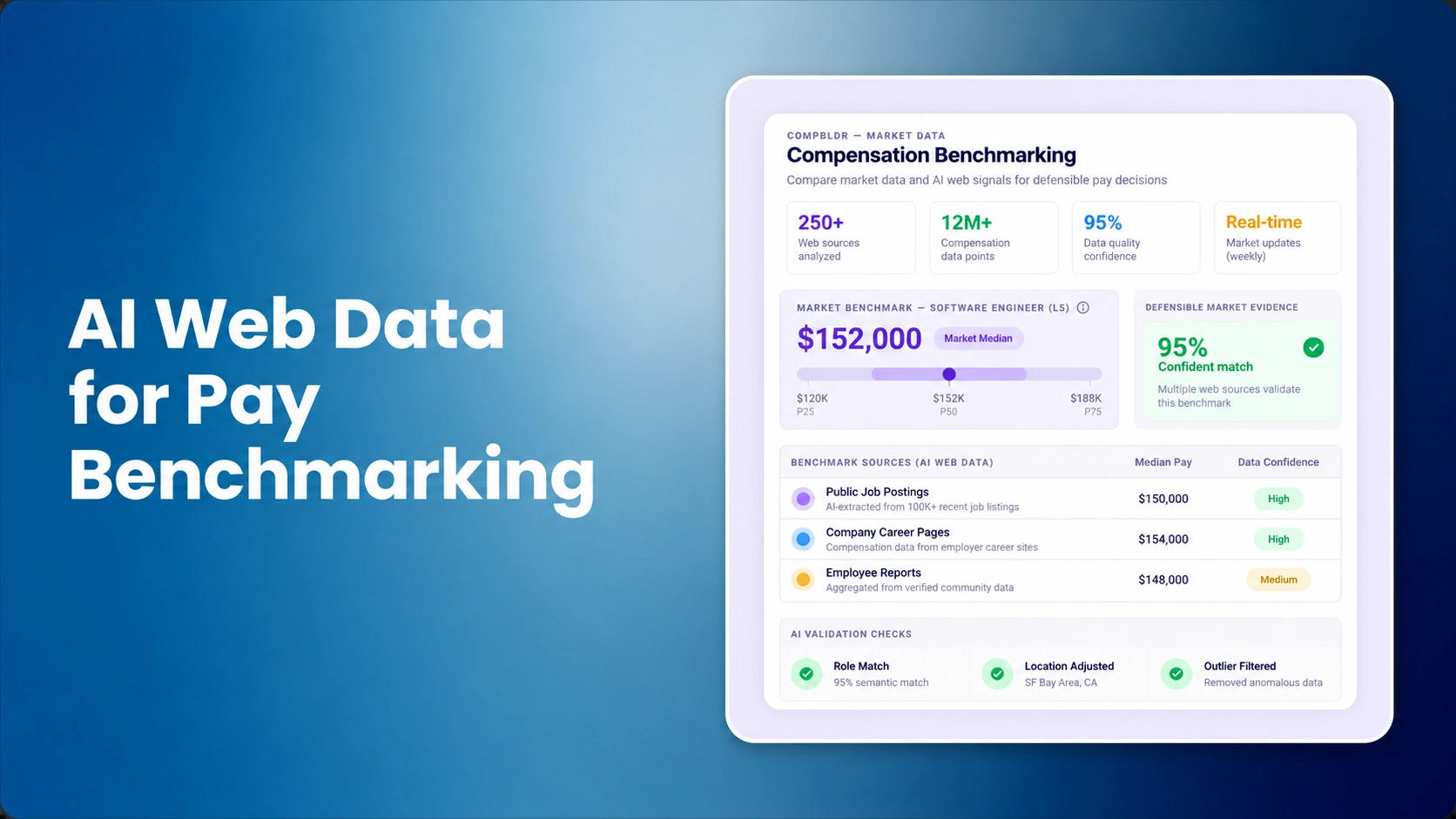

AI can search the public web faster than a compensation analyst, but speed does not make every source comparable. A salary range in a job posting, a government dataset, a competitor's compensation philosophy, a compensation survey, and an AI-generated summary can all be useful. They do not all answer the same question.
This distinction has become more important in 2026 as compensation platforms add web and job-posting intelligence. On September 15, 2026, Pave announced that its Agent can search the web for external context when internal data alone cannot answer a compensation question, while returning cited sources. Pave's current platform materials also distinguish real-time benchmark data from public job-posting intelligence, which is a useful reminder that “available on the web” and “fit for formal benchmarking” are not the same thing.
That is the right problem for compensation teams to solve: How should public and AI-assisted evidence enter a governed market-pricing decision?
Separate Market Evidence From Market Signals
Market evidence is information your organization is prepared to use in a formal compensation methodology. It needs a defined population, pay element, timing, matching logic, and documented assumptions.
Market signals can change your question, trigger further investigation, or provide context without automatically becoming an input to the final benchmark. That distinction should stay explicit in the organization's market benchmarking methodology rather than being left to the judgment of whichever analyst runs the search.
| Source type | Best use | Can it anchor a benchmark? | Main limitation |
|---|---|---|---|
| Approved compensation survey | Formal market pricing and range design | Usually, when the job, population, date, and pay element fit | May be older, broad, or thin for emerging roles |
| Employer-connected benchmark dataset | Current market reference and trend checks | Potentially, when methodology and peer population are understood | Coverage can vary by role, geography, and participant mix |
| Government labor data | Broad wage, employment, and occupation context | Sometimes as supporting evidence | Occupation groupings may be too broad for internal jobs |
| Public job postings | Advertised hiring ranges, titles, skills, location language | Usually as a supporting signal, not the sole anchor | Posted ranges do not equal accepted offers or incumbent pay |
| Company disclosures | Competitor pay philosophy and stated practices | Rarely by themselves | Policy statements do not reveal actual employee outcomes |
| General web content | Discovery, trend context, hypothesis generation | No, unless the underlying primary evidence is verified | Quality, methods, recency, and population may be unclear |
| AI-generated synthesis | Research acceleration and source comparison | No by itself | Can blur observed facts, inference, and weak sources unless provenance is retained |
Start With the Job Before You Start With the Web
AI can retrieve hundreds of salary references in seconds, but the hardest part of benchmarking is still defining what you are pricing. Before searching, confirm the internal job description, job family, level, location, and relevant pay element.
If the job is new or materially changed, use job evaluation and the existing job architecture before selecting market matches. Where the role does not map cleanly to one external benchmark, the salary survey matching workflow provides a better starting point than matching by title alone.
This matters most for emerging AI roles. Two employers can use the same title while assigning very different decision rights, technical depth, leadership scope, and risk ownership. AI can surface the titles. Compensation still has to determine whether the jobs are comparable.
Why Job Posting Data Is Useful, but Different
Pay transparency has made posted ranges more visible, which creates a valuable research layer. A compensation team can see how companies describe emerging roles, which skills they emphasize, where ranges are posted, and how title conventions are changing.
But a posting represents an employer's stated hiring position. It may not reveal actual employee pay, accepted offers, the full total rewards package, internal range design, or how frequently the employer hires at each point in the range.
Pave's documentation makes the same distinction for its own data: job postings are curated separately from market benchmarks, and inferred mappings should be identified as inferred. That is a useful governance principle regardless of which tools a team uses.
What Job Postings Can Tell You and What They Cannot
Job postings are especially useful for seeing what employers are trying to hire now. They can show advertised salary ranges, location strategy, emerging titles, required skills, and how competitors describe the work. That can help Compensation detect when the external market is changing faster than an annual survey cycle.
But job postings have important limits. A posted range may represent a legal disclosure requirement, a broad national range, a hiring range, or the full salary band. It may not reveal where offers are actually accepted, how incumbents are paid, how variable compensation is structured, or whether the role is filled at all.
For that reason, do not merge job-posting data directly into a survey median without defining the methodology. If your team wants to compare posting data with traditional survey evidence, keep them as separate columns or evidence layers until you understand population, date, geography, and role match.
The difference between compensation benchmarking and market pricing is useful here. Benchmarking gathers and compares external evidence. Market pricing applies that evidence to a specific internal job. Web data can strengthen the first activity without automatically completing the second.
Seven Questions Before an AI-Sourced Number Enters a Pay Decision
- Where did the number come from? Preserve the original URL, dataset, survey, or document.
- When was it observed? Evidence without an effective date is difficult to compare or age.
- What population does it represent? Industry, size, geography, level, and employment type can materially change relevance.
- What pay element is shown? Base salary, total cash, OTE, equity, and total direct compensation should not be mixed.
- How was the job matched? Title similarity is not enough. Compare scope, responsibilities, level, and expertise.
- What is observed and what is inferred? Model-based mapping should not be presented as directly reported data.
- What happens when sources disagree? Document weighting, exclusions, and escalation instead of hiding conflict inside an average.
Keep the Source Behind Every Market Decision
Use CompBldr Market Benchmarking to connect job matches, source dates, assumptions, reviewer decisions, and approved references instead of reducing the process to one unexplained number.
Build a Provenance Record for Every AI-Sourced Data Point
A citation is a good start, but compensation governance needs more than a URL. The analyst should be able to reproduce how the evidence entered the decision.
For each externally sourced number, preserve:
- Source owner: survey provider, employer, government agency, publication, or other origin.
- Source type: survey, benchmark dataset, job posting, public filing, policy page, article, or model-generated summary.
- Observation or effective date: when the data was published, collected, or observed.
- Population: industry, company size, geography, role family, level, and employment type where known.
- Pay element: base salary, total cash, OTE, equity, total direct compensation, or another defined measure.
- Match basis: why the external role is comparable to the internal job.
- Transformation: currency conversion, aging, geographic adjustment, weighting, or other change applied.
- Inference flag: which fields were reported directly and which were inferred by the system or analyst.
- Reviewer: who approved the evidence for decision use.
The compensation benchmarking evaluation guide covers the same underlying principle: a benchmark is only as defensible as the data fitness, matching logic, and governance behind it.
Use a Confidence Level Instead of Pretending Every Source Is Equal
A practical compensation team can classify evidence as high, medium, or low confidence rather than assigning every source the same weight.
| Confidence | Typical characteristics | Permitted use | Escalation trigger |
|---|---|---|---|
| High | Clear methodology, relevant population, recent date, strong job match, defined pay element | Can inform a formal benchmark or range decision | Material conflict with another high-confidence source |
| Medium | Identifiable source and date, but population or job match has limitations | Supporting evidence, triangulation, sensitivity testing | Would materially change employee pay or range design |
| Low | General web commentary, unclear population, inferred role mapping, stale or unverifiable source | Discovery only | Any attempt to use it as a decision anchor |
This framework reduces false precision. It also makes disagreement visible instead of allowing an AI summary to flatten strong and weak evidence into one answer.
Worked Example: Pricing a New AI Governance Role
Suppose an organization creates a new AI governance role that does not map cleanly to one survey job. The analyst finds an approved compensation survey with a broader governance role, several public job postings for AI governance positions, and current web articles discussing demand for AI risk and governance expertise.
The survey may provide the most structured pay reference, but the role match is imperfect. The postings can reveal current titles, skill requirements, location language, and advertised ranges. The articles can explain why the role is emerging. None of those sources should be silently blended into one “market rate.”
A defensible approach is to document the survey as the formal benchmark anchor, use postings as a directional signal, evaluate the internal job through job evaluation, and record where human judgment was required because the external evidence was thin.
Resolve Source Conflicts Before Calculating a Market Reference
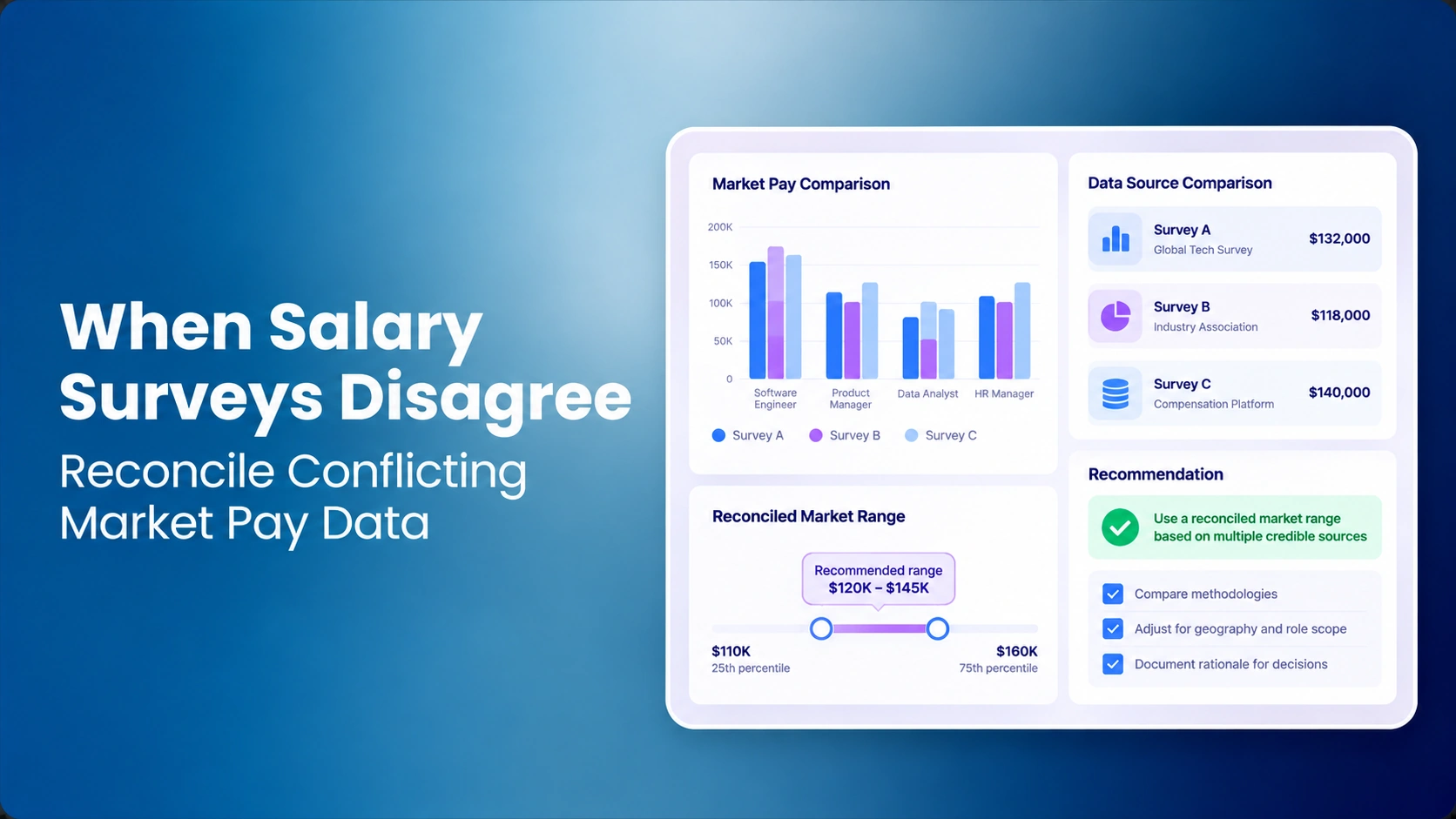
When two sources disagree, the first question should not be “Which number is higher?” Ask why they differ. Common causes include different industries, company sizes, geographies, levels, effective dates, pay elements, and job matches.
For example, a public posting for a high-growth AI company in San Francisco may show a range materially above a broad national survey. That does not automatically mean the survey is stale. The difference may reflect geography, employer type, equity strategy, or a harder-to-fill specialty.
Document whether you exclude a source, retain it as a sensitivity check, or assign it a lower weight. The common compensation benchmarking mistakes article explains why mixing mismatched sources can create a number that looks precise but has weak methodological support.
If the evidence suggests a broad and durable market shift, review the impact on the existing salary bands. If the issue appears isolated to one candidate or one scarce role, do not redesign the whole structure based on a handful of public postings.
Check the Internal Employee Context Before Acting
External market evidence should not be evaluated in isolation from employees already in the organization. Before changing a range or approving a market adjustment, use compensation analytics to review current range position, peer relationships, and pay compression.
For jobs already in established ranges, the compa-ratio can help show how current employee pay relates to the range midpoint. If you also use range penetration, the compa-ratio versus range penetration comparison clarifies what each measure tells you.
A web-sourced salary signal may justify investigating a range. It does not tell you which employees should receive increases, how large those increases should be, or how the decision should interact with internal equity.
What Changes for Executive or Highly Specialized Roles?
Thin external data is more common for executive, niche technical, and emerging roles. In those cases, web research can help identify titles, peer companies, disclosed ranges, and role language, but the methodology needs even more documentation.
For senior leadership roles, use the executive compensation benchmarking guide and separate base salary, annual incentive, long-term incentive, and other reward elements. A public salary range for base pay should not be treated as evidence for total direct compensation.
For emerging technical roles, triangulate multiple sources and state the uncertainty. A defensible decision can include judgment. The problem is undocumented judgment presented as objective market fact.
How AI Should Handle Source Conflicts
An AI assistant can make conflicting evidence look deceptively tidy. If one survey reflects large technology companies, another reflects broad industry data, and job postings come from a narrow set of high-cost markets, combining the numbers without showing those differences creates false precision.
Require the workflow to preserve source name, source type, effective date, job and level match, geographic scope, pay element, adjustments, weighting, reviewer rationale, and final approved reference.
This is the same principle behind governed market benchmarking: the final number matters, but the evidence trail matters just as much.
Design the AI Workflow So Weak Evidence Cannot Quietly Become Policy
A governed AI workflow should separate three actions: discover evidence, evaluate evidence, and approve evidence. The same system can support all three, but the permissions and review points should be explicit.
- Discovery: AI searches for relevant sources and captures provenance.
- Evaluation: the analyst reviews fit, population, matching, date, pay element, and conflicts.
- Approval: Compensation confirms which sources can influence the final market reference.
Keep those steps aligned with the organization's compensation philosophy and compensation governance model. A tool should not be able to introduce a new market source, change a range, and apply an employee adjustment without the controls appropriate to each action.
Once a decision is approved, preserve the source and reviewer history in compensation reporting. That creates a record for future range reviews, manager questions, and audits instead of forcing the next analyst to reconstruct the logic from browser history.
Where General Web Search Is Most Useful
- How are companies describing a newly emerging role?
- Which skills are appearing in current postings?
- Has a competitor publicly changed its pay philosophy?
- Are new pay-transparency rules changing what employers disclose?
- Is public labor-market context explaining unusual recruiting pressure?
Those questions can change how Compensation frames its analysis. They should not automatically determine salary ranges.
Where Web Data Should Not Stand Alone
Do not rely on general web data alone for a high-stakes employee pay decision when the source population is unknown, the role match is unclear, the compensation element is ambiguous, or the evidence cannot be reproduced. That is especially important for executive pay, pay-equity work, regulated roles, and decisions likely to face audit or employee challenge.
Use compensation analytics to compare external signals with internal position, compression, and employee patterns. External market context and internal equity should be reviewed together.
A Three-Tier Governance Policy
- Tier 1, decision evidence: approved surveys and datasets with documented methodology.
- Tier 2, supporting signal: public job postings, government data, company disclosures, and other identifiable sources.
- Tier 3, discovery only: general web commentary and AI-generated synthesis until original evidence is verified.
AI can move evidence through the workflow faster, but it should not promote weak evidence into a formal benchmark simply because the answer sounds confident.
See How CompBldr Keeps Market Evidence Governed
Walk through a compensation benchmarking workflow where job context, approved sources, matching decisions, and reviewer rationale stay connected from research through the final pay decision.
Book a Demo

.svg)

.svg)
.svg)

