

.svg)





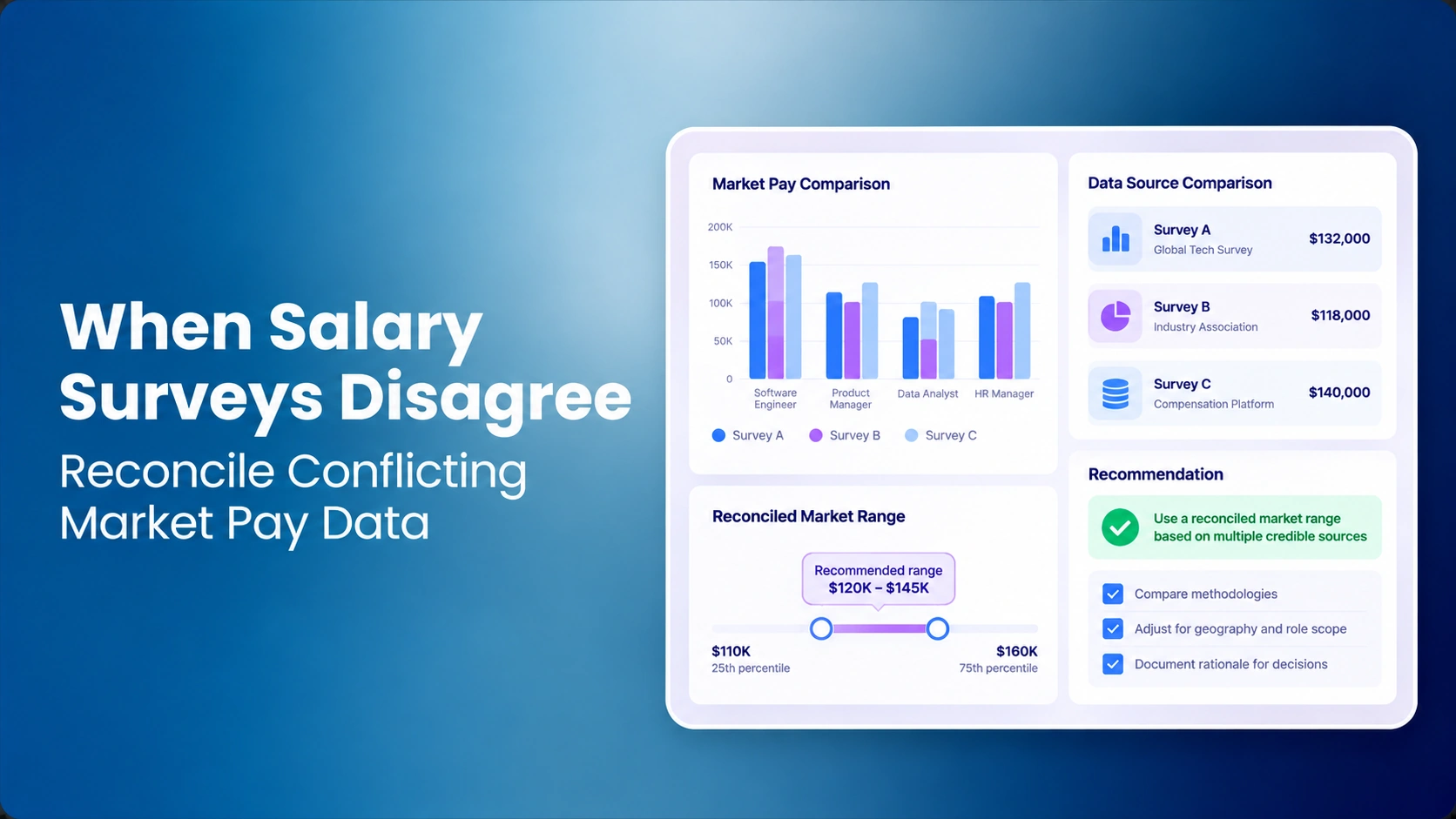

Three surveys price the same advertised "senior financial analyst" role at $112,000, $126,000 and $117,000. Finance wants a midpoint recommendation by Friday. If Compensation merely picks the middle number or averages all three, it may be blending two different jobs, pay definitions or labor markets. The $14,000 spread between the first two sources is a reason to investigate, not a reason to choose one vendor over another.
Conflicting salary survey data needs a reconciliation record: determine what each source actually measures, compare only eligible cuts, document transformations, and retain the reason for the final market reference. Survey B's higher result could be valid for a broader job and misleading for this employer's position at the same time.
This article starts after survey subscriptions and job matches have been selected. CompBldr already covers how to choose a survey provider, how jobs are matched to surveys, and the wider market pricing methodology. Here the problem is narrower: how to reconcile salary survey results when apparently relevant observations disagree.
Why Survey Medians Can Disagree Without Either Vendor Being Wrong
Before dividing, multiplying or weighting values, confirm that each survey measures substantially the same work, geography, company population, statistic, reference date and pay elements. For example, a mean wage and a median salary are not interchangeable even when reported in the same currency. A compensation cut that includes variable pay should not be presented as base salary without an authorized and supportable conversion.
The difference between $126,000 and $112,000 is 12.5% when $112,000 is the denominator: ($126,000 ÷ $112,000 − 1) × 100. The percent is a useful triage measure but not a universal rejection rule. An analyst must first ask whether the comparison is valid.
| Dimension | Possible mismatch | Evidence to inspect | Decision |
|---|---|---|---|
| Job responsibilities | Direct reports, complexity or specialist scope | Published survey role description and approved job profile | Rematch or exclude |
| Pay elements | Annual base, total cash, commissions or allowances | Survey definitions and employee pay basis | Compare like with like |
| Geography | National vs. metro area or approved geo tier | Labor market definition and market policy | Use approved geographic policy |
| Time period | Different survey cutoff or effective dates | Source reference date and approved aging assumptions | Normalize where supported |
| Population | Industry, size, ownership or sample limits | Cut-level methodology and published limitations | Qualify the result |
| Statistic | Mean, P50, P75 or modeled value | Exact measure and distribution definition | Recalculate only where possible |
A title match is especially dangerous when one organization calls a specialist "senior" and another uses the same label for a supervisory position. Compare job scope using Job Architecture and Job Evaluation. The job grades versus levels guide explains why titles cannot substitute for evaluated work.
Worked Example: Three Sources for One Evaluated Job
Assume an illustrative U.S. senior financial analyst role with no direct reports. The question is its annual base-pay 50th percentile, using a consistent geographic policy and reference date. All values are invented to show the reconciliation method, not observed survey data or a recommendation for this role.
| Source | Annual base P50 | Job and cut assessment | Initial disposition |
|---|---|---|---|
| Survey A | $112,000 | Strong job and population match | Eligible |
| Survey B | $126,000 | Strategic scope broader than the internal role | Exclude pending rematch |
| Survey C | $117,000 | Strong scope match; narrower employer population | Eligible with documented limitation |
Survey B does not fail because it is high. It fails this proposed comparison because its underlying responsibilities differ. If later evaluation shows it was a suitable match after all, the original conclusion should be revisited. A defensible process does not exclude inconvenient observations while keeping equally weak data that supports management's preferred pay number.
The benchmarking versus market pricing comparison separates gathering reference points from the organization's final pay decision. A market P50 is input to policy, not an automatic new salary range midpoint.
Normalize What Is Defensible, and Withhold the Rest
Some salary survey discrepancies disappear once the analyst aligns survey reference dates or pay elements. Others cannot be repaired with a spreadsheet formula. For example, a report describing total cash compensation cannot be converted to base salary by simply subtracting a flat bonus assumption for every participant. Document what changed and why; if the needed inputs do not exist, mark the observation ineligible for the main blend.
| Cut | Original observation | Treatment | Eligible reviewed P50 |
|---|---|---|---|
| A | $112,000 annual base | Approved job match, geography and date | $112,000 |
| B | $126,000 annual base | Broader job scope; do not apply arbitrary seniority discount | Excluded |
| C | $117,000 annual base | Approved job match; disclose narrower population limitation | $117,000 |
| Statistic | Median (P50) | Keep mean, P50 and P75 separate | P50 only |
| Pay definition | Base salary | Verify survey compensation elements and annualization | Comparable annual base |
For an older usable survey, an approved aging method may help align the reference date. If a fictional cut is exactly one year old at $110,000 and the authorized annual aging assumption is 3%, the adjusted figure is $110,000 × 1.03 = $113,300. The 3% is only an arithmetic example. The employer should not present a merit-increase forecast as verified market data movement without evidence.
Public occupational sources also need careful treatment. The Bureau of Labor Statistics OEWS FAQ documents the wage concept and published estimates; those estimates need not measure precisely the same employee compensation elements or population as a commercial base-salary survey. The AI and web data benchmarking guide similarly separates unverified online salary signals from documented market evidence.
Reconcile Multiple Compensation Surveys With an Explicit Decision
Comparing multiple compensation surveys does not require that all observations enter a final blend. An organization may prefer a single well-matched source, weight two sufficiently comparable sources, or withhold a benchmark until a better match is found. Establish weight criteria such as scope fit, geographic relevance, date, and known sample limitations before examining the final pay recommendation.
| Scenario | Calculation | Result | Conclusion |
|---|---|---|---|
| Unfiltered three-source mean | ($112,000 + $126,000 + $117,000) ÷ 3 | $118,333 | Arithmetic example only; includes mismatched B |
| Unfiltered weighted blend | 50% A + 30% B + 20% C | $117,200 | Still relies on mismatched B; not recommended |
| Reviewed two-source blend | 60% A + 40% C | $114,000 | Provisional benchmark using eligible cuts |
| Difference attributable to unqualified B | $117,200 − $114,000 | $3,200 | Shows effect of a flawed blend |
The reviewed 60/40 example contributes $67,200 from Source A and $46,800 from Source C, totaling $114,000. The weights are illustrative governance choices, not published best-practice ratios. The result must not be called statistically precise merely because it has a formula. Two surveys can share participants, and weighting does not make dependent or biased samples independent.
If new evidence reveals that Source C's narrow population is unrepresentative, record a different decision, including no approved blended value. Explain how the conclusion changes if only Source A remains eligible. This sensitivity analysis is more useful to Finance than reporting a single smooth number without its assumptions.
Make Market Data Decisions Easier to Defend
Explore the CompBldr market benchmarking context for source evidence, job matches and compensation review decisions.
Decide Whether the Disagreement Is About Data or Pay Philosophy
Analysts sometimes reconcile the numbers correctly and still hear, "That is not how we want to position this job." That is a distinct policy discussion. The approved compensation philosophy may target a market percentile above or below P50. Survey reconciliation estimates an external reference for a defined job. Leadership then decides how to use that reference under policy.
For example, a reconciled $114,000 P50 should not automatically replace the current midpoint. The salary band design workflow determines the market target, grade boundaries, and range spread, while range width guidance helps keep the grade structure coherent. A specialized function may also require a distinct positioning rule as discussed in function-level compensation strategy.
Nor should the survey disagreement be diagnosed as employee discrimination or compression. Those are independent employee-level reviews. Adjusted and unadjusted pay gaps measure different issues, while compa-ratio and range penetration describe salary placement within a band. The pay compression guide explores consequences that may warrant further analysis after a legitimate policy change.
An Evidence Standard for Market Pricing Data Reconciliation
Market pricing data reconciliation ends with an authorized disposition, not the mathematically neatest figure. Each source needs a clear include, exclude, adjust or investigate status. A Compensation lead must be able to show Finance why a disputed cut was rejected even if that rejection made the proposed salary range less expensive or more expensive.
| Evidence state | Analyst action | Approver | Document |
|---|---|---|---|
| Strong job match and same pay basis | Include and justify any weighting | Compensation owner | Job scope, source cut, weighting and version |
| Comparable job, older reference date | Apply approved aging methodology only | Compensation / Finance as required | Rate, period, original and adjusted values |
| Different job scope | Rematch or exclude; no arbitrary seniority adjustment | Job evaluation reviewer | Duties that differ and exception outcome |
| Weak or undocumented cut | Qualify or withhold use | Compensation governance | Reliability limits and unresolved assumptions |
| No defensible combination | Escalate with no single benchmark | Compensation decision owner | Open question and next review date |
A universal rejection threshold is tempting and usually too crude. The same percent spread can have different meanings across common operational roles and scarce specialist jobs. Record the triggering variance for investigation, but make the final eligibility decision using source content and relevance. Never silently delete a cut simply because it raises the proposed budget.
What Finance Should Receive Before a Salary Range Is Changed
Finance needs a short market-pricing memo, not the vendor's entire confidential survey workbook. State the evaluated job and market, what each source measures, which cuts were rejected, why the remaining sources are usable, how the proposed reference was derived, the alternatives considered and the approval status. Preserve survey licensing terms and restrict raw copyrighted tables as appropriate.
The market reference may inform Salary Structure Software, but the compensation structure decision needs its own governance. When an approved market point would move a band, use Compensation Planning to assess proposed salary actions under actual policy. If pay is adjusted, do not confuse an approved market adjustment with merit or COLA. The existing benchmarking mistakes guide provides related prevention checks.
| Field | Illustrative record | Reviewer question |
|---|---|---|
| Job and market | Senior financial analyst, fictional market | Is role scope documented? |
| Input values | A: $112,000; B: $126,000; C: $117,000 | Which cut and edition supplied each? |
| Excluded observation | B: broader duties than evaluated job | Was exclusion based on evidence? |
| Reviewed blend | A 60% + C 40% = $114,000 | Is method preapproved and sensitivity shown? |
| Approval state | Proposed market reference, not yet adopted | Who can approve downstream use? |
| Next control | Review if job match or survey edition changes | Can the old decision be reproduced? |
Retain both original and normalized cut values, the date of each survey, the job-matching rationale, any aging calculation, and the person who approved the weighting. A new survey edition should trigger a review, not silently overwrite the reference used for previous pay decisions. Compensation Reporting can support reviewable outputs, while Compensation Analytics helps examine downstream salary-position effects.
How to Evaluate CompBldr for This Specific Workflow
CompBldr's Market Benchmarking provides compensation-market context, with related Job Architecture and Job Evaluation capabilities for more consistent role classification. Its Salary Structure Software links grades with min, midpoint and max decisions. These capabilities make a relevant product workflow, but they do not prove that the configured software automatically resolves conflicting survey data.
In a demo, ask the vendor to reproduce this fictional case: enter two eligible benchmark cuts, attach a third disputed cut, explain the match difference, calculate the weighted reference, and show the decision before and after approval. Verify which steps are native, configurable, or handled outside CompBldr. If a feature cannot be demonstrated, do not describe it as automated.
References and Further Reading
- WorldatWork: Market Pricing, Data, Directions & Decisions reviews industry practices in data selection, blending, weighting and aging.
- WorldatWork: When the Job Benchmark Doesn't Fit distinguishes job-match concerns from other organizational disagreements.
- BLS: Occupational Employment and Wage Statistics FAQs describes estimation and wage definitions relevant to source comparisons.
- CompBldr: Choosing a Salary Survey Provider addresses the separate upstream provider-selection problem.
Review Conflicting Market Data With CompBldr
Bring a hypothetical job, two comparable survey cuts, a disputed third source and your approval policy. Explore how source evidence and compensation decisions can be reviewed together.
Book a DemoEditorial note: Every salary value, percentage, aging factor, survey label and proposed weight used above is fictional. This is compensation-operations guidance, not observed survey evidence or legal advice. Use documented source methodology, authorized compensation policy, survey licensing terms and appropriate qualified review.


.svg)

.svg)
.svg)

