

.svg)





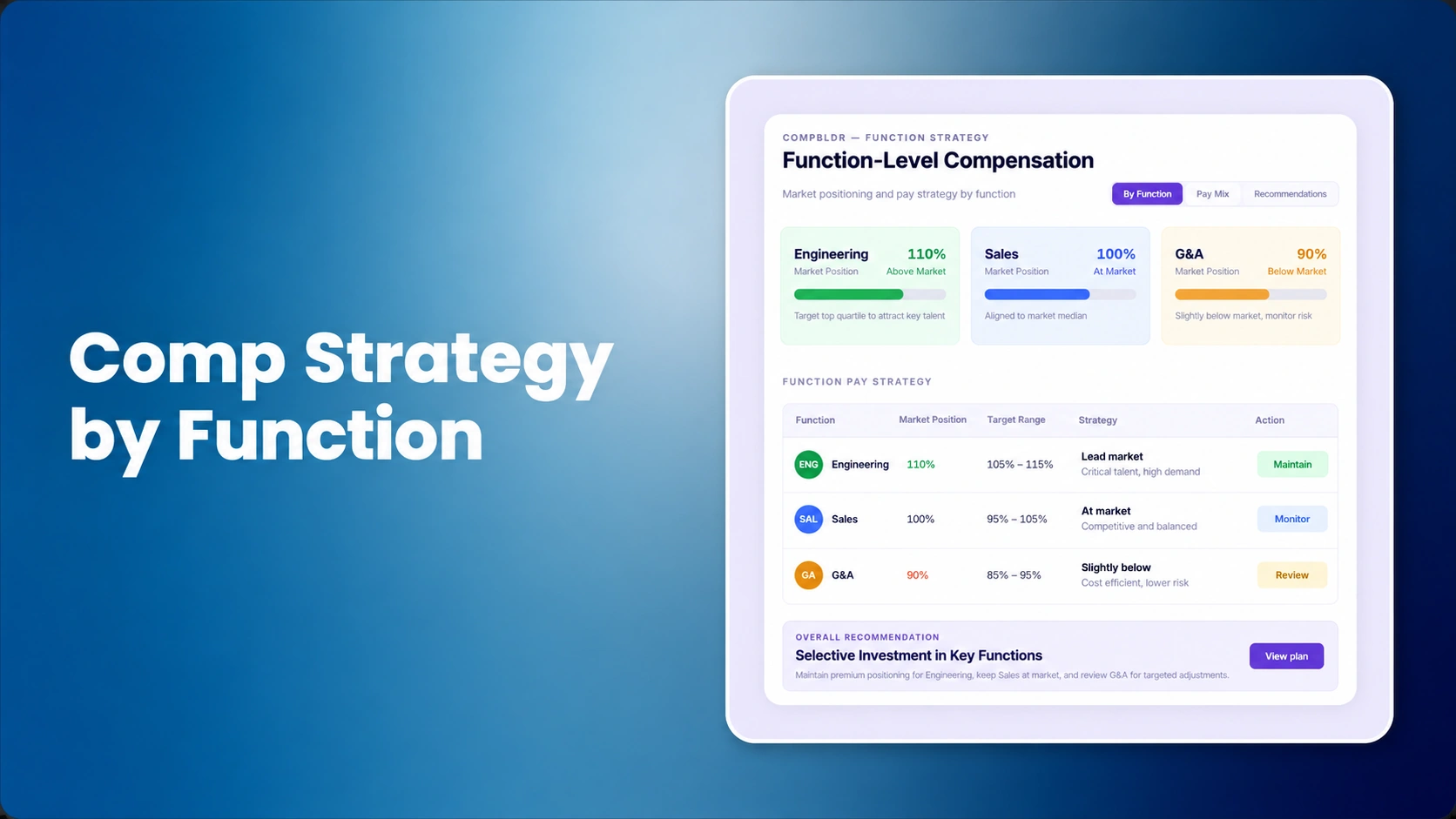

A company-wide statement such as “we target the 50th percentile” is easy to communicate and often too simple to operate. Engineering may compete in a fast-moving specialist market. Sales may rely more heavily on variable pay. G&A roles may face broader and more stable labor markets. Applying one market position to all three can overspend in one area while leaving another unable to recruit or retain.
Current 2026 evidence supports this divergence. BetterComp's 2026 trends analysis identifies function-level pay divergence as an under-discussed issue and argues that blended company-wide assumptions can produce under-competitive results in some functions and overspending in others. Pave's June 2026 merit-cycle analysis, based on data from more than 200 companies and 100,000 employees, shows materially different reward patterns across R&D, G&A, and go-to-market populations. Mercer likewise notes that overall compensation growth can look stable while specialized roles and job families move differently.
The answer is not to create three unrelated compensation systems. The answer is to keep one philosophy and governance model while making market-position decisions more specific.
Compensation Philosophy Is the Boundary, Not the Percentage
A useful compensation philosophy explains what the organization rewards and how decisions should be made. It does not need to force every job family into one percentile target.
A mature philosophy can say that the company uses market data appropriate to each talent market, keeps internal job levels and evaluation standards consistent, allows function-specific positioning when evidence supports it, reviews total rewards rather than base salary alone, and requires changes to be approved through the same governance process.
That creates coherence without pretending every function behaves the same.
One Compensation Philosophy Can Support Different Market Positions
A function-level strategy should not mean every department invents its own pay rules. The organization's compensation philosophy still sets the common boundaries: how the company defines its talent markets, how it balances external competitiveness with internal equity, which reward elements matter, and who can approve exceptions.
The difference is that the philosophy can allow distinct positioning by function, level, geography, and pay element when there is evidence for the difference. BetterComp's 2026 strategy framework makes this explicit by treating positioning as a decision across base pay, total cash, total direct compensation, function, level, and geography rather than one company-wide percentile.
For example, the organization might target a stronger external position for a scarce AI engineering family while keeping a broader market position for general corporate roles. That can still be one coherent compensation philosophy if the decision rules, data sources, and review cadence are documented.
Start With One Job Architecture So Function Differences Stay Comparable
Function-specific market strategy only works when the internal structure is consistent. Use one governed job architecture and a common job leveling framework so a P4 in Engineering and a P4 in Finance represent comparable scope, complexity, and business impact even when their market prices differ.
The job grades versus job levels distinction is especially important here. Level establishes job scope. Grade and salary structure translate jobs into pay opportunities. A different market position should not silently redefine what the level means.
If one function has evolved faster than the architecture, use job evaluation and the job leveling matrix to recalibrate the role before changing pay strategy.
Why Functions Need Different Compensation Inputs
Engineering and technical roles
Specialized engineering roles may compete with a narrower set of employers, change quickly as skills evolve, and rely more heavily on equity in some markets. A broad professional-services benchmark may not represent the talent market the company is actually recruiting from. For a connected operating model, see how technology compensation management links technical job architecture, market evidence, salary structures, planning, and total rewards.
Sales and go-to-market roles
Sales compensation depends heavily on base and variable pay together. Territory, segment, quota design, sales motion, and industry can materially affect OTE and market comparisons. Base salary alone can make a sales package look more or less competitive than it really is.
G&A and corporate roles
Many finance, HR, legal, and operations roles compete in broader cross-industry markets. Internal career progression and consistent architecture may matter as much as narrow peer matching, although specialized corporate roles can still require distinct treatment.
| Dimension | Engineering / technical | Sales / GTM | G&A / corporate |
|---|---|---|---|
| Relevant talent market | Specialized technical peers, scarce skills, selected industry competitors | Industry, segment, sales motion, territory, quota level | Often broader cross-industry professional markets |
| Primary pay element | Base salary plus equity can be material | Base salary plus variable pay and OTE | Base salary plus annual incentive where applicable |
| Refresh cadence | Potentially faster for scarce specialties | Depends on role, market, and commercial model | Can be more stable for broad professional roles |
| Leveling pressure | New specialties can evolve faster than title libraries | Scope changes with segment, quota, territory, and leadership responsibility | Cross-functional consistency and career progression are often central |
| Common retention lever | Base, equity, skill growth, scope | OTE, variable opportunity, territory quality, base | Base, career path, manager quality, benefits, internal mobility |
Define the Market by Function Before Choosing the Percentile
The percentile is the end of the decision, not the beginning. First define the talent market. Use market benchmarking to document the relevant peer population, geography, industry, company size, role family, level, and pay element for each function.
The market pricing methodology should make those choices visible. Engineering may need a technology-specific cut for selected specialties. Sales may need role-specific OTE data rather than base salary only. G&A roles may use broader cross-industry sources where the talent market is less specialized.
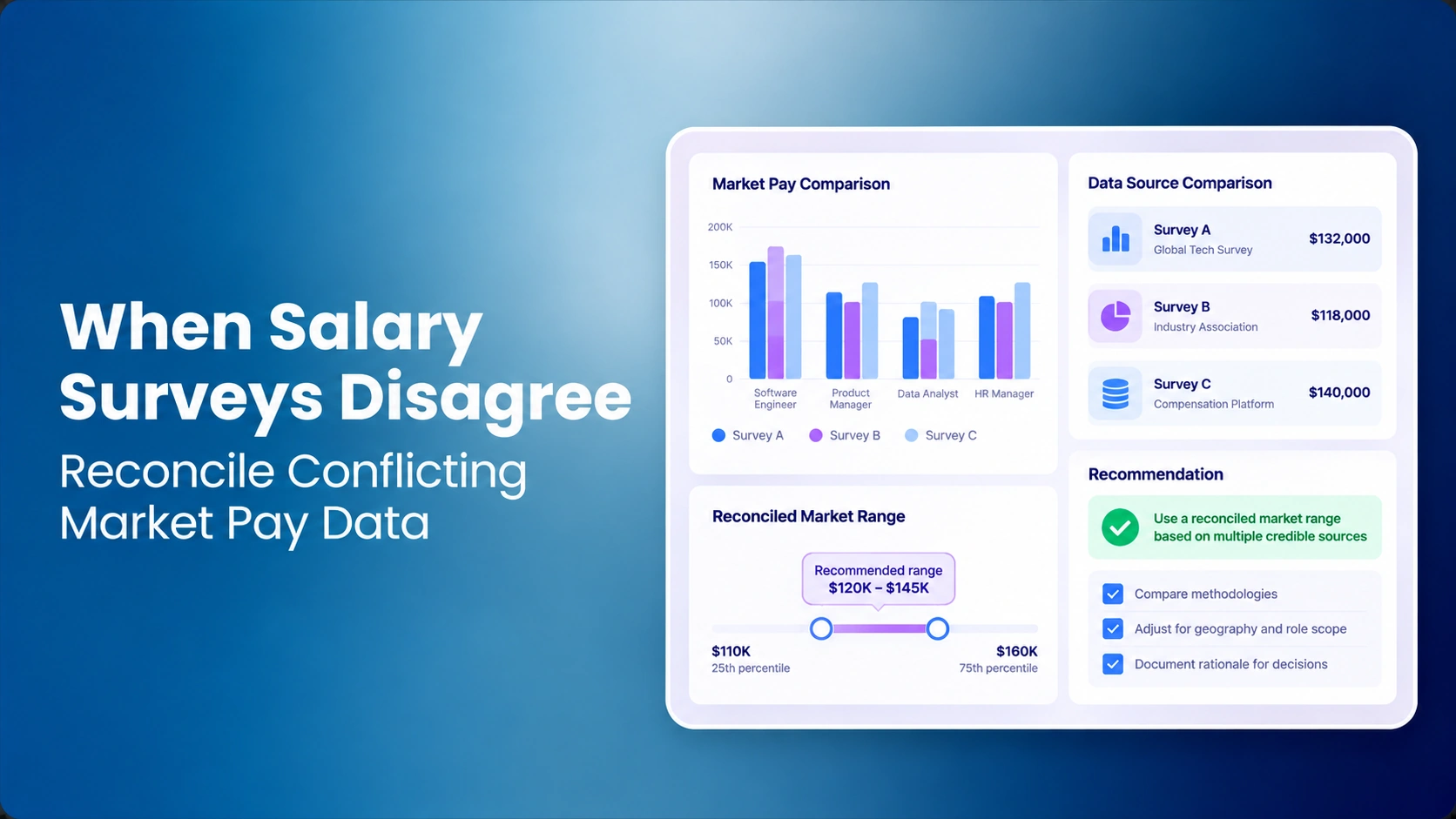
When the evidence is mixed, use the compensation benchmarking evaluation guide rather than averaging incompatible datasets. A company-wide target can look precise while masking very different source populations underneath.
Base Salary Is Not the Same Strategy as Total Rewards
Function-level positioning should be set by pay element. Engineering, Sales, and G&A may look similar on base salary and very different on total cash or total direct compensation.
Pave's 2026 merit-cycle analysis illustrates that difference. Among employees rated Meets Expectations, ongoing equity participation was materially higher in R&D than in G&A or GTM. That does not mean every company should copy those percentages. It shows why a function-level review can miss the real reward strategy if it looks only at base salary.
Sales needs the same care. Compare base salary and target incentive together where OTE is the appropriate market reference. A low-base/high-variable sales design should not be judged against a corporate role using base salary alone.
Five Steps to Build Function-Level Positioning
1. Keep one job architecture
Functions can have different labor markets without inventing different definitions of level. Use one governed job architecture so equivalent levels still represent comparable scope, complexity, and impact across the organization.
2. Define the relevant talent market by function
Engineering might recruit from a different peer set than corporate accounting. Sales may need cuts based on industry or commercial model. Document the peer group, geography, company characteristics, and survey sources used for each function.
3. Set positioning by pay element
Do not stop at base salary. Define whether the function's strategy applies to base pay, total cash, equity, or total direct compensation. A function can look competitive on base salary while falling behind on the component employees value most.
4. Model employee outcomes
Apply the strategy to actual employees before approving it. Review compa-ratio, range position, compression, internal relationships, cost, and likely exceptions. Use compensation analytics to see whether a theoretically sound policy produces awkward outcomes.
5. Establish a review cadence
Fast-moving technical specialties may need more frequent market review than stable corporate roles. The cadence itself can differ, but it should be documented rather than triggered only when a manager escalates a hiring problem.
Differentiate by Function Without Fragmenting the Structure
Use one job architecture, then apply function-specific market evidence, pay elements, and review cadences with documented governance.
| Signal | Function-specific treatment? | Evidence required | Common mistake |
|---|---|---|---|
| Specialized technical talent competes in a different labor market | Often yes | Relevant peer data, role match, scarcity, hiring/retention evidence | Applying the company-wide professional market cut |
| Sales role has a materially different base / variable mix | Yes, by pay element | OTE, incentive design, role type, segment, quota context | Comparing base salary only |
| One manager wants to pay above market | Not by itself | Broader market or business evidence | Turning a local preference into policy |
| One employee has a scarce skill | Not necessarily | Skill value, permanence, role impact | Changing the function strategy instead of using a targeted premium |
| Repeated exceptions occur across a whole function | Potentially | Benchmark fit, ranges, offers, turnover, employee distribution | Treating a structural problem as individual exceptions |
Worked Example: One Company, Three Different Market Decisions
Consider a company with three P4 populations: software engineering, enterprise account executives, and corporate finance. The organization uses one P4 definition based on independent ownership of complex work and material business impact.
- Engineering: uses specialized technology market data, reviews selected scarce skills more frequently, and considers equity as part of the competitive package.
- Sales: evaluates base salary and target variable pay together, using OTE and role-specific market cuts rather than base pay alone.
- Finance: uses a broader professional market and places greater emphasis on consistent internal progression across related corporate functions.
The levels remain comparable. The market inputs and reward mix differ because the talent markets differ.
Set Different Review Cadences Without Losing Governance
Not every function needs market data refreshed at the same frequency. Mercer notes that broad compensation conditions can be stable while specific job families diverge, especially where specialized skills or labor shortages persist. Compensation teams can respond with different review cadences while keeping one governance process.
For example, a scarce AI engineering family might receive a quarterly market check, while a stable corporate family remains on an annual cycle. The difference should be written into the methodology, not triggered only when a hiring manager escalates a problem.
Use compensation reporting to track when each function was last reviewed, which source was used, what market position was approved, and when the next review is due.
Model the Employee Impact Before Leadership Approves the Strategy
A function-level market target can look reasonable on a slide and still create difficult employee outcomes. Before approval, apply the proposed strategy to actual employees in compensation analytics.
Review the distribution of employees by range position, compa-ratio, promotion history, location, performance context, and other legitimate factors. Look for pay compression within the function and unexplained relationships across functions.
Function-specific market positioning does not eliminate internal equity. It changes the explanation the organization needs to support. Where differences cannot be explained by job scope, talent market, pay mix, geography, or another legitimate factor, investigate further through a pay equity audit.
Build Salary Structures That Reflect the Strategy
If leadership approves a different market position for a function, the salary ranges should reflect it. Otherwise the organization has a strategy on paper and a conflicting structure in payroll.
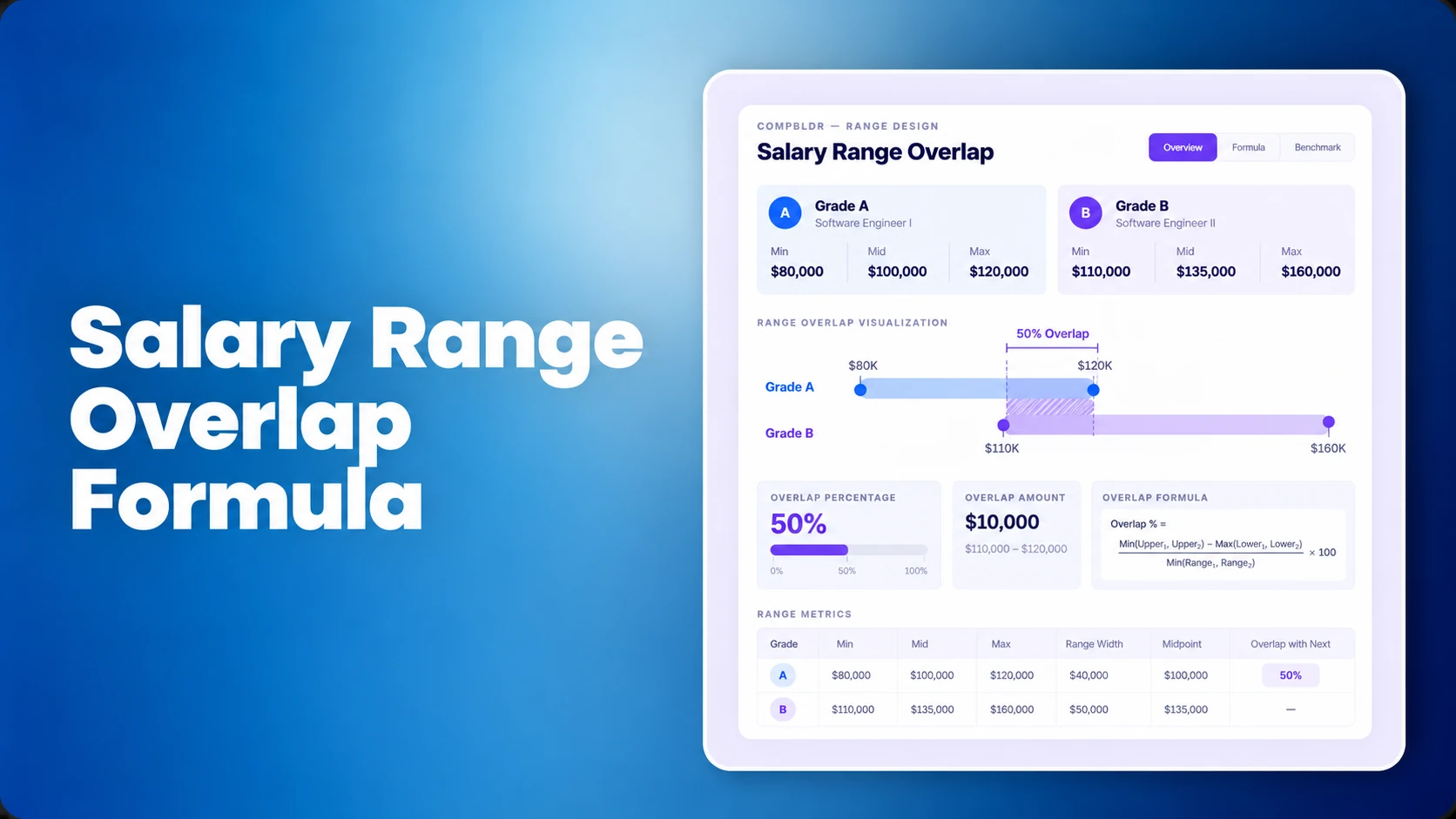
Use the salary-band methodology to translate approved market references into ranges, and use the salary range width guide to avoid solving function differentiation only by making ranges excessively wide.
Do not create a separate grade system for every function. Keep the architecture common and adjust the market reference, range structure, or pay mix only where the evidence supports it.
What Not to Do
Do not let every function choose its own percentile
Function-level strategy is not departmental autonomy. Compensation should own the methodology and require evidence for differences.
Do not use one blended dataset because it is convenient
A broad average can hide important movement in specialized roles. Match survey sources and market cuts to the work being priced.
Do not confuse skill scarcity with job level
A scarce AI skill does not automatically make an employee a higher level. Evaluate job scope separately from market scarcity.
Do not compare base salary when functions use different pay mixes
Sales OTE and technical equity can materially change the competitive picture. Use the pay element that matches the market decision.
Do not ignore internal equity
External differentiation still needs a defensible internal rationale. Review whether function-specific positioning produces unexplained gaps across comparable employees or career moves.
Use Merit Budgets as an Allocation Decision, Not a Single Percentage
A company can approve one overall salary budget while allocating the pool differently underneath it. BetterComp's 2026 trends analysis argues that the variance between functions can matter more than small year-over-year changes in the headline budget. Pave's merit-cycle data shows that technical populations can receive reward through different channels, including ongoing raises and equity rather than promotion increases alone.
During compensation planning, separate the affordability decision from the allocation decision. Leadership can approve one total pool, while Compensation uses targeted market-adjustment budgets or different guidance where the function-level evidence supports it.
The merit budget guide and merit matrix methodology can help keep market adjustments, merit, promotions, and other actions from being mixed into one unexplained percentage.
Function Strategy Also Changes Offer Governance
If Engineering, Sales, and G&A use different market positions, recruiters need approved guardrails before they make offers. The recently published offer compensation governance framework explains how job level, range, hiring zone, internal comparators, and exception authority should be settled before the finalist waits.
This is especially important when a function-specific strategy changes the normal hiring zone or pay mix. A recruiter should not have to infer the function strategy from a spreadsheet or previous offer.
Governance: Who Can Change a Function's Market Position?
A function-specific strategy should have stronger approval than a manager preference. Define who can propose a change, who validates the market evidence, who models cost and employee impact, and who gives final approval.
- Compensation: owns methodology, market data, modeling, and recommendation.
- Functional leadership: provides talent-market and business context.
- Finance: reviews affordability and budget impact.
- HR leadership: reviews enterprise consistency and employee implications.
- Executive leadership or compensation committee: approves material shifts where required by governance.
A compensation governance platform should preserve the approved position, evidence, effective date, and review cadence so the strategy does not drift through one-off exceptions.
Metrics That Show Whether Function-Level Strategy Is Working
Track the results by function, not just company-wide averages:
- offer acceptance and compensation-related declines;
- time to fill and repeated offer exceptions;
- employee distribution by range position;
- market adjustment spend versus merit spend;
- promotion and equity participation by function;
- compression and pay-equity signals;
- regrettable turnover in targeted roles;
- frequency of benchmark and range refreshes.
If the company-wide average looks healthy while one function shows persistent offer exceptions, compression, or regrettable turnover, the blended dashboard is hiding the problem. The compensation dashboard metrics guide provides a useful framework for making those differences visible.
How Function-Level Strategy Changes Merit and Planning Decisions
A company can still approve one overall salary budget while allocating resources differently underneath it. BetterComp's 2026 analysis argues that blended company-wide numbers can hide different function needs. Pave's merit-cycle data also shows function-specific differences in ongoing equity participation, particularly for technical populations.
During compensation planning, Compensation and Finance should separate the overall affordability decision from the allocation decision. The company may have one approved pool but use different guidelines or targeted market-adjustment pools where the evidence supports them.
Governance Questions for Leadership
- Which functions have formally approved market positions?
- What evidence supports each difference?
- Are base, total cash, and equity strategies documented separately where needed?
- Do ranges actually reflect the stated market position?
- Which functions require faster market-data refresh?
- How are employees moving between functions handled?
- How often does leadership review whether the differentiation still makes sense?
If the organization cannot answer those questions, it may have function-specific pay practices without a function-level compensation strategy.
See Function-Level Compensation Strategy in One Governed Workflow
See how CompBldr connects job architecture, market benchmarking, salary structures, planning, and analytics so function-specific positioning stays explainable and controlled.
Book a DemoSources and Further Reading
- BetterComp, Compensation Trends 2026
- BetterComp, Compensation Strategy: A Working Framework for 2026
- Pave, How the AI Era Is Reshaping Merit Cycles, updated August 14, 2026
- Mercer, Developing Your 2026 Compensation Planning Strategy
- Mercer, Navigating the Fog: Charting Your 2026 Compensation Planning Strategy


.svg)

.svg)
.svg)

