

.svg)





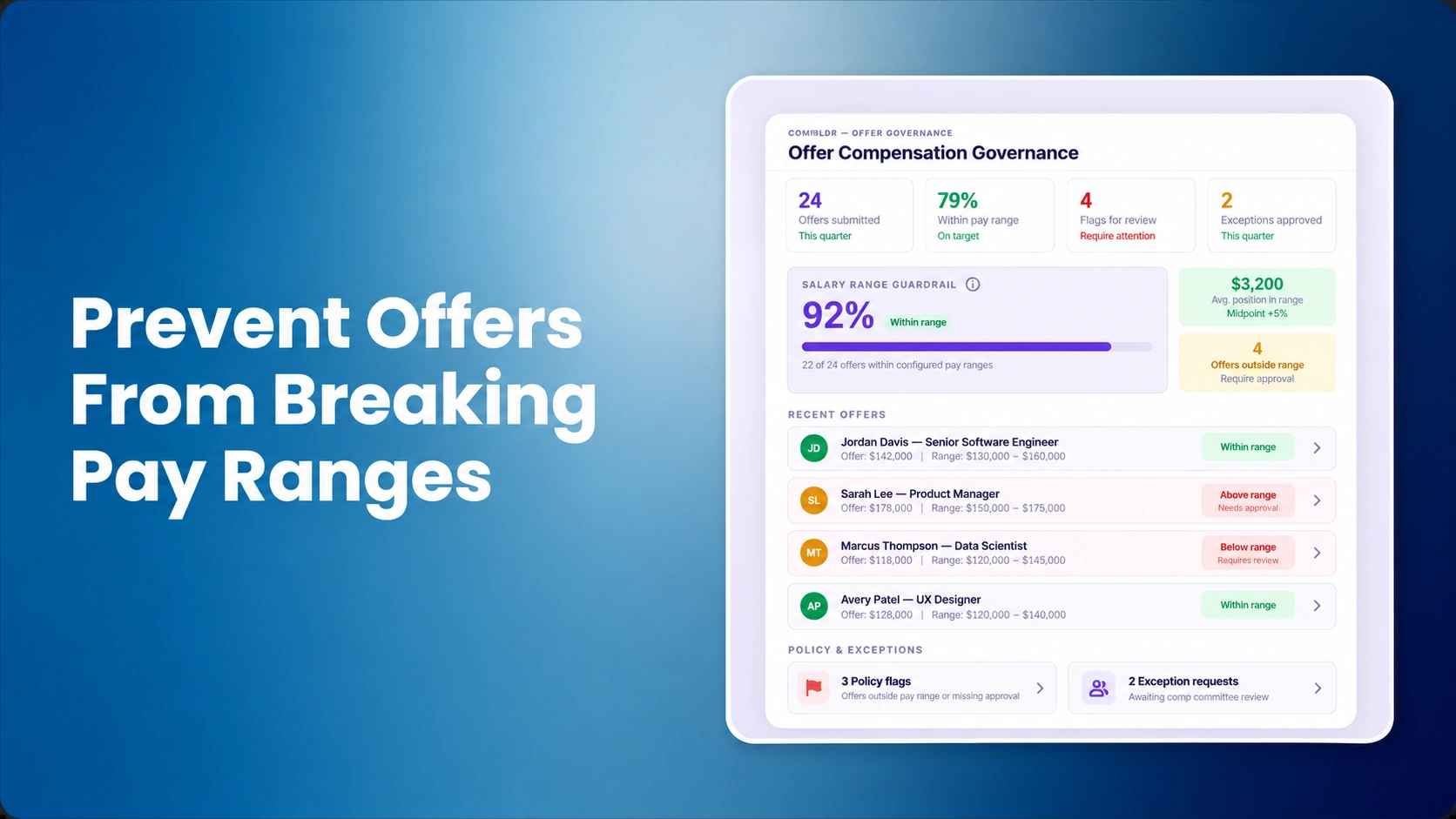

The most expensive offer problems usually start before anyone writes the offer letter. Recruiting begins with an unclear job level, Compensation has not confirmed the salary range, the hiring manager assumes there is room to negotiate, and Finance sees the requested amount only after a finalist is waiting.
Payscale described this pattern on August 28, 2026 as an alignment problem between Talent Acquisition and Compensation rather than a simple speed problem. Its example is nearly identical to what compensation teams see in practice: recruiting starts before the role is fully leveled or priced, a candidate reaches offer stage expecting $190,000, and Compensation later confirms a $180,000 range maximum. The delay is not created by the final approval step. It is created because the job, range, and negotiation guardrails were not settled earlier.
Payscale's 2026 Compensation Best Practices Report also found that 57% of organizations post salary ranges in job ads. That makes pre-offer range governance more important, not less. Once a range is visible to candidates, recruiters and managers need to understand what the published range means, what portion is normally available to new hires, and what evidence is required to move outside the normal hiring zone.
A governed offer process moves those decisions earlier.
The Offer Should Be the Final Step of a Compensation Decision Chain
A clean offer starts with an approved job description, connects to the correct job architecture, uses current market evidence, applies an approved salary range, and checks the proposed amount against internal employees before final approval.
Eight Pre-Offer Decisions to Lock
| Decision | What must be approved | Primary owner | What breaks if it is left unresolved |
|---|---|---|---|
| Job definition | Responsibilities, minimum requirements, location, employment model | Hiring manager + HR | The recruiter sells a role that does not match the job being priced |
| Level | Approved scope and career level | Compensation / job architecture owner | Candidate expectations and internal comparators are built on the wrong level |
| Market reference | Relevant external matches, source date, geography, pay element | Compensation | Range decisions rely on stale or mismatched data |
| Salary range | Approved minimum, midpoint, maximum, and location treatment | Compensation | Recruiters improvise on what the company can pay |
| Hiring zone | Normal entry range and evidence for higher placement | Compensation + TA | Every negotiation becomes an exception request |
| Negotiation authority | Who can move base, bonus, equity, or other elements | Compensation + HR + Finance policy | Managers make commitments that the company later has to unwind |
| Internal equity check | Comparator population and escalation criteria | Compensation | A competitive offer creates compression or unexplained internal gaps |
| Exception path | Evidence, approver, and response time outside guardrails | Compensation + designated approver | Late-stage exceptions stall or become inconsistent |
Level the Role Before You Decide What the Candidate Is Worth
A candidate can be exceptionally strong and still be interviewing for the wrong internal level. That is why the offer process should begin with the job, not the individual. Use the approved job description, compare it with the organization's job leveling framework, and confirm the role in job architecture before the recruiter starts negotiating.
If the hiring manager says the candidate deserves more because they will own responsibilities beyond the approved role, treat that as a job-design question. Use job evaluation to determine whether the scope belongs at a different level rather than stretching the current range around one person.
The job leveling matrix can help managers compare observable scope, complexity, decision authority, and impact instead of using title, years of experience, or candidate negotiating power as proxies for level.
Build the Range From a Defensible Market Reference
Once the internal job is clear, use market benchmarking to establish the external reference. The market pricing methodology should document the source, effective date, geography, company or industry cut, pay element, and job match before that evidence flows into a hiring range.
If the current range repeatedly fails to support normal hiring, do not assume every failed offer is an exception. Review whether the benchmark, aging, geographic policy, or salary-band structure needs to be refreshed. The benchmarking evaluation guide provides a useful check when market evidence is thin or conflicting.
Define the Hiring Zone Before Recruiting Starts
A salary range is broader than the amount most candidates should receive on entry. Compensation teams often need a hiring zone or another policy that explains how experience, proficiency, internal comparators, and range position affect starting pay.
Without that rule, every candidate negotiation becomes a new compensation philosophy debate. One recruiter treats midpoint as the target, another treats maximum as negotiable, and hiring managers learn that enough escalation can move the number.
The hiring zone should answer what portion of the range is normally available, what evidence supports higher placement, who can approve an exception, what happens when the candidate is already above the normal zone, and when the job itself should be re-leveled instead of stretching the offer.
Hiring Zone vs. Salary Range: They Are Not the Same Thing
The full salary range shows the approved pay opportunity for the role. The hiring zone is the portion of that range the organization normally uses for new hires. Treating the range maximum as the recruiter’s automatic negotiation ceiling removes the logic behind progression and can create difficult employee relationships later.
A hiring-zone policy should define how experience, verified proficiency, location, scarce skills, and internal comparators affect starting pay. If your organization uses range position, the compa-ratio can help Compensation understand how a proposed offer sits relative to the midpoint. It is not a candidate score, but it is a useful structural reference.
When a proposed offer would place a new hire materially above established employees in comparable work, review the risk of pay compression before final approval. A market-competitive offer can still create an internal problem if incumbents have not been reviewed.
When the Candidate Wants More Than the Range Allows
An above-range request is not automatically a reason to approve an exception. It is a signal to diagnose the underlying problem.
Was the role scoped or leveled incorrectly?
If the expected work is materially larger than the approved job, fix the role and level before changing the offer.
Is the benchmark stale or mismatched?
If current evidence shows the approved range no longer fits the talent market, re-price the role and review the structure instead of creating a permanent individual exception.
Does the candidate bring a scarce capability not required for every incumbent?
If the value is specific and evidence-backed, consider whether a governed skill premium or another targeted reward mechanism is more appropriate than higher base salary.
Is the pressure temporary?
If the gap is driven by a one-time attraction issue, a sign-on payment, equity, or another approved reward lever may solve the problem without permanently raising base salary.
Would the offer create compression or inversion?
If comparable incumbents would be materially disadvantaged, Compensation should review the broader employee impact before approval.
Set the Offer Guardrails Before the Finalist Waits
Connect approved job scope, level, market evidence, salary range, and internal comparators before negotiation begins.
| Signal | Likely root cause | Do this first | Avoid |
|---|---|---|---|
| Candidate requires pay above the range maximum | Role may be under-leveled, range may be stale, or candidate fit may be wrong | Recheck job scope and market evidence | Approving the number before diagnosing the reason |
| Offer is inside the range but far above incumbents | Compression or inconsistent historical pay | Run internal comparator review | Calling the offer “market competitive” and ignoring employee impact |
| Candidate has a scarce skill not required for all incumbents | Skill-specific market pressure | Evaluate a governed skill premium or targeted reward | Permanently inflating the job level without scope change |
| Gap is temporary and attraction-specific | One-time hiring pressure | Evaluate sign-on, equity, or another approved lever | Using recurring base salary for every short-term problem |
| Same role needs repeated exceptions | Range, benchmark, or hiring-zone policy may be wrong | Review the structure and policy | Treating a systemic issue as individual exceptions |
Worked Example: The $190K Candidate and the $180K Range Maximum
Consider an illustrative senior product manager search. Recruiting begins assuming the role can stretch to $190,000. Compensation later confirms that the approved range tops out at $180,000.
A weak process asks, “Can we approve $190,000 anyway?” A governed process asks four earlier questions:
- Is the candidate actually being hired to perform a higher-level role?
- Does current market evidence show the range is stale?
- Is there a candidate-specific reason that should be addressed through another component of total rewards?
- What would a $190,000 base salary do to comparable employees already in the organization?
If the role is genuinely higher-level, fix the job. If the market moved, fix the benchmark or range. If the pressure is candidate-specific, use an approved targeted mechanism. If none of those conditions apply, the request may simply be an attempt to override the structure.
Internal Equity Belongs Inside the Offer Process
External competitiveness is only half the decision. An offer can be market-competitive and still create a difficult internal relationship. Before approving a high offer, compare the candidate with relevant incumbents by job, level, location, tenure where relevant, performance context, and other legitimate pay factors defined by policy.
Use compensation analytics to identify whether the offer would create compression, exceed comparable employees without clear rationale, or expose a pattern that requires broader review.
This does not mean every new hire must be paid below every incumbent. It means the organization should understand the consequence of the decision before it becomes payroll reality.
Use Total Rewards Deliberately Instead of Solving Everything With Base Salary
Base pay is persistent. A one-time attraction problem does not always justify a permanent increase to fixed salary. Depending on company policy and applicable requirements, the organization may be able to use a sign-on payment, equity, variable pay, relocation support, or a time-bound skill premium.
The sign-on bonus benchmarks guide explains why sign-on decisions should be reviewed separately from base salary. A sign-on payment can solve a specific attraction gap without moving every future merit increase, range position, and internal comparison upward with the base.
That does not mean non-base rewards should be used to disguise an uncompetitive salary range. If the organization repeatedly needs bonuses to close normal candidates for the same job, revisit the underlying market positioning.
Internal Equity Review Should Happen Before the Offer Is Final
Use compensation analytics to compare the proposed offer with the relevant employee population before approval. The comparator group should follow the organization's legitimate pay factors, such as job, level, location, proficiency, and other documented criteria. Avoid choosing comparators simply because they make the offer easier to approve.
For high offers, check whether the decision creates compression, leapfrogs employees performing comparable work, or exposes an existing inequity that needs separate remediation. Where broader patterns appear, the pay equity audit process provides a more systematic review than solving one offer at a time.
A new hire can appropriately earn more than an incumbent in some circumstances. The governance requirement is that the organization can explain the reason with evidence and apply the same reasoning consistently.
Pay Transparency Changes the Candidate Conversation
When a range is visible in the job posting, candidates naturally ask where they would enter that range and why. Payscale's 2026 Compensation Best Practices Report found that a majority of organizations publish salary ranges in job ads. That makes manager and recruiter readiness part of offer governance.
Use the organization's compensation philosophy to explain how market data, role scope, skills, internal equity, location, and performance influence pay. The pay transparency guide can help separate meaningful transparency from simply displaying a wide number without explaining how pay decisions work.
Define Who Owns Each Offer Decision
Offer governance breaks down when Talent Acquisition, Compensation, Finance, and the hiring manager all assume someone else owns the unresolved question. A clear operating model should define:
- Hiring manager: owns the business need and accurate job scope.
- Talent Acquisition: owns candidate communication within approved guardrails.
- Compensation: owns level, market reference, salary range, internal comparators, and pay exceptions.
- Finance: owns budget constraints and any approval required by financial policy.
- HR leadership: owns escalation where policy, employee relations, or strategic exceptions require broader judgment.
A compensation governance workflow can keep those decisions and approvals connected instead of scattering the evidence across email, spreadsheets, ATS notes, and chat messages.
Connect Recruiting Data to Compensation Without Giving Every System Decision Authority
Recruiting systems can pass the requisition, job code, level, location, candidate stage, and proposed offer into the compensation workflow. Compensation can return the approved range, hiring zone, and decision status. The integrations layer should reduce re-entry without allowing an ATS field to become the source of truth for job level or salary structure.
Once the offer is approved, keep the decision type and rationale visible in compensation reporting. That makes it possible to distinguish normal offers from exceptions and evaluate whether the policy is producing the outcomes leadership expected.
Monitor the Offer Process After the Policy Goes Live
A good policy should reduce repeated manual decision-making without hiding legitimate exceptions. Track:
- percentage of offers within the normal hiring zone;
- exception rate by function, level, location, and recruiter;
- average approval time for normal offers and exceptions;
- offers above midpoint or near range maximum;
- declines where compensation was a stated reason;
- sign-on and other non-base reward usage;
- compression or pay-equity reviews triggered by hiring;
- roles that repeatedly require structural review.
If one job family generates exceptions every month, the problem may be the compensation planning assumptions, market reference, range design, or hiring-zone policy rather than recruiter behavior.
Offer Exceptions Need an Evidence Standard
Require every exception request to include the approved job and level, salary range and proposed amount, range position, market evidence, candidate-specific rationale, relevant internal comparators, budget impact, alternative reward mechanisms considered, approver, and decision date.
That record turns an exception into a governed decision instead of a Slack thread or email chain that no one can reconstruct later.
Where Compensation Planning Fits
Hiring offers and annual compensation planning are often managed as separate workflows, but they draw on the same foundations: employee data, job level, salary range, market position, budgets, approvals, and exception rules. A strong compensation planning operating model carries those controls throughout the year rather than rebuilding them during merit season.
See How CompBldr Governs Offers Before They Become Pay Problems
Walk through how job architecture, market evidence, salary ranges, internal equity checks, and approvals stay connected from requisition through the final compensation decision.
Book a Demo

.svg)

.svg)
.svg)

