

.svg)





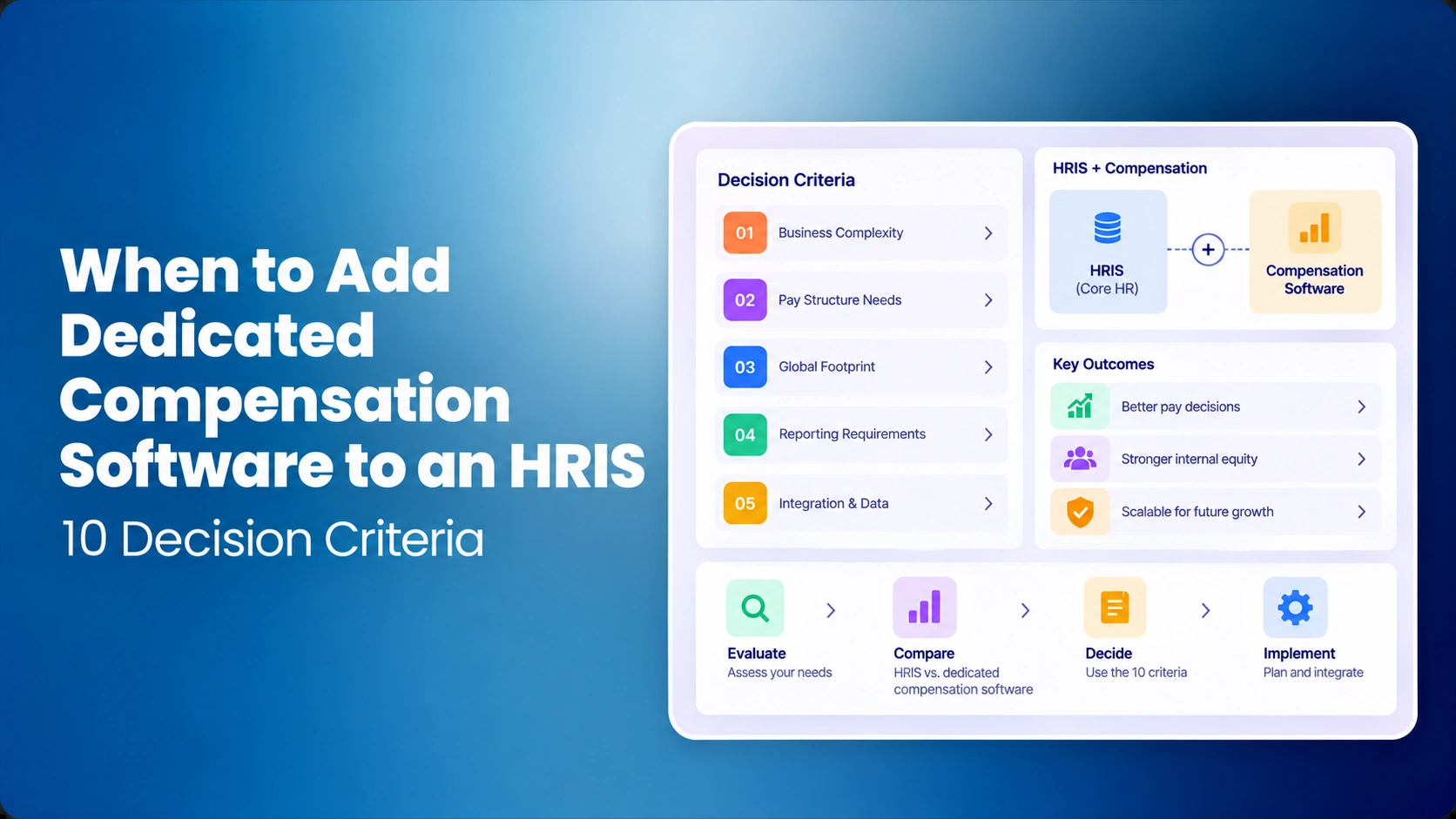

The HRIS is working. Employee records are accurate, people are paid, and HR has a predictable annual review process. Yet the Compensation Director spends three weeks reconciling salary bands and market benchmarks before managers can propose increases. Finance cannot distinguish submitted requests from approved expense. When a manager resubmits a pay change, somebody manually updates the approval trail. Is the HRIS failing, or is the company asking it to perform a specialist job?
The useful question is when to add compensation software to an HRIS, not when to replace the HRIS. A workforce system can remain authoritative for employee identities, positions and completed pay changes while a compensation application adds the specialized analysis, policy and decision controls the organization actually needs.
This article covers ten diagnostic criteria for that boundary. It does not repeat compensation planning software versus spreadsheets, whose central question is whether workbook-based operations are manageable, or the real-time integration primer, which examines synchronization. Here the buyer must decide whether the HRIS and its existing modules are sufficient, what incremental specialist capability is necessary, and what a successful integrated operating model looks like.
When Does an HRIS Need Dedicated Compensation Software?
Add dedicated compensation software when a recurring pay decision requires specialized grade and market context, controlled manager proposals, budget scenarios or authorization evidence that the configured HRIS cannot deliver without disproportionate workarounds. The threshold depends on the organization's actual complexity, not employee count alone.
It is entirely reasonable to stay with an existing HRIS if its compensation module can demonstrate the required results, permissions, pricing and change controls. Dedicated tools impose integration, security, procurement and support costs. The decision is about comparative operating capability rather than treating another SaaS subscription as an automatic modernization step.
| Decision or record | Keep in HRIS when appropriate | Specialist compensation contribution |
|---|---|---|
| Employee identity and job record | Authoritative employee, position and organization data | Consume relevant data with controlled mappings |
| Approved base salary and effective date | Final personnel or payroll transaction | Propose, review, authorize and reconcile decisions |
| Market references and pay architecture | May store some grade/pay-range fields | Govern matching, market evidence and structure versions |
| Merit and off-cycle proposals | May have native approval features | Model complex guidelines, budgets, exceptions and alternatives |
| Compensation analysis and reviews | Standard reports may suffice | Link equity signals, job value, range positions and decision rationale |
Ten Decision Criteria to Test Before Adding a Compensation Platform
1. Job grades and salary ranges are not governed in one place
Ask two reviewers to identify the effective salary range for a job in a particular location and grade. If the only reliable answer requires emailing a spreadsheet owner, the current environment has a governance gap. A specialist tool should connect the role in Job Architecture to a job evaluation outcome and the approved salary structure. It should not invent a new grade independently of the organization's policy.
2. Market data cannot be explained from job-match to approved pay range
If managers question why a range moved by 7%, the compensation analyst should be able to identify the matched job, market-source date, selected target and policy decision. A general HRIS field containing a new midpoint does not explain how the new midpoint was derived. The incremental need may be market benchmarking rather than a whole new merit-cycle product. See market pricing methodology before treating an imported figure as approved truth.
3. Merit decisions need more than the HRIS's available rules
Give the existing module a policy where guidelines vary by performance, grade, compa-ratio, eligibility and operating unit. It should handle legitimate exceptions, reviewer returns and revised recommendations without a side spreadsheet. If it can, retain it. If it cannot, evaluate a specialist Compensation Planning workflow and apply the merit matrix consistently.
4. Finance cannot separate requested, reserved and approved budget
A submitted proposal is not necessarily an approved obligation. Some employers reserve funds at submission, others when Finance approves, and still others only when finalizing. Whatever the policy, the current system must reconcile both the total merit pool and business-unit allocations as recommendations change. Merit budgeting and real-time cycle controls cover related operational mechanics.
5. Off-cycle adjustments repeatedly bypass annual governance
Promotions, retention responses, market adjustments and equity corrections need different reasons and approvals. If all are entered as an unlabeled salary-change field, HR will struggle to reconstruct why the amount was authorized. Use merit versus market adjustment and merit versus promotion as distinct classifications. The system should preserve the outcome as a change to the employee's pay, not just an adjustment to the annual worksheet.
Keep Your HRIS. Add the Compensation Controls You Need.
Explore CompBldr's governed compensation planning workflow, including grade context, reviewer approvals, salary positioning and budget visibility.
6. Managers have either too much access or too little context
Managers need the right salary positioning, guideline and recommendation history for their teams. They do not need unrestricted access to sensitive data across the organization. In a specialist demo, deliberately log in as two different managers and test access to employee detail, exceptions and analytics. See the governance considerations in manager merit-season preparation.
7. Reviewers cannot reconstruct an approval months later
Choose a past raise and ask who originally proposed it, whether it exceeded policy, who returned it, what changed, and which exact salary was finally approved. If the HRIS already has this trace, there may be no need to buy another approval tool. If the answer lives in meeting notes, test workflow versioning using the eight compensation approval demo tests.
8. Compensation planning and pay equity are investigated in isolation
An analyst might identify a potential issue while managers are revising recommendations. A standalone report cannot answer which proposed salary version will actually be approved. Pay Equity Software and planning need a governed handoff, with human review rather than automatic legal conclusions. Compare the connected equity-and-merit evaluation when reviewing this capability.
9. HRIS integration errors require manual detective work
A good architecture documents which system owns an employee identifier, grade, base salary, effective date and budget center. It also documents when changes move in each direction, failed transactions, reconciliation, and authorized reruns. Buyers should examine available integrations and the specific Workday integration example without assuming another HRIS supports identical bidirectional behavior.
10. Reporting explains the past but cannot model the decision ahead
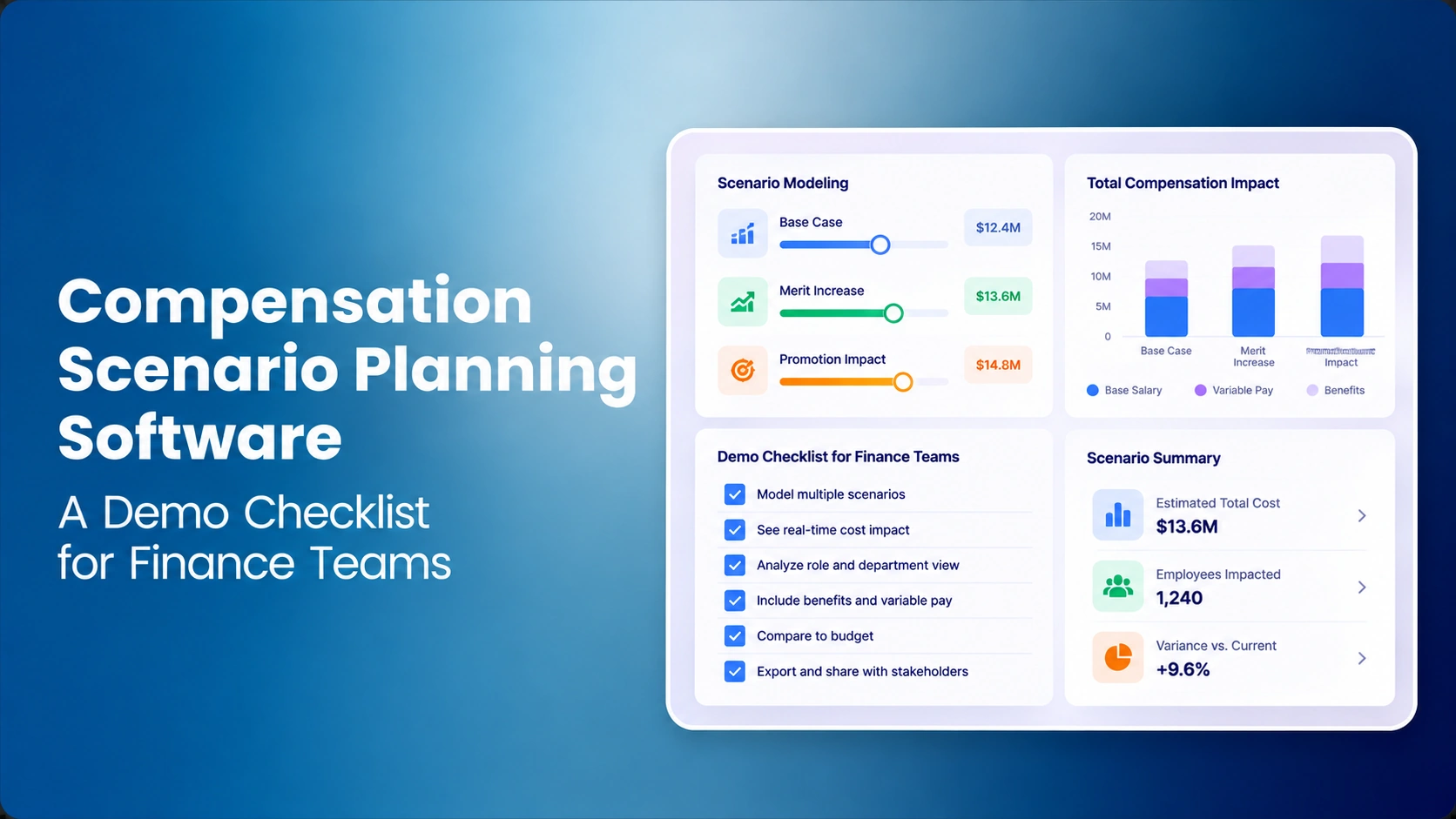
Finance may have accurate historical payroll reports and still lack a scenario showing the cost of proposed merit, promotion and salary-structure changes. Specialist Compensation Analytics and Compensation Reporting may provide a better decision layer when the existing stack cannot model or explain those scenarios. Test the proposed vs approved variance, not just dashboard appearance.
| Signal | Observed failure | Required demonstration |
|---|---|---|
| Grade governance | Conflicting salary ranges in files | Role, grade, approved range and effective date align |
| Market pricing | No trace from matched role to midpoint | Source and decision rationale shown |
| Merit complexity | Exceptions reviewed outside the system | Conditional rules, reviewer return and revision |
| Budget control | Finance reconciles by spreadsheet | Submitted, reserved and approved states reconcile |
| Off-cycle changes | Promotion and market changes have same reason code | Distinct action type, authority and effective date |
| Signal | Observed failure | Required demonstration |
|---|---|---|
| Manager security | Unrelated salaries available to reviewers | Role-based access and restricted population |
| Audit reconstruction | No traceable reviewer sequence | Original, revision, approval and final outcome |
| Equity context | Analysis uses obsolete salaries | Correct review cohort and versioned proposal |
| HRIS sync | Manual rekeying and silent errors | Mapped fields, status, failure and recovery |
| Decision reporting | No future-cost comparison | Scenario before authorization and actual reconciliation |
HRIS vs compensation management software is not a replacement comparison when the employee record remains in the HRIS. The boundary is the decision responsibility. Buyers evaluating compensation software integration with HRIS should verify mappings, effective dates, error handling and reconciliation. These are often the signs you need compensation planning software beyond a basic annual HRIS pay form.
Worked Example: Does the Specialist Layer Justify Its Cost?
Assume a fictional employer has 420 employees, four business units, two annual merit pools, and several off-cycle policies. The HRIS handles employee records and payroll reliably. The compensation team estimates that preparing, reconciling and administering these decisions consumes 180 Compensation hours at a loaded $80/hour, 60 Finance hours at $100/hour, and 40 extra HR correction hours at $80/hour per year.
| Work item | Hours and loaded rate | Modeled yearly cost |
|---|---|---|
| Compensation administration | 180 hours × $80 | $14,400 |
| Finance reconciliation | 60 hours × $100 | $6,000 |
| HR correction effort | 40 hours × $80 | $3,200 |
| Total modeled effort | 280 hours | $23,600 |
| Hypothetical specialist subscription | Annual illustrative quote | $28,000 |
| Hypothetical initial implementation | One-time illustrative quote | $12,000 |
The subscription alone exceeds the $23,600 of modeled labor by $4,400, and year-one software plus implementation would be $40,000 before internal change effort. Even if every modeled hour disappeared, this example would not justify the purchase on labor savings alone. Buyers need substantiated value from stronger control, better budget allocation, reduced process risk, improved decisions, or avoided alternative tooling. Do not invent a dollar value for a prevented legal problem or assume every manual hour can be eliminated.
A useful procurement model compares the current HRIS module, an improved process using existing tools, and a specialist solution. Include license pricing, integration build and support, security reviews, reviewer training, future configuration and the risk of duplicated employee data. The Compensation Planning buyer's checklist supports the broader vendor assessment.
Three Architecture Options, Not Just Buy or Do Nothing
| Operating option | Best-fit conditions | Likely trade-off |
|---|---|---|
| Configure the existing HRIS further | Current module supports policy and approvals with acceptable effort | Lower integration footprint, but may require customization |
| Add a targeted specialist module | Only market pricing, structure or cycle governance is missing | Incremental data integration and subscription oversight |
| Adopt a broader governed compensation platform | Architecture, pay ranges, planning and reporting all need one connected review layer | Larger implementation and change-management scope |
A specialist platform should not attempt to become a second, inconsistent master HRIS. Keep authoritative employee and completed-pay records in the source configured by the employer. Use a defined handoff from governance and approval to execution, then reconcile the accepted result. When evaluating replacement of compensation spreadsheets, distinguish eliminating unmanaged workbooks from eliminating legitimate data exports.
How CompBldr Fits Without Replacing the HRIS
CompBldr brings related capabilities across Job Architecture, Job Evaluation, Market Benchmarking, Salary Structure Software, Compensation Planning and Compensation Reporting. This creates a relevant candidate for organizations whose HRIS retains core employee data but does not provide the desired compensation decision context.
The TrAI capability provides AI-assisted pay review signals, which still require authorized interpretation. Specific integrations, approval paths, synchronization directions and audit outputs should be validated in a demonstration. A single product website cannot prove that the exact buyer's HRIS configuration supports every stated data flow. For a practical operational comparison, see the compensation governance platform guide.
Minimum Ten-Criteria Demo Scorecard
For each of the ten signs above, rate actual fit from zero to five, where zero means absent and five means it can be demonstrated repeatedly with the buyer's own fictitious test data and appropriate permissions. A weighted score may help rank finalists, but keep security, data governance and unauthorized salary-change controls as hard pass/fail gates.
| Evaluation dimension | Illustrative weight | Minimum acceptable evidence | Vendor score (0 to 5) |
|---|---|---|---|
| Job and market architecture | 20% | Grade, benchmark source and approved range identified | Unscored |
| Planning and exception controls | 25% | Conditional rules and revised approvals | Unscored |
| Finance scenarios and reporting | 20% | Submitted, approved and projected impact reconciled | Unscored |
| Security and audit trail | 20% | Manager scope enforced; review events recoverable | Unscored |
| HRIS integration and support | 15% | Mapped data, safe failure and reconciliation | Unscored |
| Total | 100% | Critical access/authorization controls also pass | Unscored |
Calculate total score as the sum of (each score ÷ 5 × its weight), which yields a number out of 100. All percentages here are illustrative procurement weights. In the demo, ask a reviewer to change a proposed salary twice, return it once, and reconcile the final approved value with the simulated HRIS employee record. The degree of integration is more important than a slideshow claiming everything is connected.
Sources and Next Steps
- Compensation Planning Software vs. Spreadsheets for the separate workbook decision.
- Compensation Planning Integrations for synchronization approaches.
- Compensation Planning Software Buyer's Checklist for procurement scoring.
- CompBldr + Workday Integration for one specific product integration context.
Run an HRIS-to-Compensation Decision Test
Use a synthetic employee roster, salary bands, two budget pools and a returned manager proposal. Evaluate what CompBldr adds without assuming a change to your HRIS.
Book a DemoEditorial note: All employee counts, hours, rates, costs and scenarios are fictional illustrations, not client outcomes, software pricing quotations or industry benchmarks. Confirm product capabilities and integration behavior against current vendor documentation and a test environment before purchasing.


.svg)

.svg)
.svg)

