

.svg)





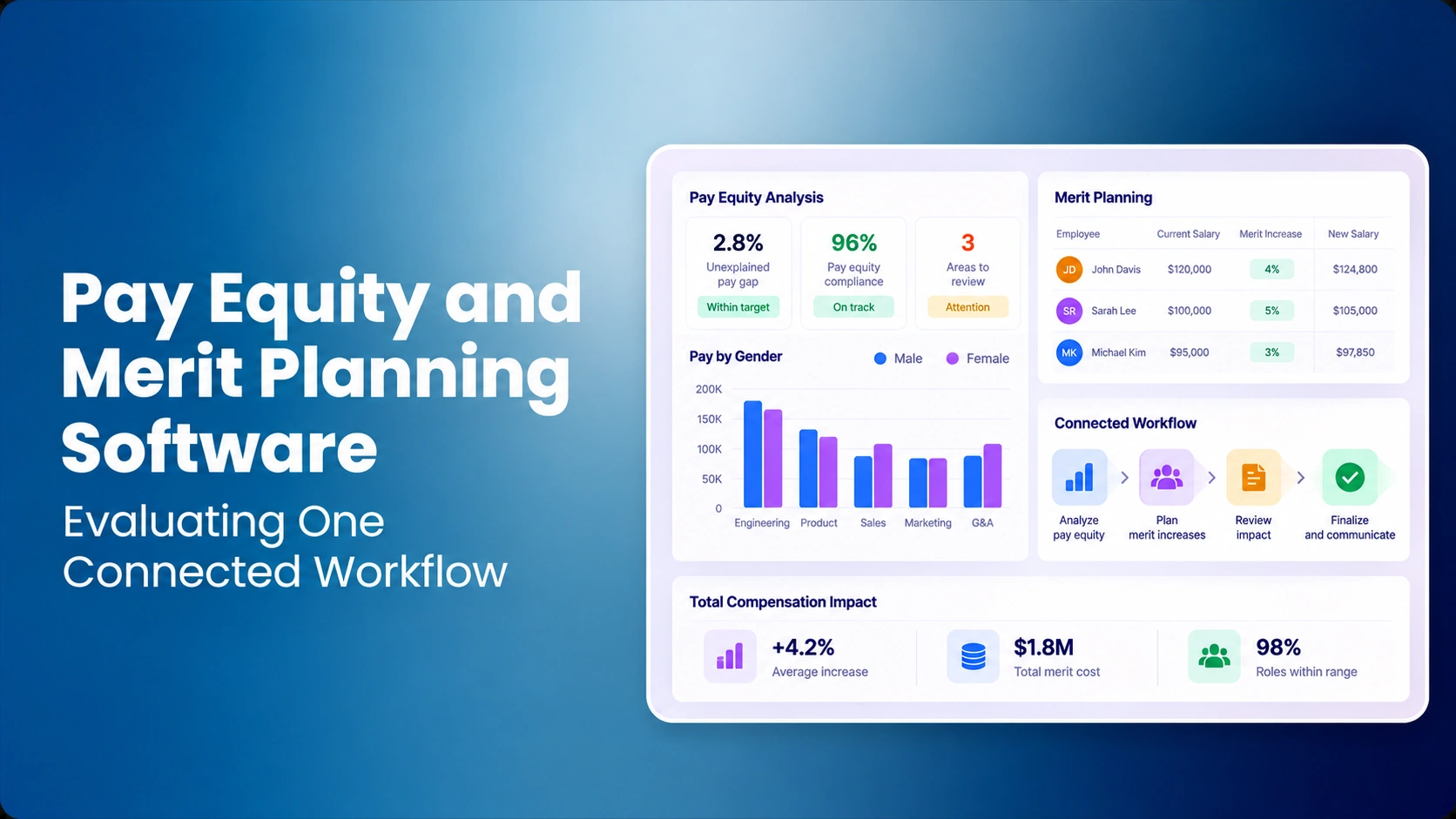

A Compensation Director is halfway through an annual merit cycle. Most department managers have submitted increases, Finance says the total pool is on plan, and the pay equity analyst identifies a questionable pattern in one job family. The analyst's report comes from last month's salary file. The managers have since revised their recommendations. Which figures are actually being approved?
That is the buying test for pay equity and merit planning software: can the organization investigate a possible pay difference inside the active decision workflow, revise a recommendation where warranted, recalculate the cost, and retain the reason before salaries are finalized? The answer is more useful than a promise of an AI-driven fairness score.
Evaluate the handoff, not two disconnected feature demos. The pay equity software evaluation guide and merit-cycle automation guide cover the separate components. Here the buying test is whether the final authorized salary and its budget effect can be traced to the equity review that preceded it.
What Does Integrated Pay Equity and Merit Planning Software Actually Do?
Integrated pay equity planning connects salary review recommendations with appropriate equity analysis, compensation guidelines, budgets, approvals, and decision records. When a manager changes a proposed increase, the analysis can be refreshed against the updated population, and the responsible Compensation or HR reviewer can document what the signal means before the increase becomes final.
The important distinction is between a signal and a determination. A comparison may reveal different proposed increases, but it does not establish unlawful discrimination. Defensible investigations require valid comparison groups, relevant explanatory factors, the correct statistical approach where appropriate, and human or legal review. The U.S. Equal Employment Opportunity Commission emphasizes actual job content rather than job titles alone when assessing substantially equal work under the Equal Pay Act.
A buyer evaluating integrated pay equity planning should test how the same employee record moves between manager recommendations, the analyst's review and Finance approval.
Where Separate Equity Dashboards and Merit Worksheets Lose Context
A stand-alone pay equity analysis tool may inspect a monthly employee extract, while the merit planning workflow contains a different set of proposed increases. Both tools can be well designed and still produce conflicting answers because they use different effective dates, job classifications, or approval states.
| Decision point | What must stay connected | Typical failure when separated |
|---|---|---|
| Employee population | Eligibility, employment status, effective date | Departed or transferred employee remains in a comparison |
| Role comparability | Approved job scope, grade, family, location | Same job title treated as proof of comparable work |
| Proposed pay | Current base, action type, effective-dated increase | Equity review uses an older salary extract |
| Manager decision | Recommendation, guideline, override reason | Reviewer sees a difference but not the manager's rationale |
| Final approval | Budget impact, decision owner, revision history | An approved amount differs from the last reviewed population |
This is why HRIS integration and authoritative data sources matter. A connected interface is not automatically a connected decision record: the vendor needs to show which version of each field was used and when. A workflow can still require external specialist analysis when the population or legal question warrants it.
Build Defensible Comparison Groups Before Turning On Equity Alerts
A meaningful alert begins with comparable work, not a collection of employees who share a title. Confirm job scope, relevant location, pay basis, grade and legitimate explanatory factors with the organization's job architecture and job evaluation methodology. The earlier comparison of grades versus levels is useful when the same level label spans materially different responsibilities.
Check that the salary benchmark, permitted pay range, and employee position within that range are current. Salary structure software helps preserve the authorized minimum, midpoint, and maximum; compa-ratio and range penetration describe different dimensions of pay position. Neither substitutes for an appropriate statistical equity analysis.
Create two review layers: one for policy and consistency screening of current merit proposals, and another for any protected-class analysis performed with authorized access, careful comparison-group construction, and qualified review. Do not expose sensitive demographic details broadly in manager approval screens.
Worked Example: A Merit Cycle That Widens a Difference
Consider four fictional employees in a preliminary same-grade review population. A Compensation analyst has not yet established whether they meet the relevant legal or statistical comparability test. All salaries and ratings are illustrative, and no protected characteristics are implied.
| Employee | Current annual base | Performance rating | Proposed merit | Proposed new base |
|---|---|---|---|---|
| A | $90,000 | 4 | 4% | $93,600 |
| B | $88,000 | 4 | 2% | $89,760 |
| C | $92,000 | 3 | 3% | $94,760 |
| D | $89,000 | 3 | 3% | $91,670 |
Employees A and B have the same illustrative performance rating, yet the proposed increase percentages differ. Their salary difference before the cycle is $2,000. After these two proposals, it would be $3,840. The arithmetic is a useful screening signal, not a finding of bias; legitimate factors may explain the difference, and the first task is to verify that the employees are actually comparable for the question being asked.
| Measure | Before merit | After proposed merit | Change |
|---|---|---|---|
| Employee A annual base | $90,000 | $93,600 | +$3,600 |
| Employee B annual base | $88,000 | $89,760 | +$1,760 |
| A minus B salary difference | $2,000 | $3,840 | +$1,840 |
| A minus B increase percentage | Not applicable | 4% vs. 2% | 2 percentage points |
A Compensation analyst might find that B's recommendation was constrained by a documented policy, reflect a separate in-year increase, or was entered incorrectly. If a correction is warranted, the resulting proposal may change again. The vendor needs to show the revised salary, new budget consumption, the reason for the revision, and whether the updated comparison changes other review signals.
Do not conflate this unadjusted pairwise comparison with an adjusted group-level estimate. The adjusted versus unadjusted pay gap guide explains why interpretation depends on the analysis question and controls. Likewise, a formal pay equity audit is a different process from a preliminary alert during the merit cycle.
Six Product Demo Tests for One Connected Workflow
1. Does the system use the same current population across both workflows?
Import a small fictional employee dataset and remove one employee from merit eligibility during the demo. Ask for the current eligibility count in both planning and the equity-review population, the reason for exclusion, and the effective date. If the totals differ, the reviewer needs to see exactly why.
The same test should cover a role move or promotion. A revised promotion and merit classification may change job scope or the pay action being evaluated. It must not silently remain in an obsolete cohort.
Good pay equity checks during merit review should surface a question early enough for a person to investigate it without stopping unrelated pay decisions.
2. Can a current manager proposal trigger an actionable review signal?
Have the manager enter the four recommendations from the worked example. Ask the software to show the inputs and rule behind any equity or compression signal. Some systems support alerts during submission, others only after a scheduled analytical run. A buyer needs a demonstrated distinction, not a claim of “real-time AI.”
CompBldr describes TrAI as an AI-assisted review layer that can surface possible compression, equity, and budget exceptions while a cycle is active. The existing TrAI merit-cycle explanation covers the feature concept. In this evaluation, ask to see what review evidence accompanies the flag, not merely whether an alert appears.
Also require the vendor to distinguish pay compression from a potential equity concern. An employee nearing a manager's salary may warrant structural review but does not, by itself, establish inequitable pay.
3. Can HR investigate the finding without losing the manager's decision context?
Assign the flag to Compensation. The reviewer should be able to inspect the proposed salary, merit guideline, performance context, available rationale, relevant salary range, and past approved changes. The analyst may need additional records not available in the routine manager interface. Keep protected information subject to appropriate access control.
Test three outcomes: the proposal is supported and the reviewer records why; the evidence is incomplete and the request stays pending; or the manager is asked for a revised amount. The system needs an explicit disposition. A dashboard that merely colors the employee red and provides no investigation workflow is insufficient.
Review Equity Signals Before Merit Approvals Close
Explore how CompBldr connects proposed increases, compensation guidelines, exception review, and pay equity context in the active cycle.
4. Can the organization model the funding impact of a correction?
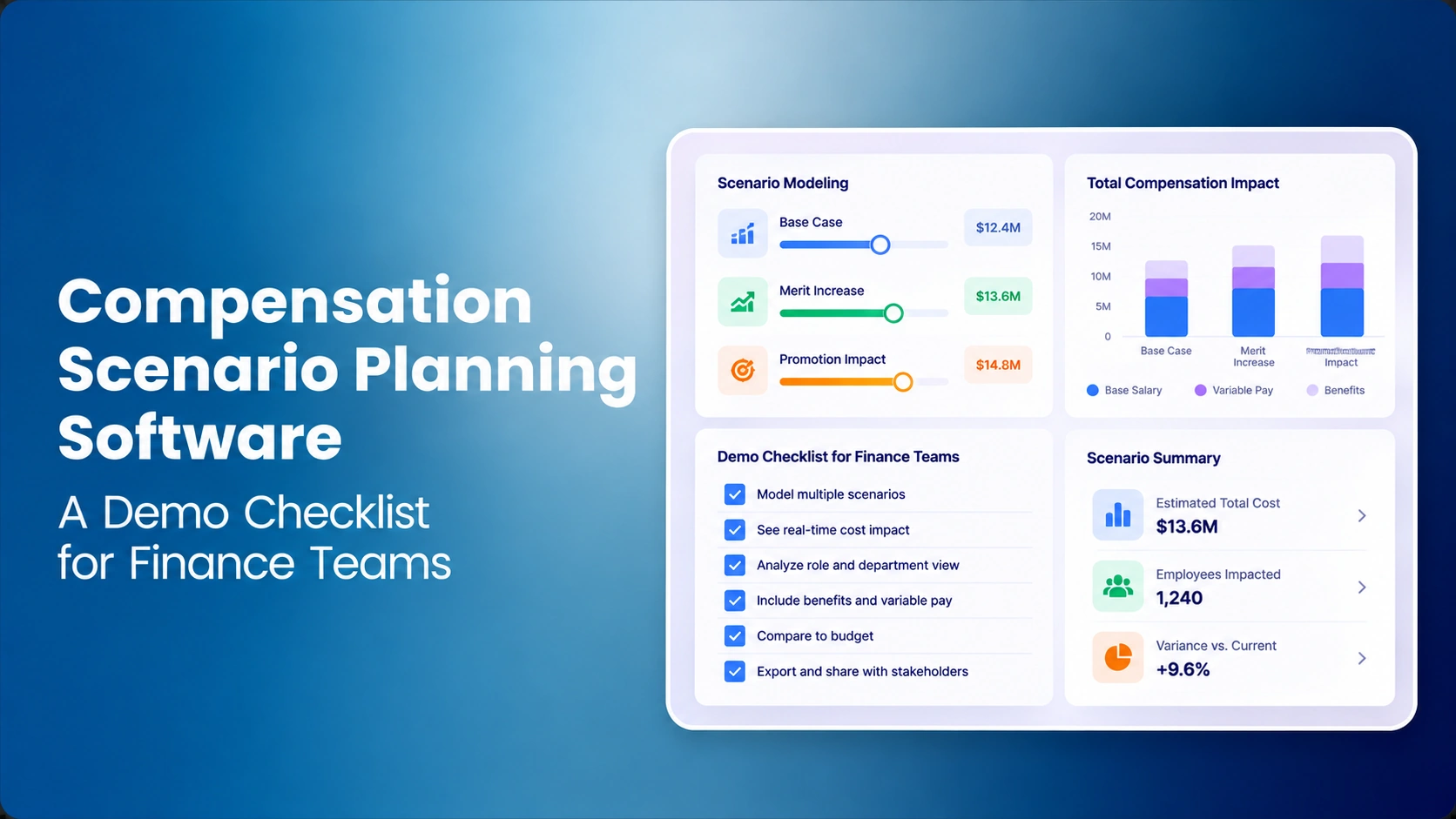
Suppose the reviewer concludes that B's proposal should be revised from 2% to 4% under the organization's approved criteria. That is an additional 2% of B's $88,000 current base salary, or $1,760 annualized. The revised proposed salary would be $91,520. With A's proposed $93,600 unchanged, the revised A-to-B salary difference would be $2,080, down from the initial proposed $3,840 but still $80 above the pre-cycle difference of $2,000. The calculation shows the remaining difference; it does not justify or prescribe a particular salary correction. This is an illustrative decision, not a legally sufficient remedy.
Ask the vendor to show where that additional $1,760 comes from, which department owns it, whether the pending salary action reserves money, and who can approve it. Compensation dashboard metrics must distinguish draft, pending, and approved increases. Finance should see the change in budget and equity reporting without comparing two different exports.
If the increase was instead a justified market adjustment, it might require a different cost center or approval chain. A platform that merges market, equity, and merit allocations without separate decision categories makes reconciliation harder.
5. Does the equity review refresh after the proposal is revised?
Change B's proposed increase, resubmit it, then open the same equity-review record. Does it reflect the updated amount? Can the reviewer inspect both versions, retain the prior concern and final rationale, and distinguish an addressed item from a dismissed or unresolved one?
A strong connected workflow should keep proposal version, review state, reviewer identity, and final authorization together. That does not mean every flag will resolve immediately or every workflow can be automated. Check how delegated approvers and managers use the organization's merit review instructions when a recommendation returns for revision.
When comparing compensation equity review software, ask whether the outcome links back to the exact proposal version rather than a detached employee record.
6. Can Finance reconstruct what was approved and why?
After the fictional cycle closes, ask a different reviewer to recreate the sequence for Employee B: original proposal, flagged pattern, comparator definition, additional evidence, revised recommendation, incremental annualized cost, approvers, effective date, and final approved value. The record should support authorized internal review and downstream compensation reporting.
The broader compensation governance framework determines what must be retained and who may see it. The EEOC's employer pay guidance specifically recommends consistent compensation decision criteria and documentation of decisions about raises and other adjustments. Recordkeeping periods and other legal duties should be reviewed for the employer's jurisdictions.
Set Review Ownership and Budget Rules Before Buying Software
Even an integrated platform cannot resolve ambiguity about who has final authority. Write down the decision rights before configuring alerts and escalation rules.
| Decision or question | Primary owner | Evidence required | Escalation trigger |
|---|---|---|---|
| Is this a valid group for comparison? | Compensation / qualified analyst | Job content, grade, location, analysis method | Missing or inconsistent employee data |
| Why does the proposed increase differ? | Manager + Compensation | Performance, policy, prior approved actions | Insufficient or disputed rationale |
| Is further investigation needed? | Compensation / authorized HR | Current analysis, relevant lawful factors | Unresolved equity concern |
| Can the revised increase be funded? | Finance + Compensation | Annualized cost, cost center, approval state | Budget or policy exception |
| May the change be finalized? | Authorized approver | Completed reviews and approval history | Open required review or unauthorized override |
The right controls differ by organization. An employer with several HR business partners and one annual cycle may prioritize permission boundaries and simple exception tracking. A multi-division group with staggered reviews, multiple currencies, and different bonus programs needs effective-dated actions, budget ownership, and more complex approval routing. Start from the operating merit-cycle process rather than adapting policy to a vendor's default screen.
The real issue is pay gap risk in salary planning: whether proposed decisions widen an unexplained difference within a justified comparison group before approval.
Vendor Scorecard: Verify One Workflow, Not Two Product Demos
Have each vendor use the same fictional employees and the same stated policy. Score demonstrated behavior, not roadmap commitments. The weights are illustrative and should be adapted to the employer's risk and operating model.
| Connected capability | Illustrative weight | Evidence to request | Vendor score (0–5) |
|---|---|---|---|
| Current data and cohort consistency | 20% | Same employee population, dated sources, traceable exclusions | — |
| In-cycle equity and compression signals | 20% | Proposal-triggered signal with reviewable logic | — |
| Case ownership and investigation | 15% | Assigned reviewer, rationale, disposition, permission controls | — |
| Revision and budget integration | 20% | New salary, incremental cost, budget reconciliation | — |
| Approvals and decision history | 15% | Versioned recommendation, authorization and final state | — |
| Export and integration integrity | 10% | Reproducible record and documented system of truth | — |
| Total | 100% | Do not average away failed critical controls | — |
Rate each area from 0 to 5: absent (0), manual workaround (1), substantial customization (2), demonstrated with limitations (3), meets the requirement (4), or independently repeatable and traceable (5). Weighted score out of 100 = sum of (test score / 5 × weight). Treat privacy, authorization, and material data-quality failures as separate pass/fail controls.
Do not select a vendor solely because its quarterly pay equity reporting is polished. Board reports measure governance outcomes; the merit-cycle software must demonstrate the employee-level decision path producing those outcomes. Similarly, more charts do not replace valid market evidence or defensible pay comparators.
How CompBldr Connects Equity Review With Merit Planning
CompBldr's published Compensation Planning capabilities include merit guidelines, manager proposals, budget controls, multi-level approvals, and review flags for potential pay issues. Its Pay Equity Software and TrAI review layer provide related analysis context, while Compensation Analytics exposes budget and pay-position views for authorized users. The value of the proposed evaluation is to see how those capabilities connect for your policy, data, and review population.
Ask CompBldr to demonstrate the example employee from initial manager recommendation through equity review, revised amount, budget effect, approval, and a saved record. Confirm any required configuration, data restrictions, and integrations during the demo. An AI-generated flag is a starting point for expert review, not a legal conclusion.
After pay changes are approved, organizations may also use total rewards statements to communicate reviewed compensation outcomes. Those communications must draw from authorized final values rather than unresolved proposals.
Sources and Further Reading
- EEOC: Equal Pay / Compensation Discrimination: guidance on job content and equal work under the Equal Pay Act.
- EEOC: Pay Tips: employer guidance on consistent pay criteria and records.
- CompBldr: Pay Equity Software Evaluation: broader platform selection framework.
- CompBldr: Merit Cycle Automation: budget and manager workflow operations.
See Pay Equity and Merit Planning in One Workflow
Bring a synthetic merit dataset, your equity review rules, and a sample department budget. Test how CompBldr connects the proposal, equity signal, investigation, approval, and final decision history.
Book a DemoEditorial note: All employee data, salary figures, comparison cases, approval rules, and scorecard weights are illustrative. This article provides software evaluation guidance, not legal or statistical advice. Consult qualified specialists for pay equity investigations and applicable laws.


.svg)

.svg)
.svg)

