

.svg)





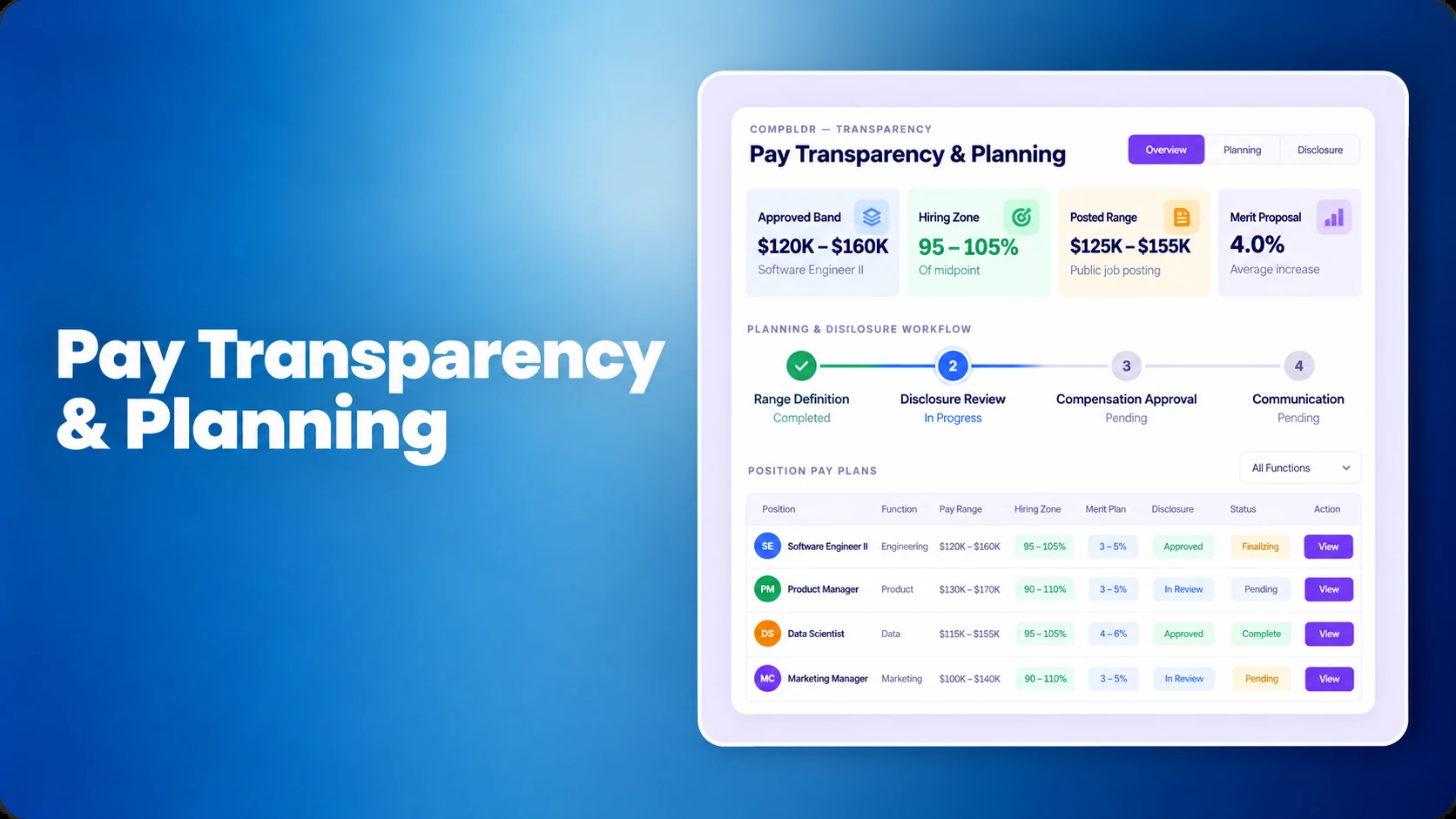

Recruiting publishes a $90,000 to $110,000 pay range for a senior analyst. Finance then receives a $115,200 merit-cycle proposal for an incumbent in the same grade, representing an illustrative 20% increase from a $96,000 salary. The approved grade band is $80,000 to $120,000. Each number has a legitimate-looking source, but the sources describe different decisions. When an employee asks why the job advertisement stops at $110,000, can HR reproduce the reason?
Pay transparency and compensation planning software need a shared job and grade definition, effective-dated approved salary ranges, clear hiring and merit rules, correct approval ownership and a record of what has been communicated. Simply showing the same salary band in two products does not make the decisions consistent.
This article examines compensation planning and pay transparency as a connected buyer workflow, rather than repeating pay transparency definitions, state-specific salary-range laws, or the transparency software readiness framework. Its central question is whether recruiting, Compensation, Finance and HR Operations can trace the same salary decision without confusing what has been proposed, authorized and disclosed.
What Must the Software Workflows Share?
A pay transparency compensation workflow must trace each number to the correct job, grade, approved range version, applicable policy, reviewer and decision state. The ATS may own job advertisements, the HRIS may own employee records, and Compensation Planning may own merit decisions. These systems do not need to be replaced by one application. They do need a clear source of truth and governed handoffs.
The chain starts with the evaluated role and Job Architecture, supported by a current Job Description and Job Evaluation. Market Benchmarking informs the grade's positioning; Salary Structure Software maintains the approved minimum, midpoint and maximum. The recruiting disclosure and manager worksheet should reference that structure rather than separate saved copies.
| Data or action | Owner | Consumer | Failure signal |
|---|---|---|---|
| Job family, level, grade | HR / Compensation | Recruiter and manager | Different grade for the same role |
| Range version and effective date | Compensation | ATS, merit planning, HRBP | Old range still published |
| Recruiting and disclosure policy | Talent Acquisition and authorized reviewer | Job applicants | Hiring zone treated as legally approved range |
| Proposed pay change | Manager / Compensation | Finance and HRBP | Threshold exception bypassed |
| Final approval | Designated reviewers | HR Operations | Unapproved salary communicated |
| Communication record | Recruiting or HR Operations | Applicants and employees | Cannot recover what was disclosed |
Three Ranges That Must Not Be Confused
A formal salary band is the authorized range for a grade. A hiring zone can be a smaller set of starting-pay values used for recruiting guidance. A disclosed range is what a candidate or employee is told under a particular legal requirement or company policy. Those three can be different, and a posting range cannot be chosen solely because a recruiter prefers a narrower number.
| Item | Illustrative value | What it means | Decision authority |
|---|---|---|---|
| Formal Grade 6 band | $80,000 to $120,000 | Approved grade limits | Compensation governance |
| Hiring zone | $90,000 to $110,000 | Internal recruiter starting-pay guidance | Recruiting and Compensation |
| Posted range | Case-specific, subject to legal and policy review | External information provided to applicants | Authorized disclosure reviewer |
| Employee actual salary | $96,000 | Individual employee record | Authorized HRIS process |
These figures are fictitious, not recommended salary bands or legal disclosure ranges. Some jurisdictions have good-faith range requirements or rules for promotions, remote postings and requests from employees. The CompBldr laws-by-state guide links relevant primary authorities, but the employer must establish what the particular posting requires with qualified reviewers.
Two state-agency examples show why disclosure rules need separate review. The California Labor Commissioner's Equal Pay Act guidance describes a good-faith pay scale as the range the employer reasonably expects to pay on hire. The Colorado Department of Labor's pay-transparency guidance addresses a job-specific range reflecting the pay the employer genuinely expects it might offer. Neither lets recruiters assume that an internal hiring zone is automatically a compliant published range. These examples do not replace a current jurisdiction-specific legal review.
Worked Example: Merit Planning in a Transparently Disclosed Grade
Assume an existing employee earns $96,000 in Grade 6, where the formal approved band runs from $80,000 to $120,000 and the midpoint is $100,000. The manager proposes a 5% merit increase. Recruiting separately uses the fictional $90,000 to $110,000 hiring zone. Those numbers describe different decisions; they do not automatically prove unequal treatment.
| Measure | Calculation | Result |
|---|---|---|
| Current salary | Employee base record | $96,000 |
| Proposed merit increase | $96,000 x 5% | $4,800 |
| Proposed annual base | $96,000 + $4,800 | $100,800 |
| Grade midpoint | ($80,000 + $120,000) / 2 | $100,000 |
| Compa-ratio after proposal | $100,800 / $100,000 x 100 | 100.8% |
| Approval | Guidelines, budget and authorization | Not yet final |
The proposed $100,800 falls inside the band and hiring zone, but must still satisfy the merit matrix, budget and review process. For correct interpretation of position in the range, distinguish compa-ratio from range penetration.
Now change the merit recommendation to 20%. It adds $19,200, bringing the proposed salary to $115,200. That is within the formal grade but outside the recruiting hiring zone, and still needs policy review. A candidate asking for $125,000 creates a different decision, since that amount exceeds the grade maximum by $5,000. That calls for the offer governance path rather than an automatic grade change.
Six Product Tests for One Connected Transparency and Planning Workflow
Test 1: Can an approved salary-range change be traced across systems?
Future-date a change to Grade 6's maximum from $120,000 to $124,000. Ask the vendor to show which version a recruiter sees today, which version the next merit cycle uses, and how an auditor reconstructs the original $120,000 range used before the effective date.
Good salary range governance software should preserve approval context and effective dates. It should also signal to the owner of affected job postings when range information might require review. A new salary structure is not necessarily permission to retroactively change old hiring disclosures. Compare historical pay grade overlap calculations using the grade versions effective at the time, not mixed historical data.
Test 2: Can the right reviewer stop an unauthorized amount?
Ask the recruiter to propose a starting salary above the internal hiring zone and the manager to enter a merit increase above the configured guideline. The proposed amounts may be valid subjects for review, but the relevant reviewers and authority rules are different. Request the actual routing result, the justification field and an attempt to finalize without permission.
CompBldr Compensation Planning describes configurable merit approvals, threshold rules, current budget visibility and recorded review decisions. The product evaluation should test those exact capabilities without assuming an external applicant tracking system uses identical authorization settings. For a detailed multi-reviewer scenario, see the compensation approval workflow guide.
Connect Salary Range Governance With Pay Decisions
Explore the grade context, review controls and decision records that support more explainable pay ranges in CompBldr.
Test 3: Can a manager explain the range without seeing private peer salaries?
Pay transparency software for HR and Finance has a difficult access problem. A manager needs to explain an employee's grade, authorized band, policy and relevant decision context, but should not automatically see compensation information for unrelated employees. Test two accounts with different populations and deliberately attempt an unauthorized lookup.
Use merit-season manager guidance to distinguish the permitted conversation from an internal pay equity investigation. More visible range information does not establish that every salary difference is unlawful. That separate issue belongs to qualified pay equity analysis and the employer's approved escalation policy.
Test 4: Can the system keep four approvals distinct?
Posting a range, changing a grade band, approving a salary increase and authorizing a promotion are related but not identical transactions. Each needs the right owner, timestamp, reason and effective date. A buyer should ask the vendor to show them as separate actions that share approved compensation context.
| Action | Review owner | Evidence to preserve | Common workflow failure |
|---|---|---|---|
| Grade band revision | Compensation governance | Old/new limits and effective date | Changes past compa-ratios silently |
| Posting range | Recruiting and approved disclosure reviewer | What was published, where and when | Unapproved range goes public |
| Merit recommendation | Manager / HR / Finance | Proposed amount, budget, rationale | Threshold approval bypassed |
| Promotion or market action | Authorized HR / Compensation | Role change, new grade, adjusted salary | Merit and market actions mixed together |
The classification of market adjustments versus merit increases is especially important when both happen in one cycle. The grade-versus-level distinction also matters when a promotion triggers a new grade rather than a movement within the same band.
Test 5: Can employee communications exclude unapproved proposals?
Open the employee-facing view before and after the fictional $4,800 increase has been authorized and processed. The draft salary must not appear as an accomplished pay change. Where the organization provides total rewards statements, verify that the communication receives the approved final data, not a still-pending manager recommendation.
A request for the current pay range is different from a full total rewards explanation. The former involves a salary band or other required disclosure; the latter may include benefits, incentives and employer contributions. Do not force both communications through one unlabeled message template.
Test 6: Can Finance reconcile submitted, approved and executed dollars?
Finance needs an explicit policy defining when proposals reserve money. In some configurations, submitted requests count against available budget before approval; in others, only approved decisions count. Ask the vendor to reject the example request, revise it and approve a new amount. The budget must move predictably without duplicate counting.
| Status | Increase | Financial meaning | Employee communication |
|---|---|---|---|
| Draft | $4,800 | Not yet submitted; reserve treatment depends on policy | Not final |
| Submitted | $4,800 | Pending and possibly reserved | Not final |
| Approved | $4,800 | Authorized commitment | Subject to effective-date policy |
| Executed | $4,800 | Completed authorized pay change | Can be communicated as final |
Compare the figures in Compensation Analytics and Compensation Reporting, where those modules are configured. An authorized planning decision is still different from confirmed downstream execution in an HRIS or payroll environment. This distinction matters when Finance explains the cost of pay decisions already disclosed to employees.
Connected-Workflow Scorecard for HR and Finance Buyers
Run all six demonstrations against the same synthetic grade, candidate and employee scenario. A vendor with a strong transparency dashboard can still fail because the range exported to recruiting does not match the value shown in merit planning. Use demonstrated actions and saved evidence to score the actual implementation, not aspirational product diagrams.
| Demo test | Illustrative weight | Minimum evidence | Score (0 to 5) |
|---|---|---|---|
| Range version and shared data | 20% | Effective-dated approved limits | Not yet scored |
| Recruiting disclosures | 15% | Authorized posting and revision record | Not yet scored |
| Merit and offer exceptions | 20% | Distinct reviewers and outcomes | Not yet scored |
| Manager context and access | 15% | Relevant grade context, access denied where necessary | Not yet scored |
| Budget reconciliation | 15% | Consistent draft, pending and executed states | Not yet scored |
| Communications and audit history | 15% | Exact disclosed and approved values recoverable | Not yet scored |
| Total | 100% | Hard stops for unauthorized access or approval | Not yet scored |
Rate each capability from zero when absent to five when independently repeatable. Weighted score out of 100 = sum of (test score ÷ 5 × its assigned weight). This scoring method is a starting point, not a universal purchasing benchmark. Failed authorization, data-access or legal-disclosure controls must remain separate pass/fail items.
Where CompBldr Fits in the Compensation Decision Chain
CompBldr Pay Transparency Software helps compensation teams work with governed salary ranges and related decision evidence. Its Compensation Planning product describes configured merit rules, approval paths, proposals, budget visibility and recorded decisions. Upstream Job Architecture, Market Benchmarking and Salary Structure Software help establish role and range context.
CompBldr also describes pay-position and compression review signals during merit planning; TrAI can assist reviewers with relevant compensation patterns. A signal is not a legal determination or permission to change an employee's pay. Buyers should verify which recruiting exports, ATS connections, disclosure approvals and employee communications are native, configurable or handled outside the application.
In a smaller organization, one Compensation owner, a short review chain and a governed salary table may suffice. A multi-entity enterprise can require different currencies, grade families, regional disclosure rules, union or collective agreement constraints and restricted reviewer populations. Either operating model still needs the same question answered: who approved this amount, under which range version, and what did the employee or applicant actually see?
Common Implementation Mistakes Worth Testing Before Rollout
- Confusing the hiring zone with the disclosed range: internal recruiter guidance is published without confirming the correct legal and policy requirements.
- Rewriting the past: a changed range midpoint makes earlier merit-cycle positions appear incorrect because old ranges cannot be recovered.
- Oversharing salary details: managers are given individual pay history for unrelated employees when only the approved range is appropriate.
- Combining unlike approvals: a changed job advertisement is treated as authorizing a salary increase.
- Losing approved changes downstream: merit planning shows a final increase but HRIS execution remains incomplete.
- Equating disclosure with equity: published bands cannot replace appropriate pay equity analysis or required human review.
Managers also need to understand that promotions and merit increases are different actions; a new title does not itself define the correct salary. For broader buyer diligence use the Compensation Planning Software Buyer's Checklist. For international obligations, compare relevant rules using the EU pay transparency guide rather than assuming one global posting policy will satisfy every jurisdiction.
Sources and Related Reading
- California Labor Commissioner: Equal Pay Act and pay-scale FAQs for the good-faith pay scale standard.
- Colorado Department of Labor: Equal Pay for Equal Work Act guidance for position-specific posting ranges.
- CompBldr: Pay Transparency Laws by State (2027), including links to current government and legislative sources.
- CompBldr: Pay Transparency Software Readiness for organizational maturity and disclosure models.
- CompBldr: Compensation Planning Software Buyer's Checklist for wider vendor evaluation.
- EEOC: Equal Pay / Compensation Discrimination for principles of equal compensation, a separate question from range-disclosure requirements.
Test Transparency and Compensation Planning Together
Bring a fictional role, a salary band, an out-of-policy pay proposal, and your Finance approval rules to evaluate the complete decision chain.
Book a DemoEditorial note: All salary ranges, employee examples, percentages and vendor score weights are illustrative. Pay transparency rules and permissible disclosures vary by jurisdiction and may change. This article explains software evaluation and compensation governance, not legal or tax advice. Obtain appropriate legal review before applying any disclosure rule.


.svg)

.svg)
.svg)

