

.svg)





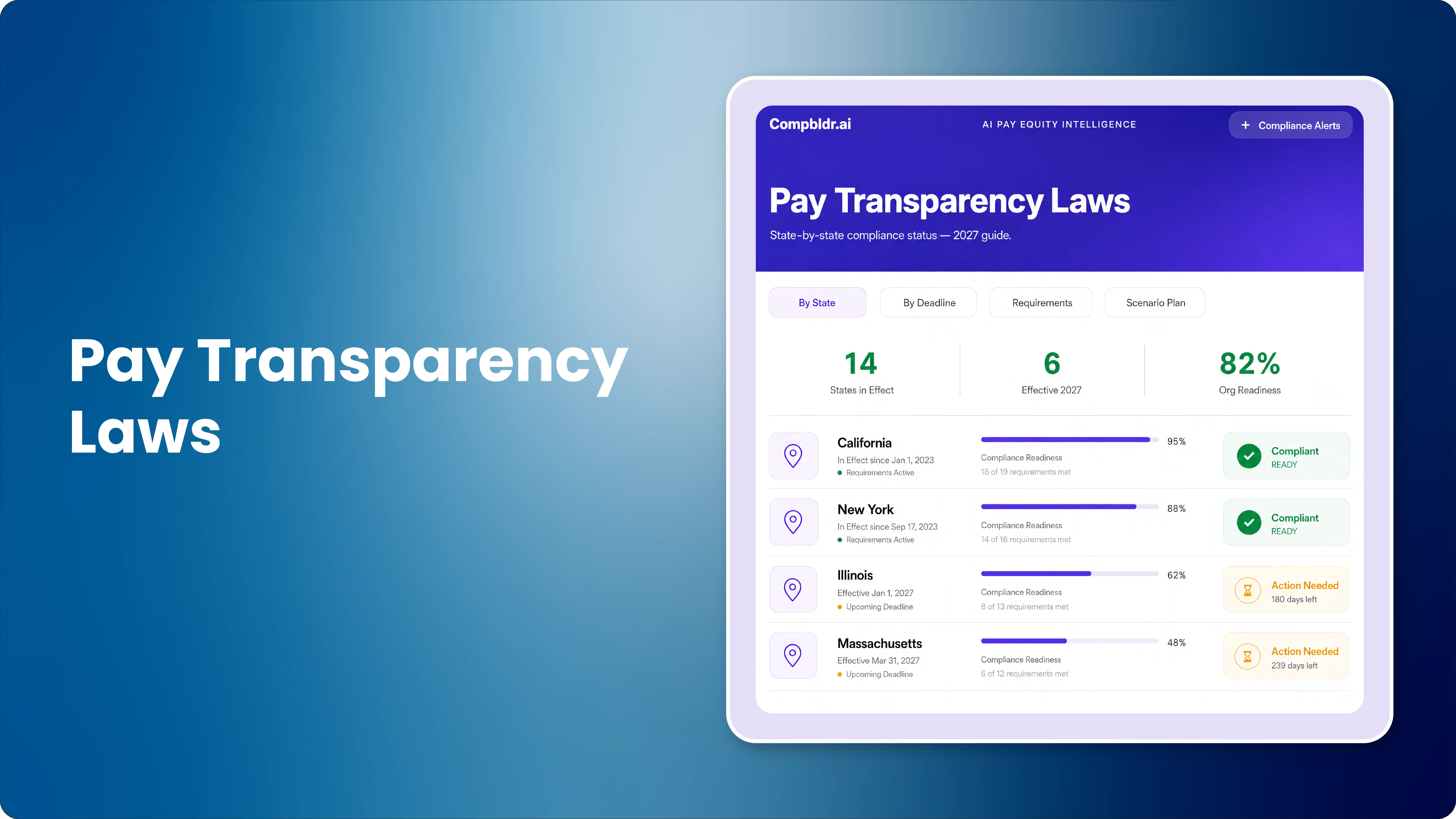

Pay transparency compliance in the United States is a jurisdiction-by-jurisdiction problem, not one national posting rule. Employers recruiting across multiple states, hiring remotely, or moving employees through promotions and transfers may need to account for different salary-range disclosure triggers, employer-size thresholds, benefits requirements, employee-request rights, salary-history restrictions, recordkeeping rules, and local ordinances. For the compensation-data and governance workflow behind approved ranges, see CompBldr pay transparency software; legal applicability still requires jurisdiction-specific review.
For 2027 planning, the most important new deadline currently on the calendar is Delaware's statewide pay transparency law, which takes effect September 26, 2027. Virginia's statewide job-posting range requirement took effect July 1, 2026, and Maine's new pay-range posting law took effect July 29, 2026. Existing requirements in California, Colorado, Illinois, Massachusetts, Minnesota, New Jersey, New York, Vermont, Washington, Washington, D.C., and other jurisdictions remain part of the compliance map.
Legal review notice: This guide provides general operational information, not legal advice. It was reviewed on October 7, 2026. Pay transparency, equal pay, salary-history, recordkeeping, and local requirements can change. Before relying on this guide for a live posting or employment decision, confirm the current statute and agency guidance for every applicable jurisdiction and consult qualified employment counsel.
Source-verification note: This guide was rechecked against current government and legislative sources. Where published summaries and current official sources differ, the article follows the current primary source and identifies material distinctions.
Why Pay Transparency Laws Matter for Multi-State Employers
Pay transparency has moved from an HR best practice into a legal requirement in many jurisdictions. For organizations operating across states, recruiting nationally, or hiring remote employees, the challenge is the patchwork itself: one jurisdiction may require a salary range in the job advertisement, another may require disclosure only before an offer or after an interview, and another may add benefits, internal opportunities, employee requests, or recordkeeping obligations.
The compliance question is therefore broader than, "Did we put a salary range in the posting?" Employers increasingly need a repeatable process for determining which rule applies, what must be disclosed, what evidence supports the range, and how the same approved information is carried through the careers site, applicant-tracking system, recruiter brief, job board, internal opportunity, offer process, and employee request.
Federal Pay Transparency Baseline
There is no single general federal law that requires private employers nationwide to include a salary range in every ordinary job posting. Federal law still creates an important compensation baseline, however, and state pay-transparency rules sit on top of those protections.
| Federal law | Status | What employers should know | Official source |
|---|---|---|---|
| Equal Pay Act of 1963 | In effect | Requires equal pay for men and women performing substantially equal work in the same establishment, subject to the statute's standards and defenses. | EEOC compensation guidance |
| Title VII of the Civil Rights Act of 1964 | In effect | Prohibits compensation discrimination because of race, color, religion, sex, or national origin, subject to the statute's coverage and standards. | EEOC Title VII text |
| National Labor Relations Act | In effect | Protects covered employees' right to discuss wages and compensation. Employer policies that prohibit or chill protected wage discussions can be unlawful. | NLRB wage-discussion rights |
| Nationwide salary-range posting rule | No general private-sector requirement identified as of October 7, 2026 | There is not one general federal rule requiring all private employers nationwide to put salary ranges in ordinary job postings. Employers should still check any federal contractor, industry, program, or other specialized requirements that may apply to them. | U.S. Department of Labor |
What Changes for 2027?
The 2027 compliance calendar is not only about laws that begin in 2027. Employers entering 2027 must also account for state rules that became effective during 2025 and 2026 and may already apply to their active postings.
- Virginia: Beginning July 1, 2026, Virginia requires wage or salary ranges in job postings and hiring advertisements and prohibits seeking an applicant's wage or salary history. See the Virginia Department of Labor and Industry guidance.
- Maine: Public Law 2025, Chapter 771 was enacted and signed April 24, 2026. Because it was a nonemergency law from Maine's Second Regular Session, it took effect on the session's general effective date, July 29, 2026. Employers with 10 or more employees must include the prospective range of pay in covered postings; employees can request the range for their current position, and position/pay history records must be maintained. See Maine LD 54 / HP 18.
- Delaware: House Substitute 2 for House Bill 105 was signed September 26, 2025 and takes effect September 26, 2027. It applies to employers with more than 25 employees and requires salary or wage range information plus a general description of benefits in covered postings, along with applicant access and recordkeeping requirements. See the Delaware General Assembly bill record.
Effective-date clarification: Delaware's law was signed on September 26, 2025 but becomes effective September 26, 2027.
Pay Transparency Laws by State and Jurisdiction
The table below covers the jurisdictions most relevant to a 2027-ready workflow and adds the operational distinctions that matter for employers. It is a compliance reference, not a substitute for jurisdiction-specific legal advice.
| Jurisdiction | Effective date / status | Key requirement for employers | Operational note | Official source |
|---|---|---|---|---|
| California | Jan. 1, 2023 posting rule; additional 2026 amendments | Covered employers must include the pay scale in job postings. Employees can request the pay scale for their current position. Separate pay-data reporting obligations apply to covered employers. | The Labor Commissioner interprets the posting rule to cover positions that may ever be filled in California, in person or remotely. For the detailed California workflow, see CompBldr's California pay transparency guide. | California DIR |
| Colorado | Jan. 1, 2021; current rules amended since original enactment | Covered job opportunity notices must disclose compensation and generally describe benefits and other required opportunity information. | Colorado also regulates notice and transparency around job opportunities and career progression. Employers should use current CDLE guidance rather than an older 2021 summary. | Colorado CDLE INFO #9A |
| Connecticut | Oct. 1, 2021 | Employers must provide the wage range to an applicant at the earliest of the applicant's request or before/at the time an offer of compensation is made. | Employees must receive the wage range at hire, when their position changes, or on their first request. Connecticut is not simply a job-posting mandate. | Connecticut DOL |
| Delaware | Sept. 26, 2027 | Covered postings must include salary or wage range information and a general description of benefits. Applicants must have access to the information before an offer or compensation discussion when required. | Applies to employers with more than 25 employees. The law also includes recordkeeping and specified Delaware-job/remote-job scope rules. | Delaware General Assembly |
| Hawaii | Jan. 1, 2024 | Certain job listings must include an hourly rate or salary range. | The statewide posting requirement applies to employers with 50 or more employees, subject to the statute's scope and exceptions. | Hawaii Civil Rights Commission |
| Illinois | Jan. 1, 2025 | Employers with 15 or more employees must include pay scale and benefits in covered internal and external job postings. | When a covered employer publishes a specific external job opportunity, it generally must make the opportunity known to current employees within 14 days. Posting records must also be preserved. | Illinois DOL |
| Maryland | Oct. 1, 2024 | Internal and external job postings must include the wage range, a general description of benefits, and other compensation elements offered for the position. | The range is based on the minimum and maximum wage the employer in good faith believes to be accurate at the time of posting. | Maryland DOL |
| Massachusetts | Oct. 29, 2025 | Employers with 25 or more Massachusetts employees must disclose a good-faith pay range in job postings and provide ranges at specified promotion, transfer, applicant-request, and employee-request points. | Separate workforce/EEO reporting obligations apply to employers with 100 or more employees that are subject to the relevant federal EEO reporting requirements. | Massachusetts Attorney General |
| Minnesota | Jan. 1, 2025 | Employers with 30 or more employees at one or more Minnesota sites must include the starting salary range and a general description of benefits and other compensation in each covered job posting. | If no range is offered, the employer must list a fixed pay rate. The salary range may not be open ended. | Minnesota Statutes § 181.173 |
| Nevada | Oct. 1, 2021 | Employers must provide the wage or salary range/rate to an applicant who has completed an interview. | For promotions or transfers, disclosure applies when statutory conditions are met and the employee requests the range. Nevada also restricts salary-history inquiries and use. | Nevada NRS 613.133 |
| New Jersey | June 1, 2025 | Covered postings for new jobs and transfer opportunities must disclose the hourly wage or salary, or a range, plus a general description of benefits and other compensation programs. | The law covers employers with 10 or more employees over 20 or more calendar weeks that meet the statute's New Jersey business/employment/application connection. Proposed agency rules should not be treated as binding until adopted. | New Jersey DOL |
| New York | Sept. 17, 2023 | Covered advertisements for jobs, promotions, and transfers must include a good-faith range of pay and, when applicable, a job description. | The statewide law generally covers employers with four or more employees and can reach certain jobs performed outside New York that report to a New York supervisor, office, or worksite. | New York DOL |
| Oregon | Related pay-equity and hiring protections are in effect; no general statewide range-posting rule verified as of Oct. 7, 2026 | Oregon has equal-pay and salary-history protections, and employees have rights to access specified personnel and pay records. | Classification note: Current official sources reviewed for this article do not show a general statewide requirement to publish salary ranges in job postings. HB 2746 would have added posting disclosures, but it remained in committee and did not become law. | Oregon BOLI and HB 2746 status |
| Rhode Island | Jan. 1, 2023 | Employers must disclose the wage range at hire or internal transfer and whenever an employee requests it. | Rhode Island also restricts wage-history inquiries and protects wage discussions. The trigger differs from a universal job-posting range mandate. | Rhode Island DLT |
| Vermont | July 1, 2025 | Employers with five or more employees must include compensation or a range of compensation in advertisements for covered Vermont job openings. | The law includes rules for commission and tipped roles and defines how certain remote positions are treated. | 21 V.S.A. § 495p |
| Washington | Jan. 1, 2023 posting requirement; current law includes later amendments | Employers with 15 or more employees must include the wage scale or salary range, a general description of benefits, and a general description of other compensation in covered job postings. | Washington also provides salary-range rights for certain internal transfers/promotions and prohibits salary-history inquiries. Remote/nationwide postings can be covered when the position could be filled by a Washington-based employee, subject to current L&I guidance. | Washington L&I |
| Washington, D.C. | June 30, 2024 | Employers with District employees must provide minimum and maximum salary or hourly pay information in job postings. | Employers must also tell candidates about healthcare benefits before the first interview and comply with wage-discussion and salary-history protections. | D.C. Attorney General |
| Virginia | July 1, 2026 | Job postings and hiring advertisements in Virginia must include a wage or salary range for the position. | The same 2026 change also prohibits employers from seeking applicant wage or salary history during the application or interview process. | Virginia DOLI |
| Maine | July 29, 2026 | Employers with 10 or more employees must include the prospective range of pay in covered job postings. | Employees may request the range for their current position. Employers must maintain each employee's position and pay history during employment and for three years after termination. | Maine Legislature, LD 54 / HP 18 |
Municipal and Local Pay Transparency Rules
State law is not the only layer. Cities and counties can impose additional or more specific requirements. Examples include New York City, Ithaca, Westchester County, Jersey City, Cincinnati, Toledo, Philadelphia, and Kansas City. Those local rules do not all do the same thing. Some require ranges in postings; others focus on salary-history inquiries or later-stage pay-scale disclosure.
| Municipality | General requirement | What to know | Official source |
|---|---|---|---|
| New York City, NY | Good-faith pay range in covered job, promotion, and transfer advertisements | Effective Nov. 1, 2022. The city rule generally applies to employers with four or more employees, with separate coverage for domestic workers. | NYC Commission on Human Rights |
| Ithaca, NY | Minimum and maximum hourly or salary compensation in covered employment advertisements | The city code applies to employers meeting its local threshold and covers jobs, promotions, and transfers within the ordinance's scope. | City of Ithaca Code § 215-3(F) |
| Westchester County, NY | Salary-range posting requirements were enacted locally; New York's statewide pay-transparency law also applies | Because the state law now covers the core posting obligation and local/state interaction can change, employers should verify the current county and state rules together before relying on an older local summary. | Westchester County legislation record and New York DOL |
| Jersey City, NJ | Minimum and maximum base salary/hourly wage plus job benefits in postings | The Jersey City rule applies to employers with five or more employees, staff, or independent contractors, making the local threshold potentially more demanding than the statewide New Jersey threshold. | City of Jersey City |
| Cincinnati, OH | Salary-history restrictions; pay scale after conditional offer on reasonable request | This is not a general salary-range-in-every-posting rule. Employers generally may not inquire about, screen on, or rely on salary history, subject to ordinance exceptions, and must provide the pay scale after a conditional offer when reasonably requested. | City of Cincinnati Salary Equity Ordinance |
| Toledo, OH | Salary-history restrictions; pay scale after conditional offer on reasonable request | Like Cincinnati, Toledo's Pay Equity Act focuses on salary-history practices and later-stage pay-scale access rather than a universal posting-range mandate. | Toledo Municipal Code 768.02 |
| Philadelphia, PA | Salary-history inquiry and reliance restrictions | The Philadelphia Wage Equity Ordinance restricts employers from asking about or relying on salary history in the hiring process. It should not be described as a general salary-range job-posting mandate. | City of Philadelphia Wage Equity Ordinance |
| Kansas City, MO | Local salary-history restrictions in hiring | The city code generally restricts employers from inquiring about, screening on, or relying on an applicant's salary history, subject to exceptions. This is a salary-history rule rather than a general salary-range posting mandate. | Kansas City Code § 38-102 |
Not Every Pay Transparency Law Is a Job-Posting Law
One of the easiest ways to misread the state map is to treat every transparency law as the same requirement. Several different legal models exist, and a compliant workflow needs to preserve those differences.
- Posting disclosure: California, Colorado, Hawaii, Illinois, Maryland, Massachusetts, Minnesota, New Jersey, New York, Vermont, Washington, Washington, D.C., Virginia, Maine, and, beginning in 2027, Delaware use some form of job-posting or advertisement disclosure within their scope.
- Later-stage or request disclosure: Connecticut and Nevada are important examples where disclosure can be triggered by an applicant request, offer, completed interview, promotion, transfer, or employee request rather than only by a public job advertisement.
- Benefits and other compensation: Colorado, Illinois, Maryland, Minnesota, New Jersey, Washington, and Delaware's 2027 law are among the jurisdictions where employers need to look beyond the base salary range and check benefits or other-compensation disclosure requirements.
- Salary-history restrictions: Nevada, Washington, Washington, D.C., Virginia, Cincinnati, Toledo, Philadelphia, Kansas City, and other jurisdictions restrict how salary history can be requested or used.
- Employee rights: several states require employers to provide current employees with range information at specific points or on request, and federal law protects wage discussions for employees covered by the NLRA.
How Remote and Multi-State Job Postings Change the Analysis
A common compliance mistake is to assume one remote posting is automatically subject to every state's law and that one broad national range solves the issue. That is not a reliable legal test. Each jurisdiction defines its geographic trigger differently.
For example, California guidance applies its posting rule when a position may ever be filled in California. Washington guidance can reach remote postings that could be filled by a Washington-based employee. New York's statewide law can cover work performed outside New York when the position reports to a New York supervisor, office, or worksite. Vermont defines covered remote jobs using its own relationship to a Vermont office or work location. Delaware's 2027 law includes its own Delaware-based and non-international remote-position language.
A national disclosure policy can still be a useful administrative choice, but it is a company policy choice, not proof that every jurisdictional requirement has been satisfied. For every posting, the compliance owner should map:
- The physical work location and any permitted remote locations.
- The employer entity and headcount threshold that applies.
- Whether the opportunity is external, internal, a promotion, or a transfer.
- Whether the jurisdiction requires a range, fixed rate, benefits, other compensation, a job description, an application deadline, or another disclosure.
- Whether there are applicant or employee request rights even when no posting is required.
- Whether a third-party recruiter or job board is involved and who controls the published content.
- What records must be retained and for how long.
What Makes a Salary Range Defensible?
Many state laws use a good-faith concept, but the statutory definition and evidence standard are not identical everywhere. A compensation team should therefore separate the legal question from the operating question.
The legal question is what a specific state requires. The operating question is whether the organization can reproduce the basis for the range it published. That is easier when the role has a current job description, a documented level or grade, an approved job architecture, current market context, a salary structure, and an approval record. CompBldr's Market Benchmarking workflow can support the compensation-data and range-governance side of that process, but software does not determine which law applies or guarantee legal compliance.
For a deeper California-specific example of how good-faith range language interacts with job structure and recordkeeping, see the California pay transparency law guide.
Existing Employees, Promotions, Transfers, and Wage Discussions
Pay transparency obligations do not stop at recruiting. Several jurisdictions require range disclosure during employment.
California employees can request the pay scale for their current position. Connecticut requires range disclosure at hire, when an employee's position changes, or on the employee's first request. Massachusetts requires disclosure at specified promotion, transfer, and request points. Nevada provides a range for a promotion or transfer when the statutory conditions are met and the employee requests it. Maine requires disclosure of the range for the employee's current position on request. Washington requires range disclosure for certain internal transfers and promotions on request.
Separately, the National Labor Relations Act protects covered employees' right to discuss wages. Employers should not treat a pay-transparency rollout as permission to adopt wage-secrecy rules. State and local laws can add their own protections.
Penalties and Enforcement Risk Vary by Jurisdiction
There is no single nationwide penalty schedule for pay transparency violations. Enforcement authority, cure periods, civil penalties, complaint procedures, private rights, and retaliation protections differ from state to state and can change through amendments or regulations.
For that reason, this guide does not reuse one penalty figure across jurisdictions. The safer process is to link each internal legal register entry to the official statute or agency guidance, record the last review date, and have counsel validate the enforcement section that applies to the employer's actual workforce and posting footprint. Local rules can also be stricter. Jersey City, for example, states that violations of its pay-transparency ordinance can carry fines of up to $2,000.
How to Build a 2027-Ready Pay Transparency Compliance Process
A strong 2027 process treats legal monitoring and compensation governance as connected but separate responsibilities. The law determines what must be disclosed. The compensation system determines whether the employer can produce and maintain an approved range consistently.
- Maintain a jurisdiction register. Track state and local law, effective date, employer threshold, geographic trigger, posting fields, internal-opportunity rules, applicant/employee rights, salary-history restrictions, recordkeeping, source URL, owner, and last legal review date.
- Map each requisition before publication. Capture work location, remote eligibility, reporting location, employing entity, headcount, and whether the opportunity is a new job, promotion, or transfer.
- Validate the job before validating the range. Confirm job description, family, level, grade, and location. A range attached to the wrong job is still a governance failure even when the number itself looks plausible.
- Use an approved compensation basis. Connect the posting range to a governed salary structure and relevant market benchmarking evidence rather than a recruiter-created estimate with no owner.
- Build the exact disclosure package. Depending on the jurisdiction, that may include salary/wage range, fixed rate, benefits, other compensation, job description, application timing, or another required statement.
- Synchronize every posting channel. Check the careers site, ATS, recruiter copy, external job board, social post, internal posting, and agency brief. A compliant master record does not help if a stale third-party copy remains live.
- Handle promotions, transfers, and employee requests separately. Do not assume the external posting workflow satisfies internal disclosure rights.
- Preserve the evidence. Keep the approved range, job/grade basis, effective date, approver, posting snapshot, changes, and any records specifically required by the jurisdiction.
- Review laws on a defined cadence. Recheck before a new state launch, before opening remote eligibility, when a law's effective date approaches, and at a scheduled legal-review cadence rather than relying on an old spreadsheet indefinitely.
- Run legal and compensation QA before publish. Legal determines whether the rule applies. Compensation validates the job and range. Recruiting validates the posting. No one function should silently own all three.
A Practical 2027 Compliance Checklist
- The job's physical and remote work locations are documented.
- The correct employing entity and employer-size threshold have been checked.
- The team has confirmed whether the opportunity is external, internal, a promotion, or a transfer.
- The salary or wage range reflects the approved job/grade and the employer's actual compensation intent.
- Benefits and other compensation are included when the applicable rule requires them.
- The job description and other posting fields are included when required.
- Salary-history questions have been removed where prohibited.
- Employee-request and internal-mobility rights have a separate workflow.
- Third-party recruiters and job boards have the same approved disclosure data.
- Posting snapshots, range versions, and required records are retained.
- The internal legal register links to the current official statute or agency guidance.
- The review date is current enough for the posting, especially for a 2027 law or newly amended rule.
Additional Compliance Context
Pay transparency compliance is broader than a recruiting-field requirement. It can connect salary disclosure, employee rights, wage-discussion protections, equal-pay law, state and local variation, and the need for fair, consistent, well-governed compensation practices.
Primary legal sources should remain the final authority. Delaware's effective date, Oregon's statewide classification, and several municipal rules illustrate why employers should distinguish salary-history rules from salary-range posting mandates and verify each requirement against current official guidance.
The Bottom Line for HR and Compensation Teams
There is no single "pay transparency law" that a national employer can check once and reuse everywhere. By 2027, employers need a controlled workflow that can answer five questions for every opening: Which jurisdiction applies? What must be disclosed? When must it be disclosed? What approved compensation evidence supports it? What record proves the process was followed?
Virginia and Maine are already part of the 2026 operating environment, while Delaware becomes a major 2027 deadline on September 26, 2027. Existing state and local rules remain active and continue to evolve. Multi-state employers should build the compensation foundation once, maintain the legal rule set separately, and connect the two through a documented review and approval process.
For employers operating in Europe as well as the United States, keep the legal frameworks separate. The EU Pay Transparency Directive guide for US employers covers the EU operating model, national implementation, worker requests, reporting, and governance.


.svg)

.svg)
.svg)

