

.svg)





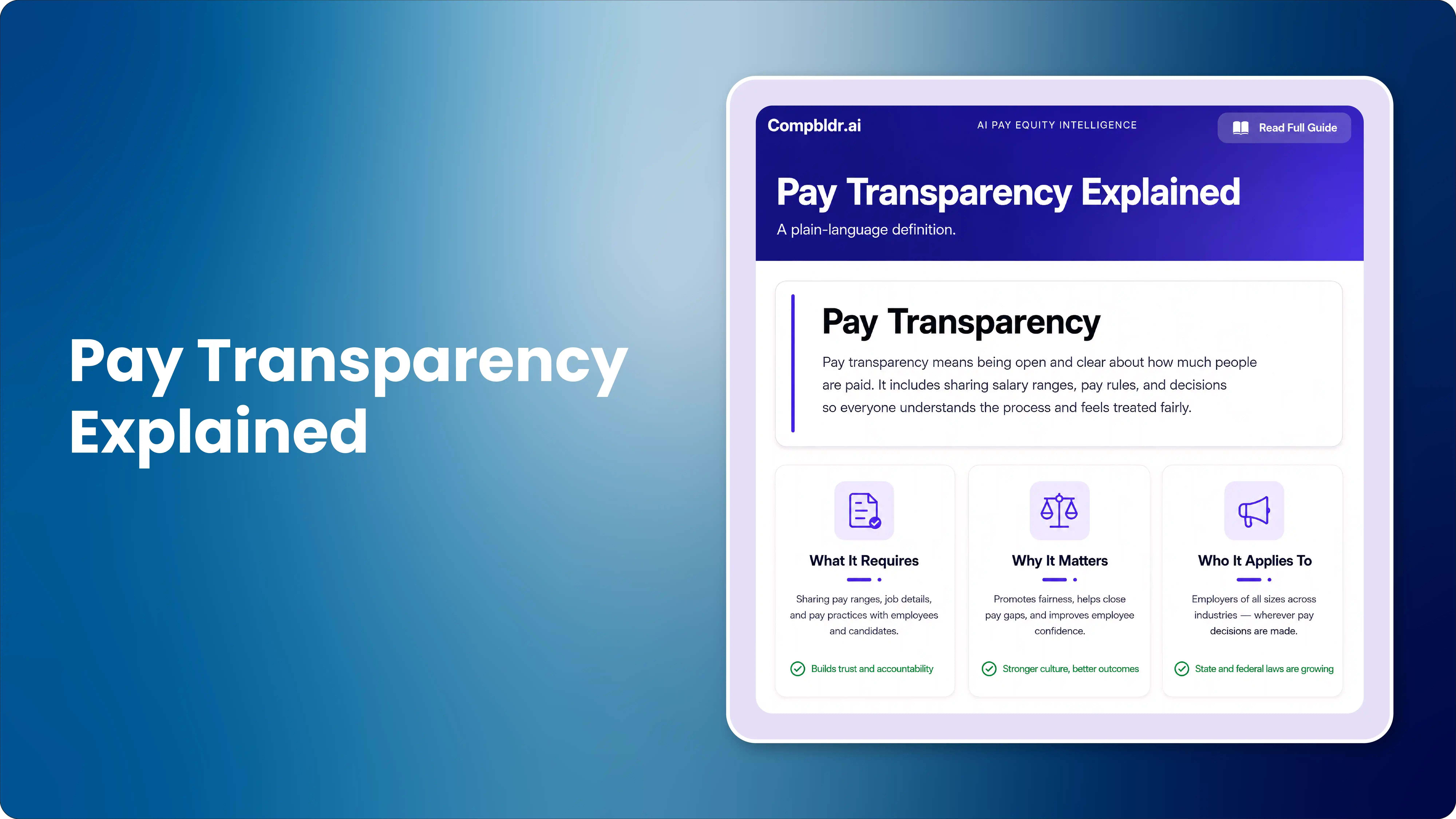

Pay transparency is the practice of making compensation information and pay-setting rules more visible to candidates and employees. Depending on the organization and the law that applies, that can include salary or wage ranges in job postings, employee access to pay ranges, and clear criteria for starting pay, promotions, market adjustments, and pay progression. It does not automatically mean publishing every employee's exact salary.
For employers, the practical goal is not maximum disclosure for its own sake. It is to decide what information must or should be visible, make sure the underlying pay structure can support that information, and give recruiters, managers, employees, and reviewers a consistent explanation of how pay decisions are made. For the governed compensation workflow behind those ranges, see CompBldr pay transparency software.
Legal review notice: This article provides general operational information, not legal advice. Pay-transparency, equal-pay, salary-history, employee-request, and recordkeeping requirements vary by jurisdiction and can change. Confirm the current law and agency guidance for each applicable location with qualified counsel.
Last reviewed: August 25, 2026.
What Does Pay Transparency Include?
Pay transparency is a spectrum. A company may disclose only the information required for a particular job posting, or it may choose to give employees broader visibility into salary ranges, range placement, pay criteria, and career progression. A smaller group of organizations chooses to disclose individual salaries, but exact-salary publication is not the definition of pay transparency and is not a universal requirement.
| Transparency practice | Who sees it | Example | What must support it |
|---|---|---|---|
| Job-posting pay range | Candidates and the public | A minimum and maximum salary or hourly range in a covered posting | Applicable legal rule, approved hiring range, and posting controls |
| Employee range access | Current employees | An employee can see the range for the employee's current role | Current job level, grade, salary structure, and employee-request process |
| Pay-setting criteria | Employees and managers | Documented factors used for starting pay, progression, promotions, or market adjustments | Compensation philosophy, policy, decision criteria, and manager guidance |
| Company-wide range visibility | Broader workforce | Employees can view ranges by job family, level, or grade | Consistent job architecture, range governance, communication, and change control |
| Open individual pay | Defined internal or public audience | Individual compensation amounts are disclosed by company policy | Privacy, employee-relations, legal, security, and compensation review |
The right level of disclosure depends on legal requirements, company policy, workforce expectations, privacy considerations, and the maturity of the underlying compensation structure. For a deeper decision framework on disclosure levels and tooling, see the pay transparency software guide.
Pay Transparency vs. Pay Equity, Pay Compression, and Compa-Ratio
These concepts are related, but they answer different compensation questions. Treating them as interchangeable can create weak policies and misleading employee communication.
| Concept | Question it answers | What it does not prove |
|---|---|---|
| Pay transparency | What compensation information and decision rules can people see? | It does not by itself prove that pay outcomes are equitable. |
| Pay equity | Are pay differences among comparable employees or jobs explainable by legitimate factors and consistent with applicable equal-pay and discrimination rules? | A visible range alone does not establish equity. |
| Pay compression | Are pay differences between employees, levels, or tenure groups becoming unusually narrow for the organization's structure? | Compression is not automatically discrimination or a legal violation. |
| Compa-ratio | Where does an employee's salary sit relative to the midpoint of the salary range? | A compa-ratio above or below 1.00 does not by itself show overpayment, underpayment, or inequity. |
A pay equity audit examines actual compensation outcomes and relevant explanatory factors. Pay compression looks at the spacing between pay relationships. Compa-ratio is a range-position metric. Pay transparency makes parts of the compensation system visible, which can make inconsistencies easier to identify, but visibility and fairness remain separate questions.
Is Pay Transparency Required by Law?
Sometimes. There is no single general federal rule requiring every private employer nationwide to include a salary range in every ordinary job posting. State and local requirements vary substantially, and some laws also address employee requests, promotions, transfers, benefits, other compensation, salary-history inquiries, recordkeeping, or remote-work coverage.
Federal law still matters to the broader compensation environment. The Equal Pay Act and other federal anti-discrimination laws prohibit specified forms of compensation discrimination. The U.S. Equal Employment Opportunity Commission explains that compensation discrimination is covered by the Equal Pay Act, Title VII, the Age Discrimination in Employment Act, and the Americans with Disabilities Act. Review the EEOC compensation guidance.
The National Labor Relations Board also explains that employees covered by the National Labor Relations Act have rights to discuss wages and that employer policies prohibiting or chilling protected wage discussions can be unlawful. Review NLRB wage-discussion guidance.
For employers with California workers, the California pay transparency law guide covers the state's posting, employee-request, remote-role, and recordkeeping rules. Employers with EU operations should use the separate EU Pay Transparency Directive guide, because the EU framework and member-state implementation should not be treated as an extension of U.S. state law.
What Does Pay Transparency Look Like in Practice?
A practical pay-transparency program usually touches several points in the employment lifecycle rather than one job-posting field.
During recruiting
A candidate may see a salary or hourly range, benefits information, or other compensation details when a jurisdiction requires them or when the employer chooses to disclose them more broadly. The range should reflect the organization's actual hiring intent and the approved compensation structure behind the role.
For current employees
An employee may be able to see the range for the employee's role, the grade or level, and the criteria used to make compensation decisions. Some jurisdictions create specific employee-request rights. A company can also choose to provide broader range visibility as part of its compensation policy.
During promotions and transfers
Transparency can include the range for the destination role and the factors used to determine where the employee enters that range. In some jurisdictions, promotion or transfer events create separate legal disclosure triggers.
During merit and market adjustments
Employees and managers can be given clear decision criteria, such as performance guidance, approved range position, market context, policy limits, and the difference between a merit increase and a promotion increase. Transparency does not require exposing every internal calculation, but the organization should be able to explain the decision framework it actually uses.
At the organization level
Some employers publish salary bands by job family or grade. Others choose a narrower model. The important operating question is whether the company can keep the disclosed information accurate when jobs, market data, ranges, or policies change.
Potential Benefits of Pay Transparency
Pay transparency can improve compensation operations when the information being disclosed is accurate and the underlying process is governed. The benefits should be treated as potential outcomes rather than guarantees.
- Clearer candidate expectations: a credible range can help applicants understand the employer's intended pay zone before later-stage negotiation.
- More consistent manager explanations: documented ranges and decision criteria give managers a common reference point instead of forcing them to invent individual explanations.
- Earlier identification of structural problems: making ranges and criteria visible can expose stale job descriptions, inconsistent leveling, unusually broad ranges, compression, or unsupported exceptions that deserve review.
- Better auditability: a governed range with an effective date, source, approver, and job/grade context is easier to reconstruct later than a number stored only in an email or recruiter spreadsheet.
- Stronger internal-mobility conversations: employees can make more informed decisions when they understand the range and level associated with another role.
None of those outcomes happen automatically because a company publishes a number. A poorly governed range can make an existing problem more visible without solving it.
Trade-offs and Risks Employers Should Plan For
Pay transparency also creates operational and communication demands that should be addressed before expanding disclosure.
- Inconsistent jobs become easier to see. Two roles with similar titles but different scopes may need clearer job descriptions and leveling before their ranges can be explained.
- Overly broad ranges can reduce usefulness. A range that spans multiple levels or does not reflect genuine hiring intent can confuse candidates and may conflict with jurisdiction-specific good-faith standards.
- Managers need training. A visible range naturally leads to questions about why one employee sits at the minimum, midpoint, or upper part of the range.
- Exact-pay disclosure raises privacy and employee-relations questions. Organizations considering open individual salaries need legal, privacy, security, and workforce review rather than treating the decision as a simple extension of range disclosure.
- Multi-state rules are not interchangeable. A national disclosure policy can simplify administration, but it does not replace jurisdiction-specific legal analysis.
- Ranges can go stale. If the internal salary structure changes but the careers site, job board, or recruiter copy does not, the employer may be communicating outdated information.
How to Build a Pay Transparency Process
A sustainable rollout starts with the compensation foundation and the legal scope, then moves to communication.
- Map the legal requirements. Identify work locations, remote eligibility, employer thresholds, posting requirements, employee rights, salary-history restrictions, and local rules. Assign a legal owner and a review date.
- Validate job descriptions and job architecture. Make sure each role has current responsibilities, a consistent family and level, and an approved place in the organization's job architecture.
- Validate salary structures and market context. Use current market evidence and an approved compensation philosophy to create or refresh salary bands that match the job structure.
- Review pay equity and compression. Examine actual employee pay before expanding internal visibility. A transparency launch should not be used as a substitute for a substantive pay review.
- Define the disclosure policy. Specify what candidates, current employees, managers, recruiters, and the broader workforce can see, and distinguish legal requirements from voluntary company policy.
- Document decision criteria. Define how starting pay, promotions, market adjustments, merit decisions, and exceptions are evaluated and approved.
- Train managers and recruiters. Give them the range, the decision criteria, escalation paths, and examples of how to answer common questions without improvising policy.
- Keep disclosed information current. Connect range changes to the careers site, ATS, job boards, internal opportunities, employee communications, and approval records.
Common Pay Transparency Mistakes
- Publishing ranges before validating the jobs behind them. If job scope and level are wrong, the range can be wrong for the role even when the number looks market-competitive.
- Assuming transparency equals pay equity. Visibility can reveal a difference; it does not determine whether that difference is justified, remediable, or unlawful.
- Using one legal summary for every state. Posting rules, request rights, benefits requirements, salary-history restrictions, thresholds, and remote-work triggers vary.
- Giving managers ranges but no explanation framework. Employees may receive different answers to the same question across departments.
- Using very broad ranges to avoid difficult leveling decisions. A range spanning several plausible roles or levels may be less useful and harder to support.
- Failing to update third-party postings. A corrected internal range does not fix an outdated copy still live on an external job board.
- Publishing exact employee pay without the necessary review. Open-pay policies require deliberate privacy, security, employee-relations, and legal decisions.
Where CompBldr Fits in a Pay Transparency Operating Model
CompBldr is compensation management and governance software. It can support the compensation evidence behind a transparency process by connecting job descriptions, job architecture, market context, salary structures, compensation planning, approvals, analytics, reporting, and decision history.
That can help a compensation team answer operational questions such as: Which job and grade produced this range? Which market references were reviewed? What range version was effective? Who approved the decision? What changed later? Those records can make a disclosed range easier to explain and maintain.
CompBldr does not determine which pay-transparency law applies to a job, provide legal advice, replace employment counsel, make statutory filings unless a specific capability is separately confirmed, or guarantee legal compliance or pay equity. Legal interpretation and employment decisions remain human responsibilities.
Pay Transparency: The Practical Bottom Line
Pay transparency means making compensation information and pay-setting rules more visible. For one employer, that may start with legally required salary ranges in job postings. For another, it may also include employee range access, career-level ranges, and clear criteria for pay progression. Exact individual salaries are a separate policy choice, not the default definition.
The strongest transparency programs connect three things: the legal requirement, the compensation structure, and the communication process. When those three are aligned, the organization can explain what it shares, why the number is credible, who approved it, and how it stays current.



.svg)

.svg)
.svg)

