Salary Structure Software for Governed Pay Ranges
CompBldr salary structure software connects governed jobs and grades with market percentile targets to build and manage salary range minimums, midpoints, and maximums—then keeps approved structures tied to employee pay, compensation planning, analytics, and reporting.
.svg)
Move beyond disconnected salary-band spreadsheets. CompBldr connects the proposed structure to the jobs, market evidence, employee pay, planning workflow, and reports behind it.
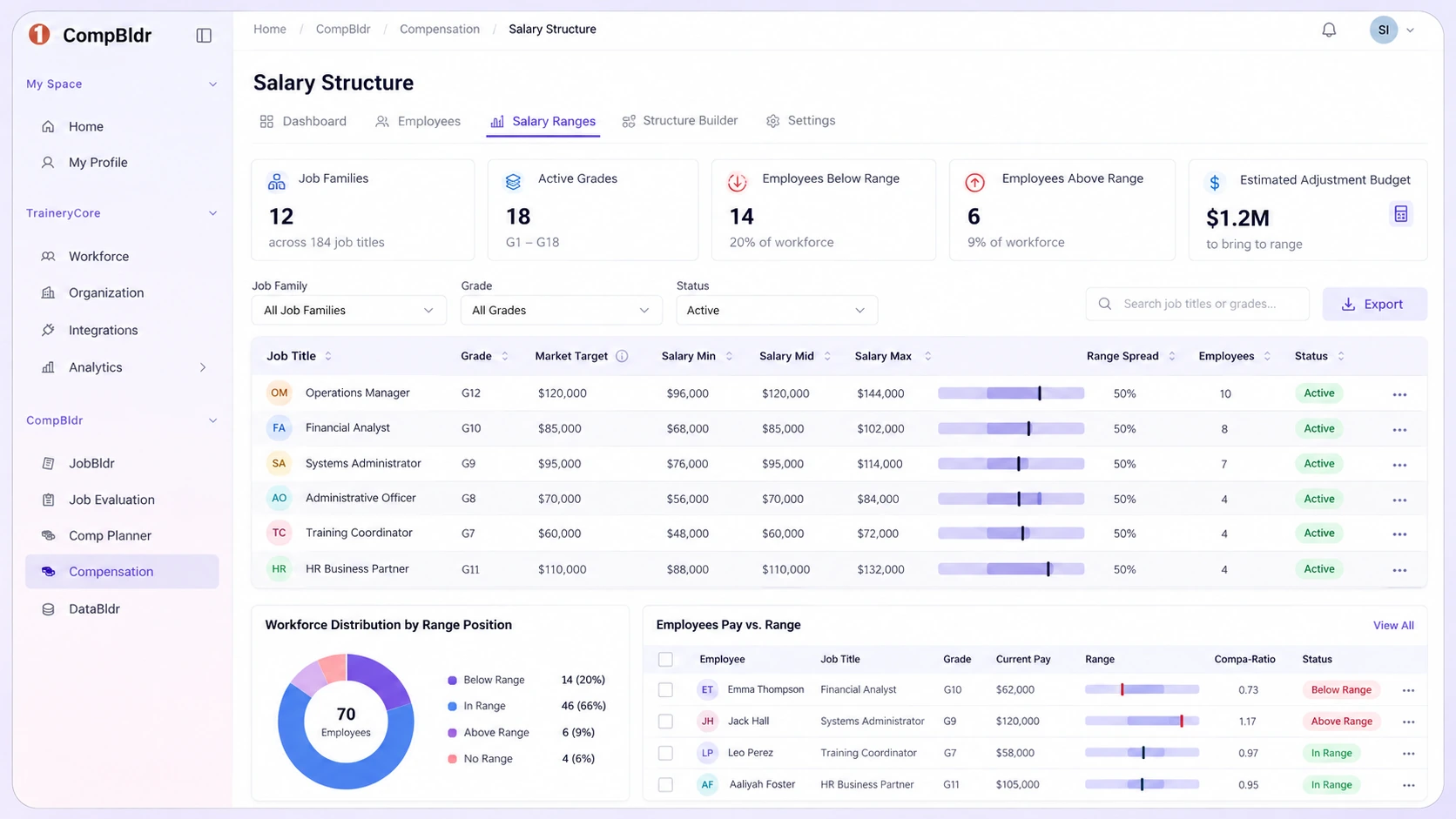
Salary Structures Break When the Inputs and Decisions Live Apart
A salary structure is more than a table of minimums, midpoints, and maximums. It depends on the jobs being graded, the market evidence behind the range, the employees affected by the change, and the compensation decisions that follow.
CompBldr keeps the job structure, market evidence, proposed ranges, employee impact, and downstream compensation workflow connected.
.svg)
Job Grades and Salary Ranges Drift Apart
A grade structure can change while the salary-band file continues using older job assignments, leaving the range disconnected from the role it is supposed to govern.

Market Evidence Gets Separated From the Range
Teams may know the final midpoint without being able to trace it back to the market matches, target percentile, and evaluated jobs that informed it.
.svg)
Employee Impact Appears Too Late
A proposed range can look reasonable at the structure level while current employee pay creates significant below-minimum, above-maximum, or budget implications.

The Approved Structure Becomes Another Static File
Even after ranges are finalized, compensation planning may happen somewhere else, forcing teams to manually re-enter grade, range, and employee-position information.
Move From Job Structure to Approved Salary Ranges
CompBldr connects the operational steps around salary structure development while your compensation team keeps control of pay philosophy and range methodology.
Start With Governed Jobs and Grades
Use the job family, level, grade, and evaluated job structure already maintained by your compensation team. Clear distinctions between job grades and job levels help ensure salary ranges govern defined roles rather than titles maintained independently in a spreadsheet.
Connect the Structure to Market Evidence
Bring approved market matches, survey sources, target percentiles, market position, and other benchmarking evidence into the same compensation context so the proposed salary ranges remain traceable to the data that informed them.
Develop the Proposed Grade and Range Structure
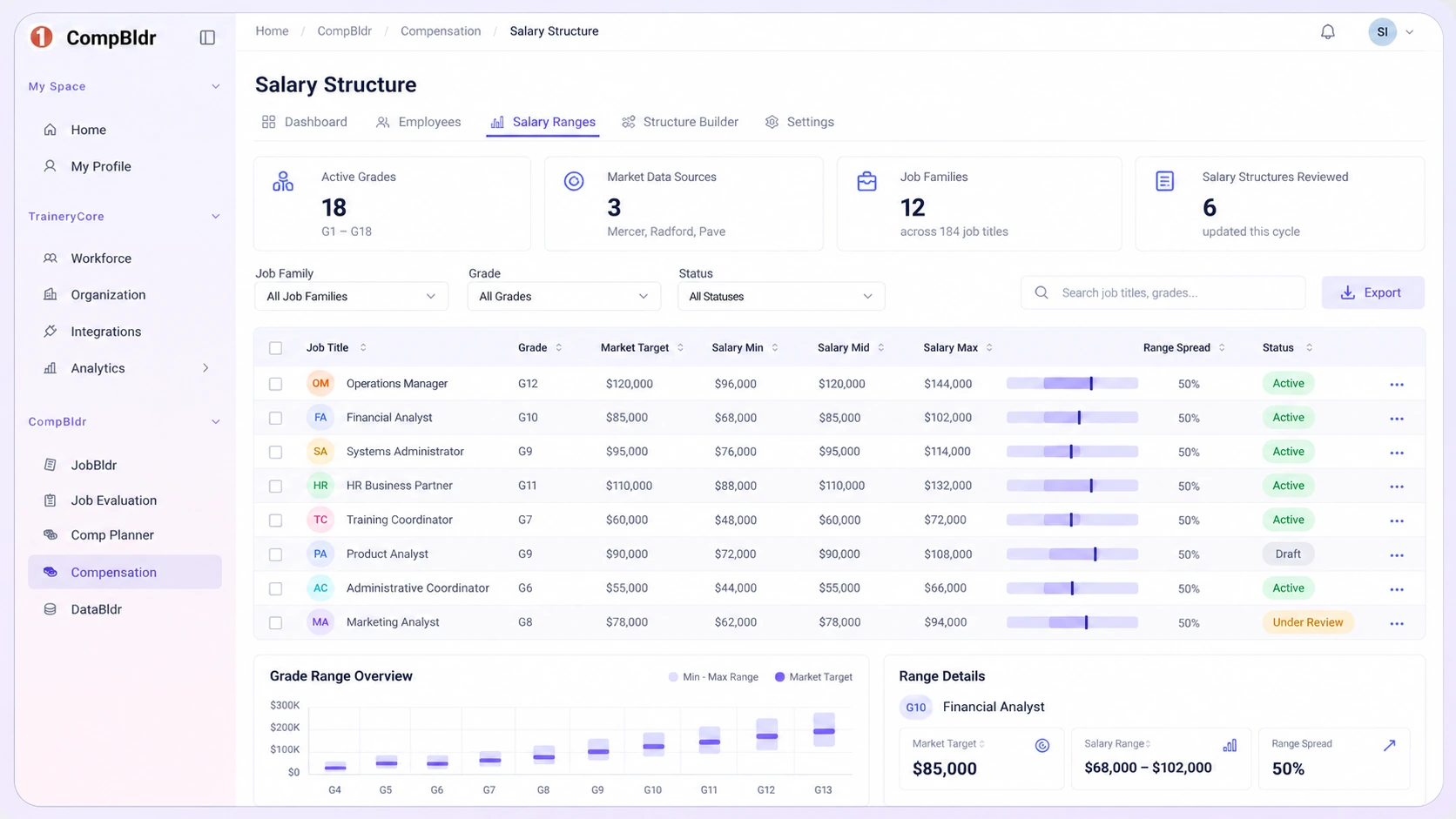
Review the proposed structure across grades with market target salary, range minimum, midpoint, maximum, and range spread available together. As teams build salary bands, CompBldr can keep those range decisions connected to the grade structure and show current paylines against proposed minimum, midpoint, and maximum policy lines.
Review Employee Impact Before Implementation
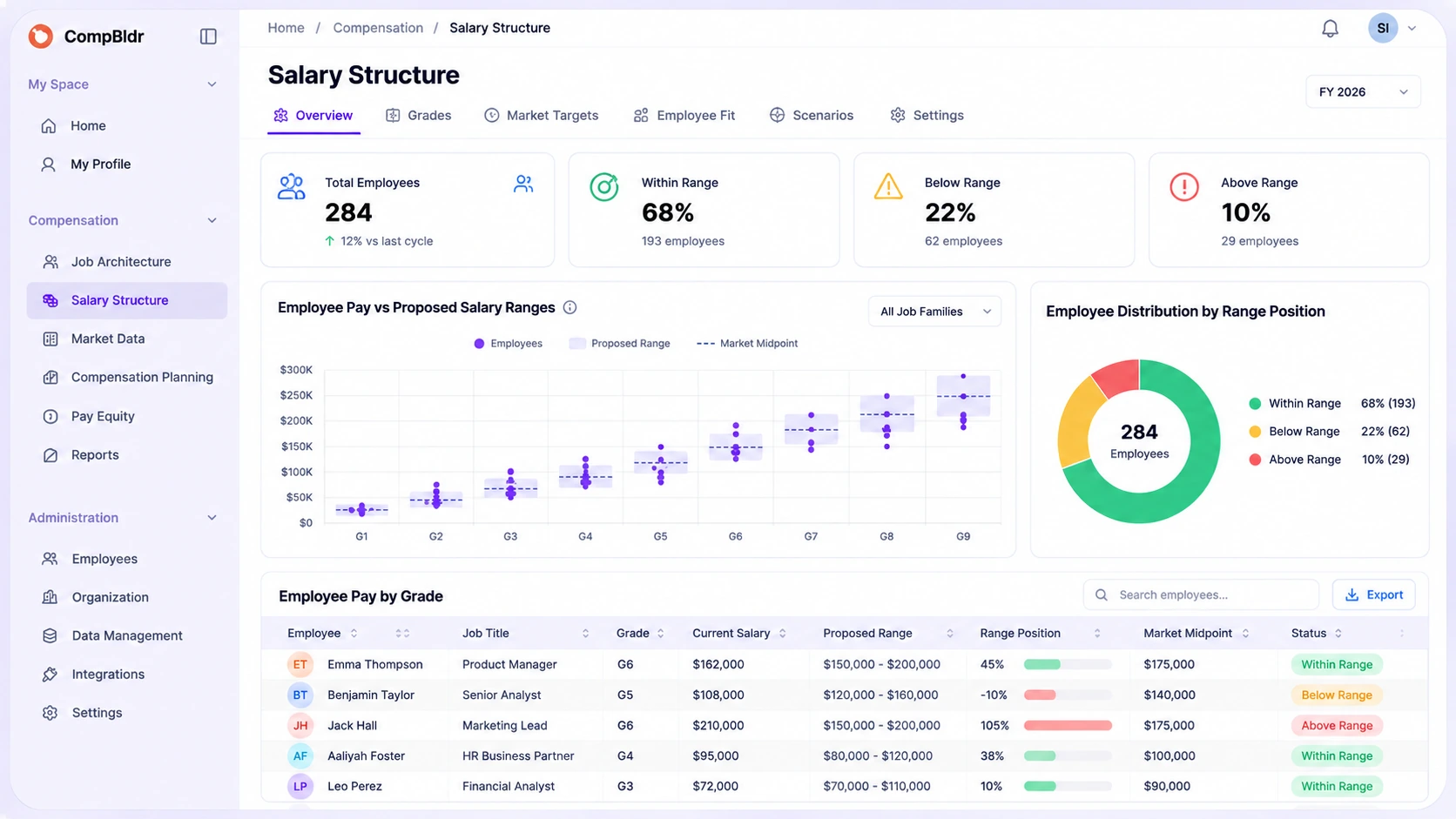
Compare current employee pay with the proposed salary ranges before the structure becomes operational. Use compa-ratio and range penetration alongside below-minimum and above-maximum positions to understand how the proposed structure affects employees and potential implementation costs.
Carry the Approved Structure Into Compensation Planning
Use approved salary ranges as operating inputs for compensation planning, employee pay review, analytics, and reporting rather than recreating the structure for every cycle.
Build the Structure, See the Impact, Keep It Governed
CompBldr connects salary-range development to the compensation records and workflows that make the structure operational.
Connect Grades, Market Targets, and Salary Ranges
Review proposed salary structures with the information needed to understand what each grade and range represents.
.svg)
CompBldr keeps the proposed structure tied to job evaluation and market evidence, while compensation teams can review salary range width by job level within the broader grade-and-range structure.
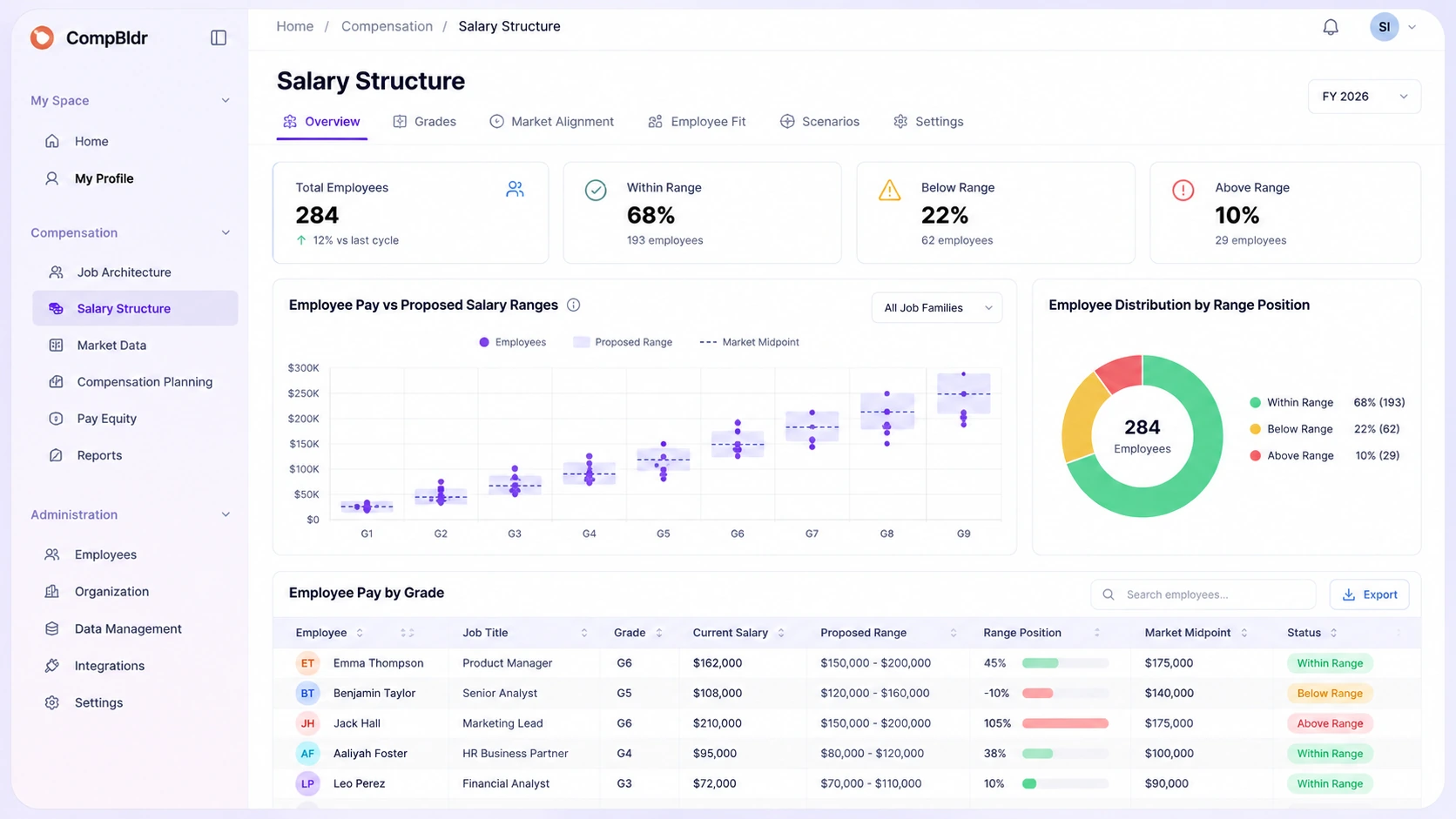
See How Current Employee Pay Fits the Proposed Structure
A new salary structure changes how employee pay is interpreted across the proposed ranges, making it important to understand how salary ranges are defined and governed before the structure becomes operational.
This gives HR, Total Rewards, and Finance visibility into workforce impact before implementation.
Preserve the Structure as a Reviewable Compensation Record
CompBldr salary-structure outputs can remain connected to the reports and records produced from the approved analysis.
That helps Compensation preserve the evidence behind a structure instead of relying on an undated spreadsheet labeled “final.”
Turn Salary Ranges Into an
Operating Compensation Structure
The value of salary structure software is not simply producing pay bands. The structure needs to work with the employees, decisions, and compensation cycles that use it.
Build and Review the Structure
Connect governed jobs and grades to market evidence, then review the proposed minimums, midpoints, maximums, and range relationships.
Test the Workforce Impact
Compare employee pay with the proposed structure so Compensation and Finance can identify implementation needs before the salary ranges become operational.
Use the Approved Ranges in Pay Decisions
Carry approved salary bands and pay-range context into compensation planning, analytics, approvals, and reporting without rebuilding the structure in another spreadsheet.
Salary Structures Work Better When the
Compensation Workflow Is Connected
Salary structure management sits between job architecture, market benchmarking, and employee compensation decisions. CompBldr keeps approved salary ranges connected to the broader compensation system.
.svg)
Job Architecture
Job Evaluation
Market Benchmarking

Compensation Planning

Compensation Analytics

Compensation Reporting
Frequently Asked Questions

Market Benchmarking establishes the external compensation evidence, including market matches, survey data, percentiles, and market position. Salary Structure Software connects that evidence to jobs and grades so compensation teams can develop and manage the salary ranges that govern employee pay.

Yes. CompBldr connects job architecture, job evaluation, grades, market benchmarking, and salary-range development so a proposed range can remain tied to the job structure it is intended to govern.
CompBldr supports salary-range development across grades, including minimums, midpoints, maximums, market targets, and range spreads. Organizations may refer to these structures as salary ranges, salary bands, or pay bands depending on their compensation terminology.
Yes. CompBldr can show current employee pay against proposed minimums, midpoints, and maximums, including information such as compa-ratio, amounts below minimum, amounts above maximum, and quartile placement.
Yes. Approved structure changes can be preserved as versioned records so teams can distinguish current ranges from prior structures, review effective changes, and maintain decision history instead of overwriting the previous range.
CompBldr supports implementation-cost reporting that compares employee pay with proposed salary ranges. This allows teams to identify where current pay falls outside the proposed structure and evaluate the financial impact before implementation.
Once approved, salary ranges become part of Compensation Planning, where teams can use employee band position, compa-ratio, budgets, manager recommendations, proposals, and approvals during active pay cycles.
Build Salary Structures That Stay Connected to Pay Decisions
Connect jobs, grades, market evidence, salary ranges, employee pay, planning, and reporting in one governed CompBldr compensation workflow.
No credit card · 15-minute walkthrough · Most teams invest $25K–$120K/yr


.svg)

.svg)
.svg)

