

.svg)





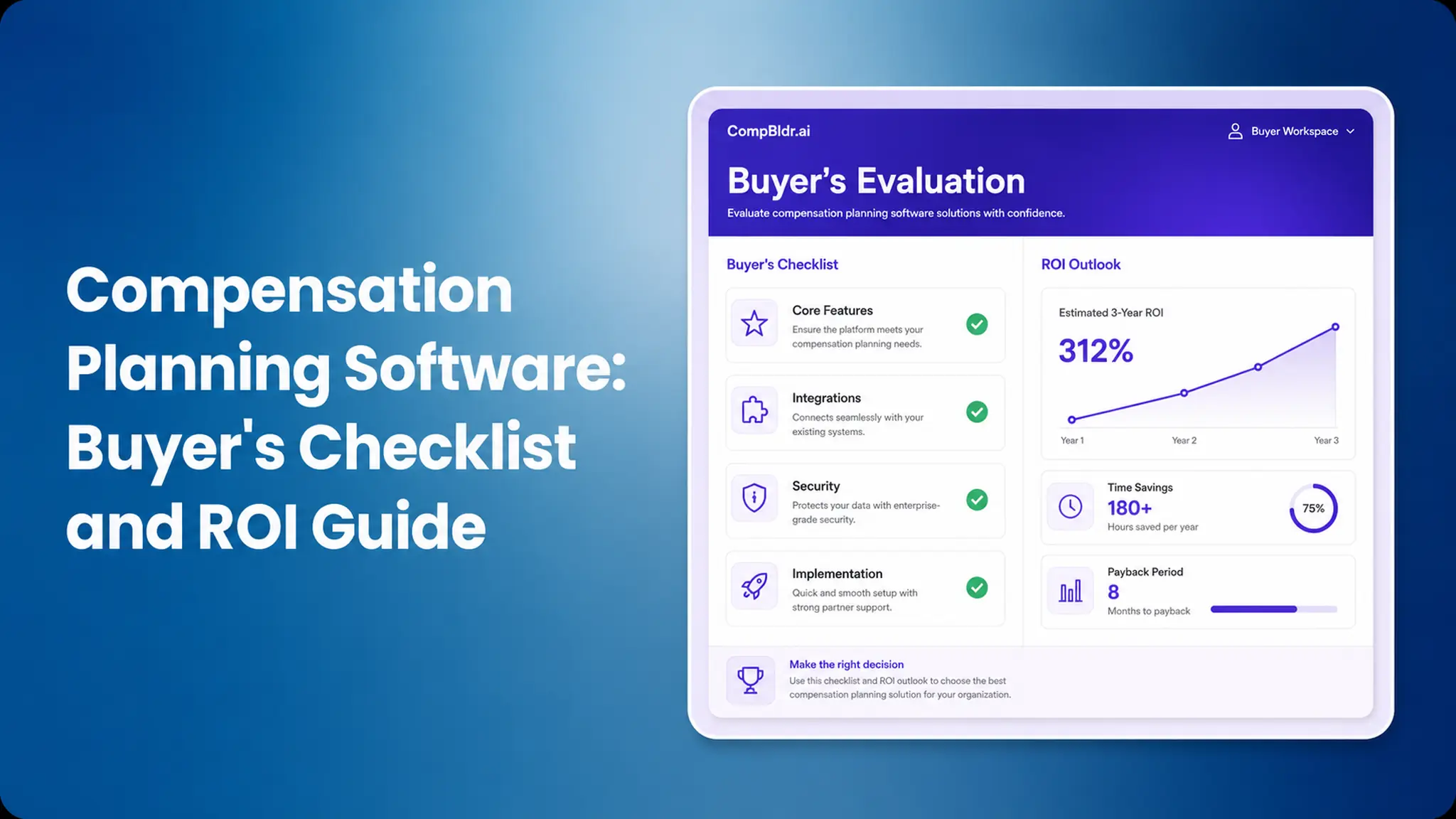

Compensation planning software should govern the complete path from approved employee and job data through budgets, manager recommendations, approvals, exceptions, final decisions, and auditable records. A product that only replaces the merit worksheet may make recommendations easier to enter while leaving the most important decisions disconnected.
The buyer's job is to test whether the software fits the organization's actual compensation operating model. That includes data ownership, salary structures, eligibility rules, multiple action types, manager behavior, Finance controls, exception review, employee communication, and the records required after the cycle closes.
This framework is intended for teams moving beyond spreadsheets or outgrowing a general HRIS workflow. Different operating models require different modules, data controls, and approval paths. Vendor ROI percentages are not evidence for your business case. The research was reviewed on August 13, 2026. Product capabilities, packaging, and integrations can change, so confirm the current scope directly with each vendor.
Start With the Compensation Decision Chain
Before comparing features, map one real decision from beginning to end. An employee record should connect to an approved role, a grade or level, a salary range, market evidence, current pay, performance input when policy allows it, an eligible action, budget rules, manager rationale, approvals, and the final record.
That chain begins earlier than the merit worksheet. Weak job description governance creates inconsistent roles. Unclear job evaluation makes grade placement difficult to explain. A fragmented job architecture weakens comparisons. Uncontrolled market benchmarking can place too much weight on a title match instead of role scope.
A compensation planning system does not need to own every upstream process, but it must preserve enough context to explain why a decision was proposed and approved. If the evaluator cannot follow that evidence chain in the demo, the software may be moving spreadsheet cells into a browser rather than improving governance.
Compensation Planning Software Buyer's Checklist
| Evaluation area | Proof to request | Failure signal |
|---|---|---|
| Data foundation | Employee, job, grade, range, pay, performance, and organization fields with ownership rules | Implementation begins before source conflicts are resolved |
| Cycle configuration | Eligibility, budgets, guidelines, action types, dates, and population rules | Every exception requires a new offline worksheet |
| Manager workflow | Clear recommendations, rationale, warnings, remaining budget, and next action | Managers cannot explain why a recommendation is outside guidance |
| Approval governance | Conditional routing, role permissions, comments, return paths, and history | Email becomes the actual approval record |
| Exception control | Documented thresholds, reason codes, supporting evidence, and escalation | Outliers are discovered after the cycle closes |
| Analytics | Budget, range position, compression, equity indicators, cycle progress, and filters | Every question requires a new export |
| Finalization | Locked approved records, effective dates, downstream handoff, and audit evidence | Final numbers can change without a recorded approval |
| Implementation | Named owners, data validation, configuration decisions, testing, and acceptance criteria | The plan is only a feature setup schedule |
| ROI measurement | Baseline labor, cycle time, rework, exceptions, leakage, and decision-quality measures | The business case relies only on vendor percentages |
1. Verify the Data Foundation
Compensation planning uses sensitive, interdependent records. Identify the system of record for employee status, salary, job, manager, department, location, currency, grade, level, range, and performance input. Then define how the planning system handles missing, conflicting, stale, or unauthorized data.
A clean import is not proof of data quality. Test employees with two assignments, a recent promotion, a leave status, a future-dated salary, an out-of-range salary, missing performance input, and a changed manager. The product should make the issue visible and route it to an owner rather than silently defaulting the record.
When compensation planning depends on HRIS or payroll connections, review the exact data direction and object coverage on the compensation software integrations page and in current technical documentation. A named vendor connection does not prove that every field, workflow, or writeback is included.
2. Test More Than a Standard Merit Cycle
Ask the team to list the actions processed in a typical year. These may include merit increases, promotions, market adjustments, equity corrections, lump sums, bonuses, incentives, retention actions, or off-cycle changes. Confirm which are current product capabilities and which require configuration, import, or a separate process.
The core CompBldr compensation planning software workflow should be evaluated against the organization's actual budget pools, eligibility dates, manager hierarchy, guideline logic, and approval sequence. Avoid turning one illustrative configuration into a universal benchmark.
A good demonstration includes an employee who is ineligible, a manager who exceeds budget, a recommendation outside the guideline, a promotion with a new grade, and a late organizational change. The buyer should see how each case is handled, documented, and approved.
3. Evaluate Manager Decision Support
Managers need enough context to make a reasoned recommendation without seeing information outside their authority. The worksheet should display relevant pay, range position, guidelines, available budget, and required rationale. It should also make the next action obvious.
Test what happens when a manager proposes zero, follows the guideline, exceeds the guideline, exceeds the range maximum, or concentrates the budget among a small number of employees. A warning is useful only when it explains the issue and sends the decision to the correct review path.
The distinctions in merit increases versus promotions are especially important. The system should not force different business actions into one percentage field when they require different evidence, approvals, effective dates, and reporting.
4. Confirm Budget and Finance Controls
Finance should be able to reconcile the same numbers HR and managers use. Verify how the system defines available, recommended, submitted, approved, and finalized spend. Ask whether budgets can be assigned by department, cost center, legal entity, manager, or other approved structure.
Review the operating logic in merit cycle automation and budget control. Then test one transfer between budgets, one organizational change, one retroactive adjustment, and one currency conversion. The goal is not to reproduce every edge case in the first demo. It is to learn whether the governance model can represent the organization's rules without hidden spreadsheets.
Test Budget Controls With a Real Compensation Case
Evaluate manager recommendations, budget visibility, exception handling, approvals, and final records in the same governed compensation cycle.
5. Inspect Approval and Exception Governance
Approval workflows should show who proposed, reviewed, returned, changed, and approved a decision. Conditional routing matters when exceptions require compensation, Finance, Legal, or executive review. A generic manager-to-manager approval chain may not be enough.
Create an exception register for the pilot. Include the employee, proposed action, rule triggered, reason code, evidence, reviewer, decision, and date. Compare that record with the platform's history. If the actual rationale lives in email or meeting notes, the formal audit trail is incomplete.
Review role-based access and current controls through the CompBldr security page, then confirm high-stakes details through approved security documentation. Marketing language should not substitute for the evidence required by IT, Security, Legal, or procurement.
6. Separate Analytics From Final Reports
Analytics answers active-cycle questions. Reports preserve a defined output at a point in time. Buyers need both concepts even if they are delivered in one interface.
Use compensation analytics to test budget, cycle progress, range position, compression, and potential equity patterns. These indicators support review; they do not independently prove discrimination or prescribe a remedy. Qualified compensation, statistical, and legal review may still be required.
Use compensation reporting to test whether an approved version identifies the population, data date, effective date, methodology, assumptions, exclusions, preparer, and approver. The final record should remain distinguishable from a live dashboard that continues to change.
7. Plan the Employee Communication Step
The planning cycle is incomplete until the organization communicates approved outcomes. Confirm what data passes to payroll, HRIS, letters, statements, or manager communication. Define who owns final review and what happens when an error is found after approval.
Organizations using total rewards statements should verify which compensation and benefit fields are available, how the statement is approved, and which distribution methods are supported. Do not assume that a planning module automatically includes every communication capability.
A Worked Evaluation Scenario
Consider an illustrative 650-employee organization with three salary structures, two currencies, decentralized managers, and a shared HR and Finance approval process. The compensation team wants to run merit, promotion, and market adjustments in one annual cycle.
The pilot population includes 60 employees across two departments. One employee has a missing grade, one employee's manager changed after the snapshot, one is above the range maximum, one is receiving a promotion, one has a market adjustment outside the merit budget, and one is excluded because of the eligibility date.
The team should score each platform on five questions:
Score the Pilot With Five Decision Questions
1. Did the system identify the data issue before managers entered recommendations?
2. Did managers see the correct guidance without unauthorized employee data?
3. Did the budget reconcile across recommendation and approval stages?
4. Did exceptions follow the required review path with clear rationale?
5. Could HR reproduce the final decision and evidence after the cycle closed?
This scenario is more informative than counting configuration options. It tests how the platform behaves when compensation work becomes difficult.
How to Build a Defensible ROI Model
ROI should begin with the current process, not a vendor promise. Measure the labor and failure costs that the software is expected to change. Keep time savings, financial exposure, and decision-quality improvements separate so the business case remains reviewable.
Baseline Operating Cost
Estimate hours spent by compensation, HRIS, Finance, managers, and reviewers on data preparation, worksheet distribution, support, reconciliation, approvals, reporting, and corrections. Multiply each role's hours by an approved loaded labor rate. Label estimates and ranges clearly.
Rework and Error Cost
Count duplicate files, manual corrections, late organizational changes, budget reconciliation issues, unsupported exceptions, and post-cycle adjustments. Avoid assigning a dollar value when the organization has no reasonable basis. A count and severity classification may be more credible.
Cycle Speed
Measure calendar days from data freeze to final approval, plus days spent waiting for missing information or repeated approvals. Faster is useful only if decisions remain accurate and governed.
Decision Quality and Governance
Track measurable process indicators such as percentage of jobs with an approved grade and range, percentage of recommendations within the approved guideline, exceptions with documented rationale, manager completion on time, budget variance, and records finalized with complete approval history. These indicators are not guaranteed business outcomes, but they show whether the operating model improved.
A simple ROI formula is:
(Estimated annual benefit minus annual software and operating cost) divided by annual software and operating cost.
Use a conservative case, expected case, and high case. Keep implementation labor, integration, change management, and ongoing administration on the cost side. Do not include savings that cannot be traced to a baseline and a responsible owner.
Implementation Questions That Change the Decision
Ask who cleans the source data, configures eligibility rules, builds approval routing, validates budgets, tests permissions, trains managers, and signs off on the final cycle. Review CompBldr compensation software pricing in the context of modules, population, complexity, integrations, implementation, and services rather than assuming a fixed public price.
Separate software from consulting. CompBldr can be supported by compensation consulting, but buyers should confirm which methodology, data, configuration, and advisory deliverables are included in the proposed scope.
For a broader view of the product model, review how CompBldr connects compensation governance from job structure through planning, analytics, reporting, approvals, and employee communication.
Final Selection Rule
Select the platform that can run the organization's difficult compensation cases with clear ownership, controlled data, explainable rules, workable manager actions, reconciled budgets, reviewable exceptions, and durable final records. Feature breadth matters only when the operating model can use it safely.
CompBldr is compensation management and governance software that connects job descriptions, JESAP®-based evaluation, job architecture, market benchmarking, compensation planning, analytics, reporting, approvals, and total rewards. TrAI can support compensation intelligence while qualified people retain authority over decisions.
Test the Buyer's Checklist Against a Real Cycle
Bring one representative employee population, one exception path, and one approval scenario to see how CompBldr handles the complete compensation decision chain.
Book a Demo

.svg)

.svg)
.svg)

