

.svg)





.webp)

Three years ago, a board compensation committee that received a pay equity update once a year was considered progressive. The update was typically a slide deck summarizing the most recent annual pay equity audit: a percentage unadjusted gap, a methodology note, and a list of remediation actions in progress. The board received it, noted it, and moved on to executive compensation.
That model no longer satisfies the questions boards are now asking. The EU Pay Transparency Directive, enforceable from June 2026 for organizations with 250 or more employees in the EU, requires joint pay assessments when any unexplained gap above 5% exists within a category of workers performing equal work or work of equal value. This is not an annual filing. It is an ongoing monitoring obligation. Proxy advisory firms ISS and Glass Lewis have incorporated pay equity metrics into their voting guidance for publicly listed companies. Institutional investors are asking CHROs directly about pay equity progress in annual engagement calls. And in the US, EEOC, OFCCP, and state-level pay transparency laws have created documentation requirements that a once-per-year audit does not satisfy on its own.
The result is that CHROs are now expected to present pay equity data to their boards quarterly, with a consistent methodology, clear trend lines, and a documented framework for when findings require escalation beyond HR. This guide defines exactly what those quarterly reports should contain, what escalation thresholds should govern the response to findings, and how a compensation governance platform like CompBldr automates the reporting without requiring a quarterly manual audit. For the governed product workflow behind review, planning, approvals, and reporting, see CompBldr pay equity software.
What Is Quarterly Pay Equity Reporting?
Quarterly pay equity reporting is a regular governance process in which CHROs present pay equity data to their board compensation committee every quarter rather than relying on annual audits. It tracks six metrics: adjusted pay gap by grade cluster, unadjusted pay ratio by demographic dimension, compa-ratio distribution by demographic, equity flag count and resolution rate, merit cycle differentiation score, and pay transparency compliance status. It includes a documented escalation framework defining when HR resolves findings independently, when the CHRO produces a formal action plan, and when the board receives notification. It is driven by a combination of EU Pay Transparency Directive obligations, ESG proxy advisory requirements, and US regulatory guidance.
Why Boards Are Now Asking About Pay Equity Every Quarter
The EU Pay Transparency Directive changed the frequency expectation
The EU Pay Transparency Directive, which became enforceable in June 2026 for organizations with 250 or more EU employees, established a new compliance standard that requires ongoing monitoring rather than point-in-time audits. Specifically, it requires that organizations conduct a joint pay assessment whenever an unexplained pay gap above 5% is identified within a category of workers performing equal work or work of equal value. The joint pay assessment must include an analysis of the causes of the gap, a documented action plan with concrete measures and timelines, and evidence that social partners (trade unions or employee representatives where applicable) were consulted in the process.
This is not a once-a-year filing exercise. It is a monitoring obligation that requires HR to know whether a 5% threshold has been crossed at any time, which requires, at a minimum, quarterly monitoring of the adjusted pay gap by grade cluster across the EU population. For US-headquartered organizations with EU operations, this has created a board-level governance question: how do we know whether we are below or above the 5% threshold right now, not as of last December's audit?
Proxy advisors and ESG frameworks elevated pay equity to board-level risk.
ISS (Institutional Shareholder Services) and Glass Lewis, the two dominant proxy advisory firms for institutional investors, have incorporated human capital management metrics, including pay equity, into their governance assessments of publicly listed companies. When institutional shareholders vote against compensation committee director nominations because of inadequate pay equity governance disclosure, the board pays attention in a way it did not when pay equity was viewed purely as an HR compliance function.
The GRI Standards (Global Reporting Initiative), the SASB Standards (Sustainability Accounting Standards Board), and the TCFD (Task Force on Climate-related Financial Disclosures) successor frameworks have all incorporated pay equity as a required disclosure metric for organizations reporting under ESG frameworks. The result is that the CHRO is now expected to provide the board with data that is current enough to feed into annual ESG disclosures, which requires a quarterly measurement cadence at a minimum.
One-time audits cannot answer repeated board questions.
When a board director asks in a September compensation committee meeting whether the organization's pay equity position has improved since the February audit, an annual audit cannot answer that question. The February findings may reflect data that was current in December of the prior year, which is nine to twelve months before the September meeting. If the merit cycle ran in April and closed in May, the February audit does not reflect the merit cycle outcomes at all.
Quarterly reporting solves this by producing a consistent snapshot of the six pay equity metrics at regular intervals throughout the year, enabling trend analysis that shows whether the merit cycle improved, maintained, or worsened the equity position. The board can see the trajectory, not just a point-in-time result.
The 6 Metrics That Belong in a Quarterly Pay Equity Report
These six metrics cover the full picture of pay equity governance: what the gap is, who it affects, where it occurred in the merit cycle, whether it was caught and resolved, and whether the organization is compliant. Each metric should appear in every quarterly report with a trend line showing the prior three quarters.
Metric 1: Adjusted Pay Gap by Grade Cluster
The adjusted pay gap measures the percentage difference in average compensation between demographic groups within comparable role clusters, after controlling for factors that legitimately explain pay differences: grade, tenure, performance rating, and geographic location. An adjusted gap of 3.2% means that employees in one demographic group earn 3.2% less than comparable peers in the same grade after controlling for legitimate factors. This is the number most directly relevant to the EU Pay Transparency Directive's 5% threshold.
In a quarterly board report, this metric should show the current adjusted gap percentage, the prior three quarters for trend context, the grade clusters where the gap is above and below the 5% threshold, and the demographic dimension producing the largest gap. The board does not need to see the statistical methodology. They need to know whether the organization is above or below the threshold, in which grade clusters, and whether the trend is improving or worsening.
Metric 2: Unadjusted Pay Ratio by Demographic Dimension
The unadjusted pay ratio shows the raw difference in median compensation between demographic groups without controlling for grade or role. The unadjusted gap is typically larger than the adjusted gap because it reflects differences in representation across grades as well as differences in pay within grades. The UK Gender Pay Gap Report, the EU Pay Transparency Directive disclosure requirement, and California CRD pay data reporting all use unadjusted measures as part of their required disclosures.
For a quarterly board report, the unadjusted ratio serves a different purpose than the adjusted gap. While the adjusted gap shows whether the organization is paying equitably within grades, the unadjusted ratio shows whether demographic groups are represented equitably across grades. A low adjusted gap combined with a high unadjusted ratio signals that pay is relatively equitable within grades but that one demographic group is concentrated in lower grades, which is a structural pipeline and promotion equity issue rather than a direct compensation equity issue.
Metric 3: Compa-Ratio Distribution by Demographic and Grade
Compa-ratio distribution by demographic shows whether one group of employees is systematically paid at a lower position within their salary band than comparable peers in the same grade. An average compa-ratio of 0.91 for one demographic group in Grade 4, compared to 0.98 for another demographic group in the same grade, signals structural underpayment that will not be corrected by a standard merit cycle without targeted equity adjustments.
This metric is particularly valuable for identifying compression problems that developed over multiple merit cycles as market rates moved faster than internal merit budgets. A group of employees hired three to five years ago at market rate who received below-market merit increases in subsequent years may show a compa-ratio pattern that correlates with a demographic dimension. The quarterly compa-ratio distribution analysis catches this pattern before it accumulates further.
Metric 4: TrAI Equity Flag Count and Resolution Rate
TrAI is CompBldr's AI engine that monitors merit cycle proposals in real time and surfaces pay equity flags when it detects patterns that signal risk: compa-ratio gaps within grade clusters, flat-rate submission patterns, or systematic demographic differences in proposed increases after controlling for performance and pay position. The TrAI equity flag count shows how many flags were generated in the most recent period, and the resolution rate shows what percentage were reviewed, documented, and either resolved with a corrective adjustment or escalated with a documented rationale.
The TrAI flag count and resolution rate are the metrics that demonstrate proactive pay equity governance rather than reactive compliance. A board that sees a resolution rate of 100% for all informational and review-recommended flags, with proper escalation documentation for flags designated as requiring escalation, has evidence that the organization is identifying and responding to equity signals during the merit cycle rather than discovering them in an annual audit.
Metric 5: Merit Cycle Differentiation Score
Merit cycle differentiation measures whether the most recent merit cycle distributed increases in a way that is differentiated by performance and pay position rather than applied uniformly. A merit cycle where 80% of all employees received increases within a narrow 0.5% band, regardless of performance rating or compa-ratio, is not functioning as a merit-based system. It is distributing the budget uniformly, which over time produces pay equity problems as employees with different demographic profiles accumulate different salary histories based on negotiation skill rather than documented merit.
The differentiation score for a quarterly report is a simple measure: what percentage of merit increases fell within the recommended range for the employee's performance rating and compa-ratio zone from the merit matrix, versus what percentage fell outside it without a documented rationale? A high differentiation score (80% or more within matrix range) indicates that the merit cycle is functioning as designed. A low score indicates that managers are either not using the merit matrix guidance or are overriding it consistently without documentation.
Metric 6: Pay Transparency Compliance Status
Pay transparency compliance status tracks whether the organization is meeting its current obligations under applicable pay transparency laws. For a US organization with employees in California, Colorado, New York, Washington, and Illinois, this means: what percentage of job postings include a salary range, are those ranges consistent with the documented salary bands for the grades in question, and have any complaints or enforcement actions been received regarding pay transparency disclosures? For organizations with EU employees, it means: what is the current adjusted pay gap in the EU population relative to the 5% threshold, and whether any joint pay assessment obligation has been triggered.
.webp)
From Metrics to Board Reporting in One Workflow
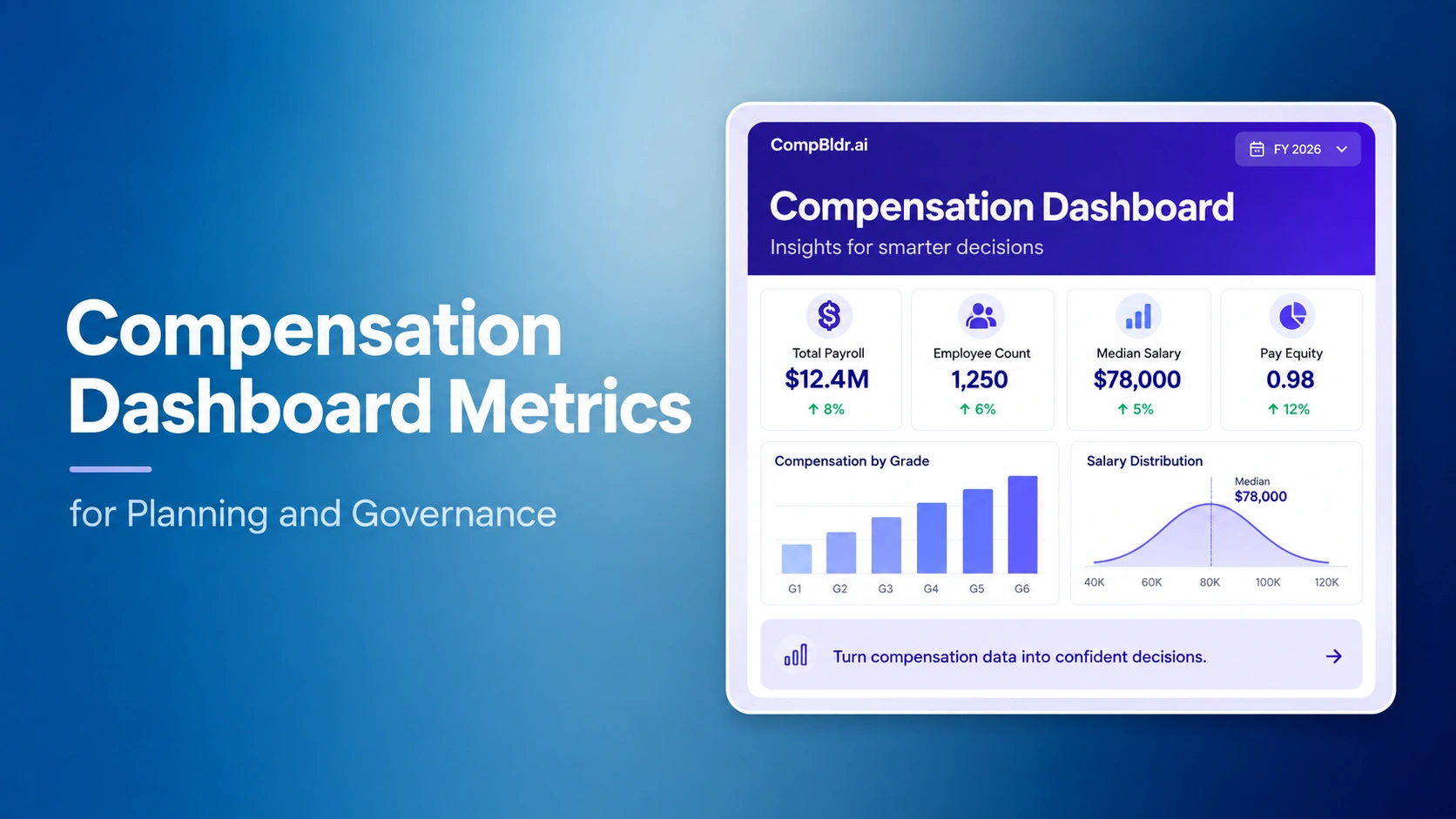
CompBldr tracks all six pay equity metrics within its Compensation Analytics module, automatically updating from the same live compensation data used to manage the merit cycle. There is no separate quarterly audit process or manual report assembly. Quarterly board updates are generated from current data and delivered as exportable reports.
The Escalation Decision Tree: When HR Resolves, When the CHRO Acts, When the Board Is Notified
The escalation framework defines what happens when a pay equity finding is identified. Without a documented escalation framework, every finding creates ambiguity about who is responsible for responding, what the response should be, and what documentation is required. With a documented framework, the response is consistent, defensible, and proportionate to the severity of the finding.
Level 1: HR team resolution within the merit cycle
A Level 1 finding is a TrAI equity flag classified as informational or review recommended, with an adjusted pay gap below 3% in the affected grade cluster and fewer than 5 employees affected. HR team resolution means the compensation analyst reviews the flag, identifies the specific proposals producing the pattern, consults with the relevant managers about the basis for their submissions, and either confirms that the pattern reflects documented legitimate factors or requests a revised proposal with a corrected increase. The resolution and the rationale are logged in CompBldr. No escalation to the CHRO is required unless the analyst cannot confirm a legitimate basis for the pattern within the cycle window.
Level 2: CHRO review and documented action plan
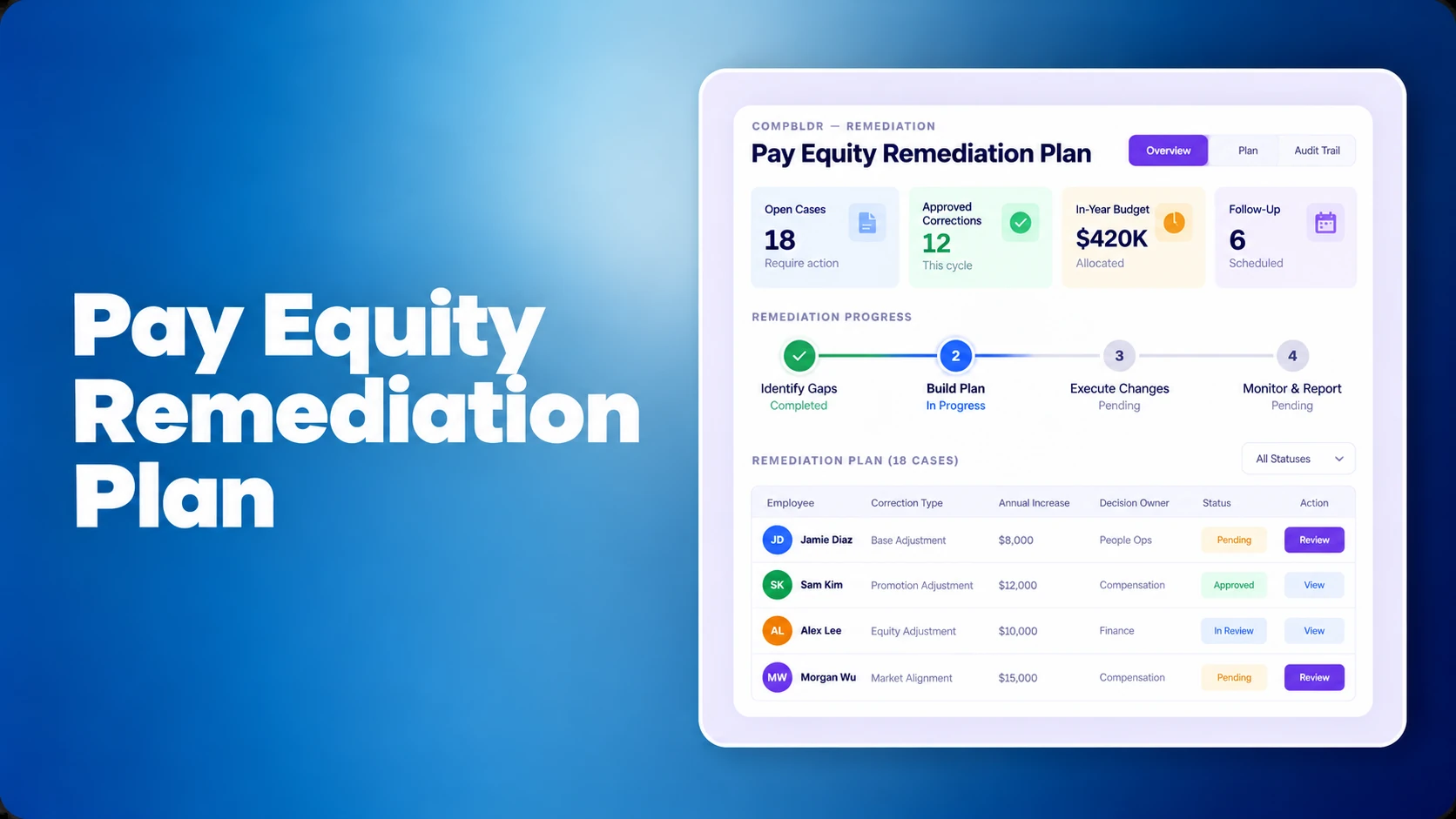
A Level 2 finding is an adjusted pay gap between 3% and 5% in a grade cluster, a TrAI flag classified as escalation required, or a pattern that persists from the prior quarter's report despite a Level 1 resolution attempt. The CHRO receives a documented finding brief including the affected grade cluster, the gap measurement, the demographic dimension, the proposed resolution, and the timeline for correction. The CHRO approves the action plan, and the action plan is archived as a governance record. The findings and action plan are summarized in the quarterly board report without requiring detailed methodology.
Level 3: Board compensation committee notification
A Level 3 finding triggers board notification under three conditions: an adjusted pay gap above 5% in any grade cluster (the EU Pay Transparency Directive's joint pay assessment threshold), a gap that has persisted above 3% for three or more consecutive quarters despite documented Level 2 action plans, or the receipt of a regulatory inquiry (EEOC charge, OFCCP scheduling letter, California CRD complaint) related to pay equity. Board notification means the compensation committee receives a written summary with the findings, the action plan, the timeline, and legal counsel's assessment of regulatory exposure. This is not an optional communication; it is a governance obligation for any board with pay equity in its compensation committee charter.
The documentation each level requires
| Escalation Level | Trigger Conditions | Required Documentation | Timeline |
|---|---|---|---|
| Level 1: HR Resolution |
TrAI flag: informational or review recommended. Adjusted gap below 3%. Under 5 employees affected. |
Flag review log in CompBldr. Rationale for resolution or revised proposal. Analyst identity and timestamp. |
Within the current merit cycle window |
| Level 2: CHRO Action Plan |
Adjusted gap 3–5%. TrAI flag: escalation required. Prior-quarter Level 1 finding unresolved. |
CHRO-approved finding brief. Action plan with specific measures and timeline. Archived governance record. Summary in quarterly board report. |
Within 30 days of cycle close |
| Level 3: Board Notification |
Adjusted gap above 5%. Gap persists for 3+ quarters at 3%+. Regulatory inquiry received. |
Board compensation committee written summary. Legal counsel assessment. Action plan with regulatory context. Documentation package for external disclosure if required. |
Within 15 days of the threshold being crossed |
Why Annual Pay Equity Audits Cannot Replace Quarterly Reporting
Annual audits find problems after the cycle; quarterly reporting prevents them.
A traditional annual pay equity audit runs after the compensation cycle closes. The methodology is correct, and the findings are valid, but the timing means that every gap identified in the audit reflects decisions that have already been communicated to employees. An equity gap discovered in a February audit reflects merit increases distributed in January. Correcting it requires an off-cycle equity adjustment program, which costs more, takes longer, and requires a second compensation communication to affected employees explaining why their salary is changing again, within weeks of their original increase.
TrAI catches the same pattern during the merit cycle while proposals are still in draft or pending approval status. The correction is a straightforward proposal revision, not an off-cycle program. The cost is the time of an HR review conversation and a minor budget reallocation within the existing cycle budget. The timing difference between these two scenarios is the core argument for quarterly monitoring rather than annual auditing as the primary pay equity governance mechanism.
What changes between annual audits that a quarterly cadence captures
Between a February annual audit and the following February audit, the following events affect the pay equity position: a merit cycle distributing increases to every eligible employee, potentially introducing new gaps or widening existing ones; any number of individual salary adjustments for promotions, market adjustments, or equity corrections; new hires at salaries set by individual negotiation that may not reflect the grade band consistently; departures that change the demographic composition of grade clusters; and any changes to the salary band structure resulting from market pricing updates. A quarterly cadence captures the pay equity impact of each of these events within three months of it occurring, rather than accumulating an entire year's worth of changes into a single annual review.
How to Automate Quarterly Pay Equity Reporting
Quarterly pay equity reporting is only sustainable if it is automated. A process that requires a compensation analyst to pull four separate data exports, run regression analysis in Excel, format a board presentation, and get it reviewed by legal counsel every three months will either be deprioritized or done inconsistently. Automation removes the manual effort and ensures methodological consistency across quarters.
Step 1: Connect to a governed compensation data source
Pay equity analysis is only as accurate as the compensation data underlying it. Using HRIS exports with inconsistent grade assignments, manually maintained equity data that is weeks out of date, or benefits cost estimates rather than actual employer contributions, produces pay equity metrics that cannot be defended under regulatory scrutiny. The data source for quarterly pay equity reporting must be the same governed compensation platform that manages salary bands, merit cycles, and HRIS integration. CompBldr syncs compensation data daily from Workday, BambooHR, Rippling, and other HRIS platforms, ensuring that the pay equity analysis uses current employee data rather than a snapshot from the last manual export.
Step 2: Configure the six metrics with a consistent methodology
The statistical methodology for each metric must be documented and applied consistently across every quarterly report. The adjusted gap analysis must use the same control variables (grade, tenure band, performance rating, location) every quarter so that trend comparisons are valid. The compa-ratio distribution analysis must use the same grade band definitions and midpoints. The differentiation score must use the same merit matrix configuration. If the methodology changes between quarters, the trend line is invalid, and the board cannot conclude it. CompBldr's compensation analytics module applies configured methodology consistently to every quarterly report run, producing trend-comparable results without manual recalibration.
Step 3: Automate the TrAI monitoring layer
TrAI operates continuously during active merit cycles, not as a periodic analytical run. It monitors proposals in real time as managers submit and flags equity patterns as they emerge. This means that by the time the quarterly report is generated, the TrAI flag count for the quarter already reflects actual merit cycle activity rather than a retroactive statistical analysis of outcomes. The flag resolution rate is calculated automatically from the CompBldr workflow records showing which flags were reviewed, how they were resolved, and who authorized the resolution. No separate data collection step is required.
Step 4: Generate the board summary from live data
The quarterly board compensation committee summary is a report generated from CompBldr's compensation analytics module, not assembled manually from multiple sources. It reflects the six metrics at the report generation date, with trend comparisons drawn from the prior three quarters' automatically stored report data. The CHRO reviews the generated summary, adds any qualitative commentary relevant to the board context, and the document is ready for the compensation committee packet without requiring a separate data compilation exercise.
.webp)
Simplify Quarterly Pay Equity Reporting
CompBldr automates quarterly pay equity reporting from live compensation data, generating six key metrics, trend comparisons, and escalation flags in a single report run. The CHRO reviews and annotates the findings, while the board receives a consistent, defensible summary every quarter.
What the Board Compensation Committee Summary Should Look Like
The board compensation committee receives two pages per quarter. The first page contains the six metrics in a dashboard format: the current value of each metric, the prior quarter value, the direction of change (improved, stable, worsened), and the threshold or benchmark for each metric. The second page contains the escalation summary: how many Level 1 findings were resolved within the merit cycle, how many Level 2 action plans are currently active, and whether any Level 3 notifications are required this quarter. If a Level 3 threshold has been crossed, legal counsel's one-paragraph assessment of regulatory exposure is included on the second page.
The board does not need the statistical methodology. They need to see six numbers with trend lines, know which numbers are above and below the threshold, know what the HR team did about any findings, and receive a clear statement from the CHRO about whether any regulatory disclosure obligation has been triggered. That is a two-page document. Any board compensation committee summary longer than two pages is providing more information than the board's governance role requires, which dilutes attention from the findings that actually matter.
How CompBldr Delivers Quarterly Pay Equity Reporting for CHROs and Boards
CompBldr's compensation analytics module produces the six pay equity metrics from live data without a separate quarterly audit process. The adjusted pay gap and compa-ratio distribution calculations run automatically against the current HRIS-synced compensation dataset. TrAI's flag count and resolution rate are drawn from the merit cycle workflow records automatically. The merit cycle differentiation score is calculated from the merit matrix configuration and the submitted increase distribution from the most recently closed cycle. Pay transparency compliance status reflects the current salary band coverage percentage from the job architecture module.
The escalation framework is configured in CompBldr with the thresholds that trigger each level. When the adjusted gap in a grade cluster crosses the configured Level 2 threshold, CompBldr flags it for CHRO review automatically. When it crosses the Level 3 threshold, the system generates a notification for the configured escalation contacts. The quarterly board summary report is generated from CompBldr's reporting module in a format the CHRO can deliver directly to the compensation committee packet with minimal editing.
For CHROs who have been manually assembling pay equity quarterly summaries from multiple data sources, or who have been presenting annual audit results without a quarterly cadence, CompBldr provides the infrastructure that makes genuine quarterly governance operational rather than aspirational.
Quarterly pay equity reporting is no longer an advanced practice. The EU Pay Transparency Directive, ESG disclosure frameworks, and proxy advisor governance requirements have made it a baseline expectation for CHROs and board compensation committees at organizations above a few hundred employees. The question is not whether to report quarterly but how to do it without a quarterly manual audit that overwhelms HR capacity.
The answer is a compensation governance platform that continuously monitors the six metrics from live data, surfaces equity flags through real-time AI monitoring during the merit cycle, applies the escalation framework automatically when thresholds are crossed, and generates board-ready packages through CompBldr’s compensation reporting software from the same governed data behind each compensation decision. That is what CompBldr provides, and it is the architecture that makes quarterly pay equity governance sustainable rather than a heroic annual effort squeezed into four cycles a year.
Support Quarterly Board Reviews with Current Pay Equity Data
Access the metrics, reporting, and documentation needed to review pay equity outcomes and compensation practices throughout the year.
Book a Demo
.svg)

.svg)
.svg)

