

.svg)





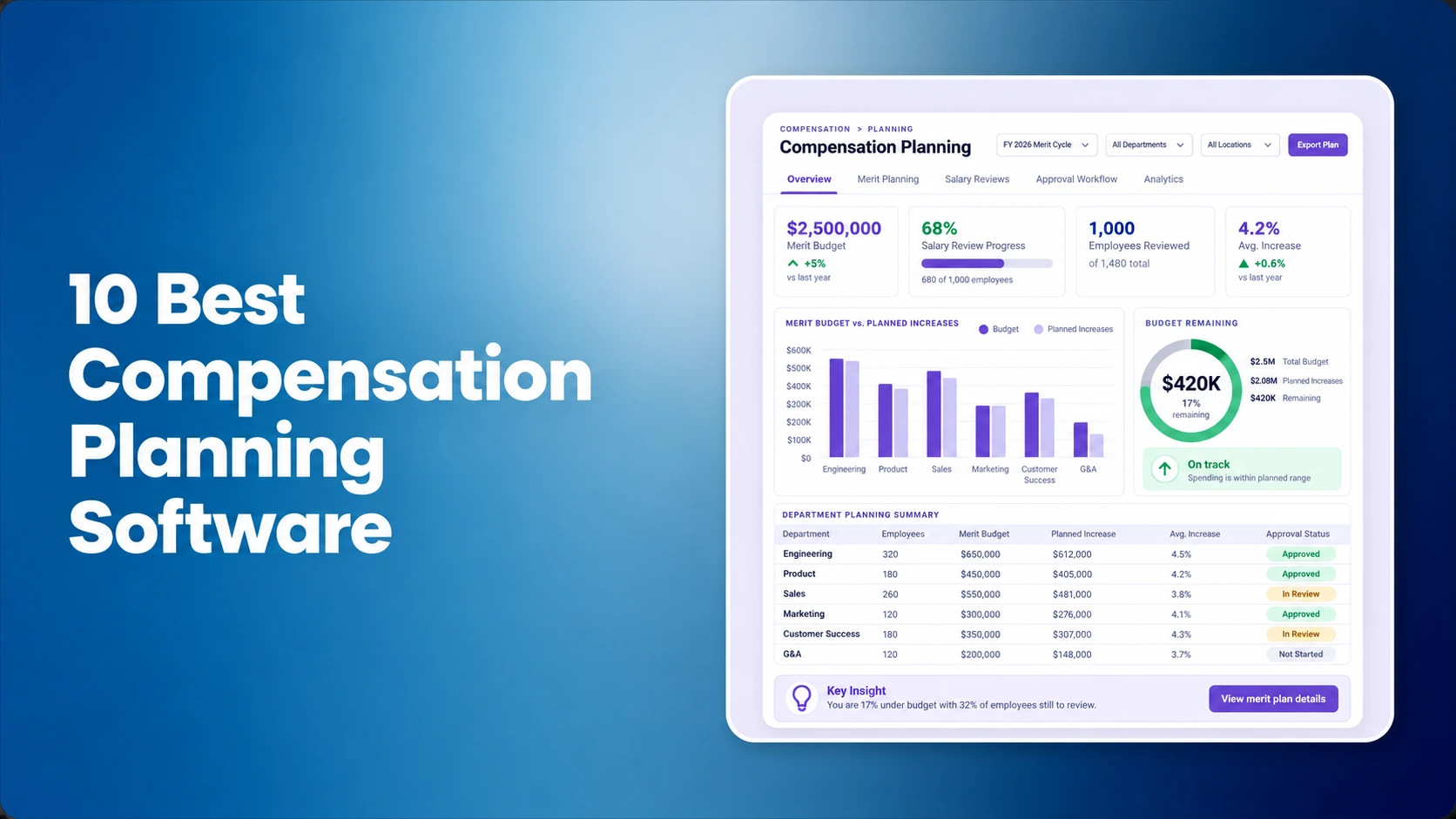

The best compensation planning software for a merit or salary review cycle is the platform that can keep employee data, pay context, budgets, manager recommendations, exceptions, approvals, and final decisions synchronized while the cycle is changing. For 2026, a practical shortlist includes CompBldr, Pave, Payscale Paycycle, Salary.com CompXL, Workday, beqom PaySuite, Compport, HRSoft, Aeqium, and Ravio.
Use this comparison to build a shortlist. For deeper implementation criteria, use CompBldr's Compensation Planning Software Buyer's Checklist. For migration risk and spreadsheet replacement, use the guide to compensation planning software vs. spreadsheets.
Research method: current vendor capabilities were rechecked against first-party product documentation available on September 16, 2026. Vendor-owned documentation can establish documented capabilities, but it does not independently prove implementation quality, service quality, customer outcomes, or fit for your employee population. Product packaging changes quickly, so buyers should confirm the exact module, integration, service, and commercial scope during procurement.
Publisher disclosure: CompBldr publishes this comparison and is included in it. The order below is an editorial best-fit framework, not a universal performance ranking. Apply the same proof-of-capability tests to CompBldr that you apply to every other finalist.
Quick Comparison: Compensation Planning Software for 2026
| Platform | Best fit | Planning strength to test | Buyer watchpoint |
|---|---|---|---|
| CompBldr | Governed planning connected to compensation architecture | Budgets, merit guidance, approvals, job and range context, analytics and reporting | Confirm configuration and integration scope for your cycle |
| Pave | Data-connected merit cycles and manager experience | Top-down and bottom-up budgets, guardrails, worksheets and live analytics | Confirm which workflows and data products are included |
| Payscale Paycycle | Planning inside a broader compensation intelligence ecosystem | Scenario planning, configurable workflows, alerts and market context | Map Paycycle to the other Payscale modules you require |
| Salary.com CompXL | Complex merit logic and spreadsheet-like flexibility | Formula logic, proration, currencies, guidelines and approvals | Confirm product tier and modules for your use case |
| Workday | Organizations already standardized on Workday HCM | Unified HR data, compensation review, modeling and financial guardrails | Test specialist compensation complexity against suite-native workflow |
| beqom PaySuite | Large global and complex total-comp programs | Merit, bonuses, global incentives, top-down budgeting and configurable workflows | Validate implementation effort for highly customized processes |
| Compport | Highly configurable global compensation processes | Merit, promotions, adjustments, bonus planning and granular workflow configuration | Test administrator usability alongside flexibility |
| HRSoft | Enterprise compensation complexity and budget governance | Total compensation planning, pay for performance, budgeting and global capabilities | Confirm integration and configuration fit for your HCM environment |
| Aeqium | Specialist planning with configurable merit and bonus logic | Merit matrices, proration, budgets, approval chains, reporting and audit history | Pressure-test global scale, complex-plan requirements and integration depth |
| Ravio | Technology-focused teams connecting benchmarks, bands and pay reviews | HRIS-connected market data, salary bands and compensation-review workflow | Check role and geography coverage for your employee population |
How We Evaluated Compensation Planning Platforms
A planning platform should be tested against the compensation decisions it must govern, not the number of fields on a manager worksheet. The most important criteria are:
- Cycle configuration: eligibility, proration, action types, guidelines, dates, currencies and employee populations.
- Budget control: allocation, live consumption, overage handling, transfers and Finance visibility.
- Manager workflow: relevant pay context, recommendations, rationale, warnings and simple submission.
- Approval governance: conditional routing, return paths, exceptions, timestamps and durable history.
- Compensation context: salary ranges, market position, performance inputs, promotions and other pay actions.
- Analytics and close: cycle progress, budget variance, outliers, final records and downstream communication.
Compare Commercial Scope on the Same Basis
Public pricing is not consistently available across this shortlist, so a headline subscription number is rarely enough. Ask each finalist to quote the same employee population, planning modules, implementation, integrations, data products, support, administrator access, and renewal assumptions. A lower software fee can still create a higher operating cost if critical configuration, reconciliation, or reporting work remains manual.
1. CompBldr: Best Fit for Governed Planning Connected to Compensation Architecture
CompBldr's Compensation Planning workflow is designed to keep merit and salary-review decisions connected to the compensation records that precede and follow the cycle. Current CompBldr content describes configurable eligibility and merit guidance, budget allocation and live consumption, manager proposals, structured approvals, documented overrides, and connections to Job Architecture, Market Benchmarking, Compensation Analytics, and Compensation Reporting.
Why shortlist it: the core fit is a Total Rewards team that wants the merit decision to remain traceable to the employee's job, grade, range, market context, budget, exception, approval, and final reporting record.
What to test: bring a real cycle design with one transfer, one promotion, one out-of-guideline recommendation, one employee near range maximum, and one Finance budget change. Require the demo to show what changes, what remains versioned, and who can approve each exception.
2. Pave: Best Fit for Data-Connected Merit Cycles and Manager Experience
Pave's current Compensation Planning product emphasizes centralized budgets, built-in guardrails, manager guidance, flexible worksheet views, configurable planning windows, top-down and bottom-up budgets, and live cycle analytics. Pave also connects planning to its market-data, market-pricing, pay-range and total-rewards products.
Why shortlist it: Pave is relevant when a team wants a modern manager experience with current compensation data close to the planning workflow.
What to test: verify the difference between a warning and a hard control, how budget exceptions are routed, which market and band data appear in the manager view, and how cycle results move back into the systems that remain authoritative.
Review Pave Compensation Planning.
3. Payscale Paycycle: Best Fit for Planning Inside a Compensation Intelligence Ecosystem
Payscale positions Paycycle as a compensation-planning product with scenario planning, configurable workflows and alerts. Payscale's broader 2026 platform messaging connects merit cycles with market data, job structures, pay equity insights, manager-ready pay context and budget-impact visibility.
Why shortlist it: Paycycle is a logical candidate for teams already using or considering Payscale data and compensation intelligence and wanting planning closer to those workflows.
What to test: ask which data and insights are native to Paycycle versus dependent on other Payscale products, then run the same difficult employee through budget, manager recommendation, exception and approval steps.
4. Salary.com CompXL: Best Fit for Complex Merit Logic and Spreadsheet-Like Flexibility
Salary.com's current CompXL Merit Planning documentation describes salary increases, lump-sum awards, promotion adjustments and market-based changes, with an Excel-style logic engine, automated proration, HRIS connectivity and support for 96+ currencies. Salary.com also describes merit guidelines, manager budget guardrails and structured approvals.
Why shortlist it: CompXL is relevant when the organization has complex formulas or global planning rules and wants to retain configurability while moving away from uncontrolled spreadsheets.
What to test: recreate one of your hardest formulas, including proration and an exception. Confirm which logic is visible to administrators, how changes are versioned, and which CompXL tier or related Salary.com modules are required.
5. Workday: Best Fit for Organizations Already Standardized on Workday HCM
Workday's current Compensation Management product combines compensation review with unified HCM data, pay-equity dashboards, analysis tools, total rewards statements and in-flight cost modeling. For organizations already using Workday as the core people system, the advantage is reducing the number of data handoffs between HR records and the compensation cycle.
Why shortlist it: Workday is relevant when suite consolidation and native HCM context matter more than selecting a stand-alone specialist platform.
What to test: bring the exceptions that make your compensation program unusual. Determine whether they are handled natively, through configuration, through an extension, or outside the compensation workflow.
Review Workday Compensation Management.
6. beqom PaySuite: Best Fit for Large Global and Complex Total-Comp Programs
beqom PaySuite currently combines salary and merit, bonuses and global incentives in a unified compensation platform. Its documentation highlights compensation rounds, top-down budgeting, configurable workflows, approval tracking, market adjustments, and modeling through its broader Pay Intelligence capabilities.
Why shortlist it: beqom is relevant for large multinational organizations that need compensation planning across several pay components, countries and complex approval structures.
What to test: configure a multi-country round with different currencies, local rules, multiple pay components and a conditional approval path. Assess how much specialist administration is required to maintain the design.
7. Compport: Best Fit for Highly Configurable Global Compensation Processes
Compport's current planning product describes merit cycles, promotions and ad hoc adjustments alongside bonus planning, pay equity, long-term incentives and total rewards. The vendor emphasizes granular configuration, role-based workflows, guardrails and integrations with HCM, ERP and CRM systems.
Why shortlist it: Compport is a candidate when the compensation team values configuration depth across multiple compensation programs.
What to test: ask administrators, not only managers, to configure a representative rule change. Flexibility is useful only when the team can maintain it without creating a new dependency bottleneck.
Review Compport Compensation Planning.
8. HRSoft: Best Fit for Enterprise Compensation Complexity and Budget Governance
HRSoft positions its platform around total compensation planning, pay for performance, award modeling, budgeting, global capabilities and total rewards communication. Its current budgeting documentation emphasizes configurable budget pools, while its Workday partnership demonstrates an option for organizations that need specialist compensation workflows alongside a major HCM platform.
Why shortlist it: HRSoft is relevant for large organizations with complex compensation programs that need dedicated planning and budget controls.
What to test: verify integration ownership, multi-currency behavior, approval routing and how the system handles salary, incentive and other compensation components across your actual employee populations.
Review HRSoft Total Compensation Management.
9. Aeqium: Best Fit for Specialist Planning With Configurable Merit and Bonus Logic
Aeqium's current Compensation Cycle Management product supports configurable merit, bonus, equity, and other compensation cycles with no-code workflow setup. Its documentation describes merit matrices, bonus formulas, proration logic, manager assignments, approval flows, budget settings, custom calculations, real-time reporting, role-specific access, and audit trails.
Why shortlist it: Aeqium is relevant when a Total Rewards team wants a focused planning product with administrator-configurable cycle logic rather than a broad HCM suite.
What to test: rebuild your actual merit matrix and one bonus or proration rule, change the approval chain during the demo, and show the audit history. Then validate global scale, data integrations, security, reporting, and support requirements against your operating model.
Review Aeqium Compensation Cycle Management.
10. Ravio: Best Fit for Technology-Focused Teams Connecting Benchmarks, Bands and Pay Reviews
Ravio connects real-time compensation benchmarking with salary bands and pay-review workflows. Its current product materials describe total-reward benchmarking across 50+ countries and 100+ roles in the pay-review experience, with HR-system integrations and market context available alongside review decisions.
Why shortlist it: Ravio is relevant when a technology or tech-enabled workforce wants current market context close to salary-band and review decisions.
What to test: use non-technology roles, smaller geographies, executive jobs, and an active-cycle band change. Confirm which market snapshot the review uses, how salary bands are governed during the cycle, and what happens when HRIS data changes after managers start.
Review Ravio Compensation Reviews.
Compensation Planning Software vs. Compensation Management Software
Compensation planning software primarily governs periodic decisions such as merit, salary review, promotion, market adjustment, bonus or other compensation cycles. Compensation management software is the broader category and can include market pricing, salary structures, job architecture, pay equity, analytics, reporting, total rewards and ongoing compensation administration.
Buyers should decide whether the immediate problem is cycle execution or a broader compensation operating model. If jobs, grades, ranges, market data, pay-equity analysis, and total rewards will stay in other systems, test the integrations and ownership rules. If you expect one platform to govern more of that lifecycle, compare the broader compensation management software platforms before contracting for a planning-only workflow.
Use One Demo Script for Every Compensation Planning Vendor
- Load a representative employee population with one recent transfer and one missing or changed manager.
- Apply eligibility and proration rules and show which employees are excluded and why.
- Allocate budgets and change one Finance assumption after managers have started planning.
- Enter a normal merit recommendation, an out-of-guideline proposal and a promotion.
- Show what a manager can see for salary range, performance, market context and remaining budget.
- Return one proposal for revision and preserve the reviewer, rationale and previous value.
- Move an employee between managers during the active cycle and show what happens to access and budget ownership.
- Close the cycle and reproduce the final decision, approval path, effective date and downstream output.
This scenario exposes more than a polished feature tour. It tests whether the platform can preserve one current decision state while people, budgets and approvals change.
How to Choose the Right Compensation Planning Software
Choose for the hardest 10% of the cycle. Standard merit recommendations are easy to automate. Promotions, transfers, multiple currencies, exceptions, range maximums, budget changes and late employee-data corrections reveal the real operating model. If your hardest issue is keeping spend controlled while managers make decisions, compare the workflow against a real merit cycle with real-time budget control.
Separate data from workflow. Determine which system owns employee, manager, salary, performance, job, grade and range data. A planning platform should make ownership clearer, not create another competing source.
Test the merit logic, not just the final worksheet. If your process uses performance ratings and range position, rebuild the actual merit increase matrix and verify eligibility, proration, overrides, and budget effects.
Measure manager experience and administrator effort separately. A simple manager screen can hide a highly manual configuration process. Evaluate both, and use a realistic manager-preparation scenario such as the guidance in preparing managers for merit season.
Require reproducibility. After the demo, ask someone who did not configure the cycle to reconstruct why a difficult employee received the final amount. If the answer depends on email or an offline worksheet, governance is incomplete.
If terminology varies across vendors, use the Compensation Glossary to normalize concepts such as merit increase, salary range, compa-ratio, market adjustment, and pay grade before comparing product claims.
Limitations of This Comparison
This comparison is based primarily on current public vendor documentation and product information. Vendor pages can establish documented capabilities, but they cannot independently prove implementation quality, service quality, adoption, customer outcomes, or fit for your employee population. Use this guide to narrow the field, then verify requirements with your own employee data, security review, integrations, administrators, managers, and procurement terms.
Which Compensation Planning Platforms Should You Shortlist?
Start with the operating model. If planning needs to stay tightly connected to job architecture, ranges, market evidence, approvals, analytics and reporting, evaluate CompBldr. If employer-connected compensation data and a modern manager workflow are priorities, evaluate Pave. If your organization is already invested in Payscale intelligence, test Paycycle. If highly configurable merit formulas and global currencies are central, test Salary.com CompXL. Workday is a natural candidate for organizations prioritizing a suite-native HCM workflow. beqom, Compport and HRSoft deserve attention for complex global compensation programs. Aeqium can fit teams seeking configurable specialist cycle logic, while Ravio is particularly relevant to technology-oriented organizations that want market data, bands and reviews close together.
Then reduce the list to the vendors that can run the same difficult demo case with the least ambiguity about data ownership, budget control, manager access, exceptions, commercial scope, and final records.


.svg)

.svg)
.svg)

