

.svg)





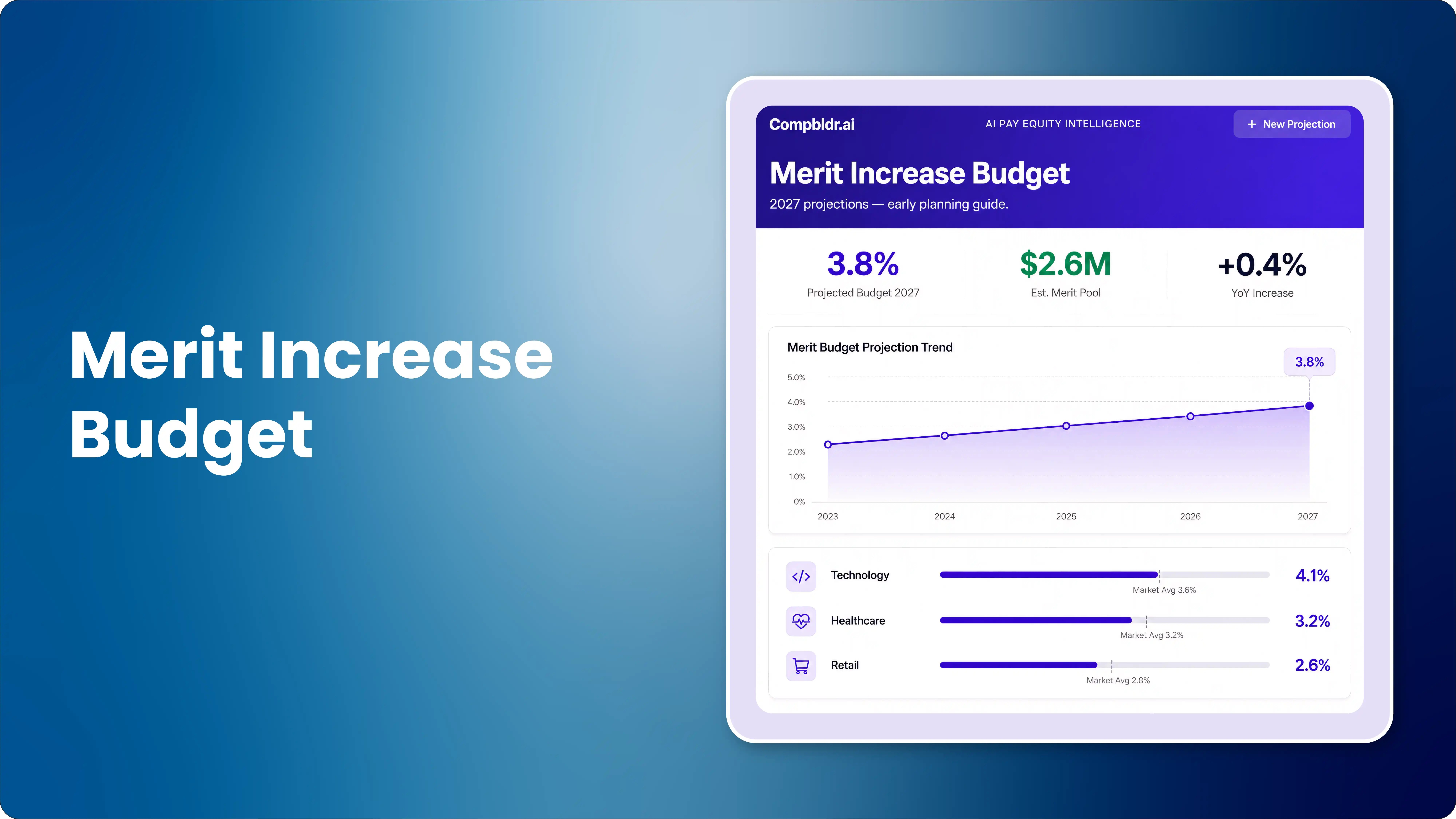

Current 2027 U.S. merit-budget projections cluster around 3.0% to 3.2%, while broader total salary increase budgets are running around 3.5% to 3.6%. Payscale reports a 3.0% merit allocation inside a 3.5% total payroll increase budget. Mercer projects 3.2% merit and 3.5% total salary increases. Salary.com's latest U.S. survey also reports a 3.2% merit projection and a 3.5% total salary increase budget.
This distinction matters because a total salary increase budget can include merit, general or cost-of-living increases, market adjustments, and other base-pay actions depending on survey methodology. A merit budget is the portion intended specifically for performance-linked base-pay increases. This guide reflects public 2027 planning data reviewed through October 7, 2026. These figures are projections, not final 2027 actual results.
2027 Merit Increase Budget: What the Current Data Actually Says
The current public U.S. data supports a narrow but important merit range rather than one universal number. Payscale reports 3.0% allocated to merit; Mercer and Salary.com each report 3.2% projected merit increases. All three sources place broader total salary increase budgets at 3.5%.
Payscale 2026-2027 Salary Budget Survey · Mercer 2027 Compensation Planning Strategy · Salary.com 2027 survey summary via WorldatWork.
Broader salary increase budget surveys show a relatively narrow 2027 planning range:
| Source | 2027 projection | What the figure represents | Planning note |
|---|---|---|---|
| Payscale | 3.0% merit; 3.5% total payroll increase budget | Merit allocation plus broader total payroll increase budget | Useful for separating merit funding from the full base-pay budget. |
| Mercer | 3.2% merit; 3.5% total salary increase | Projected U.S. merit and total salary increase budgets | Mercer notes that most reported 2027 budgets were still preliminary when surveyed. |
| Salary.com | 3.2% merit; 3.5% total salary increase | Projected U.S. merit and total salary increase budgets | Reinforces that merit and total increase budgets should be tracked separately. |
| WorldatWork | 3.6% mean total salary increase budget | Total salary increase budget | Useful as a broader market-budget reference, not a merit-only benchmark. |
WorldatWork 2027 salary budget summary provides the 3.6% total-budget benchmark. The practical takeaway is not that one survey is “right”; it is that compensation teams should compare like-for-like metrics before selecting a merit pool.
Merit Budget vs. Total Salary Increase Budget
A merit increase budget is the pool an employer sets aside for performance-linked base-pay increases. A total salary increase budget is broader and can include multiple types of base-pay actions depending on the employer and survey methodology.
This is why a compensation team should not take a 3.5% or 3.6% total salary budget benchmark and automatically load that entire amount into a merit increase matrix. First define which pay actions the budget is meant to fund.
| Budget category | Primary purpose | Typical planning question |
|---|---|---|
| Merit increase | Reward performance in the current role | How should the merit pool be distributed across performance and pay-position guidelines? |
| Promotion increase | Recognize movement to a higher-level role or expanded scope | What pay position is appropriate in the new grade or range? |
| Market adjustment | Address external or internal pay positioning | Which employees or roles require a correction independent of performance? |
| General or COLA increase | Apply a broader pay adjustment under employer policy | Who is eligible and what broad adjustment rule applies? |
| Bonus or incentive | Provide variable compensation under a separate plan | Is the award funded from a base-pay budget or a distinct incentive pool? |
For the basic definition and formula behind an individual merit raise, see what a merit increase is and how employers calculate it.
How to Calculate a 2027 Merit Budget
The starting formula is:
Merit Pool Dollars = Eligible Base Payroll × Merit Budget Percentage
For example, if an employer has $10 million in eligible base payroll and approves a 3.0% merit budget:
$10,000,000 × 0.03 = $300,000
The $300,000 is the available merit pool before any separately funded promotions, market adjustments, bonuses, or other pay actions. The employer should document exactly which employee population and pay elements are included in the eligible-payroll denominator so Finance and HR are modeling the same number.
Why Early 2027 Planning Should Start With Scenarios, Not One Percentage
Market surveys answer a useful but limited question: what are other organizations planning? They do not determine what one employer should spend.
For a calendar-year merit cycle, scenario modeling should be underway by Q4 2026. Current survey data is available, so HR and Finance can now compare external benchmarks with internal payroll, pay-position, and workforce assumptions before manager planning opens. The exact calendar should still follow the organization's budgeting and compensation cycle.
A good early-planning model tests more than one pool. For example, an organization could compare a conservative case, a market-reference case, and a higher-investment case, then evaluate each against eligible payroll, expected performance distribution, salary-range position, critical-role pressure, internal equity, and Finance constraints.
A 5-Step Framework for Building the 2027 Merit Budget
Step 1: Define the Budget Scope Before Selecting a Percentage
Decide which employee population is eligible and which pay actions the merit pool will cover. Separate merit from promotions, market adjustments, bonuses, and other increases before comparing the organization with external survey figures.
Also confirm whether the budget denominator is all base payroll, eligible base payroll, or another Finance-defined population. A percentage is not meaningful if HR and Finance are applying it to different payroll bases.
Step 2: Use Multiple External Benchmarks
Use at least two current, methodologically understood sources rather than treating one survey headline as the answer. For 2027, the public U.S. merit-specific benchmarks now sit around 3.0% to 3.2%, while the broader total salary increase budget benchmarks in the sources above sit around 3.5% to 3.6%.
External data should establish context, not replace the employer's own compensation analytics, recent cycle history, salary-range position, and business constraints.
Step 3: Convert Percentages Into Payroll Dollars
Model each proposed pool in dollars and by business unit. A 0.25 percentage-point change can become a material fixed-pay difference at scale, so Finance should see the actual annualized payroll effect rather than only a percentage.
Document assumptions such as employee eligibility, planned hires, expected separations, effective dates, and whether off-cycle adjustments are included or funded separately.
Step 4: Test the Distribution Before Managers See It
A merit budget is a funding pool, not an instruction to give every employee the same percentage. Test how the pool behaves when distributed through performance and salary-range guidelines.
A merit matrix can connect performance outcomes with compa-ratio or another pay-position measure, but it does not guarantee equity by itself. Before the cycle opens, review whether the proposed guidelines create unexplained pay gaps, range-limit issues, or pay compression.
Step 5: Build the Approval Narrative for Finance
A CFO-ready recommendation should make the assumptions visible: external benchmarks reviewed, eligible payroll, scenarios modeled, merit guidelines, separate promotion and market-adjustment pools, expected annualized cost, and the controls that will keep the cycle within budget.
The objective is not to prove that one percentage is universally correct. It is to show why the selected budget fits the organization's pay strategy and what tradeoffs were considered.
What the 2027 Data Suggests About Distribution Strategy
Payscale reports that only 32% of U.S. organizations plan a standard across-the-board increase for 2027, down from 36% that actually used one in 2026. It also reports that 89% of organizations use merit increases. That supports a planning environment in which more employers are differentiating pay actions rather than treating the annual budget as one uniform increase.
This does not mean every organization should abandon broad increases. Workforces with step structures, collective bargaining requirements, inflation-sensitive populations, or other policy constraints can require different approaches. The important control is to make the reason for each pay action explicit and track it separately.
Common 2027 Merit Budget Planning Mistakes
Calling a total salary increase budget a merit budget. Payscale, Mercer, Salary.com, and WorldatWork publish salary-budget figures using different labels and methodologies. Only use a merit-specific figure when the source identifies it that way, and do not substitute a total salary increase budget for the merit pool.
Giving every employee the budget percentage. A 3.0% merit budget does not mean every eligible employee should automatically receive 3.0%. The pool and the individual award are different decisions.
Mixing promotions and market adjustments into the merit pool without visibility. This makes it difficult to explain where the budget went and can distort the intended performance distribution. Review merit increases vs. promotion increases before finalizing the funding model.
Ignoring salary ranges. Proposed merit increases should be tested against approved salary ranges and pay-position rules before communication.
Assuming the market projection is final. The current 2027 figures are still planning projections, not final 2027 actual results. Refresh the benchmark before final approval if newer survey data becomes available or if the organization's labor-market assumptions materially change.
Opening manager planning before HR and Finance agree on controls. Eligibility, budget ownership, merit guidelines, approval thresholds, and exception documentation should be set before managers begin submitting proposals.
How CompBldr Supports 2027 Merit Planning
CompBldr's Compensation Planning workflow supports merit cycles with configurable eligibility rules, merit matrix guidelines, organization and department budgets, real-time budget consumption, performance-linked recommendations, and structured approvals.
Managers can review current salary, compa-ratio, band position, performance rating, and merit guidelines while making proposals. Finance and HR can see budget consumption as proposals move through the cycle, and proposals outside configured controls can be flagged before final approval.
CompBldr also surfaces compression and equity signals during the cycle through TrAI and Compensation Analytics. These tools support review and governance. They do not replace human judgment about performance, policy, legal obligations, or final pay decisions.
2027 Merit Budget: The Practical Bottom Line
As of October 7, 2026, the most useful public U.S. merit-specific benchmarks cluster around 3.0% to 3.2%: Payscale reports 3.0%, while Mercer and Salary.com report 3.2%. Broader total salary increase budget benchmarks in the same current source set sit around 3.5% to 3.6%.
Use those figures as external context, not as an automatic budget. Define the eligible payroll, separate merit from other pay actions, model more than one scenario, test the proposed distribution against performance and pay position, and give Finance a transparent explanation of the assumptions before the cycle opens.


.svg)

.svg)
.svg)

