

.svg)





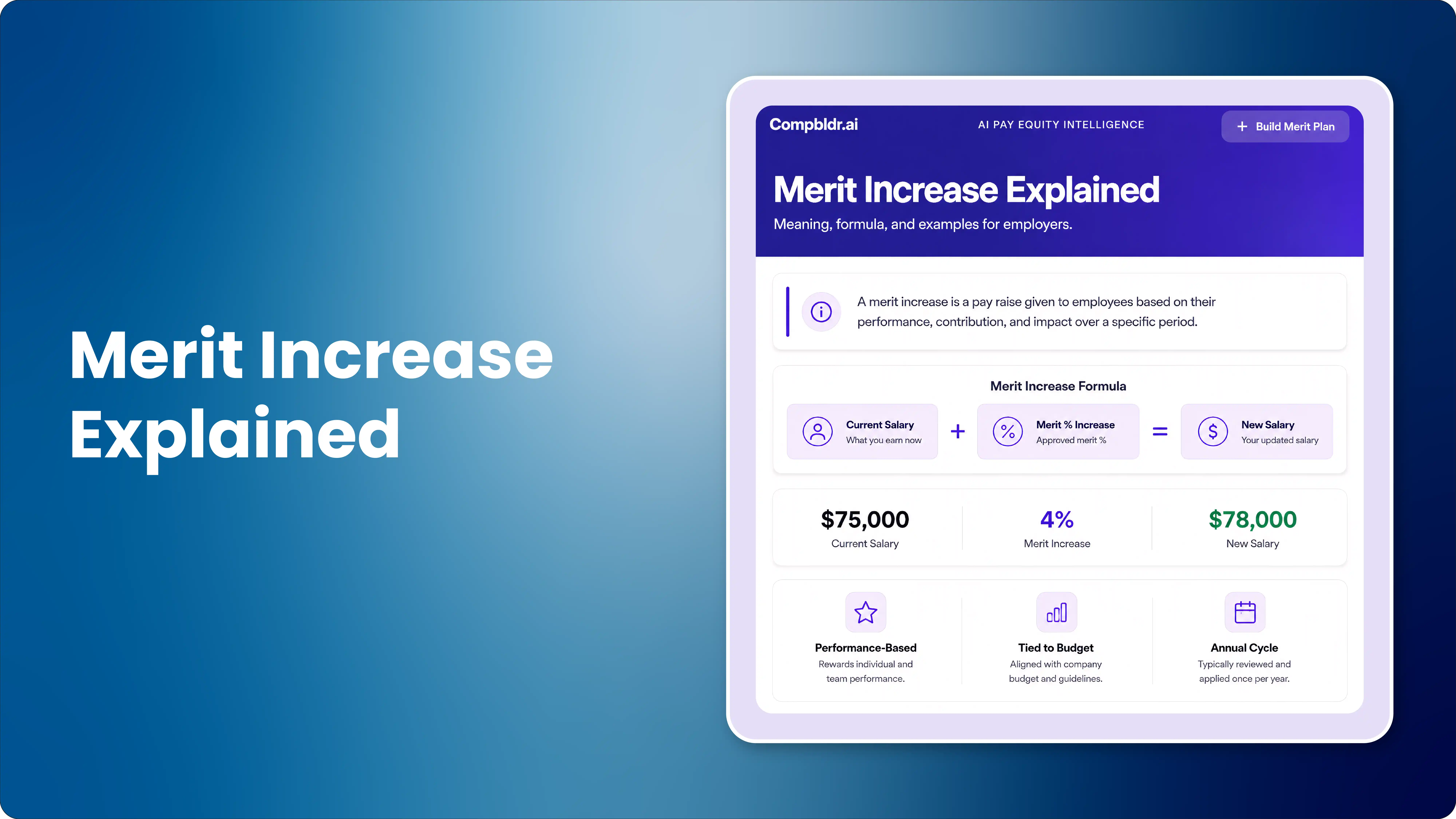

A merit increase is a pay raise tied to an employee's performance under the employer's compensation program. In many organizations, it is applied as an ongoing increase to base pay rather than a one-time bonus. The basic calculation is straightforward: multiply the employee's current base pay by the approved merit increase percentage, then add that amount to the current base pay.
For employers, the difficult part is usually not the arithmetic. It is deciding the percentage consistently, keeping the total cycle within budget, accounting for the employee's position in the salary range, documenting exceptions, and separating merit from promotions, market adjustments, and other pay actions.
What Is a Merit Increase?
A merit increase, sometimes called merit pay or a merit raise, is an increase in pay based on performance criteria set by the employer. The U.S. Department of Labor describes merit pay as pay-for-performance based on employer-defined criteria. Merit increases are often decided during a formal merit cycle. For related definitions such as base pay, merit matrix, market adjustment, and compa-ratio, see the compensation glossary, although employers can use different review schedules.
A merit increase is usually intended to recognize performance in the employee's current role. That distinguishes it from a promotion increase, which reflects movement to a role with greater scope or level, and from a market adjustment, which addresses pay positioning relative to the external or internal market.
Employers should define these pay actions separately in policy and compensation workflows. Clear definitions make it easier to budget each action, explain decisions to managers and employees, and review outcomes later.
Merit Increase vs. Raise, Promotion, Market Adjustment, COLA, and Bonus
| Pay action | Primary trigger | Base-pay impact | Employer question |
|---|---|---|---|
| Merit increase | Individual performance under the employer's program | Usually increases ongoing base pay | What increase is appropriate within performance, range, and budget guidelines? |
| Promotion increase | Movement to a higher-level role or materially expanded scope | Usually increases base pay | Where should pay sit in the new role's salary range? |
| Market adjustment | Pay position relative to relevant market or internal structure | Usually increases base pay | Does current pay need correction independent of performance? |
| COLA or broad general increase | Employer policy, economic conditions, or another broad adjustment basis | Often increases base pay | Who is eligible and how is the broad adjustment determined? |
| Bonus | Bonus plan, individual or company results, or another defined event | Typically does not change base pay | What does the applicable bonus plan or policy specify? |
A raise is the umbrella term. A merit increase is one type of raise, but not every raise is merit-based.
Merit Increase Formula
The core merit increase formula is:
Merit Increase Amount = Current Base Pay × Merit Increase Percentage
Then calculate the new base pay:
New Base Pay = Current Base Pay + Merit Increase Amount
You can also express the second formula as:
New Base Pay = Current Base Pay × (1 + Merit Increase Percentage)
The formula works for annual salaries and hourly base rates. The employer still needs a separate process for determining the percentage that should be used.
Merit Increase Example for a Salaried Employee
Assume an employee earns $65,000 and receives an approved 4% merit increase.
Step 1: Calculate the increase.
$65,000 × 0.04 = $2,600
Step 2: Calculate the new salary.
$65,000 + $2,600 = $67,600
The employee's new annual base salary is $67,600. If the employer later calculates compa-ratio, range position, or future base-pay increases, the updated base salary becomes the relevant input.
Merit Increase Example for an Hourly Employee
The same formula can be applied to an hourly base rate. Assume an employee earns $25.00 per hour and receives a 4% merit increase.
Increase per hour: $25.00 × 0.04 = $1.00
New hourly rate: $25.00 + $1.00 = $26.00 per hour
The merit calculation determines the new base rate. Payroll teams should separately confirm the effective date and any downstream payroll implications for the employee's status and work circumstances.
What Is a Typical Merit Increase Percentage in 2026?
There is no universal merit increase percentage that every employer should use. Merit budgets vary by organization, industry, financial conditions, workforce strategy, and compensation philosophy.
For a current U.S. planning benchmark, Mercer's 2026 compensation planning research projects an average merit increase budget of 3.2% and an average total salary increase budget of 3.5%. The merit figure is an employer-level budget benchmark, not a recommendation that every employee should receive 3.2%.
Review Mercer's 2026 compensation planning research.
Individual merit awards can be higher, lower, or zero depending on the employer's plan. The more important question is how the organization translates its approved merit pool into individual decisions using consistent criteria.
How Employers Decide an Individual Merit Increase
A governed merit decision usually combines several inputs rather than relying on performance alone:
| Input | Why it matters | Control question |
|---|---|---|
| Performance result | Connects the merit decision to the employer's performance criteria | Is the rating or performance outcome documented and calibrated? |
| Compa-ratio or salary-range position | Shows where current pay sits relative to the approved range | Would the proposed increase create an unintended range-position issue? |
| Merit budget | Constrains individual decisions to the approved organization or department pool | Does the proposal keep the cycle within budget? |
| Internal equity review | Helps identify patterns that merit guidelines alone may not explain | Does the decision create or widen an unexplained pay difference? |
| Eligibility and effective date | Determines who participates and when the new rate begins | Are eligibility and timing rules applied consistently? |
| Exception rationale | Preserves the reason for an out-of-guideline decision | Who approved the exception and why? |
These inputs should be defined before managers begin making proposals. Otherwise, the organization risks turning a merit program into a series of one-off negotiations.
How a Merit Matrix Supports Consistent Decisions
A merit increase matrix is a decision framework that maps performance results against a second compensation input, commonly salary-range position or compa-ratio, to produce a recommended increase or increase range.
The matrix is useful because two employees can have the same performance result but different pay positions. An employee who is already near the top of the salary range may require a different base-pay decision from an employee with the same performance result who sits much lower in the range.
However, a merit matrix does not automatically make a pay program equitable or legally compliant. It is one governance tool. Employers still need to review the quality of performance ratings, the salary structure, exception patterns, demographic outcomes where appropriate, and the reasoning behind decisions.
Where Compa-Ratio Fits Into a Merit Increase
Compa-ratio compares an employee's current base pay with the midpoint of the assigned salary range:
Compa-Ratio = Employee Base Pay ÷ Salary Range Midpoint
A compa-ratio below 1.00 means the employee is below the midpoint; a ratio above 1.00 means the employee is above it. Employers may use compa-ratio, range penetration, or another range-position measure as an input to merit guidelines.
Compa-ratio should not be treated as a verdict on whether an employee is underpaid or overpaid. Range midpoint is one reference point. Experience, sustained performance, tenure in role, job scope, geographic policy, market data, and other legitimate factors may also explain where an employee sits in the range.
What Happens When an Employee Is Near the Top of the Salary Range?
A strong performer near or at the maximum of an approved salary range creates a different decision problem. Increasing base pay beyond the range maximum may conflict with the organization's compensation structure.
Depending on policy, employers may consider a smaller base increase, a lump-sum merit award, a promotion review, a range review, or another form of recognition. None of those options should be automatic. The correct approach depends on the employee's role, performance, pay structure, internal equity, and the employer's compensation philosophy.
Are Merit Increases Required by Law?
At the federal level, the Fair Labor Standards Act does not require or address merit pay. The U.S. Department of Labor states that merit pay is generally a matter between an employer and employee, or the employee's representative.
Review the U.S. Department of Labor merit pay guidance.
That does not mean every employer can change or ignore a merit program without review. Employment agreements, collective bargaining agreements, employer policies, state or local law, anti-discrimination requirements, and other obligations can still affect pay decisions. Employers should obtain appropriate HR or legal review when a merit decision raises compliance questions.
Budgeting Merit Increases Across the Organization
At the organizational level, a merit cycle converts an approved compensation budget into individual pay decisions. HR and Finance first establish the available merit pool, then managers make proposals within the organization's guidelines and approval structure.
A stronger process separates the budget decision from the individual award decision. The budget establishes how much the organization can spend. The merit guidelines determine how that pool should be distributed. Approval controls then identify proposals that fall outside the agreed rules.
This is where a documented compensation philosophy, clear eligibility rules, and cycle-level reporting matter. They give managers a shared framework rather than asking each manager to invent a percentage independently.
Preparing Managers for Merit Conversations
Managers should understand the merit process before they communicate increases. That includes the performance input, salary-range context, eligibility rules, approval status, effective date, and how to explain a decision without making unsupported comparisons to coworkers.
Calibration can also help teams review whether performance ratings and proposed increases are being applied consistently across groups. A structured plan for preparing managers for merit season should happen before employee conversations begin, not after questions arise.
Common Merit Increase Mistakes
Applying the same percentage to everyone and calling it merit. If the employer's program is intended to differentiate by performance, a flat increase does not accomplish that purpose.
Using performance as the only input. Range position, budget, eligibility, internal equity, and exceptions may also need review.
Confusing merit with promotion or market adjustment. Different pay actions solve different compensation problems. Combining them into one unexplained percentage makes later analysis harder.
Assuming a merit matrix fixes pay equity automatically. A matrix can improve consistency, but the organization still needs to review outcomes and investigate unexplained patterns.
Ignoring salary-range limits. A merit increase can push an employee toward or beyond the range maximum. Review range position before final approval.
Failing to preserve the decision record. Keep the performance input, guideline, proposed amount, exception rationale, approver, effective date, and final salary together so the decision can be reviewed later.
Skipping pre-cycle analysis. A compensation analysis can surface range-position, pay compression, or other pay patterns that deserve review before the merit budget is distributed.
How CompBldr Supports Merit Increase Planning
CompBldr's Compensation Planning workflow is designed for merit increases, bonuses, and other compensation cycles. Teams can configure merit guidelines and eligibility rules, allocate budgets, review current salary and compa-ratio context, track budget consumption as proposals are submitted, and route decisions through structured approvals.
The value is governance around the decision, not a claim that software should decide pay automatically. Managers and compensation teams remain responsible for reviewing performance inputs, exceptions, employee context, and final approvals.
For larger programs, merit cycle automation can reduce spreadsheet handoffs and give HR and Finance a shared view of the cycle while preserving the decision history.
Merit Increase: The Practical Bottom Line
A merit increase is a performance-linked increase to base pay. The formula is simple: multiply current base pay by the approved percentage. The employer's real work is establishing how that percentage is determined, how the total budget is governed, how pay position and exceptions are reviewed, and how the decision is documented.
A strong merit program separates performance recognition from promotions and market corrections, uses consistent guidelines, reviews range position and equity risks, and preserves enough evidence to explain each decision after the cycle closes.



.svg)

.svg)
.svg)

