

.svg)





.webp)

How Compensation Terminology Fits Into Real Pay Decisions
Compensation teams rarely use important terms in isolation. Job architecture affects market matching. Market data informs salary structures. Salary structures shape compa-ratios, merit decisions, and equity reviews. Incentive terminology becomes relevant when organizations move beyond base salary into variable and long-term rewards.
This guide focuses on how those concepts connect in actual compensation workflows. It is intentionally not an alphabetical dictionary. If you need to look up a specific term, acronym, or definition, use the CompBldr Compensation Terms A-Z reference, the primary CompBldr resource for individual compensation definitions.
1. Define the Work Before Pricing It
Reliable compensation decisions begin with a consistent way to describe and compare work. Before a role can be priced against the market or placed into a salary structure, the organization needs to know what the role is, where it belongs, and how its scope compares with other work.
- Job architecture is the overall framework used to organize roles into families, levels, grades, and related structures.
- Job family groups roles that share a functional or professional discipline.
- Career level describes progression in scope, complexity, autonomy, and impact within a career path.
- Job grade groups roles with comparable organizational value into a common compensation level.
- Job code provides a stable identifier that helps connect role data across HR systems.
- Job evaluation assesses the relative internal value of work using a documented methodology.
- Compensable factors are the job-related criteria used in structured evaluation.
- Point factor method converts those criteria into a consistent scoring framework.
- JESAP is CompBldr's structured job evaluation methodology for translating evaluated role scope into governed grade decisions.
These concepts are related, but they are not interchangeable. Architecture organizes the workforce; evaluation determines relative role value; grades connect evaluated work to the pay structure. See how CompBldr approaches job architecture and job evaluation.
2. Translate Job Structure Into Market Evidence
Once roles are consistently defined, compensation teams can compare them with external market data. This is where terminology around surveys, matching, aging, benchmarking, and market positioning becomes important.
- Benchmark role is an internal job that can be matched with reasonable confidence to external survey data.
- Job matching is the process of selecting the most appropriate external survey comparison based on work, level, and scope rather than title alone.
- Market pricing estimates the competitive market value of a role using relevant survey information.
- Salary benchmarking evaluates how roles or pay structures compare with a defined external labor market.
- Aging survey data adjusts older survey values to a later reference date using an appropriate market movement assumption.
- Survey blending combines information from multiple data sources using a documented methodology.
- Market reference point is the market value selected as the anchor for a role or structure.
- Cost of labor reflects what employers typically pay for comparable work in a labor market and should not be confused with consumer cost of living.
- Pay positioning strategy defines how an organization intends to position pay relative to the market.
- Differentiated pay positioning applies different market targets to selected talent groups, locations, or job families when business strategy supports it.
- External equity describes how competitive internal pay is relative to the external market.
The sequence matters: define the job first, select appropriate market evidence second, and apply the organization's documented pay strategy third. CompBldr's market benchmarking workflow and market pricing guide go deeper into these steps.
3. Turn Market Data Into Salary Structures
Market information becomes useful only when it is translated into a structure that managers and HR teams can apply consistently. Salary-structure terminology explains where an employee sits, how much room exists within a range, and when a pay relationship requires review.
- Salary band is the governed pay structure assigned to a grade or defined group of roles.
- Band minimum, midpoint, and maximum are the primary reference points within that structure.
- Range spread describes the width of the salary range.
- Compa-ratio compares an employee's base salary with the applicable range midpoint.
- Range penetration measures an employee's position between the range minimum and maximum.
- Broadbanding uses fewer, wider pay bands instead of a larger number of narrower grades.
- Pay band is often used as a general synonym for salary band, although organizations should document the terminology they use internally.
These measures describe different aspects of the same structure. For example, compa-ratio answers a different question from range penetration, even though both describe pay position. Read the deeper guides to building salary bands and using compa-ratio.
4. Use the Structure to Govern Pay Decisions
During compensation planning, HR and Finance need to distinguish between different reasons for changing pay. Treating every increase as the same type of action makes budgets harder to control and weakens the audit trail behind individual decisions.
- Annual merit budget is the funding pool authorized for performance-related base-pay increases during a defined cycle.
- Merit cycle is the structured process for preparing, recommending, reviewing, approving, and communicating merit increases.
- Merit matrix combines defined factors such as performance and pay position to guide increase recommendations.
- Merit increase rewards performance while the employee remains in the same role or grade.
- Promotional increase accompanies a move into a role with greater scope or a higher grade.
- Equity adjustment addresses an identified pay relationship or structural issue rather than rewarding current-period performance.
- Pay compression occurs when meaningful pay differences between employees or levels narrow enough to create an alignment concern.
- Green-circle employee generally refers to an employee paid below the assigned range minimum.
- Red-circle employee generally refers to an employee paid above the assigned range maximum.
Keeping these actions separate helps Finance understand cost, helps managers understand the reason for each recommendation, and preserves a clearer decision record. Explore CompBldr's compensation planning workflow and the guide to running a merit cycle.
5. Connect Pay Decisions With Equity, Transparency, and Governance
Compensation terminology also establishes the language used to evaluate fairness and explain pay decisions. These concepts need careful interpretation because a metric can identify a pattern without explaining its cause by itself.
- Pay equity focuses on whether employees performing comparable work are compensated fairly under applicable policies and requirements.
- Internal equity examines pay relationships among employees and roles inside the organization.
- Adjusted pay gap evaluates group pay differences after selected relevant factors are incorporated into the analysis.
- Unadjusted pay gap is the raw difference between groups before those factors are considered.
- EEOC pay data reporting and other jurisdiction-specific reporting requirements involve separate legal and data obligations that should be reviewed against current requirements.
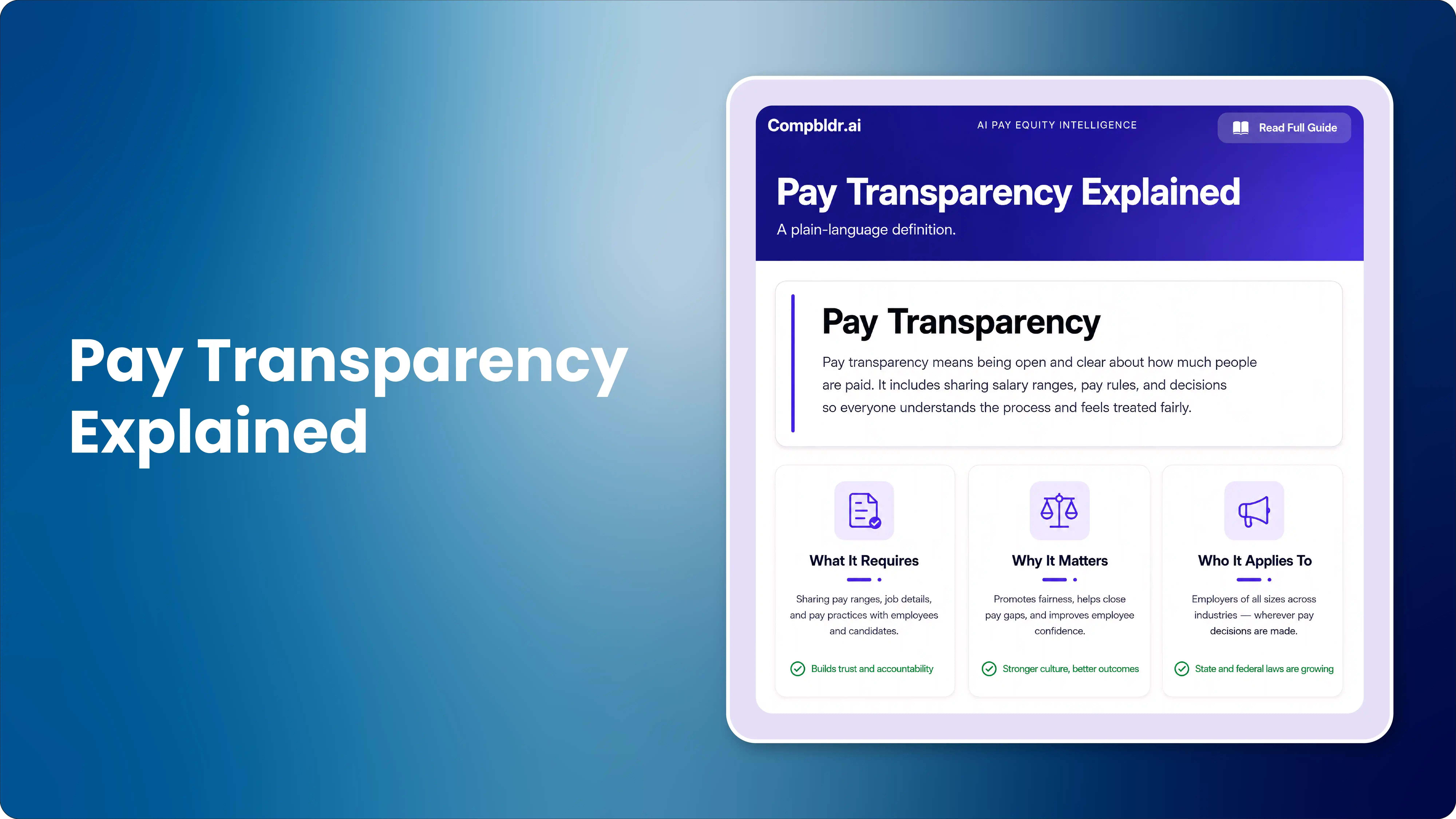
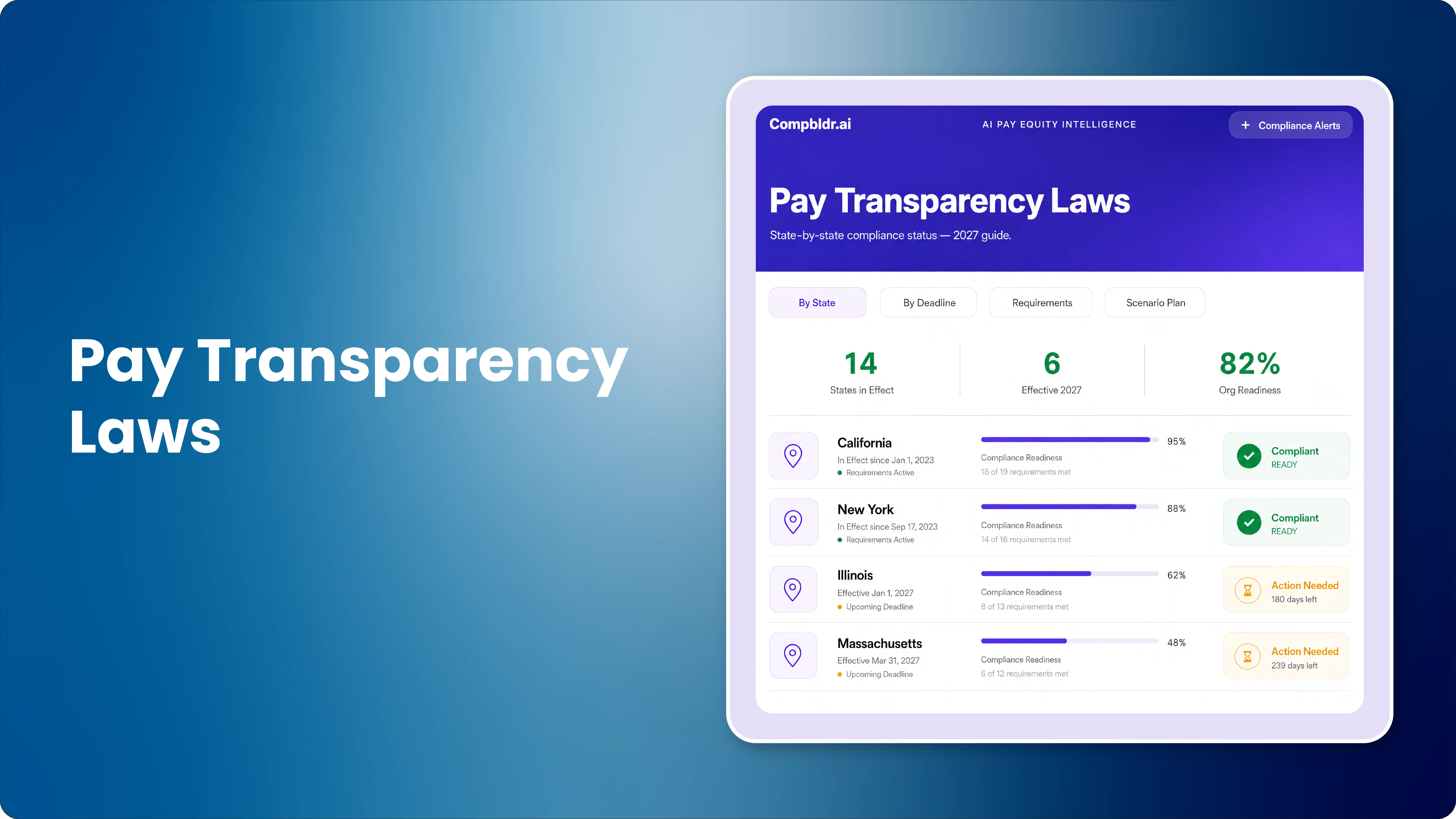
- Pay transparency refers to practices and, in some jurisdictions, legal requirements for communicating compensation information.
- Compensation governance defines the policies, roles, approvals, evidence, documentation, and review processes behind pay decisions.
- Compensation philosophy states the organization's principles for market positioning, internal equity, rewards, transparency, and decision governance.
The important distinction is that metrics support review; they do not replace judgment, documented methodology, or qualified legal analysis where required. See the pay equity audit process and CompBldr's broader compensation governance approach.
6. Understand Incentive and Executive Compensation Language
Base salary is only one part of compensation. Incentive and executive programs introduce another set of concepts that describe performance periods, award vehicles, vesting, payout conditions, and risk controls.
- Short-term incentive (STI) is variable compensation tied to results measured over a relatively short performance period.
- Long-term incentive (LTI) aligns rewards with multi-year performance, value creation, or retention objectives.
- Restricted stock unit (RSU) is an equity award that delivers shares or equivalent value when defined vesting conditions are satisfied.
- Performance share unit (PSU) ties the amount earned to specified performance conditions over a defined period.
- Sign-on bonus is a one-time payment used as part of a new-hire compensation package.
- Deferred compensation is compensation earned or promised in one period but delivered later under defined terms.
- Vesting schedule defines when an employee earns the right to an award.
- Hurdle rate is a minimum performance threshold that must be achieved before a specified incentive outcome becomes available.
- EBIT is one of several financial measures organizations may use when designing performance-based incentives.
- Management incentive plan (MIP) is a structured incentive arrangement often used to align a management team with defined business or ownership outcomes.
- Carried interest is a specialized form of performance participation used in certain investment-fund structures.
- Clawback provision defines circumstances in which previously awarded compensation may need to be recovered under the governing plan or agreement.
Because incentive, equity, tax, and regulatory treatment depends on plan design and jurisdiction, organizations should rely on current plan documents and qualified advisers for implementation. The executive compensation guide provides additional context.
7. Put Base Pay Into the Total Rewards Picture
Compensation discussions can become confusing when teams use salary, cash compensation, direct compensation, total compensation, and total rewards as though they mean the same thing. They describe progressively broader views of employee value.
- Base salary is fixed cash pay for performing a role before variable awards or benefits are added.
- Total cash compensation (TCC) generally combines base cash pay with applicable cash incentive opportunity or payout, depending on the reporting context.
- Total direct compensation (TDC) generally extends cash compensation to include the value of applicable long-term incentives.
- Total compensation takes a broader economic view of the employee's compensation package.
- Total rewards extends beyond direct compensation to the broader employment value proposition, which can include benefits and non-cash programs.
Clear terminology is especially important when communicating offers, benchmarking roles, designing rewards statements, or comparing packages across employee populations. Read the total compensation guide or explore CompBldr's Total Rewards Statements.
How to Use This Guide With the Compensation Terms A-Z Reference
Use this article when you need to understand how compensation concepts relate to one another across the workflow. Use the complete Compensation Terms A-Z reference when you need a specific definition, acronym, related term, or a direct route to a deeper CompBldr resource.
That separation is intentional: this guide provides context and relationships; the pillar page provides the comprehensive lookup experience.
Turn Compensation Language Into Governed Workflows
Compensation terminology becomes useful when the underlying decisions are connected: define the role, evaluate it, price it against the market, place it in a salary structure, plan pay actions, review equity, and communicate the full reward package consistently.
CompBldr connects job architecture, job evaluation, market benchmarking, compensation planning, analytics, and total rewards in one governed system. Book a 15-minute demo to see how the workflow fits together.



.svg)

.svg)
.svg)

