

.svg)





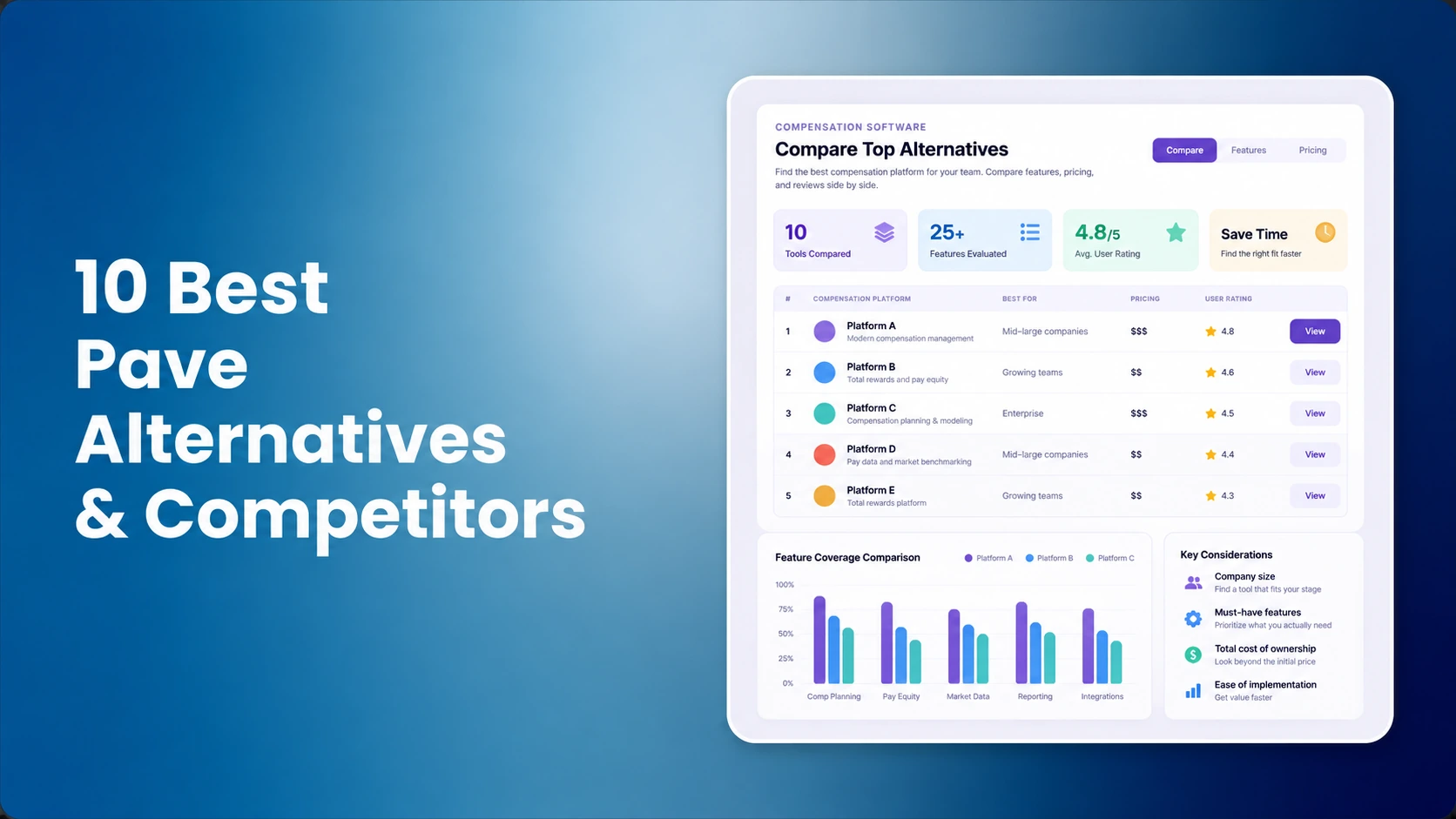

The best Pave alternatives and competitors depend on the compensation problem your team needs to solve. Pave in 2026 is broader than a benchmarking product: its current platform spans market intelligence, market pricing and pay ranges, job architecture, compensation planning, total rewards, connected data sources, and governed workflows. A useful alternatives comparison therefore starts with the capability gap, not with a generic vendor list.
For compensation and Total Rewards teams, a practical shortlist includes CompBldr, Payscale, Salary.com CompAnalyst, Bettercomp, Ravio, Compa, OpenComp, Figures, Compport, and beqom. These products are not interchangeable. Some compete most directly with Pave's market-data model, some with market pricing, and others with planning or enterprise compensation execution.
Research method: current product positioning and material capability claims were rechecked against first-party vendor documentation on October 7, 2026. The order is not an independent product score. “Best fit” labels are editorial judgments based on documented product models and buyer scenarios. Pricing, packaging, data coverage, integrations, and implementation scope can change.
Publisher disclosure: CompBldr publishes this comparison and is included in it. Apply the same proof-of-capability test to CompBldr as to every other finalist.
Quick Comparison: 10 Pave Alternatives for 2026
| Platform | Best fit | Primary model | What to verify |
|---|---|---|---|
| CompBldr | Architecture-linked multi-source governance | Survey sources tied to job architecture, ranges, planning, and evidence | Supported sources, licensing, and integrations |
| Payscale Ascent | Current compensation intelligence across broader pay workflows | Market intelligence, benchmarking workflows, job management, and planning context | Data coverage, product scope, and production workflow for your use case |
| Salary.com CompAnalyst | HR-reported data and multi-source composites | Salary.com data plus third-party surveys and market pricing | Modules, survey workflow, and total commercial scope |
| Bettercomp | Policy-driven multi-survey market pricing | Pricing Policies, PayMarkets, survey cuts, matching, and ranges | Explainability and retained reviewer history |
| Ravio | Employer-connected international benchmarking | HR-system-connected total-reward benchmarks | Depth for your roles, levels, and geographies |
| Compa | Enterprise live market signals | Employee, offer, stock, skills, and frontline market intelligence | Peer depth and required data products |
| OpenComp | Lean teams connecting data to pay strategy | Benchmarking, ranges, cycles, and total rewards | Data coverage and bundle boundaries |
| Figures | European/global compensation workflows | HRIS-connected benchmarks plus bands, reviews, and pay equity | Role-level coverage and optional data sources |
| Compport | Highly configurable compensation execution | Merit, bonus, LTI, incentives, pay equity, and statements | How external market data enters the workflow |
| beqom | Complex multinational rewards execution | Enterprise salary, merit, bonuses, incentives, and global rewards workflows | Implementation and market-data configuration |
Use this table as a screening aid, not as a substitute for a controlled demo. The same platform can look very different depending on the jobs, geographies, data sources, governance requirements, modules, and implementation scope you need.
What Pave Offers in 2026
Pave currently positions itself as an AI-native compensation platform. Its current product and pricing pages describe real-time Market Data, Market Pricing, job architecture and compensation data workflows, Compensation Planning, Total Rewards, persistent data connections, APIs, and permission-controlled workflows. Pave also states that its real-time dataset is powered by 9,000+ integrated clients.
This matters because a comparison based on an older view of Pave as only a salary-benchmarking database would be misleading. Buyers should first identify the specific reason they are evaluating an alternative: data-source fit, survey workflow, market-pricing governance, job architecture, planning, geographic coverage, implementation model, or total operating cost.
Review Pave's Market Data methodology and current Pave plans and product scope.
How We Evaluated Pave Alternatives
- Data model: employer-connected data, vendor data, traditional surveys, customer-licensed surveys, or a combination.
- Coverage fit: depth for required jobs, levels, industries, locations, and compensation components.
- Job matching: explainability, reviewer control, confidence, and override history.
- Multi-source market pricing: ingestion, aging, weighting, survey cuts, pay markets, and reproducibility.
- Workflow continuity: movement from benchmark to salary range, planning, approval, and communication.
- Governance: permissions, versions, effective dates, approvals, and retained evidence.
Evidence standard for vendor claims
Product and coverage statements below are based on current vendor-owned documentation. A vendor page confirms what the supplier says its product supports; it does not independently prove implementation quality, service quality, data sufficiency for your workforce, or customer outcomes. Treat every material claim as something to reproduce in the demo with your own jobs and data.
1. CompBldr: Best Fit for Architecture-Linked Multi-Source Governance
CompBldr is a strong candidate when the buyer wants external market evidence to remain connected to the internal job structure and downstream pay decision. Its Market Benchmarking workflow connects survey matching with job architecture, salary structures, review controls, and versioned outputs. That same structure can feed Compensation Planning.
Why shortlist it: teams using several compensation surveys may value the ability to preserve source context, reviewer decisions, range logic, and approvals instead of rebuilding those relationships in spreadsheets.
What to test: bring the survey sources you actually license and one difficult hybrid job. Verify ingestion, matching, weighting, overrides, range generation, planning handoff, and retained history.
2. Payscale Ascent: Best Fit for Current Compensation Intelligence Across Broader Pay Workflows
Payscale launched Ascent in September 2026 as an AI-first benchmarking platform within the Payscale Intelligence Cloud. Payscale positions it around current market intelligence, smart benchmarking workflows, contextual insights, and connections into broader compensation work such as job management and planning.
Why shortlist it: it is relevant when the buyer wants benchmarking intelligence inside a broader compensation ecosystem rather than as a stand-alone data lookup.
What to test: because Ascent is new, use difficult jobs and ask Payscale to demonstrate the production workflow available today. Verify source context, cohort logic, job matching, confidence information, unusual-job handling, the exact handoff into job management or planning, and the modules required for your use case.
Review Payscale's Ascent launch documentation.
3. Salary.com CompAnalyst: Best Fit for HR-Reported Data and Multi-Source Market Pricing
CompAnalyst supports market composites built from CompAnalyst Market Data, Salary.com surveys, and customer-owned third-party datasets. Current documentation also describes AI-recommended job matches, automated scopes, custom pay markets, aging factors, weights, adjustments, salary structures, and pay-equity analysis.
Why shortlist it: it can fit teams that want HR-reported market data while continuing to use third-party survey investments in a centralized market-pricing workflow.
What to test: load a third-party survey, build a composite, change a match, age the data, and trace the approved result into a range. Confirm which modules and services are required.
Review Salary.com CompAnalyst Market Pricing.
4. Bettercomp: Best Fit for Policy-Driven Multi-Survey Market Pricing
Bettercomp centers on compensation market-pricing operations, including Pricing Policies, PayMarkets, survey cuts, job matching, percentiles, adjustments, range modeling, and mass repricing.
Why shortlist it: it is relevant when a compensation team already relies on multiple survey sources and wants its pricing policy applied consistently across jobs, markets, and reviewers.
What to test: ask the vendor to show why a job matched, which survey cuts and policies affected the result, what a reviewer can change, and what evidence remains after an override.
Review Bettercomp Market Pricing.
5. Ravio: Best Fit for Employer-Connected International Benchmarking
Ravio uses HR-system-connected compensation data and supports total-reward benchmarking across salary, equity, variable pay, and benefits. It also connects benchmarking with salary bands and related compensation workflows.
Why shortlist it: it is relevant for organizations that want employer-connected international compensation benchmarks and need the benchmark to sit close to band and pay-review workflows.
What to test: do not rely on total company or country counts. Ask for actual coverage for your hardest roles, levels, locations, and peer groups.
Review Ravio Compensation Benchmarking.
6. Compa: Best Fit for Enterprise Live Market Signals
Compa focuses on live market intelligence across employee cash compensation, offers, stock compensation, skills, and frontline pay, with enterprise data and workflow integrations.
Why shortlist it: it is relevant to larger compensation teams that want current market signals across multiple compensation events rather than relying only on periodic survey refreshes.
What to test: verify cohort depth by role, level, location, and pay component, then confirm which data products and integrations are included in the proposed package.
Review Compa Live Market Data and pricing scope.
7. OpenComp: Best Fit for Lean Teams Connecting Benchmarks to Pay Strategy
OpenComp organizes its current offering around Comp Benchmarking, Comp Strategy, and Comp Cycles, connecting global compensation data with pay strategy, salary ranges, total rewards, merit, and bonus workflows.
Why shortlist it: it can suit lean People or compensation teams that want a direct path from benchmark data into recurring pay decisions without assembling several separate point tools.
What to test: use difficult jobs to validate data depth and ask how third-party sources, customer-specific market assumptions, ranges, and planning decisions are handled. Confirm which capabilities sit in each bundle.
Review OpenComp product bundles.
8. Figures: Best Fit for Benchmarking Connected to Bands, Reviews, and Pay Equity
Figures connects compensation benchmarking with salary bands, compensation reviews, analytics, and pay-equity workflows, with an international footprint.
Why shortlist it: it is relevant for teams that want benchmark data connected closely to salary-band management, compensation reviews, and pay-equity work.
What to test: verify role-level coverage in the countries and industries that matter, then separate native benchmark data from optional or separately licensed sources.
Review Figures' compensation platform.
9. Compport: Best Fit for Configurable Global Compensation Execution
Compport emphasizes compensation planning, merit cycles, bonus planning, long-term incentives, sales incentives, pay equity, total rewards statements, and configurable global workflows.
Why shortlist it: it is relevant when compensation execution complexity is the primary problem and the team needs several reward processes managed in one configurable environment.
What to test: separate execution capability from benchmark-data capability. Ask exactly how market data is sourced, loaded, refreshed, matched, and carried into planning.
Review Compport's compensation platform.
10. beqom: Best Fit for Complex Multinational Total Compensation
beqom PaySuite focuses on enterprise compensation management across salary and merit, bonuses, global incentives, approvals, and other complex reward workflows.
Why shortlist it: it is relevant for multinational organizations that need highly configurable compensation execution across several pay components and governance requirements.
What to test: determine what requires implementation services versus administrator configuration, and verify how market intelligence or survey data enters governed pay decisions.
Review beqom PaySuite Compensation Management.
When Pave May Still Be the Right Choice
An alternatives article should not manufacture a reason to switch. Pave may remain the right choice when employer-connected market intelligence, integrated market pricing, job architecture, merit cycles, total-rewards communication, and its broader compensation data layer match the organization's operating model.
A replacement or supplement is more defensible when a specific requirement remains unresolved after configuration: survey-source fit, niche-role coverage, governance, implementation complexity, workflow gaps, or total operating cost.
Use the Same Demo Scenario for Every Pave Alternative
- Price one difficult hybrid job in three important geographies.
- Show the source, effective date, sample or coverage context, level, and pay components.
- Explain what drove the job match and what a reviewer can change.
- Add a second market source and show how conflicting evidence is handled.
- Apply the organization's target-market policy.
- Create or update a salary range.
- Move the result into a merit or salary-review decision.
- Route an out-of-guideline exception through approval.
- Retrieve the source, override, approval, and version history needed to reproduce the decision later.
How to Choose the Right Pave Alternative
Define the reason for evaluating Pave alternatives
Write the gap in one sentence before scheduling demos. “We need a different compensation tool” is too broad. “We need governed multi-survey market pricing across six licensed sources” or “we need deeper international technology benchmarks” is testable.
Choose the authoritative data model
Decide whether employer-connected benchmarks, established surveys, customer-licensed sources, or a combination should drive decisions. For deeper methodology, see compensation benchmarking vs. market pricing.
Require explainable matching and governance
Ask what inputs drive a match, how confidence is communicated, what a practitioner can override, and whether source context survives downstream. A fast answer is not enough if the team cannot reproduce the decision.
Compare total operating cost
Include software, survey licenses, integrations, implementation, services, administrator time, training, and annual maintenance. Request written proposals for the same defined workflow.
Limitations of This Comparison
This guide relies primarily on current vendor documentation and public product pages. Vendor documentation establishes what a supplier says its product supports; it does not independently prove implementation quality, customer outcomes, data sufficiency for a particular workforce, or service quality. Coverage and pricing are buyer-specific and should be verified during procurement.
Which Pave Alternative Should You Shortlist?
If architecture-linked multi-source governance is central, include CompBldr. If a broad compensation-data ecosystem is the priority, evaluate Payscale and Salary.com. If policy-driven multi-survey market pricing is the bottleneck, test Bettercomp. If employer-connected international benchmarks matter, evaluate Ravio. For enterprise live market signals, consider Compa. For lean benchmark-to-strategy workflows, test OpenComp. For bands, reviews, and pay equity in an international environment, evaluate Figures. For complex compensation execution, test Compport and beqom.
Then put Pave through the same scenario. The evidence may support replacing it, supplementing it with a specialist platform, or keeping the current stack.


.svg)

.svg)
.svg)

