

.svg)





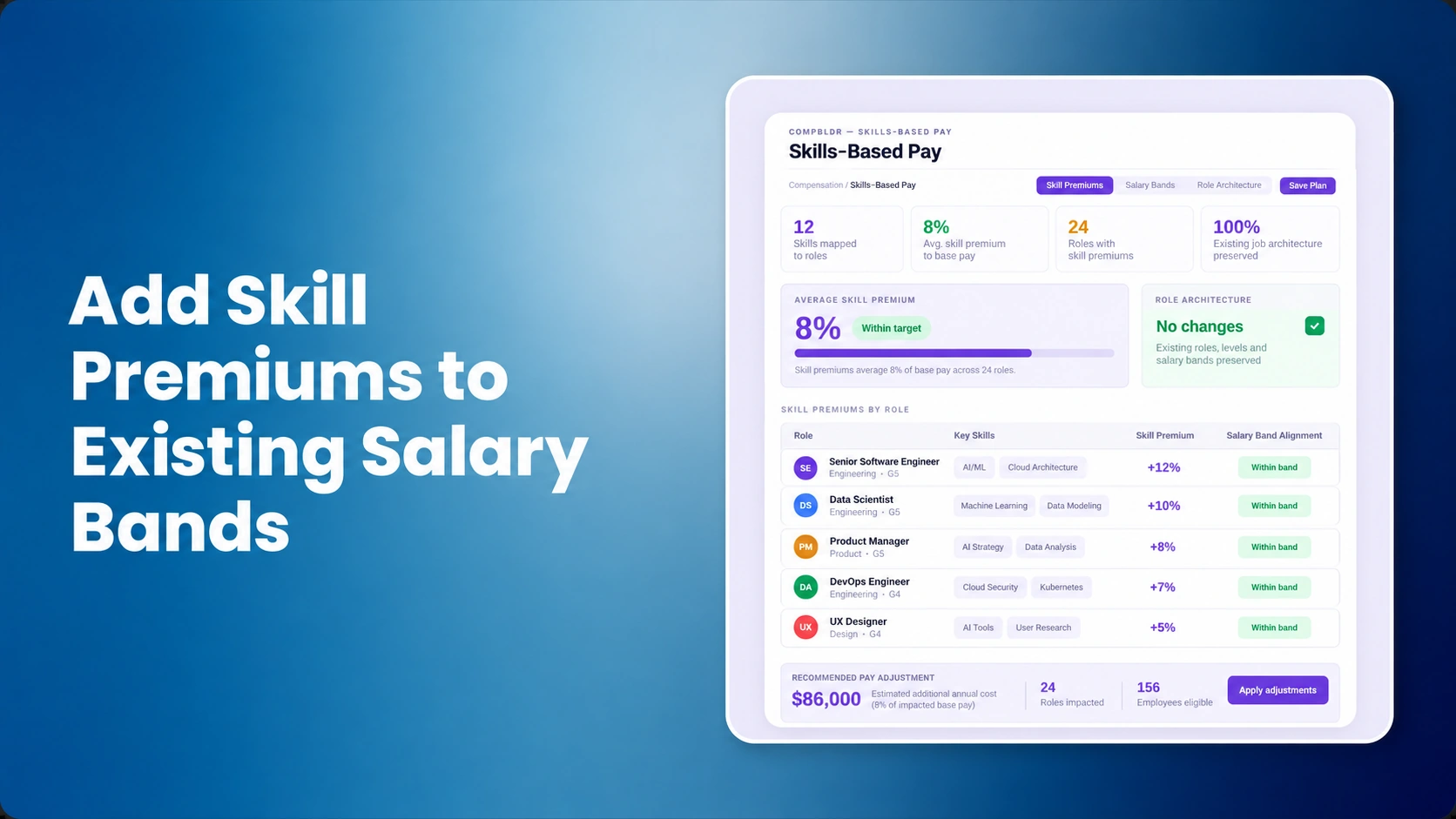

Skills-based pay works best as a controlled layer on top of job-based compensation, not as a reason to abandon job architecture. A role still needs a defined purpose, family, level, and salary range. Skills can then influence where an employee sits within that structure or whether a temporary premium is justified. For manufacturers, manufacturing compensation management can keep specialized-skill decisions connected to job structure, market evidence, salary ranges, and compensation planning.
The topic has fresh momentum in 2026. Salary.com's July 24, 2026 Skill-Based Pay 101 covers skill verification, pay structure design, market positioning, equity, and workforce planning. Payscale's June 25, 2026 analysis takes a more cautious view: most organizations still rely on job-based pay structures because the skills infrastructure needed for consistent rewards has not been built at scale.
That tension is useful. Compensation teams do not need to choose between jobs and skills. The better design question is: Which pay decisions belong to the job, and which belong to a skill layer?
The Job Should Still Determine the Base Structure
Your job architecture should continue to answer the durable questions: What work exists? Which family does it belong to? What distinguishes one level from another? Which jobs are comparable internally? What salary range applies?
A skill layer answers a narrower question: Does this employee bring a verified capability that creates additional value or market pressure beyond what the normal job profile already assumes? That distinction should stay visible in the organization's job level and grade framework, because a scarce skill does not automatically make the job a higher level.
| Decision | Job architecture layer | Skill layer | Governance question |
|---|---|---|---|
| Role definition | Purpose, responsibilities, family, level | Additional capability attached to an employee or role | Is the skill already part of the normal job? |
| Base salary range | Set through job value and market pricing | Does not replace the approved range | Does the skill justify placement within the range or a separate premium? |
| Eligibility | Everyone in the role follows the same structural criteria | Only employees who meet the defined skill standard qualify | Can proficiency be verified consistently? |
| Review cadence | Updated when the job or market structure changes | Reviewed when scarcity, usage, or business need changes | When should the premium end or become structural? |
| Internal equity | Comparable work should remain structurally comparable | Differences need documented skill evidence | Can the organization explain why two employees in the same job are paid differently? |
Build the Skill Layer on a Stable Job Architecture
Before paying for a skill, make sure the underlying job is structurally sound. The organization should be able to identify the role's job description, job family, level, grade, salary range, and normal market reference. If those foundations are inconsistent, a skill premium can hide a job-architecture problem rather than solve a skills problem.
Start with the job architecture and ask whether the skill belongs to one employee, one specialty, or the job itself. If the capability has become a standard requirement for everyone in the role, update the job and review its position in the job leveling framework. If the new capability materially changes responsibility, complexity, or impact, use job evaluation rather than solving the issue only through a premium.
That sequence keeps a skill program from becoming a second, unofficial architecture sitting beside the real one.
Five Tests Before Paying a Skill Premium
1. Is the skill actually additional to the job?
If every employee in the role is expected to have the capability, it should probably be reflected in the job profile and benchmark rather than paid as a special exception. Premiums are most defensible when the skill is genuinely incremental.
2. Can proficiency be verified?
A manager saying an employee is “good at AI” is not an assessment method. Define what evidence qualifies: certification, work sample, validated output, assessment, documented project experience, or another objective standard relevant to the skill.
3. Is the capability being used?
Paying for unused credentials can turn a targeted program into a credential inventory. Tie eligibility to actual work or a clearly defined readiness requirement.
4. Is there evidence of scarcity or business value?
Scarcity can come from market data, recruiting difficulty, retention risk, or strategic importance. The evidence does not need to be identical for every program, but it should be documented and reviewable.
5. Is the premium temporary or structural?
This is the most important governance test. If the skill will likely become a permanent requirement of the role, define the trigger for converting the premium into a revised job profile, fresh benchmark, or salary structure.
Choose the Pay Mechanism That Matches the Problem
| Mechanism | Use when | Main risk | Control |
|---|---|---|---|
| Movement within the existing range | The job and range are correct, but the employee's contribution supports different positioning | Manager discretion creates inconsistent placement | Range-position policy, internal comparators, approval rules |
| Time-bound skill premium | The capability is scarce, verified, and incremental to the normal job | The premium becomes permanent without review | Eligibility standard, owner, review date, sunset rule |
| Hiring or retention bonus | The pressure is temporary and related to attraction or retention | A one-time issue becomes recurring base-pay cost | Clear purpose, approval, duration, repayment terms where applicable |
| Re-level or new job profile | The capability changes responsibility, complexity, accountability, or job scope | Skill scarcity is confused with job value | Formal evaluation and architecture calibration |
| New specialty range or structure | A durable market segment no longer fits the existing structure | Parallel structures multiply without governance | Market evidence, employee distribution, leadership approval |
Salary.com's July 2026 discussion of pay premiums makes a similar operating distinction: keep the normal range as the anchor when the pressure is specific, and reconsider the structure when the pressure becomes broad and durable.
Keep Skill Pay Anchored to the Job Structure
Use governed job families, levels, and salary ranges as the base, then add skill premiums only where the evidence supports a separate layer.
Set the Premium Amount Without Turning a Market Signal Into a Formula
There is no universal percentage that makes a skill premium defensible. The amount should follow the evidence available to your organization, not a headline about what another employer pays for AI, cybersecurity, data, or another scarce capability.
Start with the role's normal market pricing. Then test whether the skill creates additional pressure that the standard benchmark does not capture. Use the compensation benchmarking evaluation guide to separate well-matched market evidence from weaker signals. If the labor market itself has moved broadly, the answer may be to refresh the range using a defensible salary-band methodology rather than adding premiums one employee at a time.
After choosing a proposed amount, model employee outcomes. Compare the employee's compa-ratio, relevant peer relationships, and the risk of pay compression. A skill premium that solves external competitiveness but creates unexplained internal gaps still needs redesign.
Skill Verification Needs More Than a Certification List
Verification should match the kind of skill being rewarded. A formal certification may be appropriate for some technical or regulated capabilities. Other skills are better demonstrated through a work sample, validated assessment, project evidence, or observed application.
For every paid skill, document:
- Proficiency level: what the employee must be able to do independently.
- Verification method: who or what confirms proficiency.
- Business use: where the employee is expected to apply the skill.
- Evidence owner: who maintains the verification record.
- Revalidation cadence: whether and when the capability needs to be rechecked.
If skill verification is manager-specific and undocumented, the program can produce different pay outcomes for comparable employees based on access, sponsorship, or inconsistent standards. That makes regular pay equity review important once skill-linked compensation starts affecting a meaningful population.
Govern the Premium From Approval Through Sunset
Each premium should have a lifecycle, not just an approval date. A simple governance record should include the skill, eligible roles, employee evidence, amount or calculation method, funding owner, effective date, review date, and one of three end states: continue, sunset, or convert into the job or structure.
This is where a documented compensation philosophy and a compensation governance model matter. Managers should know which decisions they can recommend and which require Compensation or Finance approval.
Use compensation reporting to distinguish skill premiums from base salary, merit increases, promotions, market adjustments, and one-time awards. If the transaction type disappears once it reaches payroll or reporting, the organization will struggle to review whether the program is still doing what it was designed to do.
Worked Example: Adding an AI Security Skill Premium
Consider an illustrative P3 data engineering role. The job architecture already reflects the expected engineering scope, independent problem-solving, and project accountability. The organization temporarily needs a specialized AI security capability for a regulated product launch.
The employee earns the premium only after completing the defined proficiency assessment and being assigned to work that uses the capability. The company chooses an illustrative 5% premium for 12 months. That percentage is an example of policy design, not a market benchmark. Compensation documents the owner, eligibility date, review date, and two possible outcomes at review:
- remove the premium if the skill is no longer scarce or required;
- redesign the role or specialty structure if the capability has become a permanent expectation of the job.
The employee's job level does not change simply because the skill is valuable. The job changes only if responsibility, complexity, or accountability also changes.
Worked Example: One Role, Three Different Outcomes
Consider three employees in the same illustrative P3 data engineering job:
- Employee A learns an AI security tool but does not use it in production. The organization records the development activity but does not pay a premium.
- Employee B passes the defined proficiency assessment and is assigned to a regulated launch where the skill is required for 12 months. The organization applies a time-bound premium under the approved policy.
- Employee C takes permanent ownership of AI security architecture, risk decisions, controls, and cross-functional governance. That change is reviewed through job evaluation because the job itself may now be larger.
The skill label is the same. The compensation response differs because the work, accountability, and permanence differ.
If Employee B's premium moves total cash materially above peers in the same range, review the relationship in compensation analytics. If Employee C is re-leveled, keep the structural change separate from the next compensation planning cycle so a job-value adjustment is not disguised as merit.
What Changes by Company Size and Program Maturity?
Smaller organizations
Keep the policy compact. A single page can define eligible skills, verification, the pay mechanism, the approver, and the review date. The bigger risk is informal manager-by-manager exceptions.
Mid-sized organizations
Introduce a central skill register, consistent proficiency standards, and periodic review of cost, usage, internal equity, and whether premiums should be converted into job requirements.
Enterprise organizations
Define ownership across Compensation, HR, Finance, functional leaders, and learning teams. The skill taxonomy, job architecture, survey matching, payroll treatment, reporting, and regional rules need to remain connected. Where the same skill exists in multiple job families, use consistent governance without assuming it has the same value in every role.
How to Measure Whether the Program Is Working
A skills-based pay program should produce more than a list of employees receiving premiums. Track:
- the number and cost of active premiums;
- which jobs and functions receive them;
- how often premiums are renewed, removed, or converted into structural changes;
- whether the targeted skills are actually being used;
- recruiting or retention outcomes where the program was designed to address them;
- pay-equity and compression signals among comparable employees;
- manager exception rates and time to approval.
Those measures help Compensation decide whether the program is solving a real workforce problem or simply adding a new layer of pay complexity.
How to Prevent a Skill Program From Becoming a Shadow Grade Structure
A weak skills program often grows one exception at a time. One department pays for a certification, another pays for a tool-specific capability, and a third creates its own critical-skill list. Within a year, employees in comparable jobs may have materially different pay for reasons no one can reconstruct.
Prevent that by defining six fields for every premium:
- Skill definition: the exact capability being rewarded.
- Proficiency standard: how the employee proves the skill.
- Business use: where the capability is expected to create value.
- Pay mechanism: base movement, premium, bonus, equity, or another approved treatment.
- Review date: when Compensation re-tests scarcity and relevance.
- Structural trigger: what evidence means the capability should become part of the job or range.
Market Pricing Still Matters
Skills-based pay is not a substitute for market benchmarking. Compensation teams still need to price the role using relevant external evidence. Skill premiums should answer a narrower gap that the normal benchmark does not fully represent.
Market evidence can also show when a premium is no longer the right answer. If external jobs in the same family now consistently require the skill and pay reflects that requirement, the organization may need to update the role and re-price the range instead of maintaining an add-on indefinitely.
Where AI Skills Fit in 2026
Payscale's 2026 Compensation Best Practices Report found that 61% of organizations had updated existing roles to include AI-related skills or competencies, while 55% had not adjusted compensation for those skills. A newer September 24, 2026 AI Workforce Impact Report preview, based on employer and employee surveys at organizations with 100+ employees plus Lightcast job-posting data, reported that 49% of employers said salary structures had not kept pace with AI-driven changes and 48% said current benchmarking did not reflect required AI skills. Payscale describes those findings as a snapshot of a rapidly changing market, so they should not be generalized to every employer or converted directly into a premium policy.
PwC's June 15, 2026 AI Jobs Barometer found that job postings requiring specific AI skills carried an average advertised wage premium of about 62%. PwC also notes that the estimate compares advertised wages for AI and non-AI roles and does not control for every factor that can affect pay, such as education, experience, or location. Treat that result as a labor-market signal, not a ready-made premium percentage.
The right response depends on the job. Some AI skills will become ordinary requirements and disappear as separate premiums. Others may remain scarce specialties. Compensation governance should be designed to tell the difference.
Build Skill Premiums Without Creating a Second Pay Structure
See how CompBldr connects job architecture, market evidence, analytics, and compensation governance so skill-based decisions stay explainable as roles and labor markets change.
Book a Demo
.svg)

.svg)
.svg)

