

.svg)





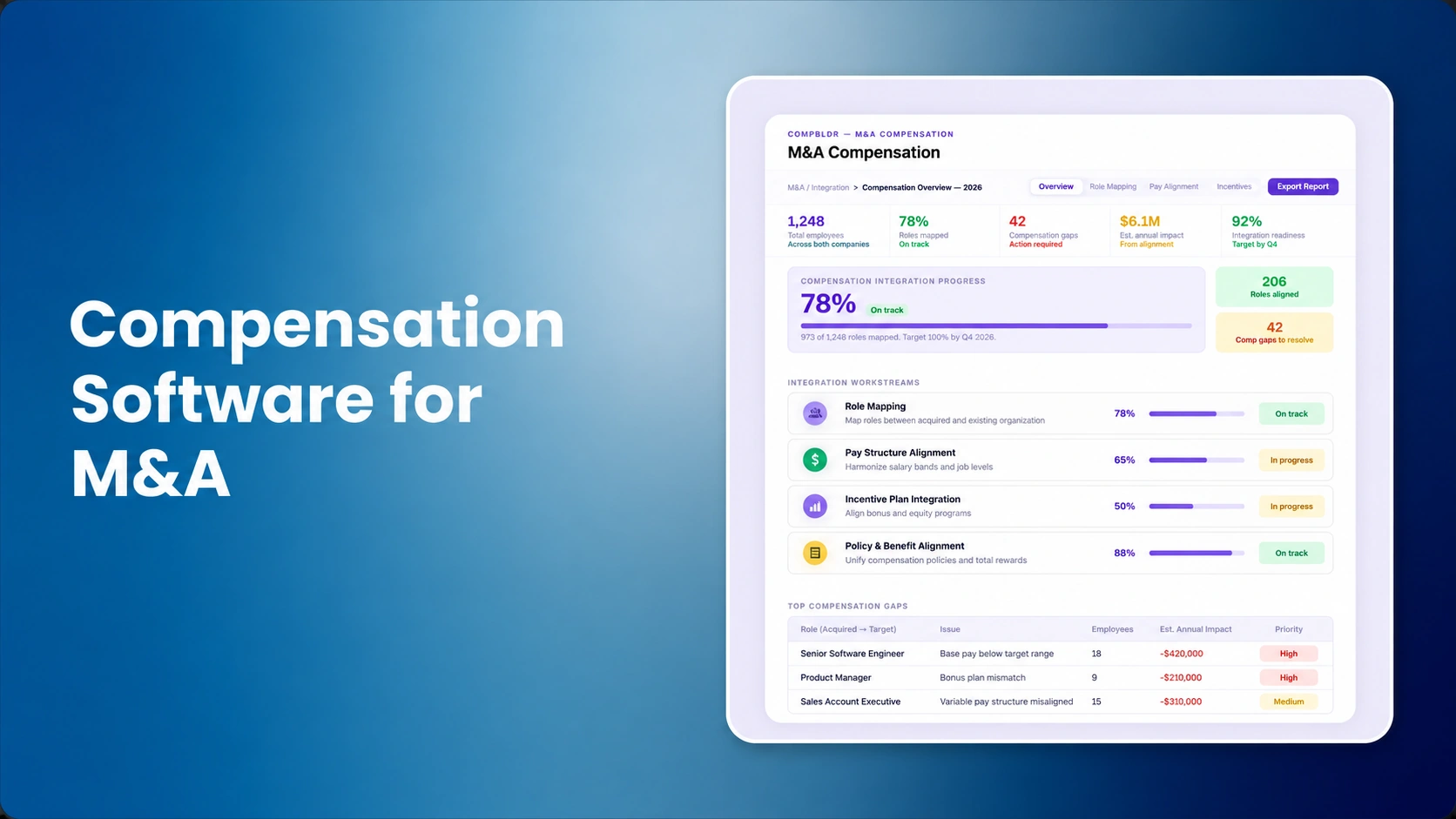

The hardest compensation problem after an acquisition is rarely that one company has no structure. It is that both companies have structures, and they were built from different histories. One business may use five professional levels while the other uses seven. The same title may represent different scope. Salary ranges can be built from different surveys, market positions, geographies, and effective dates. Employees can land in the same combined team with visibly different pay logic.
That is why post-deal compensation harmonization should not begin by forcing every employee into one spreadsheet. Preserve both source structures, define the future-state architecture, and then map jobs, ranges, and employees through governed decisions.
Mercer's M&A guidance emphasizes aligning rewards integration with the deal strategy while protecting talent continuity. WTW also positions job architecture as a way to align roles after mergers, acquisitions, and other structural changes. The practical compensation sequence is straightforward: structure first, employee pay second.
The First Decision: Harmonize Now, Transition, or Run Parallel Structures
| Model | When it fits | Main advantage | Main risk |
|---|---|---|---|
| Immediate harmonization | Similar businesses, compatible architectures, urgent integration need | One structure and one decision framework quickly | Rushed mapping can create employee disruption and hidden inequities |
| Managed transition | Structures differ but leadership wants one future-state model | Allows mapping, costing, and communication before changes take effect | Requires careful effective-date and exception governance |
| Parallel structures | Distinct entities, labor markets, currencies, or integration timelines | Preserves valid local differences | Can become permanent fragmentation if review criteria are never set |
A small specialist acquisition may remain on a transition structure for months. A merger of similar organizations may need a neutral future-state framework. A multi-country deal may keep local structures while standardizing job architecture and governance. The operating model should follow the deal thesis, not a preference for uniformity.
Step 1: Freeze the Source Structures Before You Map Anything
Preserve the pre-close or Day 1 state of both organizations. Capture the active job architecture, job codes, titles, levels, grades, salary bands, geographic structures, employee assignments, and market references.
This snapshot matters because integration decisions create a new state. If the old values are overwritten, Compensation loses the ability to explain why an employee moved, why a range changed, or which legacy policy created a pay difference. Keep the source records linked to effective dates and preserve them in Compensation Reporting or another controlled history.
Step 2: Build a Common Job Architecture Before Mapping Employees
The combined organization needs a shared language for work. Use job families, career tracks, levels, and governed titles to define the future state. The job leveling framework should describe scope, complexity, decision authority, leadership expectations, and business impact clearly enough that legacy titles do not drive the mapping.
If one organization uses "Director" for work the other calls "Senior Manager," do not split the difference by title. Compare the actual work. Use Job Evaluation where the mapping is not obvious, and use the job leveling matrix to calibrate adjacent roles.
The distinction between job grades and job levels is especially important during M&A. Level describes the job. Grade and range translate that job into pay opportunity. Harmonizing them in the wrong order can make employee salary drive job-value decisions.
Step 3: Create a Crosswalk With Evidence, Not Just a Destination Code
A useful crosswalk should show the legacy job, legacy level, proposed future-state job, proposed future level, match confidence, evidence, reviewer, and final approval. For difficult roles, include the current job description and evaluation notes.
Do not force every legacy role into an existing destination. Acquisitions often introduce real capabilities the buyer did not previously have. If a new family or specialty is needed, create it deliberately rather than hiding it inside the closest existing code.
Map the Work Before You Move the Pay
Use CompBldr Job Architecture and Job Evaluation to compare legacy roles, preserve the evidence, and build a governed future-state structure before employee pay changes are approved.
Step 4: Reconcile Market Pricing Before You Merge Salary Ranges
The two organizations may use different survey providers, peer groups, market positions, aging dates, and geographic assumptions. A higher range can reflect a different talent market rather than a more generous philosophy.
Use Market Benchmarking to rebuild the comparison at the future-state job and level. The market pricing methodology should document source, job match, geography, pay element, effective date, and approved adjustments. Where source evidence conflicts, use the benchmarking evaluation framework instead of averaging incompatible data.
Then decide whether the combined organization will preserve different market positions by function, entity, or geography. The function-level compensation strategy article shows how differentiated positioning can still sit inside one governance model.
Step 5: Model Employee Placement Before Any Range Becomes Final
A future-state range can look reasonable until real employees are placed inside it. Use Compensation Analytics to model employee distribution by new level, range, location, and entity.
Review compa-ratio, range penetration where used, employees below minimum, employees above maximum, and pay compression. Run the analysis before communication, not after employee questions surface.
An employee above the new range maximum is not automatically overpaid. The condition may reflect a valid legacy market, retention decision, location difference, or prior structure. It does mean Compensation needs a documented transition rule.
Use an Employee Transition Matrix
| Employee position | Likely question | Possible action | Evidence required |
|---|---|---|---|
| Below new range minimum | Is pay misaligned with the approved structure? | Prioritized structural or market adjustment, subject to policy | Job mapping, location, employee pay, internal comparators, budget |
| Inside new range | Does current pay remain explainable? | Usually no structural adjustment solely because of the deal | Range position and comparable employee review |
| Above new range maximum | Is this a legacy condition or a structural mismatch? | Red-circle treatment, frozen base, lump-sum treatment, or future review depending on policy | Legacy range, market data, role scope, transition agreement |
| Role maps to a higher level | Did the job change, or was the legacy structure different? | Re-level with a separate employee-pay decision | Evaluation evidence and new range mapping |
| Role maps to a lower level | Is the legacy title inflated relative to future-state scope? | Protect employee pay where appropriate while correcting structure | Job evaluation, employee-relations review, transition policy |
Separate Structural Corrections From Retention Decisions
M&A often creates retention pressure. Mercer notes that rewards continuity and retention of essential talent are central to deal execution. But a retention payment is not the same thing as a salary-structure correction.
Keep one-time retention, sign-on, or transaction awards distinct from base-pay changes. The sign-on bonus guide explains why temporary attraction or retention needs should not automatically become recurring base salary.
If the job itself has changed materially after integration, use the methodology from role scope and re-evaluation rather than solving permanent job change with a temporary premium.
Govern Day 1, Day 30, and the First Annual Cycle Differently
Day 1 is about continuity. Employees need to know what remains valid, which policies are changing immediately, and where questions go.
The first 30 to 90 days are about architecture, market evidence, range mapping, employee impact, and exception design.
The first annual cycle is where the combined organization tests whether the future-state structure actually works in manager decisions, budgets, promotions, and market adjustments.
Use Compensation Planning to keep merger-related structural actions separate from ordinary merit and promotion actions. The distinction matters when Finance later asks what portion of spend came from integration versus normal annual pay activity.
Integration Data Has to Move Across Systems Without Losing the Decision Trail
Employee, job, organization, and pay data will normally continue to live in an HRIS and payroll environment. CompBldr's Integrations page currently documents bi-directional connections with systems including Workday HCM, SAP SuccessFactors, and Oracle HCM Cloud. The practical goal is not simply data movement. It is preserving the relationship between the source employee record and the approved compensation decision.
The Workday integration article shows the same pattern: employee and job context flows into compensation work, while approved outputs can move back to the system of record.
What Changes by Deal Type?
Small tuck-in acquisition
The buyer may preserve the acquired team's pay structure temporarily while mapping specialized roles into the broader architecture.
Merger of similar-sized organizations
A neutral future-state framework may be more credible than declaring one legacy model the winner. Calibration and employee-impact modeling become more important.
Carve-out or divestiture
The work may be the reverse problem: separating shared structures, systems, and ranges cleanly so the new entity can operate independently.
Multi-country deal
Local law, currency, collective arrangements, benefits, and market practice can limit how much compensation can be standardized. Country-specific review is essential.
Legal note: Cross-border deals may also involve jurisdiction-specific employment, works-council, collective-bargaining, and pay-transparency requirements. Use local legal review before changing employee pay or employment terms.
Failure Signals That the Harmonization Is Going Off Track
- Managers use legacy titles to argue for future-state levels.
- Range mapping happens before jobs are calibrated.
- Retention payments are mixed into permanent base salary without a separate rationale.
- Employees move to a new range but the old effective date and range history disappear.
- Different entities use the same grade code for materially different job scope.
- Finance cannot distinguish integration cost from ordinary merit, promotion, and market spend.
- Recruiters continue using legacy ranges after the future-state structure is approved.
Illustrative Example: Two Companies, One Future-State Level
The following scenario is illustrative and uses hypothetical values or events to show the decision process.
Assume Company A uses P1 through P5 and Company B uses IC1 through IC7. A data engineering role in Company A is P4 with a $150,000 midpoint. A similar-looking role in Company B is IC6 with a $172,000 midpoint. It is tempting to map P4 to IC6 because the salaries are close. That would be the wrong starting point.
Compensation should compare the actual role scope: independent decision-making, technical depth, business impact, leadership expectations, and accountability. The review may show that Company A P4 maps to the future-state P4 while Company B IC6 also maps to P4 because Company B used more granular legacy levels. The different midpoints then become a market and range-harmonization question, not a leveling question.
Once both roles land in the same future-state level, Compensation can review the combined employee population, external market evidence, and the approved range. Employees do not need identical pay on Day 1. They do need a documented reason for any difference and a transition rule for how the combined structure will work going forward.
A Practical 30/60/90-Day Compensation Integration Sequence
Days 1-30: Preserve and diagnose
Freeze legacy structures, confirm employee populations, identify critical talent, inventory salary ranges and market sources, and document known exceptions. Avoid mass changes before the mapping logic is agreed.
Days 31-60: Design and model
Build the future-state architecture, complete job crosswalks, market-price the major families, model salary structures, and test employee placement. Use pay equity analysis to identify relationships that need deeper review before communication.
Days 61-90: Approve and operationalize
Finalize transition rules, effective dates, manager guidance, recruiting ranges, HRIS updates, payroll treatment, and reporting. Where the deal introduces multiple legal entities or distinct business units, preserve that context rather than collapsing every population into one generic structure.
Harmonize Compensation Without Erasing the Evidence
See how CompBldr connects job architecture, job evaluation, market benchmarking, salary structures, employee analytics, planning, and reporting across a post-acquisition transition.
Book a Demo

.svg)

.svg)
.svg)

