

.svg)





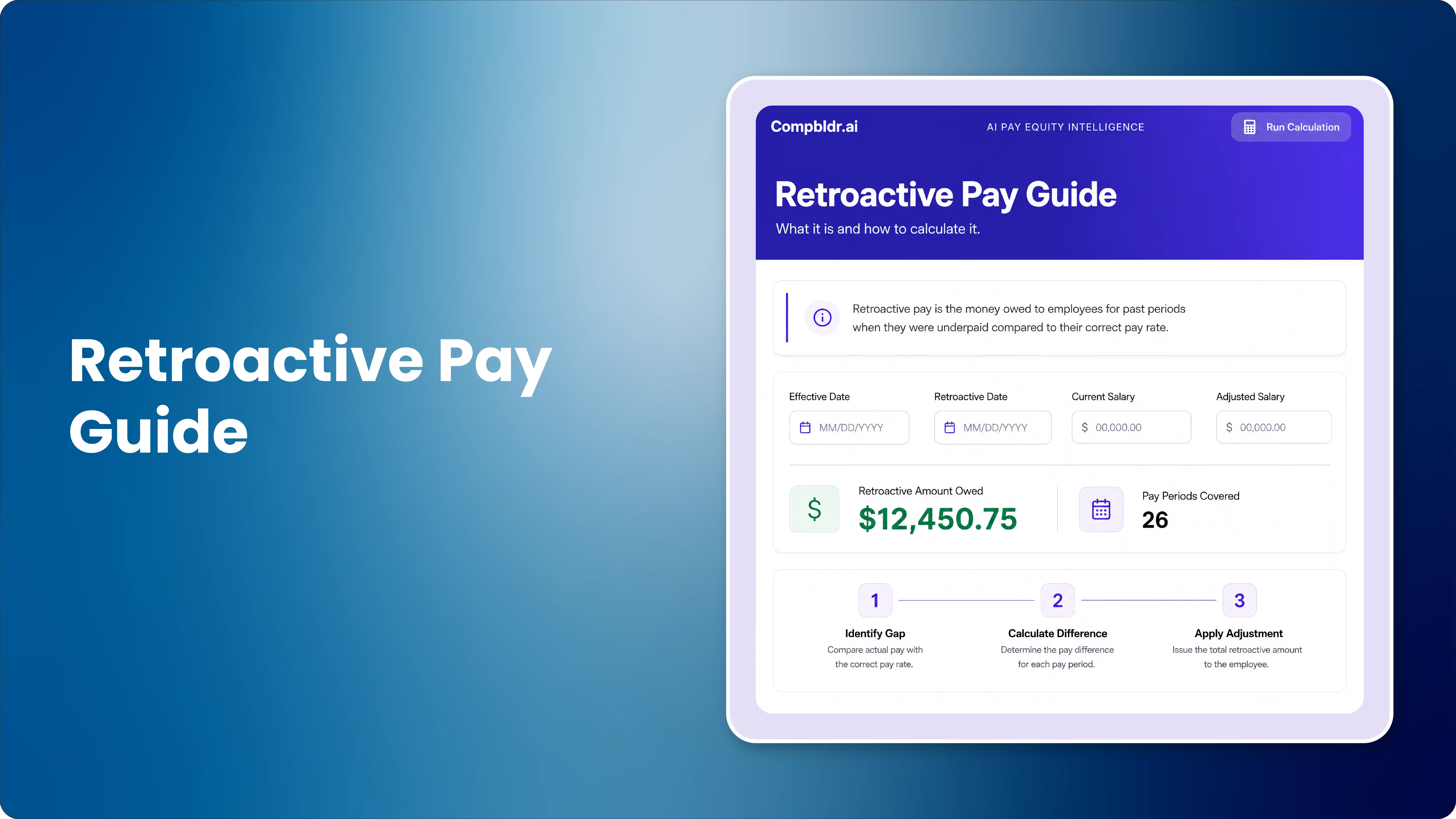

Retroactive pay is additional wages owed for a past period when an employee was paid at a lower rate than the rate that should have applied. In the simplest case, calculate the difference between the correct rate and the rate actually paid, then apply that difference to the affected hours or pay periods. If the employee is nonexempt and worked overtime, the correction may also change the regular rate used to calculate overtime.
This guide is for US compensation, HR, payroll, and Finance teams. It focuses on employer payroll corrections, not Social Security or veterans-benefit retroactive payments. Federal tax and overtime guidance was reviewed on August 25, 2026. State and local wage-payment rules can impose different timing, overtime, notice, and penalty requirements, so employers should review the rules that apply to the employee's work location and circumstances.
What Is Retroactive Pay?
Retroactive pay, often called retro pay, is compensation for a prior period that corrects the difference between the rate an employee received and the rate that should have applied.
A common example occurs when a merit cycle establishes an effective date for a salary increase, but payroll does not receive or process the approved change until a later pay period. The same issue can arise after a promotion, market adjustment, negotiated wage increase, or correction to a compensation record.
The important distinction is between the effective date and the processing date. The effective date determines when the new rate should apply. The processing date is when the change actually reaches payroll. Retroactive pay closes the gap between those two dates when compensation was underpaid.
Common Reasons Employers Issue Retroactive Pay
- Delayed merit increase: an approved increase becomes effective before the new rate is reflected in payroll. A documented merit increase matrix may guide the decision, but the effective date still has to carry through the workflow.
- Promotion processed late: the employee begins the new role or approved rate before payroll is updated. See the difference between a merit increase and a promotion.
- Market adjustment: leadership approves a compensation change with an earlier effective date after reviewing market position. A market adjustment has a different purpose from a merit increase and should be documented separately.
- Collective bargaining agreement: a negotiated wage increase may become effective before the agreement is finalized or before payroll is updated.
- Payroll or employee-data error: an employee may have been paid using the wrong rate, grade, step, or effective date.
- Compensation remediation: an organization may decide to correct a pay relationship identified through a pay equity audit. Whether remediation should be prospective or retroactive depends on the facts, governing policy, and applicable law. A pay equity finding does not automatically create the same retroactive obligation in every situation.
How to Calculate Retroactive Pay in 6 Steps
- Confirm why the correction is being made. Identify the approved merit increase, promotion, market adjustment, negotiated increase, payroll correction, or other event that created the difference.
- Confirm the effective date. Use the date the new compensation rate should have started, not simply the date it was approved or entered in the system.
- Identify the affected workweeks or pay periods. For nonexempt employees, preserve workweek-level detail because federal overtime is calculated by workweek.
- Calculate the base rate or salary difference. Compare the old rate with the correct rate for each affected period.
- Recalculate overtime and other regular-rate components when required. Review overtime, multiple rates, nondiscretionary bonuses, shift differentials, commissions, and other compensation that may affect the regular rate.
- Validate the result before payroll handoff. Confirm the employee population, calculation, approvals, tax treatment, and supporting records so the correction can be reproduced later.
Retroactive Pay Formula
The starting formula depends on how the employee is paid and whether the retroactive period includes overtime or other compensation that affects the regular rate.
| Situation | Starting formula | Important check |
|---|---|---|
| Hourly, no overtime | (New hourly rate − old hourly rate) × affected straight-time hours | Confirm the exact effective date and hours worked. |
| Hourly with overtime | Recalculate the straight-time and overtime difference for each affected workweek | A retroactive rate increase can change the regular rate and overtime amount owed. |
| Exempt salaried | Salary difference converted to the employer's pay frequency × affected pay periods | Use the employer's lawful proration method for partial periods. |
| Salaried nonexempt | Salary difference plus any required overtime recalculation | Salary status alone does not eliminate overtime analysis. |
How to Calculate Retroactive Pay for an Hourly Employee
For an hourly employee with no overtime or other regular-rate complications, subtract the old hourly rate from the new hourly rate and multiply the difference by the affected straight-time hours.
Example: An employee's hourly rate increases from $22 to $24, effective three workweeks ago. The employee worked 40 straight-time hours in each of those weeks and no overtime.
Rate difference: $24 − $22 = $2 per hour
Affected hours: 40 × 3 = 120 hours
Retroactive pay: $2 × 120 = $240 gross
The $240 is the gross wage correction before payroll applies the appropriate withholding and reporting treatment.
How Overtime Changes a Retroactive Pay Calculation
For covered nonexempt employees, a retroactive rate increase can require an overtime adjustment for the workweeks to which the increase applies. US Department of Labor guidance states that overtime generally must be paid at not less than one and one-half times the employee's regular rate for hours over 40 in a workweek. The Department's Field Operations Handbook also states that retroactive increases paid as compensation for services must be included in the regular rate and allocated back to the workweeks in which the work was performed.
Review the US Department of Labor regular-rate guidance.
Using the same $2 hourly increase, assume the employee also worked 15 overtime hours during the retroactive period. In a simplified single-rate example, the $2 increase becomes a $3 difference for those overtime hours because overtime is paid at one and one-half times the applicable rate.
Straight-time retro pay: $2 × 120 = $240
Overtime retro pay: $3 × 15 = $45
Total gross retro pay: $285
This example assumes one hourly rate and no other earnings that change the regular-rate calculation. If the employee received nondiscretionary bonuses, shift differentials, commissions, multiple rates, or other includable compensation, payroll may need a workweek-by-workweek recalculation.
How to Calculate Retroactive Pay for a Salaried Employee
For an exempt salaried employee, start with the annual salary difference, convert that difference to the employer's pay frequency, and apply it to the affected full or partial pay periods.
Example: An employee's annual salary increases from $72,000 to $78,000 and the organization pays biweekly.
Annual difference: $78,000 − $72,000 = $6,000
Difference per biweekly pay period: $6,000 ÷ 26 = $230.77
If two full pay periods were affected: $230.77 × 2 = $461.54 gross
If the effective date falls in the middle of a pay period, use the employer's lawful proration method and document it. If the employee is salaried but nonexempt, the analysis does not stop with the salary difference. Review whether the changed compensation affects overtime for the covered workweeks.
How Is Retroactive Pay Taxed?
IRS Publication 15 states that back pay, including retroactive wage increases, is taxed as ordinary wages in the year paid. The same publication treats retroactive pay increases as supplemental wages for federal income tax withholding purposes.
For 2026, if separately identified supplemental wages paid to an employee during the calendar year are $1 million or less and the applicable conditions are met, employers may use the optional flat 22% federal income tax withholding method. The aggregate method may apply instead depending on how the payment is made and whether federal income tax was withheld from regular wages. Supplemental wages are also generally subject to Social Security, Medicare, and FUTA taxes.
Review IRS Publication 15 for 2026.
Do not describe retroactive pay as simply “taxed at 22%.” The 22% figure is an optional federal withholding method in qualifying circumstances, not the employee's final income tax rate or final tax liability.
Retroactive Pay vs. Back Pay
Retroactive pay and back pay overlap. Employers should avoid presenting them as two completely separate legal categories.
| Term | Common payroll use | Typical example |
|---|---|---|
| Retroactive pay | Correction after a compensation rate should have changed earlier | A raise effective January 1 reaches payroll in February |
| Back pay | Broader description of wages owed from a prior period | Unpaid wages, a wage claim, settlement, or another prior-period underpayment |
The IRS includes retroactive wage increases within its discussion of back pay. In practice, the more useful control is to document why the money is owed, the period it covers, the calculation method, and the legal, contractual, or policy basis for the correction.
When Should Retroactive Pay Be Paid?
There is no single US payment deadline that applies to every retroactive pay situation. Timing depends on why the amount is owed and the federal, state, local, contractual, or policy requirements that apply.
For example, a routine delayed merit increase may follow a different process from a correction involving minimum wage, overtime, a collective bargaining agreement, or a wage claim. State wage-payment laws can also impose stricter payment timing or penalties than federal law.
For multi-state employers, the safest operational approach is to identify the employee's work location, the reason for the correction, the affected dates, and the governing rule before choosing a payment date. Compensation or payroll software should not be treated as a substitute for legal review when a correction may involve wage-and-hour exposure.
What About Former or Transferred Employees?
Do not automatically exclude an employee because they left the company or moved to another role. If the correction relates to services performed before separation or transfer, review whether the payment remains due and how it should be processed.
IRS guidance states that compensation paid to a former employee for services performed while employed is wages subject to employment-tax rules. That tax treatment does not determine every wage-law obligation, but it is a reminder that former employees can remain part of a retroactive payroll correction population.
Retroactive Pay Calculation Checklist
- Reason for the change: merit, promotion, market adjustment, negotiated increase, payroll correction, remediation, or another documented event.
- Approved effective date: the date the new rate should have applied.
- Old and new rates: including any additional rate changes inside the retroactive window.
- Affected workweeks or pay periods: with workweek detail for nonexempt employees.
- Overtime hours: plus any state-specific overtime rules that may apply.
- Other regular-rate earnings: such as nondiscretionary bonuses, commissions, multiple rates, or differentials when relevant.
- Pay frequency: weekly, biweekly, semimonthly, monthly, or another schedule.
- Employment changes: transfer, leave, termination, rehire, or job change during the affected period.
- Withholding treatment: based on current payroll and tax rules.
- Approval and audit evidence: who approved the change, when it became effective, how the amount was calculated, and who reviewed the result.
Common Retroactive Pay Mistakes
Using the approval date instead of the effective date. Compensation may be approved on one date but intended to apply from another. Keep both dates visible and use the effective date for the retroactive calculation.
Calculating overtime from pay periods instead of workweeks. Federal overtime is a workweek calculation for covered nonexempt employees. Identify the affected workweeks and recalculate where required.
Applying one flat difference to every hour. Overtime, multiple rates, bonuses, commissions, and differentials can change the amount owed.
Treating retro pay as a discretionary bonus. A retroactive wage correction is tied to compensation for prior work. Paying it separately does not make it a discretionary bonus.
Assuming every pay equity remediation has the same retroactive date. A pay-gap analysis can identify patterns, but remediation design and legal obligations require case-specific review.
Dropping former employees from the review population. Start with the affected work period and reason for the correction, not only the current active-employee roster.
Failing to preserve the calculation. A retroactive pay correction should be reproducible later. That matters for employee questions, audits, compensation analysis, and formal compensation reporting.
How to Reduce Retroactive Pay Errors
Many preventable retroactive pay errors begin before payroll. A compensation decision is approved, but the effective date, employee population, new rate, approval status, or rationale sits in a different spreadsheet, email thread, or HR workflow from the payroll update.
A stronger process keeps the compensation decision and its evidence connected through approval and payroll handoff. That means using consistent job and pay structures, documenting effective dates, controlling approvals, reconciling exceptions, and preserving a final record of what should be implemented.
The foundation starts with clear job architecture and governed salary ranges. During planning, teams should separate merit, promotion, market, and equity adjustments so each action has a clear reason and effective date. Compensation analytics can then help teams review pay actions and spot anomalies that need follow-up, while a broader compensation analysis provides context for recurring patterns.
A compensation governance platform can support these upstream controls by keeping compensation decisions, review steps, and supporting records organized. CompBldr is positioned as compensation management and governance software, not as a substitute for payroll, tax, or legal systems. Organizations should confirm the exact HRIS and payroll handoff required for their environment.
Retroactive Pay: The Practical Bottom Line
Retroactive pay is simple only when the underlying compensation record is simple. Start with the correct effective date, identify what the employee was paid and what should have been paid, calculate the difference over the affected period, and then review overtime, other regular-rate earnings, withholding, former employees, and jurisdiction-specific wage rules.
The strongest process does more than produce a number. It preserves the reason for the correction, approved rate, affected period, calculation method, reviewer, and final payroll handoff so the organization can explain the payment later.




.svg)

.svg)
.svg)

