


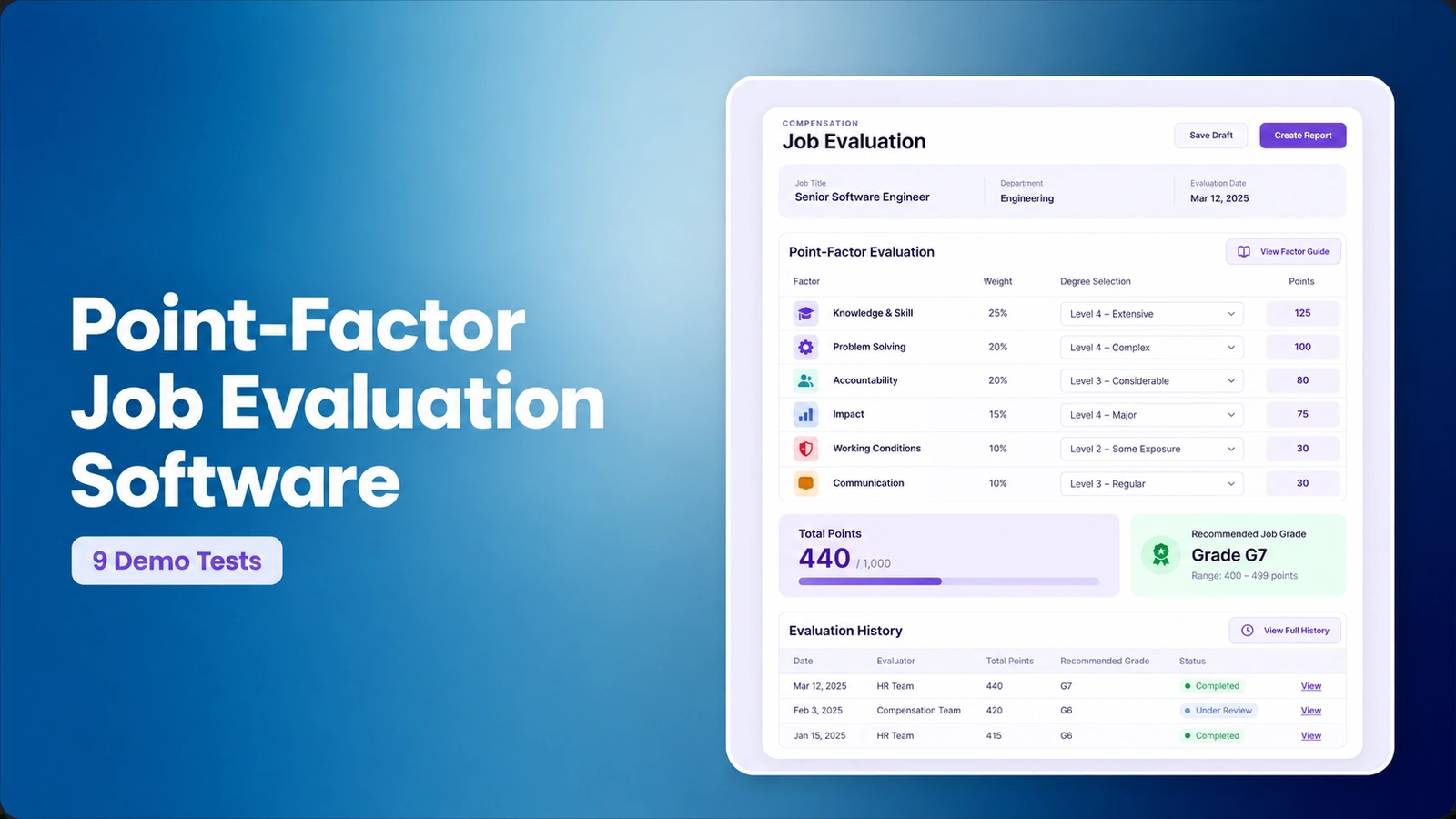

How can HR tell whether configurable point-factor job evaluation software actually works? Ask a vendor to score the same sample job twice, change one documented requirement, and show precisely what changed in the points, proposed grade, reviewer decision and saved history. If the product can only show a polished final score, the compensation team still cannot reconstruct the decision.
This buyer-focused guide provides nine live demonstration tests for US Total Rewards, HR and Finance teams. It includes a repeatable role scenario, a 100-point scorecard, an illustrative factor calculation and the evidence to request. It evaluates what to test—not independently verified scores for any vendor. For methodology fundamentals, see the point-factor method explained; for broader procurement scope, use the separate job evaluation software buying guide.
What should a point-factor job evaluation software demo prove?
A credible demonstration should prove that people can assess the job against defined compensable factors, explain each degree selection, challenge and approve a result, and revisit a prior version without losing the evidence. The method must be relevant to the organization's actual job families and approval rules. An automatic point total does not eliminate human judgment about the role, the factor structure or its calibration.
The CIPD guidance on job evaluation and market pricing distinguishes analytical and non-analytical approaches and stresses keeping schemes current as jobs change. The US EEOC's Equal Pay Act guidance separately emphasizes actual job content. Software supports a reviewable process; neither a method nor a vendor badge proves legal pay equity.
Prepare one fictional job before comparing vendors
Do not ask each vendor to choose its favorite demo role. Give everyone the same anonymized, approved sample description: Regional Operations Analyst, responsible for analyzing service exceptions, preparing forecasts, advising managers and recommending operational changes, with no authority to approve major budgets. Specify the role's typical decisions, required knowledge, work conditions and who approves changes. Do not include personal data, employee salaries or confidential customer records.
Prepare an amendment for a second run: the role now owns a regional resource-allocation decision within documented limits. This single approved scope change should test whether a system can distinguish a real increase in accountability from a title change. Also provide a draft version of the job description that should not be eligible for final scoring. Teams can use the job description workflow or their current HRIS as the approved evidence source; the important requirement is a controlled job-record version.
Nine point-factor software tests and weighted scorecard
Ask each vendor to perform the same actions with the same role and use one evaluator scale. The weights below are an illustrative procurement framework, not market research or a vendor certification. Customize them before the demonstrations, but keep the criteria unchanged while comparing shortlisted products.
| Test | Weight | Live action | Evidence to retain |
|---|---|---|---|
| 1. Approved job evidence | 12% | Create and re-evaluate an approved role | Source document and evidence reference |
| 2. Factor degrees and points | 12% | Change one factor based on job content | Degree definitions and recalculated total |
| 3. Configuration governance | 10% | Attempt an unauthorized method change | Change control or blocked edit |
| 4. Grade-boundary behavior | 12% | Cross an illustrative grade threshold | Before/after grade with approval |
| 5. Multi-reviewer calibration | 12% | Compare two independent evaluators | Differences, comments and resolution |
| 6. Algorithm/human comparison | 10% | Inspect any suggested score vs human score | Visible divergence and human decision |
| 7. Segregated access | 10% | Use manager and auditor accounts | Restricted view and export test |
| 8. Versioned audit history | 12% | Correct a previously approved evaluation | Both versions, actor, time, reason |
| 9. Export and integration | 10% | Export a reviewed grade and test mismatch | Reconciliation and failed-row handling |
Score each scenario from 0 (not shown) to 5 (independently repeatable evidence). A narrated product claim without a live test should not be recorded as a pass. For example, “has audit logs” is different from exporting a previous score with actor, version, reason and timestamp. For a broader view of how evaluation connects to levels and grades, see job architecture and job leveling software.
Test 1 — Can the system start from an approved job record?
Live script: Load the original Regional Operations Analyst description and attempt to score its unapproved draft revision. Ask the evaluator to identify which version is authoritative, what role attributes are read and whether an outdated draft triggers a review.
What to collect: Pass evidence: job ID, approved version, source date and access to the underlying description. Warning sign: a score is finalized against a title alone, or any user can silently replace the source record.
Why it matters: A source record can change between compensation cycles. If the evaluator cannot tell which job description was used, a later review may compare grades built on different jobs. The job-description governance guide provides related context.
Test 2 — Are factor degree descriptions usable in the scoring screen?
Live script: Ask the vendor to open every applicable factor and show its degree definitions before assigning points. Change the sample role's accountability evidence from advisory to a formally approved decision right. Request a recalculation and a visible explanation of the changed degree.
What to collect: Pass evidence: written degree definitions, original and revised choices, point differences and a reviewer explanation. Warning sign: reviewers must guess at ambiguous labels or cannot tell what changed.
Why it matters: The evaluation should reflect job demands rather than an incumbent's reputation or current salary. Keep the underlying JESAP methodology or other chosen method accessible to evaluators without treating factors from different frameworks as equivalent.
Test 3 — Can authorized owners govern the factor model?
Live script: Ask an administrator to show who can create, deactivate or change factors, weights, degrees and grade boundaries. Have a regular manager attempt the same change. Show whether an approved method change would require revisiting existing evaluations.
What to collect: Pass evidence: roles and approval rules for methodology changes, versioning and a blocked unauthorized edit. Warning sign: a factor change silently alters historical scores.
Why it matters: Some methodologies are licensed and have prescribed structures; not every vendor should permit editing core factors. The real buying question is whether configuration is appropriate and controlled, not whether every method is freely editable.
Test 4 — What happens when a score crosses a grade boundary?
Live script: Set an illustrative boundary between 74 and 75 points in a sandbox only. Start with the sample role at 69 points, then change a documented accountability degree so the training example reaches 75. Ask how the proposed grade changes, which approver must review it, and how an effective date is applied.
What to collect: Pass evidence: pre-change and post-change totals, proposed grade, approval step and historical range. Warning sign: a final grade changes automatically without a visible review.
Why it matters: Grade mapping should be tested in the context of the organization's approved job grades and levels; a software demonstration is not authority to replace the compensation committee's policy.
Test 5 — Can two evaluators disagree without losing their reasoning?
Live script: Assign the same approved role to two independent reviewers. Give them deliberately different accountability interpretations, then invite a calibration reviewer to compare the scores. Ask to see both rationales, the dispute, the agreed evidence and the resolved score.
What to collect: Pass evidence: separate evaluator versions, factor-level differences, recorded rationale and explicit resolution. Warning sign: the second reviewer overwrites the first, or the tool averages subjective scores with no explanation.
Why it matters: This is particularly important when leveling neighboring roles in a large job family; compare the outcomes against a job leveling matrix rather than relying on an isolated numerical rank.
Test 6 — Does any algorithm-assisted suggestion remain reviewable?
Live script: If a vendor offers AI or algorithm-assisted job evaluation, compare its suggestion with two human versions. Introduce a factor where the algorithm and evaluator choose different degrees. Ask to see the difference, the source evidence, who can accept or reject the suggestion, and what is retained.
What to collect: Pass evidence: visible separation of suggested and approved scores, a human decision and an unchanged prior record. Warning sign: an automated result overwrites the authorized human review.
Why it matters: CompBldr describes an algorithm-based comparison against human evaluations; require an actual demo before treating the description as independently validated or extrapolating it to other vendors.
Test 7 — Can access be restricted by responsibility?
Live script: Use three sandbox accounts: evaluator, line manager and auditor. Attempt to view draft job evidence, amend scores, approve a grade, and export sensitive notes from each account. Repeat after removing an evaluator's access.
What to collect: Pass evidence: blocked unauthorized actions, appropriate restricted views and preserved access-change records. Warning sign: a manager can approve their own grade change or access unrelated confidential records.
Why it matters: Connect access testing with the organization's governance needs and current vendor security documentation. A checkbox that says role-based security is insufficient proof of a specific configuration.
Test 8 — Can HR reconstruct a historical grade decision?
Live script: Finalize the first evaluation, save it, create a later correction with a reason, and request a report showing both versions. Ask an auditor to explain which source job, factor degrees, reviewer, date, grade and approval were in effect on the earlier date.
What to collect: Pass evidence: immutable or appropriately controlled historical record, actor/time/change fields and exportable evidence. Warning sign: the current record replaces the previous one, or no one can identify the approver.
Why it matters: If a grade feeds future compensation reporting, the original decision must remain reconstructable rather than being inferred from today's dashboard.
Test 9 — Does an approved grade transfer correctly to downstream systems?
Live script: Export or sync the approved role ID, grade and effective date into a test job architecture or planning environment. Intentionally change an employee or role identifier to produce a validation exception. Show how the system handles duplicate, missing or rejected records.
What to collect: Pass evidence: stable role IDs, approved grade history, validation errors and a reconciliation process. Warning sign: an incomplete transfer appears successful or silently shifts another role's grade.
Why it matters: Follow the approved grade into compensation planning and keep market benchmarking separate: internal job value does not itself determine market pay.
Worked example: how a single degree change affects the result
Use a transparent training dataset so buyers can tell whether software calculations and approvals agree. The following four-factor model is fictional, not JESAP, Mercer IPE, Korn Ferry Hay or a regulatory scoring standard. Each factor is rated from 1 to 5. A 100-point total is calculated as the sum of (factor rating ÷ 5) × factor weight.
| Example factor | Weight | Rating | Weighted points |
|---|---|---|---|
| Knowledge requirement | 30% | 4 of 5 | 24 |
| Problem complexity | 25% | 3 of 5 | 15 |
| Accountability | 30% | 4 of 5 | 24 |
| Working conditions | 15% | 2 of 5 | 6 |
| Total | 100% | Fictional example | 69 / 100 |
In this example, knowledge contributes 24 points, complexity 15, accountability 24 and working conditions 6: 69 out of 100. If the approved accountability rating rises from 4 to 5, the total becomes 75 because that 30%-weighted factor increases by 6 points. If a fictitious grade threshold begins at 75, the system should propose the new grade and route it for review rather than treating the training example as a real pay decision.
Have the vendor repeat the calculation, show who changed the factor and retain the original 69-point version. The purpose is to test mathematics, provenance and governance together—not to assert a universal pay-grade formula. For actual salary structure effects, see the salary range version-control guide.
How should HR score vendors fairly?
Before the first demonstration, agree on a shared scoring rubric. Give 0 when no functionality was shown, 1 for a verbal assertion or substantial workaround, 2 for a partial demonstration, 3 for a working but limited result, 4 for a complete demonstrated result and 5 for independently repeatable evidence. The weighted result is:
Vendor score (out of 100) = SUM(test weight × observed rating ÷ 5). A vendor with 4/5 on a 12-point criterion earns 9.6 weighted points. The nine criterion weights sum to 100. Keep any user-created scorecard's assumptions visible, particularly if a buyer changes weights for regulated industries or multi-entity organizations.
Do not allow a high weighted score to conceal material defects. If access controls expose confidential evaluation records, a historical record is destroyed, or an unauthorized grade is approved, treat that as a separate go/no-go gate. Record whether a vendor supplied proof in the meeting or promised future documentation. Procurement can compare capabilities, price and implementation risk only when those distinctions remain clear.
How do JESAP, Mercer IPE and Korn Ferry Hay differ?
Do not compare methods only by the number of factors. The publicly documented Mercer IPE approach identifies impact, communication, innovation, knowledge and effort. The Korn Ferry Hay model described by Derbyshire centers on know-how, problem solving and accountability, with additional working-conditions considerations where applicable. JESAP describes 15 compensable factors in four categories: six knowledge/skill factors, two contacts/human-relations factors, four responsibility factors and three efforts factors.
The scoring scales, degree definitions, licensing and actual product workflows are different. Buyers should request the method's factor dictionary and approved review process, then run the nine tests as far as that methodology permits. A vendor should not be penalized for protecting prescribed methodology structures; it should be challenged if the structures cannot be explained, approved or audited. For a detailed methodology comparison, use JESAP vs Hay vs Mercer.
What can CompBldr demonstrate—and what still needs verification?
CompBldr's published Job Evaluation page describes JESAP Studio's visible factor definitions, scoring in Quick Evaluation Mode, saved versions with evaluator and timestamp, version comparison, grade review and algorithm-assisted calibration against human scores. The JESAP methodology page describes the 15-factor structure. Those are first-party product descriptions, not findings from an independent hands-on product test.
In a purchasing meeting, ask CompBldr to run the fictional role scenario, show the relevant role permissions, export an earlier evaluation, demonstrate a disputed factor and confirm how an approved grade reaches job architecture. Do not infer unlisted integration support, unlimited customization, guaranteed AI accuracy or legal certification. If a capability is not available in the purchased plan, record it as unavailable or requiring written scope confirmation rather than giving the product an assumed pass.
US pay-equity caution: documented scoring is not legal compliance
The US Equal Employment Opportunity Commission explains that Equal Pay Act analysis considers substantially equal skill, effort, responsibility and similar working conditions, with actual duties more important than job titles. A point-factor methodology can organize job content, but it does not by itself establish a compliant pay practice. An internal grade, a salary range and actual employee compensation are separate evidence layers.
Use pay equity software or a qualified reviewer for relevant pay analysis, not as a substitute for selecting job factors responsibly. Also recognize that compensation-discrimination obligations can arise under other federal and state laws. This article provides software evaluation criteria, not legal advice or a compliance certification.
What should the procurement team request after the demo?
Ask for the exact factor and degree model supplied under the license; approved job-description source requirements; a sample evaluation-export schema; documented approval and exception controls; an access-control matrix; version-retention and deletion policies; integration capabilities and error-handling rules; and an implementation plan that defines the owners of method governance and HRIS data. Make the vendor distinguish currently demonstrated functionality from roadmap, customization and services.
Ask Finance to review the impact of grades on budgets and salary ranges, but keep the job-value decision independent of the incumbent's current salary. A system can support compensation analytics and related workflows while still needing human review and verified implementation details. The best final deliverable is a short, evidence-backed scorecard with recorded failures, not a feature grid based on marketing claims.
Conclusion: ask vendors to show the change, not just the score
A reliable point-factor job evaluation system should make a decision easier to explain six months later. Test one real-world change against approved role evidence, require every vendor to preserve the previous factor scores and grade, and record the review that allowed the new result. The same nine scripts work across a shortlist even when vendors use different authorized methodologies.