

.svg)





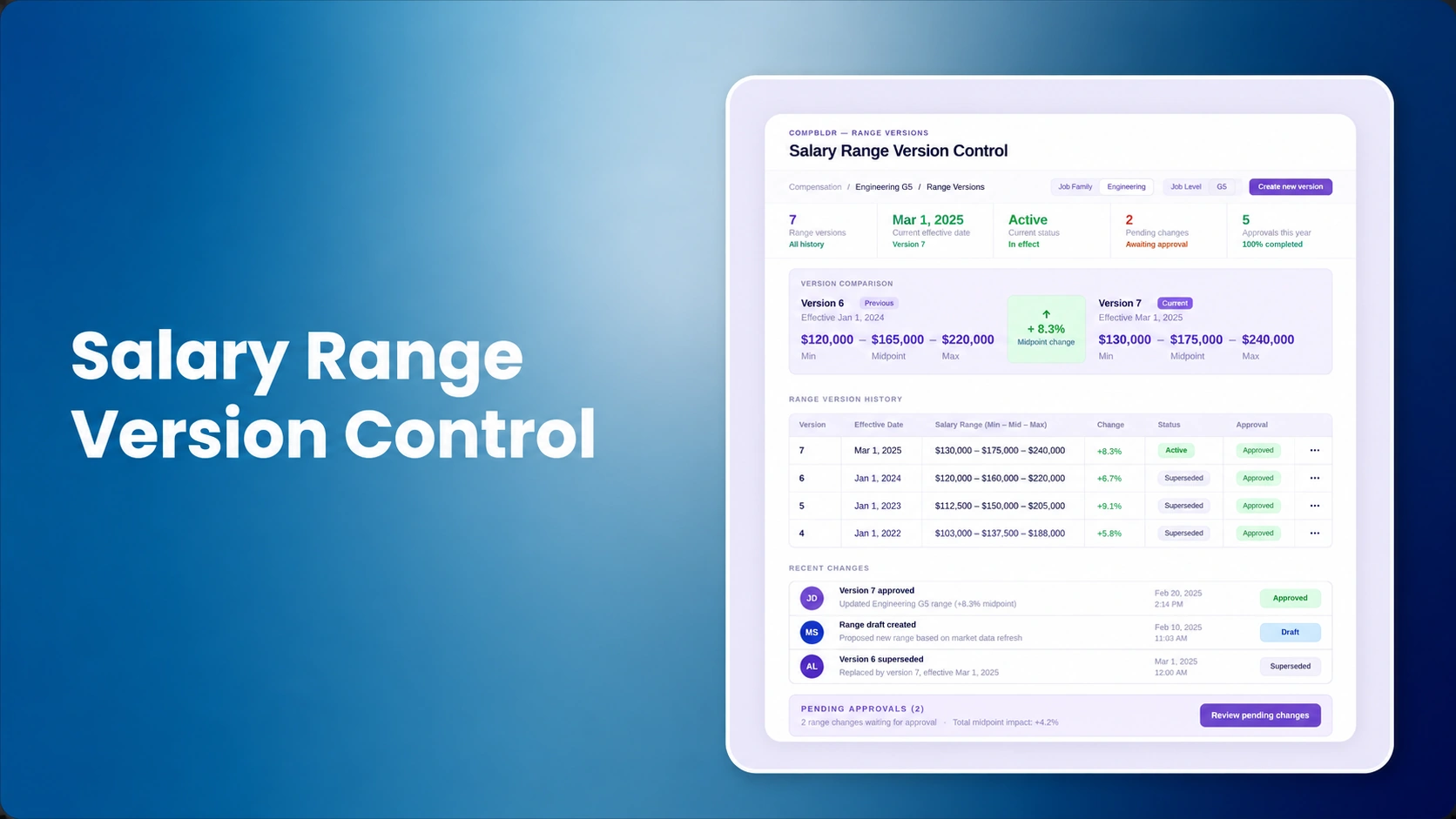

A salary range is not one permanent record. It is a time-bound compensation policy. The minimum, midpoint, and maximum approved in January may be replaced in July after a market review, geographic change, acquisition, pay-transparency requirement, or business restructuring. If the old range is overwritten, Compensation loses the ability to explain earlier offers, promotions, compa-ratios, and employee decisions.
That is the purpose of salary range version control: preserve the range that was valid at the time of a decision, activate the new range on a defined date, and keep the relationship between market evidence, approval, employee placement, and downstream systems intact.
CompBldr salary structure software supports governed salary-range development and versioned structure records within the broader compensation workflow. The operational value is not merely keeping old numbers. It is maintaining a usable decision history.
What a Salary Range Version Should Contain
| Field | Why it matters | Example governance question |
|---|---|---|
| Range ID / job-grade relationship | Shows which jobs the range governed | Did the job move grades or did only the range change? |
| Minimum, midpoint, maximum | Defines the approved pay opportunity | Which values were valid when the employee decision was made? |
| Effective start date | Controls when the new structure applies | Should an offer signed before the date use the old or new range? |
| End or superseded date | Closes the prior version without deleting it | When did managers stop using the previous values? |
| Market source and assumptions | Links structure to external evidence | Was the change caused by new market data or a policy decision? |
| Approver and rationale | Preserves governance | Who authorized the change and why? |
| Geography / entity / currency | Prevents the wrong version being applied | Does this range apply to this employee population? |
Do Not Confuse Range Versioning With Data Aging
Market data aging estimates how external survey data changes between effective dates. Range versioning governs the organization's approved salary structure over time. They are related, but not the same.
The market pricing methodology can include aging assumptions. The output may lead leadership to approve a new range. Once that happens, version control records the organizational decision and its effective date.
The benchmarking evaluation guide is useful when multiple data sources or effective dates are involved. It keeps the market evidence separate from the final salary structure.
Build the Range Correctly Before You Version It
Version control cannot rescue a weak structure. Use the salary-band methodology to establish the relationship among market reference, midpoint, minimum, maximum, and grade. Review range width so the structure supports realistic progression rather than simply copying a market percentile.
The salary range definition article explains the operating meaning of the range. The salary structure software article addresses how range generation and structure management can be systematized.
Keep Every Range Change Tied to an Effective Date and Decision
CompBldr supports salary bands with version control so teams can preserve historical structures while using the correct current range for planning and analysis.
Four Events That Should Usually Create a New Version
1. Annual or scheduled market refresh
Leadership approves revised salary structures based on updated market evidence or a new market position. Preserve the old version and activate the new one on the approved date.
2. Mid-year market correction
A function, geography, or critical role group requires an earlier adjustment. Do not overwrite the annual structure without preserving which population changed and why.
3. Structural redesign
A new job architecture, grade model, or acquisition can change the relationship between jobs and ranges. Version both the structure and the mapping decisions.
4. Geographic or entity change
A new geo zone, business entity, or currency treatment may create a distinct range version for part of the workforce even if the core job architecture stays the same.
Effective Date Rules Need to Be Written Before the Change
Consider a range update effective July 1. A candidate receives an offer June 25 and starts July 15. Which range applies? A promotion is approved June 20 but effective July 1. Does it use the old midpoint or the new midpoint? An employee's salary is adjusted June 30 because they were below minimum. Should the correction be recalculated under the July structure?
These are policy questions, not software defaults. Write the rules for offer date, effective date, payroll date, and planning-cycle snapshot before activation.
The offer compensation governance framework should reference the correct current range. The same is true for promotions and off-cycle actions in Compensation Planning.
Version-Control Decision Matrix
| Event | Which range matters? | Required control | Common failure |
|---|---|---|---|
| New hire offer | Range defined by the approved offer/effective-date policy | Store the range version used for approval | Recruiter references a newer or older range manually |
| Promotion | Destination-job range valid on the promotion effective date | Separate job-level approval from pay decision | Promotion modeled against an obsolete midpoint |
| Merit cycle | Range version frozen for the planning cycle unless policy allows refresh | Document cycle snapshot date | Mid-cycle range updates change compa-ratios unexpectedly |
| Market adjustment | Current approved structure plus supporting market evidence | Identify whether the employee changes or the range changes | One employee exception silently becomes a structure change |
| Historical analysis | Range that was valid at the time of the original decision | Preserve version history | Today's range is applied retroactively to old decisions |
Historical Compa-Ratio Requires Historical Ranges
Compa-ratio is salary divided by range midpoint. If the midpoint changes and the system retains only the newest range, historical compa-ratio becomes distorted.
For example, an employee may have been at 1.00 compa-ratio in March under a $100,000 midpoint. If the midpoint becomes $108,000 in July, today's compa-ratio tells you the current relationship, not the March relationship. Both are useful, but they answer different questions.
Use Compensation Analytics to review current employee placement, and preserve historical range versions so trend analysis reflects the structure that existed when each decision was made.
Range Versioning Also Matters for Pay Transparency
Published ranges can change while job postings remain live. The organization needs a rule for whether active requisitions are updated when ranges change and how managers explain the transition.
The pay transparency guide and state-law content should be reviewed alongside current legal requirements. Software can preserve the structure and effective date, but it does not determine the legal requirement for a specific jurisdiction.
Do Not Delete Above-Maximum and Below-Minimum History
A new range can move an employee from above maximum to inside the range, or from inside the range to below minimum. That does not mean the prior condition never existed.
Preserve the history for later analysis of pay compression, structural corrections, and employee progression. Where a range change creates a market adjustment need, keep the action distinct from merit or COLA.
Synchronize the Version Across Systems
Compensation teams commonly maintain range logic in one place while the HRIS, payroll, ATS, or recruiting workflow stores copies. Once a new range version is approved, every downstream system needs the correct effective-date treatment.
CompBldr's Integrations page describes connections with HRIS and payroll systems. The Workday integration article illustrates how evaluated jobs and salary-range parameters can move between compensation work and the HRIS.
The control is not "did the file export?" It is "can we prove which range version each downstream decision used?"
Governance Checklist for Every Range Change
- What triggered the change?
- Which jobs, grades, functions, entities, locations, and currencies are affected?
- What market evidence supports it?
- What is the approved effective date?
- What happens to active offers and pending promotions?
- How many employees fall below minimum or above maximum after activation?
- What is the budget impact?
- Which systems receive the new values?
- Who approved the version?
- When will it be reviewed again?
Failure Signals
- The range record has a "last updated" date but no effective date.
- Old ranges disappear when a new structure is loaded.
- Managers use different versions during the same planning cycle.
- Historical compa-ratios change when today's range changes.
- Recruiting, HRIS, and Compensation show different range values.
- A mid-year update changes employee placement but no one models the impact first.
Illustrative Example: A Mid-Year Range Refresh
The following scenario is illustrative and uses hypothetical values or events to show the decision process.
Assume a company approves new technology salary ranges effective July 1. The P4 midpoint moves from $140,000 to $150,000. An employee earning $140,000 was at a 1.00 compa-ratio under the old structure and becomes 0.93 under the new structure without any salary change.
Both facts are valid. In June, the employee was exactly at midpoint. In July, the market structure moved and the employee is now below midpoint. A version-controlled system should preserve both views instead of rewriting the June history with the July midpoint.
Now add an active offer approved June 25 with a July 15 start date. The policy must determine whether the offer uses the June structure or the July structure. That rule should be visible in the approval record so recruiting, Compensation, and payroll do not make different assumptions.
Range-Version Rollout Checklist
- Approve the new minimum, midpoint, maximum, population, and effective date.
- Preserve the superseded version with its end date.
- Model current employee placement under the new structure.
- Identify employees below minimum and above maximum.
- Review active offers, pending promotions, and open off-cycle requests.
- Update manager and recruiter guidance.
- Synchronize downstream systems and verify values after the update.
- Record the market evidence, rationale, and approver.
- Set the next scheduled review date.
What Changes When Multiple Range Structures Exist?
Large organizations may maintain separate structures by geography, function, legal entity, or employee population. Version control should therefore identify not only the values but the structure to which the version belongs.
The same grade label can legitimately have different ranges across locations or business units. The control is to make the relationship explicit so managers and integrations do not apply the wrong structure to the employee.
Where multiple structures are intentional, connect the logic to the function-level compensation strategy or geographic policy rather than treating every difference as an exception.
Stop Replacing Salary Ranges. Start Governing Versions.
See how CompBldr connects market evidence, salary structures, effective dates, planning, analytics, and reporting so teams can explain which range applied to which decision and why.
Book a Demo

.svg)

.svg)
.svg)

