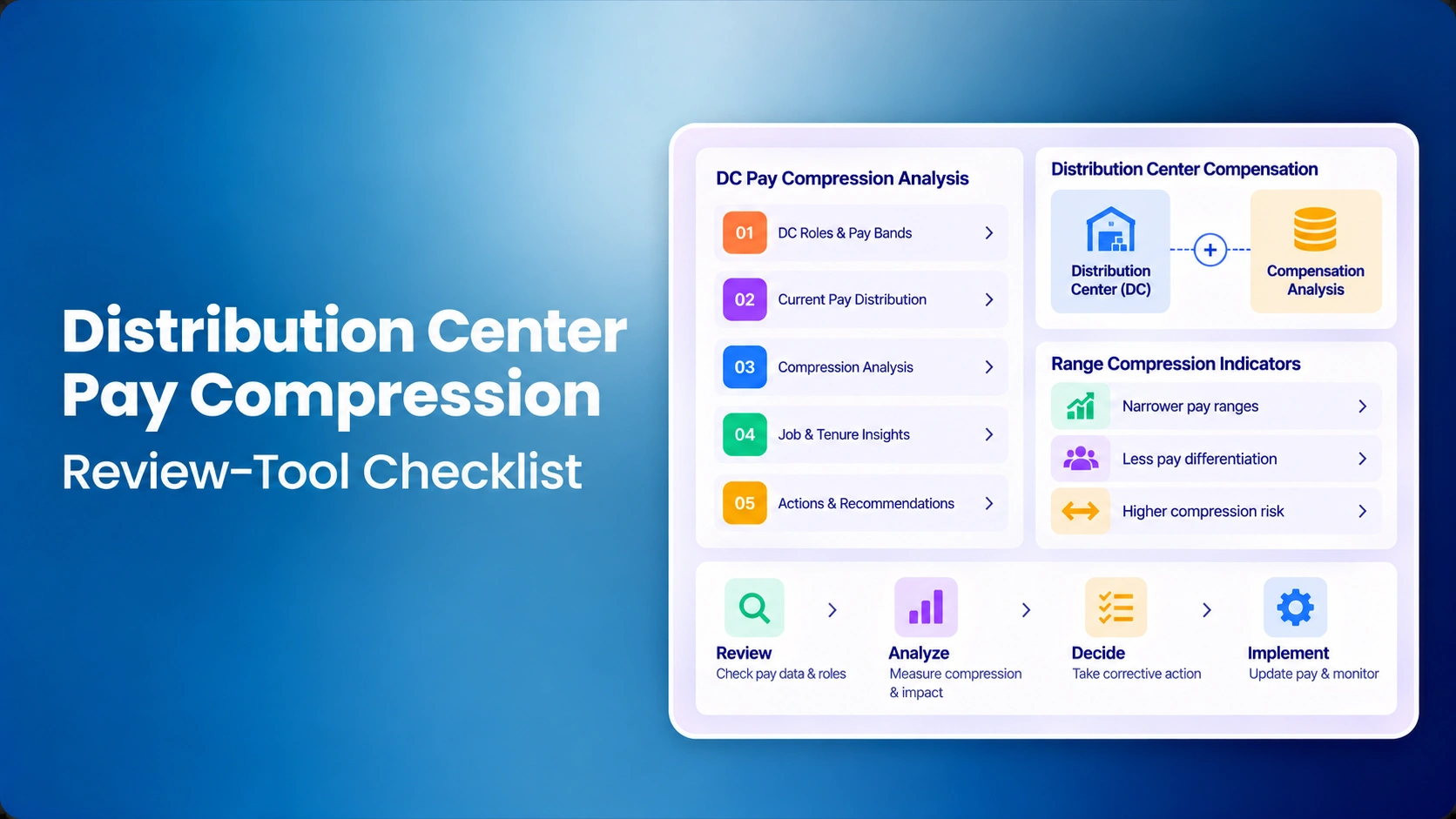





Choose a warehouse job leveling tool that captures responsibilities and reporting scope, supports repeatable evaluation criteria, retains human-approved grades and connects them with market pricing and salary structures. A demo should distinguish associate, equipment operator, lead and operations manager roles.
One distribution center uses the title Warehouse Lead for a trainer. Another uses it for a person accountable for staffing, safety decisions and an entire shift. If job grades depend on titles, those workers may be treated as interchangeable even when their responsibilities differ. Warehouse job leveling tools should help HR document job scope, apply consistent factors, review the decision and carry the result into salary ranges.
For related guidance, see compensation management for logistics and warehousing.
Four warehouse job leveling software requirements
IFDA's 2025 driver and warehouse compensation survey covered five driver and twenty warehouse positions across participating distributors. The published scope is evidence that warehouse job distinctions matter, not an instruction to copy an external survey's labels into internal grades. IFDA’s 2025 Driver and Warehouse Compensation Survey.
Define which warehouse work truly differs
An order picker, licensed equipment operator and maintenance technician may share a facility but not a compensable job family. A supervisor's accountability for schedules, people and operational decisions changes the comparison further. Begin with job architecture and the distinction between grades and levels. Ask how the platform captures role descriptions and avoids creating a new grade for every minor title variant.
Software acceptance test: Give the vendor three similarly named roles with different responsibility levels and ask it to justify every mapping.
Evaluate job scope without opaque automation
An evaluation should consider complexity, independence, responsibility and the organization's approved factors. Ask whether job evaluation records show who accepted a score and why. Compare point-factor methodology with the vendor's proposed approach. An AI suggestion is useful only when the reviewer can see its evidence, challenge its result and preserve a correction.
Software acceptance test: Have two analysts disagree about a lead role, then reconcile the decision and retrieve both comments.
Connect approved grades with the salary architecture
Grade is an internal classification; pay position also depends on labor market and policy. Review how grades connect to market benchmarking and approved salary structures. A market salary for a different distribution role should not silently decide the grade. Check how a job promotion affects salary bands and employee records.
Software acceptance test: Use one employee promoted midyear and inspect the grade, old range, new range, effective date and approved exception.
Make later audits and reclassifications practical
Facilities can reorganize, merge or change automation levels. A useful platform retains prior job versions and makes downstream consequences visible. Check reporting exports against pay-position analytics after a grade change. A current-state screen alone cannot explain why last year's salary decision used a previous role.
Software acceptance test: Ask an independent HR reviewer to reconstruct an earlier position and effective-dated grade.
How should job titles and duties be validated?
O*NET OnLine's 2026 first-line material-moving supervisor profile describes roles that direct workers, interpret operating and safety rules and plan assignments or equipment use. Its examples include Distribution Center Supervisor and Warehouse Supervisor. This is occupational context, not a requirement to assign the same enterprise grade to every employee carrying either title. Compare the actual job's staffing, performance and safety authority against written local duties.
The IFDA 2025 compensation survey distinguishes 20 warehouse positions and five driver positions, based on responses from 180 distribution companies at 795 locations. That published job coverage reinforces the need to validate survey scope, but it does not supply universal internal warehouse grades or authorize use of the licensed underlying wages.
How should HR define warehouse roles before assigning grades?
Two employees can carry the title warehouse lead and perform very different jobs. One may coach six pickers during a single shift, with the supervisor retaining all staffing and exception decisions. Another may direct receiving, replenishment, and outbound execution across a 24-hour facility, resolve inventory variances, and authorize labor reallocations. Putting both in one grade because the HRIS title matches hides differences in operational accountability. The first task in a job-leveling project is therefore to describe actual authority, not to rank incumbents by pay or tenure.
Ask operations leaders to submit recent position descriptions, reporting lines, shift coverage, direct and indirect employee counts, equipment or safety decision rights, and examples of exceptions the position can resolve independently. HR should reconcile inconsistent language before job evaluation begins. If one facility calls a role team leader and another calls it area coordinator, retain both local titles but map them to a governed enterprise job profile only if the underlying work is equivalent.
An illustrative four-role calibration
| Job profile | Primary accountability | Potential level distinction | Question reviewers should ask |
|---|---|---|---|
| Warehouse associate | Executes assigned pick, pack, receiving or replenishment work | Individual contributor | Is equipment certification a job requirement or an employee attribute? |
| Senior associate | Handles complex work and trains peers without staffing authority | Advanced individual contributor | Does the role own outcomes or merely share expertise? |
| Shift lead | Coordinates day-to-day work and escalates staffing issues | Operational coordination | Can this role change assignments or approve exceptions independently? |
| Operations supervisor | Owns labor deployment, coaching, performance and operating results | People management | What budget, safety and employee decisions are delegated? |
This is a calibration example, not a prescribed grade structure. A highly automated site, cold-chain operation, or hazardous-material environment may require different technical factors and authority boundaries.
Calibration test: keep the enterprise job family, career level, evaluated grade and individual base pay as separate records. The role evidence might support two different job levels for a trainer and a shift supervisor even if both HRIS titles say Warehouse Lead; conversely, locations with different hourly recruiting markets might retain one enterprise grade for substantially identical work. Write the approved factor rationale before checking the wage survey or incumbent's salary.
How are job levels, salary grades and market rates different?
Job evaluation is an internal assessment of responsibility and complexity. Market pricing is an external comparison for an appropriately matched role. Incumbent pay is a third dataset. Conflating them creates circular grading: a facility pays a lead more because hiring is difficult, then HR raises the lead's grade to justify the higher rate, even if the work has not changed. Build the level first, examine external market evidence second, and decide whether a location differential or hiring exception is needed third.
For instance, suppose two distribution centers use the same enterprise warehouse supervisor profile. A tight labor market at Site B may justify a different geographic salary range or temporary recruiting response without changing the job's enterprise level. Conversely, if Site B's supervisor also directs transport dispatch and has an additional management layer, the job itself may warrant a different evaluation. Ask the software vendor to show both cases without creating duplicate, ungoverned job profiles.
What should a consistent warehouse job evaluation method measure?
Use the employer's formally approved evaluation framework. Examples for warehouse roles include required technical knowledge, responsibility for work of others, initiative and decision authority, operational complexity, accountability for inventory or equipment, working conditions and safety exposures. The weights and grade thresholds belong to the employer's adopted method; this article's four-role table is a calibration example, not an industry standard.
CompBldr describes JESAP® as a 15-factor point-factor methodology organized into four categories, with degree-based scoring against a configured grade structure. Its job evaluation product page describes saved evaluator records, timestamps, factor-level version comparisons and AI-assisted calibration for review. Buyers should test whether the purchased configuration supports their own approval roles; an algorithmic proposed grade must not replace an authorized HR decision.
Which job evaluation factors should warehouse HR test?
A practical evaluation committee can compare scope of operations, degree of decision making, leadership responsibility, technical complexity, and financial or service impact. Define each factor in ordinary language, set examples for adjacent levels, and require reviewers to cite evidence from the position description. Software should show the factor ratings and reviewer rationale, not merely a final grade number. If factors carry points, HR must be able to explain the weighting and the effect of a challenged factor; see point-factor job evaluation.
Test a disputed position: an inventory control lead whose cycle-count accuracy responsibility expanded, but whose headcount did not. Request an evaluation at the existing level, then change only the accountability evidence. The committee should see which factor changed, whether the proposed level crosses the grade threshold, and who approves the decision. If the tool silently recalculates the grade without retaining reasons, it is weak for appeals and later audits.
Does a higher warehouse grade change overtime eligibility?
No automatic conclusion is possible. The U.S. Department of Labor's FLSA exemption guidance says job titles alone do not establish overtime-exempt status; applicable duties and compensation tests must be met. Production, warehouse and maintenance work can involve different classifications and state-law obligations. A title change from Team Lead to Supervisor, a JESAP score or a salary-grade label is not a substitute for separate wage-and-hour review by qualified personnel.
How should HR pilot warehouse job grading without changing payroll?
- Select the sample. Include positions from at least two sites, all common warehouse job families, one hard-to-classify technical role, and one manager role. Do not select only straightforward job titles.
- Freeze the evidence date. Use the same version of each job description and organization chart for the first pass. Record subsequent changes separately.
- Calibrate independently. Have operations and HR evaluate sample jobs before comparing outcomes. Reconcile disagreements using defined factors and accountabilities, rather than the incumbent's current rate.
- Map grades to ranges. After levels are approved, connect the approved job structure to salary ranges and employee records. Identify employees above or below range without automatically changing anyone's pay.
- Prepare exception governance. Specify who may request reclassification, what documentation is required, and who approves changes that affect budget.
The acceptance test should produce an approved grade record, a traceable rejected alternative, and a report of employees affected by the proposed structure. A vendor demo that only drags roles into a hierarchy is not enough.
What warehouse grading software warning signs matter?
Watch for one grade per job title regardless of actual scope, opaque scoring logic, missing effective dates, and no way to show which employee records depend on the approved job. Also watch for solutions that require exporting everything to spreadsheets to complete the final review. Some HRIS and payroll tools are excellent at storing job codes but provide little support for evaluation reasoning; a specialist system can still require integration work. Confirm ownership of the job master and the handoff rules before contracting.
For operations with hourly, overtime-eligible and salaried roles, verify that grade decisions do not become an unsupported employment-classification determination. Exemption status depends on applicable law and duties, not on the grade label. Review wage-and-hour implications with qualified counsel when a role changes materially.
What evidence must a completed grade decision retain?
- Job record: approved profile, family, scope, duties, reporting relationship, shift/site responsibilities and effective-dated source description
- Factor review: evaluation criteria and degree definitions, selected ratings, assessor names and comments explaining disputed responsibilities
- Decision: proposed grade, rejected alternatives, calibration outcome, final authorizer and effective date
- Pay handoff: approved grade-to-range mapping, market match if relevant, employee impact and separately authorized pay or HRIS action
- History: previous position and grade versions, appeal or reclassification reason and a clear audit export
Ask a second HR reviewer to reconstruct the grade decision without speaking to the original analyst. A clean organizational diagram is not enough if the evaluation evidence, exceptions and effective dates cannot be retrieved.
Which reports should a warehouse leveling system produce?
Request four outputs from each finalist: the scored or otherwise justified role assessment, the approved job-family and level mapping, a before-and-after salary-range impact report, and the audit trail showing reviewers and effective dates. The strongest implementation is one that HR can maintain after the vendor leaves and that a distribution manager can explain to an employee without referring to a black-box score.
Warehouse job leveling software evaluation scorecard
Use this evidence checklist with every shortlisted platform. These are test requirements, not vendor performance rankings.
| Criteria | Evidence needed | Warning |
|---|---|---|
| Job scope | Documented roles, tasks and accountability | Title-only mapping |
| Grade review | Factors, reviewer and decision history | Automatic grade with no explanation |
| Market handoff | Appropriate survey role and geographic market | Grade derived directly from a weak match |
| Change control | Prior grade and effective-dated approval | History overwritten |
How should HR score the four vendor tests?
Use a repeatable 0–2-point scale for the four scorecard areas. Award 2 when the tool completes the task with an exported, reviewable record; 1 when a documented manual control or configuration is needed; and 0 when the task cannot be demonstrated. Maximum score: 8 points. Record exactly what is native, configured, integrated or manual rather than relying on a feature claim.
Mandatory gates: factors and grade decisions must be reviewable; earlier records must remain recoverable; only authorized reviewers may approve grades; the market-pay and salary-band handoffs must not silently modify current employee payroll. A high numerical total does not compensate for failed mandatory controls.
Worked warehouse demo: grade three different Team Lead roles
Use one fictional logistics business with three facilities. Each calls a job “Team Lead”: at Site A the role trains new pickers but cannot change assignments; at Site B it allocates work within a supervisor-approved shift plan; at Site C it supervises employees, owns service targets and has documented staffing authority. The buyer must evaluate the recurring responsibilities consistently without assigning grades from the identical titles or from hourly wage differences.
- Load evidence and confirm job scope. Import approved descriptions, reporting lines, staffing permissions and operational decisions for all three sites. Use the same job leveling definitions and note which statements lack evidence. A local Team Lead title should not automatically become an enterprise supervisor job.
- Apply factors and challenge a score. Have HR and Operations independently evaluate the three jobs using approved definitions and job evaluation software criteria. Challenge Site B's supervision factor: coordination of assignments is not necessarily authority to hire, manage performance or direct independent decisions. Save both reviewer opinions and the resolution.
- Separate the grade from the market price. Show which job scope supports each approved grade, then inspect market survey matches for comparable labor markets and duties. A higher local hiring rate must not increase the job's internal grade automatically; a grade change should not imply an immediate salary change.
- Reclassify one role and preserve the prior decision. Give Site B a genuinely new supervisory responsibility and submit a revised job description. Require HR approval, an effective date, original and new factor scores, and a before-and-after salary range history. Verify whether an actual employee promotion and payroll implementation require separate authorization.
Pass criterion: an independent compensation analyst can explain all three proposed grade outcomes, find every cited position and factor record, review rejected assessments, and show what changed after reclassification. Mark any unverified software workflow as a dependency rather than a demonstrated feature.
Evaluate This Workflow
Bring a relevant warehouse or distribution-center compensation case and evaluate the CompBldr workflows in a demo.
Book a DemoWhich warehouse grading and labor-law limits must buyers verify?
This is a compensation and HR job-structure evaluation, not warehouse management software selection. Equipment dispatch, labor scheduling and safety training are separate operational needs. Do not infer that job leveling software performs them or that it guarantees legal classification compliance.
Confirm the exact job-data inputs, user roles, validation rules and integration methods in the license. Ask whether the demonstrated workflow is native, configured or dependent on additional services. A controlled test with a weak match or incorrect record will reveal more than a successful demonstration with ideal data.
Where CompBldr fits into warehouse job evaluation
CompBldr's published job architecture, evaluation, market matching, salary structure and planning product pages describe a connected compensation workflow. Confirm supported grade calculations, user permissions and the exact implementation configuration in the demonstration.
Sources and methodology (reviewed November 14, 2026): IFDA's 2025 hourly compensation survey establishes published position coverage, not a prescribed grade structure. O*NET provides occupational descriptions of warehouse and material-moving supervisors. U.S. Department of Labor FLSA guidance governs separate exemption analysis; no grade in this article establishes legal status. CompBldr's JESAP and job-evaluation pages describe the software's published factor and versioning workflows, which still require configuration checks. The four-role calibration, three-Team-Lead scenario and eight-point vendor scoring method are illustrative buyer exercises rather than validated company job grades.
Next step: test a difficult warehouse grade decision
Give each vendor the same roles, data exceptions and desired outputs. Document which evidence was produced and which conditions remain unresolved. Include the future system administrator in the evaluation and require written confirmation of the agreed configuration before purchase.
Review CompBldr With Your Team
Bring a relevant warehouse or distribution-center compensation case and evaluate the CompBldr workflows in a demo.
Book a Demo