



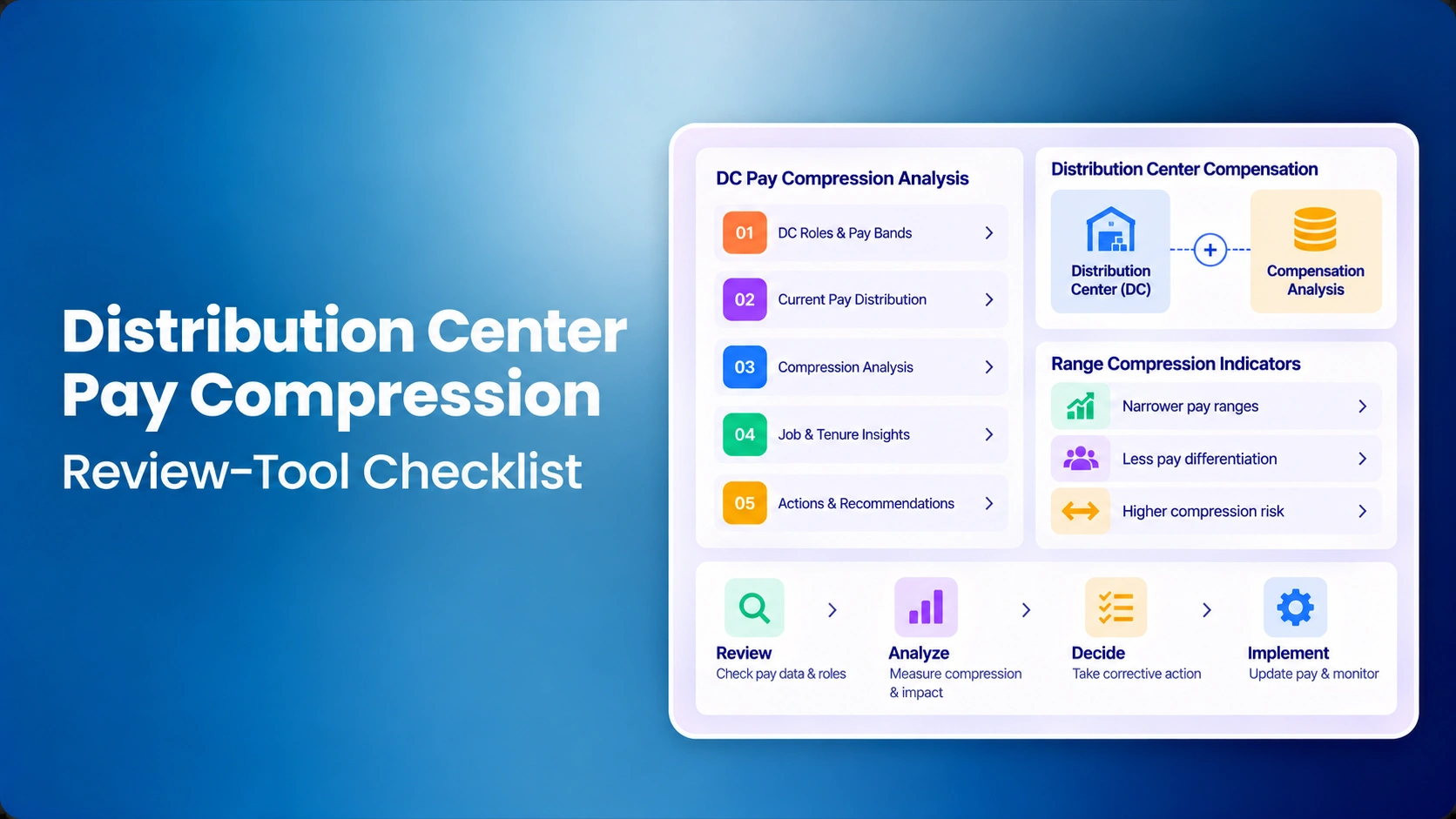

Use distribution center pay-compression tools to compare like-for-like roles in the correct market, separate base wages from shift differentials, inspect salary and hire-date history, document reviewed cases and model any approved adjustment. Alerts should prompt judgment rather than trigger automatic pay changes.
When a distribution center increases starting offers to fill shifts, some recent hires may earn nearly as much as experienced employees. That can be a legitimate market response and still create a relationship HR should investigate. A review tool must not confuse different jobs, pay zones or shift premiums and then label every narrow gap a defect.
For related guidance, see warehouse salary grades and job leveling software guide.
Four distribution center pay compression software checks
IFDA's 2025 distribution compensation survey reports several pay measures for warehouse roles, including base hourly wage and annual earnings. This underscores the need to identify the measure in any compression comparison. IFDA’s 2025 Driver and Warehouse Compensation Survey methodology.
Does the tool form meaningful warehouse cohorts?
A forklift operator, order picker and warehouse lead can have similar rates but different accountabilities. Use role definitions and grade evidence to set peer groups before comparing pay. The vendor should expose and permit review of its grouping criteria. Title matching alone is not enough to support a correction.
Software acceptance test: Create a false peer group containing an equipment operator and a supervisor and ask the system to flag or explain the mismatch.
Are shift premiums isolated from base wages?
An employee on the night shift may have higher total hourly earnings without a higher base wage. Compare the compensation components explicitly and align the methodology with market survey measures and matching rules. Mixing base wages with overtime or premiums may create misleading compression alerts.
Software acceptance test: Use two workers with equal base pay and different premiums; require separate component fields.
What context explains a narrow pay difference?
Tenure, prior promotion, a location transfer and market adjustments may all matter. Consult compression principles and market adjustment classification. Ask the vendor to open the salary history and distinguish an outdated HRIS salary from an approved current rate.
Software acceptance test: Test a pay change with an incorrect effective date; the platform should not silently analyze stale pay.
Can HR cost and approve specific changes?
Some reviewed cases may justify action; others may not. Bring each through pay analysis and model potential costs in planning, including the relevant range and budget owner. Reject products that imply a one-click remedy without human judgment or authorization.
Software acceptance test: Close one reviewed alert without action and route another adjustment for approval, retaining both outcomes.
What does the IFDA wage survey actually measure?
The 2025 IFDA Cross-Industry Compensation Survey: Driver and Warehouse Positions Edition covers 20 warehouse positions and five driver positions across 180 wholesale distribution companies and 795 locations. Its published description identifies median and average base hourly wages, gross annual pay and effective gross rates, with coverage segmented by distributor type, company size and geographic region. These are different pay measures; an analyst should not substitute annual gross earnings for a comparable base hourly wage.
The IFDA publication describes available survey cuts, not the individual compensation observations or licensed pay tables. Verify whether the employer's duties, equipment, shift and recruiting geography match a specific survey category before using a market figure. The 2026 IFDA compensation study focuses on executive, management and sales positions, so buyers should not assume it replaces the 2025 hourly warehouse survey.
How do you calculate a distribution center pay compression signal?
Pay compression is not simply a new employee earning more than a long-tenured employee. It becomes an HR decision when a pay relationship is inconsistent with the organization's documented job, performance, experience and market policies. At a distribution center, new-hire wage pressure, cross-training premiums, overtime, shift differentials and promotions can all distort a quick comparison. Start by defining an eligible comparison group based on comparable job duties, grade, employment basis and work location.
Use an illustrative cohort of ten warehouse associates on the same day shift and base-pay grade. Suppose a trained incumbent earns $22.50 per hour and a recently hired peer in a substantially similar role earns $22.00 per hour. The $0.50 difference is 2.27% of the newer hire's rate. That number alone does not establish unfair pay; HR must review relevant experience, documented skills, employment dates, performance and policy. If the recently hired peer instead earns $24.00, the relationship reverses: the incumbent is $1.50 below the hire, or 6.25% of the new hire's pay. That may justify investigation, not automatic remediation.
| Comparison field | Illustrative incumbent | Illustrative new hire | What the analyst should verify |
|---|---|---|---|
| Base hourly pay | $22.50 | $24.00 | Same wage component and effective date |
| Shift premium | $1.00 | $0.00 | Exclude or analyze separately |
| Relevant experience | 4 years | 6 years | Compare relevant, not total, service |
| Job assignment | General picking | General picking | Check equipment duties and certifications |
| Proposed action | Investigate, not automatically raise | No change proposed | Document decision basis |
Because wage relationships depend on context, a single “compression score” can mislead. The platform should allow reviewers to drill from a flagged pattern to the underlying comparable employees and explain why the pattern matters.
Worked base-pay comparison: $22.50 ÷ $24.00 = 93.75%, so the experienced employee's base wage is 6.25% lower than the new hire's when measured against the new hire's rate. This is a comparison metric, not a legal finding or universal compression threshold. The $1.00 shift premium belonging to the incumbent should be shown separately; otherwise the apparent hourly gap could be obscured. Compare people on a matched pay basis and check differences in relevant experience, actual assignments, credentials and performance evidence before deciding whether a pay action is warranted.
For wage-and-hour compliance, a pay-component display does not by itself determine the correct overtime regular rate. Payroll should separately apply applicable federal, state and contract rules when shift differentials, incentives or overtime are involved.
Which wage components should HR compare?
Compare base hourly wage to base hourly wage before adding shift premium, overtime, attendance incentives or piece-rate earnings. Then analyze total cash compensation as a separate question. Night-shift associates can appear overpaid relative to day-shift peers when their shift premium is mistakenly stored in the base-rate field. Employees working longer hours may show higher annual earnings without a higher pay rate. A system that cannot show the source, effective date and definition of each pay element is a risky compression tool.
Segment by facility, grade, core job, employment type and, where needed, bargaining unit. Do not segment away potentially relevant protected-group differences merely because the resulting cohort is easier to explain. When reviewing potential pay discrimination, the EEOC's employer pay guidance recommends consistent job-related criteria and documentation of compensation decisions. A compression review is an operational diagnostic, not a legal pay-equity conclusion.
What data should a pay compression report contain?
- Comparable cohort: facility and labor market, role, grade, bargaining unit and employment basis, with clear reasons for any exclusions
- Pay detail: current base hourly wage, shift differential, overtime and incentives as separate components with source and effective date
- Employee context: hire date, relevant experience, transfers, role changes, training, documented qualifications and applicable performance data
- Diagnostic result: selected wage comparison, identified exceptions, analyst comments and any separately reviewed pay-equity concern
- Approval record: proposed remedy, cost assumption, reviewer, final decision, effective date and HRIS/payroll reconciliation status
Keep individual employee pay data access limited to permitted HR, Compensation, Finance and designated operational reviewers. Use anonymized or synthetic records for sales demonstrations and confirm permissions before sharing extracts.
How much could a warehouse pay adjustment cost?
Assume an illustrative facility identifies six incumbents for potential adjustment after completing job-related reviews. A uniform $0.75 hourly increase for six full-time-equivalent employees costs 6 × $0.75 × 2,080 = $9,360 in annualized base wages, before payroll taxes, benefits, overtime interactions and actual-hours adjustments. If only four incumbents meet the documented correction criteria, the comparable base-pay estimate is $6,240. Showing both cases makes the approval discussion more useful than an unqualified “fix compression” recommendation.
A compensation director may choose phased changes, a range review, hiring-rate controls or targeted adjustments rather than identical increases. The tool should calculate and preserve the assumptions behind each alternative while the people involved retain the final decision. If management approves a new-hire premium without revisiting the established employee population, establish a date for rechecking related pay relationships.
Cost scenario check: the article's $0.75 adjustment for six employees at 2,080 hours each costs $9,360 annualized; adjusting four instead costs $6,240 annualized. If the approved adjustment takes effect with exactly half of those annual hours remaining, illustrative base-wage cash costs are $4,680 and $3,120 respectively. Actual employee hours, overtime interactions, taxes, benefits and effective dates may change the expense. Finance should see both recurring annualized and in-period amounts before authorizing changes.
Who approves a distribution center pay compression adjustment?
- Site HR: identifies candidate cohorts and resolves missing effective dates, duplicate job codes and wage-component inconsistencies.
- Compensation: confirms appropriate comparators, reviews grade and market evidence, and proposes a documented remedy.
- Operations: validates material job differences and operational constraints without substituting personal preference for compensation policy.
- Finance: reviews annualized run-rate, current-year cash effect and payroll-on-cost assumptions.
- Approver: records authorization, effective date and an explanation suitable for later audits and manager communication.
The acceptance test is a full case history: initial flag, evidence reviewed, options rejected, financial scenario selected, decision and subsequent monitoring. If the vendor can display a chart but cannot preserve the approval record, HR will still need a second control system.
What creates false warehouse pay compression alerts?
Common causes include an outdated employee grade, a new hire incorrectly matched to a senior incumbent, a premium folded into base pay, an off-cycle adjustment not yet reflected in the latest HRIS extract, or a comparison across different local labor markets. Conversely, an overly narrow cohort can hide systemic patterns. Run both a tightly comparable group and a broader diagnostic analysis, and record the reason for exclusions. For difficult salary exceptions, review the distinction between market adjustments and merit increases.
Compliance boundary: a high or low compression flag does not establish unlawful discrimination or legal compliance. The U.S. EEOC's employer pay guidance recommends documented, consistently applied job-related pay criteria and cautions against relying on potentially discriminatory pay factors. HR should maintain a separate, appropriately scoped pay-equity assessment when protected-group concerns or legal obligations require it. A narrow operational cohort should not hide broader inequity patterns.
Which data errors must compression software detect?
Bring a sanitized dataset with five deliberate defects: one missing grade, one duplicated employee record, one stale base rate, one separate shift premium and one recently promoted employee. A credible demonstration should identify these data issues or show how administrators resolve them, then produce understandable comparisons and a costed recommendation. Ask whether the product flags an issue, recommends an action or actually changes pay. Those are different capabilities. CompBldr's compensation analytics and planning pages are relevant evaluation points, but the implementation and review permissions still need a live demonstration.
Distribution center compression software evaluation scorecard
Use this evidence checklist with every shortlisted platform. These are test requirements, not vendor performance rankings.
| Criteria | Evidence needed | Warning |
|---|---|---|
| Job group | Comparable scope, grade and site | Every 'warehouse' title grouped |
| Pay components | Base, premium and overtime distinguishable | Premium counted as base salary |
| History | Hiring date, raises, transfers and effective dates | Only current value available |
| Review outcome | Case rationale, cost and authorization | Automatic salary revision |
How should buyers score a compression-review demonstration?
Score each of the four checklist areas on a suggested 0–2 scale: 2 when the vendor demonstrates the outcome with an understandable saved record, 1 when a documented workaround or configuration is needed, and 0 when it cannot be demonstrated. The maximum is 8 points. Record the test dataset, reviewer observations, exports and unresolved implementation dependencies. The scorecard is an editorial procurement framework, not an independent vendor performance rating.
Mandatory gates: distinguish base wages and premiums, identify suitable peer roles and stale records, restrict sensitive data access, preserve reviewer approvals and avoid automatic payroll changes from an unresolved compression alert. A high numeric score does not compensate for failure on these controls.
Worked distribution center software demo: resolve a pay compression alert
Use a fictional facility with an experienced day-shift picker earning $22.50 base pay and a newer comparable hire earning $24.00. Add one night-shift associate whose premium is recorded separately, one employee recently promoted to lead, and one employee with a stale pay-effective date. The goal is to test which alerts deserve a review, which are false matches, and how authorized adjustments are recorded.
- Build an accurate peer cohort. Ask the vendor to group workers by actual duties, facility, grade and employment basis, using job grades and levels. Exclude the promoted lead from a picking-only comparison and document why; don't hide broader pay-equity concerns through arbitrary exclusions.
- Reconcile components and effective dates. Show $22.50 and $24.00 as base wages, with shift premiums and overtime in separate fields. Inject an outdated pay-effective date and confirm the platform identifies it or supports documented data reconciliation before treating the alert as valid.
- Investigate and model alternatives. Display the 6.25% lower incumbent base wage relative to the new hire, plus relevant experience and role evidence. Review range-position measures if an approved range exists. Cost both a targeted adjustment and a larger cohort option using actual covered hours and assumed effective dates.
- Approve and close the record. Close one unsupported alert without a raise and route a supported change through authorized reviewer controls. Preserve original pay components, examined peer group, proposal, Finance cost check, approver, effective date and any HRIS/payroll handoff. Show a follow-up review after a later hiring-rate change.
Pass criterion: another analyst can reproduce the peer comparison, identify and correct data errors, explain the decision and retrieve the approved cost and effective date. If any control requires a manual workflow or separate system, document the dependency rather than presenting an unverified native feature.
Evaluate This Workflow
Bring a relevant warehouse or distribution-center compensation case and evaluate the CompBldr workflows in a demo.
Book a DemoWhat compliance and data limits should buyers verify?
Pay compression and legally defined pay inequity are not identical. Employee circumstances, workplace policy and applicable laws require independent review. Software should provide defensible context and an audit record, not promise an automated legal determination.
Confirm the exact job-data inputs, user roles, validation rules and integration methods in the license. Ask whether the demonstrated workflow is native, configured or dependent on additional services. A controlled test with a weak match or incorrect record will reveal more than a successful demonstration with ideal data.
Where CompBldr fits into the review workflow
CompBldr offers connected role records, market evidence, salary bands, pay analysis and review workflows. Verify how the proposed configuration handles the employer's wage components and distribution-center hierarchy.
How should distribution centers monitor compression after a raise?
A one-time compression review can become outdated within a single hiring season. Define when HR will recheck cohorts: after a starting-rate change, a salary-range update, a major recruiting campaign or a relevant job reclassification. Store the date and reason for each review so future analysts can distinguish the original problem from a new pay event. An organization that merely raises six incumbents today without controlling tomorrow's offer approval process can recreate the same pattern next month.
Ask recruiters to show their approved offer range and how exceptions are routed to compensation. Reviewers need to see when a proposed starting rate crosses an established employee threshold and why that threshold is meaningful. The threshold should be based on company policy and a defensible comparison group, not a software vendor's universal percentage. If the reason for a higher offer is a demonstrably different certification or responsibility, record it as job evidence rather than hiding it in a manager note.
Give the system a follow-up case: a new hire receives an exceptional base rate after the original remediation. Can the analyst identify employees whose relative position changed, compare base wages at the correct effective dates and reopen a review without deleting the prior decision? This is a meaningful acceptance criterion for a multi-site operation. Results should be explainable to both site leadership and the compensation team. The review also should not suggest that a pay relationship, by itself, proves discrimination. Legal assessments require separate qualified review.
Sources and methodology (reviewed November 14, 2026): IFDA's 2025 hourly distribution compensation survey describes role coverage and definitions, not the proprietary wages of any specific company. The EEOC publication provides general employer guidance for nondiscriminatory pay decisions, not a legal assessment of this example. All hourly amounts, cohort sizes, adjustment costs, percentage comparisons and eight-point buyer rubric in this article are illustrative. CompBldr product descriptions indicate relevant job, analytics and planning workflows but do not establish customer-specific wage-component mapping, integration or approval permissions. Verify these in a live demonstration.
Next step: test a real warehouse pay case
Give each vendor the same roles, data exceptions and desired outputs. Document which evidence was produced and which conditions remain unresolved. Include the future system administrator in the evaluation and require written confirmation of the agreed configuration before purchase.
Review CompBldr With Your Team
Bring a relevant warehouse or distribution-center compensation case and evaluate the CompBldr workflows in a demo.
Book a Demo