

.svg)





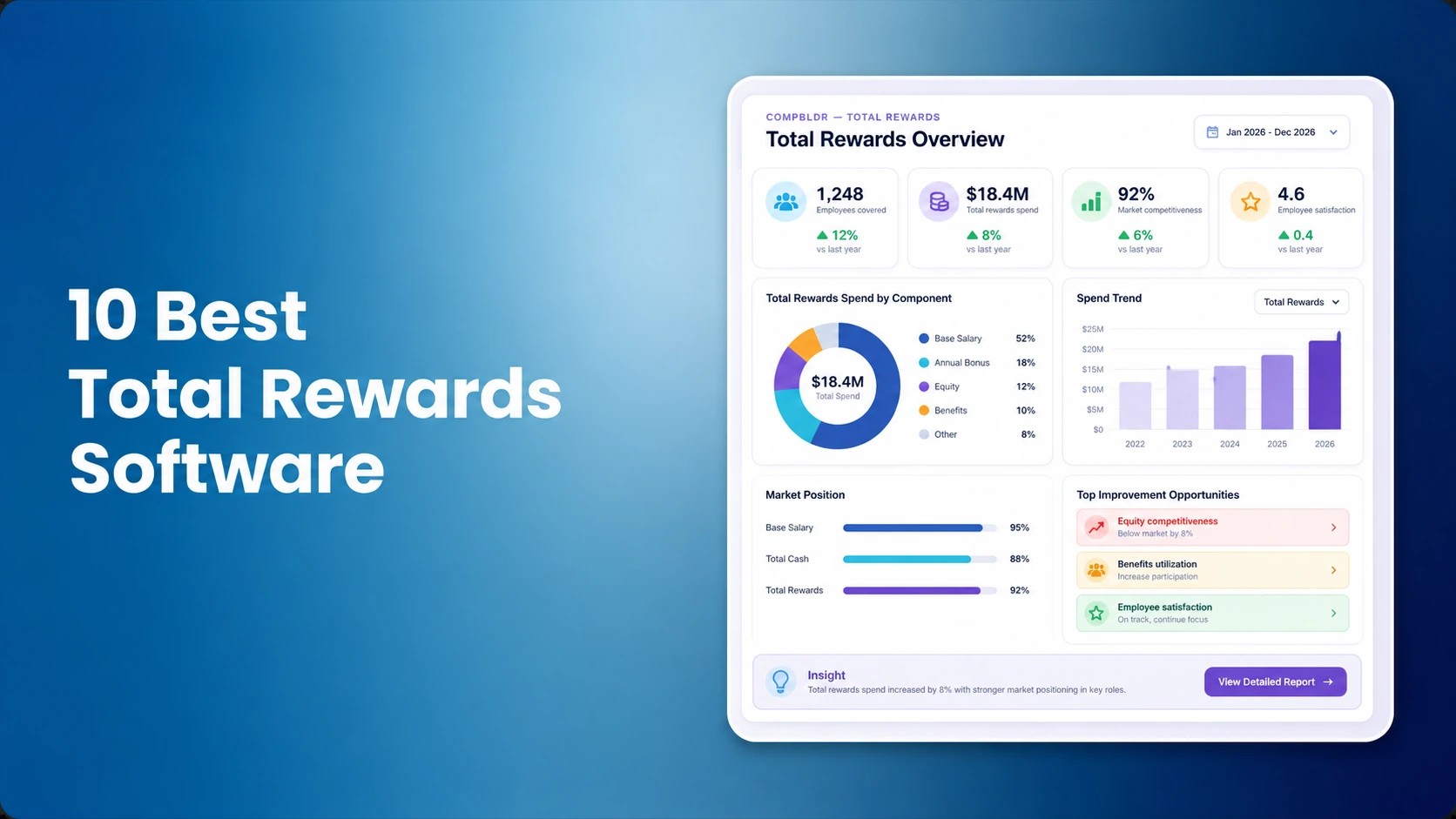

The best total rewards software for 2026 depends on which part of the rewards operating model your compensation team needs to improve. Some platforms provide market data across salary, variable pay, equity, or benefits. Some run salary reviews, bonuses, long-term incentives, and pay-equity workflows. Others specialize in communicating the complete rewards package to employees. A practical shortlist includes CompBldr, Pave, Salary.com, OpenComp, Compport, Ravio, Payscale, Workday, beqom, and Benifex.
This is a commercial buyer comparison, not a universal ranking. Product claims were reviewed against current first-party documentation available in September 2026. Total rewards is an unusually broad category, so the article separates four jobs that vendors often bundle under the same label: reward benchmarking, compensation and reward management, employee total-rewards communication, and benefits/rewards administration.
Publisher disclosure: CompBldr publishes this comparison and is included in it. Apply the same evidence and demo requirements to CompBldr that you apply to every other finalist.
How to read the “Best Fit” labels: These are editorial assessments based on each vendor’s documented product scope and likely buyer use case. They are not independent product test results or universal performance rankings.
Quick Comparison: 10 Total Rewards Software Platforms for 2026
How We Evaluated Total Rewards Platforms
Total rewards software is not one product category. We evaluated each platform against the jobs it actually documents rather than assuming every vendor provides the same stack.
- Reward data: what can the platform benchmark across salary, variable pay, equity, benefits, or other rewards?
- Reward decisions: can teams run salary reviews, bonus or incentive programs, pay-equity reviews, ranges, and approvals?
- Employee communication: can the platform explain salary, bonus, equity, benefits, ranges, and reward history in an understandable employee experience?
- Governance: can approved decisions, data sources, versions, access, and communication records remain traceable?
- Global fit: how well does the platform handle multiple currencies, locations, reward components, entities, and local program differences?
- System boundary: which jobs remain in the HRIS, benefits platform, equity system, survey provider, payroll, or another specialist tool?
1. CompBldr: Best Fit for Connected Compensation Governance and Total Rewards Communication
CompBldr connects job architecture, market benchmarking, compensation planning, analytics, reporting, and Total Rewards Statements. Its best fit is a compensation team that wants the employee-facing reward story connected to the governed job, market, range, and pay decisions that produced it.
What to test: bring one employee with base salary, bonus, equity, benefits and a recent pay change. Ask CompBldr to show which systems provide each component, how the approved compensation decision is preserved, what the employee sees, and what history remains after the statement changes. Confirm the exact integration and data-loading scope rather than assuming every reward component is native.
2. Pave: Best Fit for Compensation-Centric Total Rewards With a Dynamic Employee Experience
Pave currently combines real-time compensation market data, market pricing, pay ranges, compensation planning and a personalized Total Rewards Portal. Its Total Rewards product supports different locations, currencies, compensation and benefits programs, equity modeling, personalized benefit offerings and an always-on employee experience.
Demo check: distinguish the market-data layer from the employee communication layer. Pave is particularly strong around salary, variable pay and equity; if benefits benchmarking is a major requirement, verify the data source and methodology separately. Then test how a merit or range change reaches the employee portal.
3. Salary.com: Best Fit for a Broad Compensation Lifecycle Plus Pay Communication
Salary.com now spans market pricing, compensation planning, long-term rewards and employee pay communication through multiple products. Elevate centralizes compensation letters, total rewards statements, job documentation, manager-ready materials, controlled access, acknowledgments and audit trails. CompXL Long-Term Rewards supports RSUs, options, PSUs and SARs, automated vesting and planning across 96+ currencies.
Proof to request: map the exact Salary.com modules and datasets required for your use case. A buyer needing market pricing, merit planning, equity administration and employee statements may be evaluating several connected products rather than one fixed total-rewards SKU.
4. OpenComp: Best Fit for an Integrated Compensation Decision Workflow
OpenComp's current suite combines global compensation data, pay strategy and ranges, merit and bonus cycles, pay equity, total rewards statements, headcount planning and offer workflows. Its Total Rewards Statements product visualizes salary, bonuses, equity and benefits and can include applicable compensation ranges for pay-transparency communication.
Scenario to run: use a workforce segment with a complex reward mix and verify the depth of benchmark coverage, planning controls and employee communication. Confirm what remains outside the platform for benefits administration, payroll and specialist equity requirements.
Review OpenComp Total Rewards Statements.
5. Compport: Best Fit for Complex Global Reward Programs
Compport documents a broad reward-management suite covering merit cycles, bonus planning, sales incentives, long-term incentives, pay equity, candidate offers and Total Rewards Statements. Its employee reward experience can bring base pay, bonuses, equity, benefits and incentive information into configurable employee-facing pages, while the broader platform supports highly configurable global compensation workflows.
Admin test: model your most complex reward program, including multiple currencies, incentive types, approval paths and employee groups. Then have administrators change one rule and show the resulting statement and audit history. Configuration depth is useful only if your team can maintain it.
Review Compport Total Rewards Statements.
6. Ravio: Best Fit for Technology and Tech-Enabled Total Rewards Benchmarking
Ravio's 2026 total-rewards guidance describes its model as HRIS-sourced benchmarking across salary, variable pay, equity and benefits, alongside salary-band management, compensation reviews and pay-equity analysis. That makes it particularly relevant when the buyer's primary need is understanding how the whole reward package compares with technology-market peers rather than only producing employee statements.
Coverage check: verify coverage for the exact countries, roles and reward components in your workforce. If your organization has large non-technology populations, validate those peer groups separately rather than extrapolating from the overall dataset.
Review Ravio's current total rewards model.
7. Payscale: Best Fit for Compensation Intelligence With Scalable Total Rewards Statements
Payscale's current Total Rewards Statements capability creates personalized statements in bulk with customizable templates, benefits data, historical statements and secure delivery options. Payscale's broader compensation ecosystem adds market data and compensation workflows around that communication layer.
Workflow test: confirm which Payscale products are required to move from market data or a merit decision into the employee statement. Test how benefits data is loaded, how historical statements are retained, and how managers access the context needed to explain the communication.
Review Payscale Total Rewards Statements.
8. Workday: Best Fit for Organizations Already Centered on Workday HCM
Workday's current administrator documentation supports configurable Total Rewards templates that can display compensation, benefits and payroll data by country and can target different worker populations, including commission-oriented or executive packages. For organizations already using Workday as the HCM foundation, keeping reward communication close to core employee and benefits data can reduce system handoffs.
System-boundary test: determine which total-rewards functions are native to your Workday configuration and which still require a specialist market-data, compensation, benefits or equity product. Suite proximity is useful only if the workflow covers the rewards decisions you actually need.
Review Workday Total Rewards template documentation.
9. beqom: Best Fit for Large Enterprises With Complex Total-Compensation Execution
beqom PaySuite currently unifies salary, merit, bonuses and global incentives in an audit-ready compensation environment and positions the platform around broad total-compensation management. Current documentation also describes employee total-compensation statements covering base salary, bonus, equity and benefits.
Complexity test: use the real legal entities, currencies, incentive components, performance inputs and approval paths that make your program difficult. Also identify which external market-data and benefits sources are required; execution breadth does not automatically mean every reward benchmark is proprietary to the platform.
10. Benifex: Best Fit for Global Benefits and Employee Reward Experience
Benifex represents a different total-rewards category from compensation-centric platforms. Its center of gravity is global benefits, employee reward experience and communication rather than specialist compensation benchmarking and market pricing. That can make it a strong complement where benefits administration and employee reward visibility are the primary requirements.
Buying test: decide whether your buying problem is benefits/reward experience or compensation governance. If the team also needs salary benchmarking, job architecture, market pricing or complex compensation planning, map the additional systems and integrations required before treating the stack as complete.
Total Rewards Software vs. Total Rewards Statement Software
Total rewards software can describe a broad operating environment for reward data, compensation decisions, incentives, benefits and employee communication. Total rewards statement software is narrower: its primary job is to present the value of salary, bonuses, equity, benefits and other rewards to employees.
For a narrower comparison focused specifically on creating and delivering employee statements, see CompBldr's Total Rewards Statement Software guide. This article focuses on the broader platform decision across reward data, compensation workflows, benefits, governance, and employee communication.
Use One Total Rewards Demo Scenario for Every Finalist
- Load one employee with base salary, target bonus, equity, benefits and a current salary range.
- Show where each reward component comes from and which system is authoritative.
- Change the employee's salary through an approved compensation decision.
- Update one benefit or equity component and show the synchronization path.
- Generate or refresh the employee-facing total rewards experience.
- Show how a manager explains the employee's range position and recent change.
- Reopen the record later and reproduce the source data, decision, approver, effective date and communication version.
- If market benchmarking is included, show which reward components are actually benchmarked and the peer/sample evidence behind them.
This test prevents a polished statement from being mistaken for a complete rewards operating model and prevents a sophisticated compensation engine from being mistaken for a strong employee communication experience.
How to Choose the Right Total Rewards Platform
Start with the missing job. If the problem is employee understanding, prioritize communication. If the problem is market competitiveness, prioritize reward data. If the problem is execution, prioritize planning and incentive workflows. If the problem is benefits experience, prioritize benefits administration and communication. If your team uses total compensation, total direct compensation, incentives, and total rewards interchangeably, align the terminology first with the CompBldr Compensation Glossary.
Draw the system boundary. Identify what remains in the HRIS, payroll, equity system, benefits platform, market-data provider and compensation system. Count manual handoffs as part of the operating cost. If compensation workflow is the primary buying problem, compare the broader compensation management software category separately.
Separate reward data from reward workflow. A platform can have excellent statements without proprietary benchmarks, or excellent benchmarks without benefits administration. Require the vendor to label the source of each capability.
Test global complexity. Multiple currencies, countries, benefit programs, equity vehicles and incentive plans quickly separate broad marketing claims from real operational fit.
Require a reproducible employee story. A year later, the team should be able to explain what an employee saw, which data produced it and which approved compensation decisions changed the package.
Limitations of This Comparison
This comparison relies primarily on current first-party vendor documentation and public product information. It does not independently verify implementation quality, customer outcomes, dataset sufficiency, security configuration, support quality or commercial terms. Several vendors sell multiple modules, and a capability described by the company may require a separate product, data license, integration or service.
Total rewards is also broader than compensation. Benefits, wellbeing, recognition, career development and employee experience can be material parts of an organization's rewards strategy even when they are not managed by the compensation platform. Build the shortlist around your actual operating model rather than the label on the vendor category.
Which Total Rewards Software Should You Shortlist?
Shortlist CompBldr when employee reward communication needs to remain connected to job architecture, benchmarking, planning, analytics and reporting. Evaluate Pave when real-time compensation data, ranges, planning and a dynamic employee portal are central. Salary.com is relevant when market intelligence, planning, long-term rewards and pay communication need to work across a broad compensation suite. OpenComp can fit teams seeking an integrated compensation decision workflow with statements. Compport and beqom deserve attention for complex global reward execution. Ravio is especially relevant to technology-oriented teams prioritizing total-rewards benchmarking. Payscale combines compensation intelligence with scalable reward communication. Workday is a natural candidate when the organization wants to keep reward communication close to its existing HCM environment. Benifex fits a different need: global benefits and employee reward experience.
Reduce the list to the platforms that match your missing job, then make every finalist prove the same end-to-end employee scenario.



.svg)

.svg)
.svg)

