

.svg)





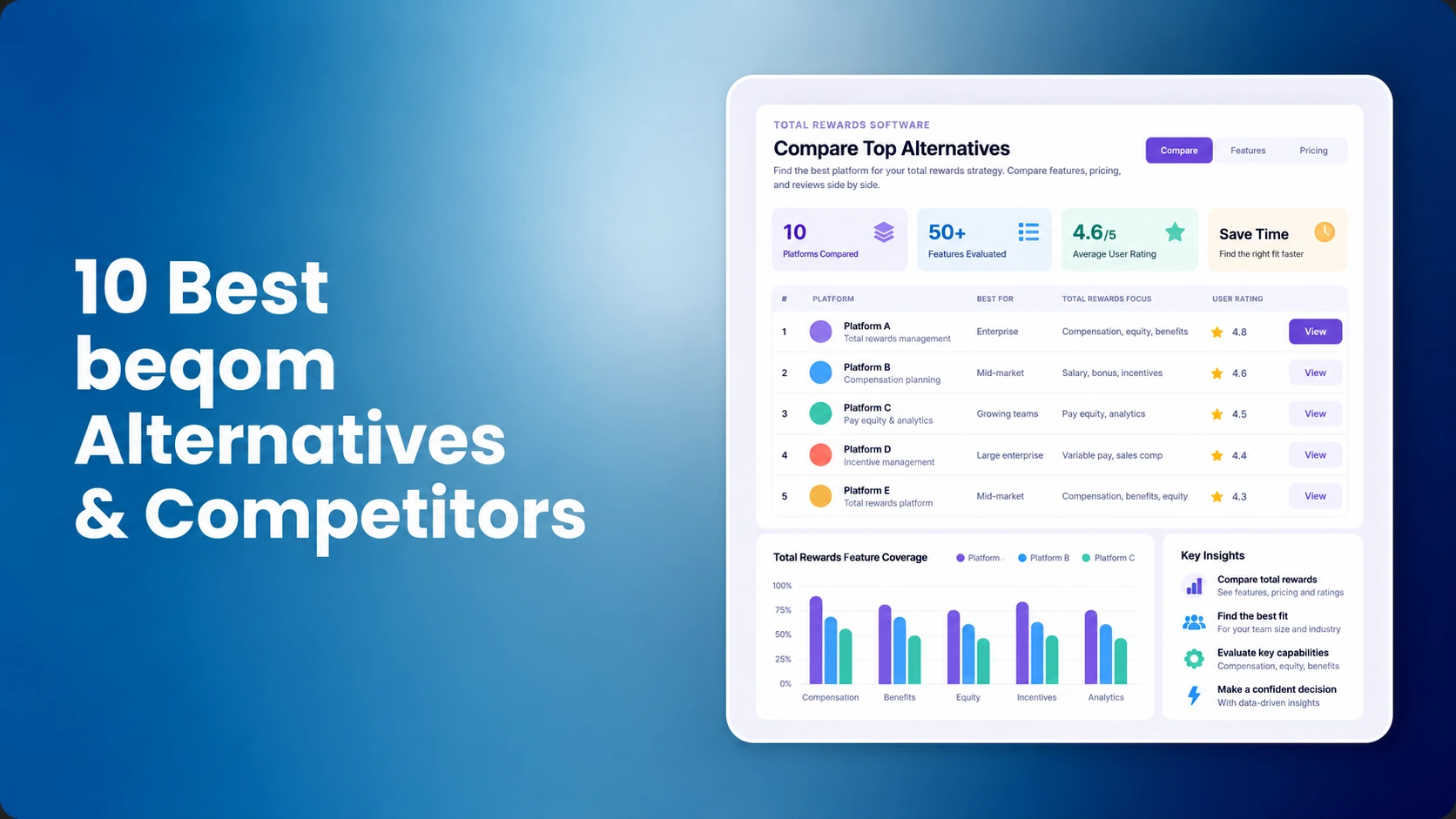

The best beqom alternative depends on which part of the compensation operating model your Total Rewards team needs to change. beqom PaySuite in 2026 is an enterprise compensation platform built for complex salary, merit, bonus, incentive, multi-currency, hierarchy, governance, and integration requirements. A useful alternatives comparison therefore should not treat every compensation product as a feature-for-feature substitute.
For 2026, a practical shortlist includes CompBldr, Payscale Ascent, Salary.com CompAnalyst Max, Pave, BetterComp, Compport, HRSoft, OpenComp, Figures, and Workday. Some are strongest for market data and market pricing; others emphasize compensation planning, global rewards execution, or HCM-native workflows.
Research method: current material product claims were rechecked against first-party vendor documentation on September 23, 2026. This order is an editorial buyer-fit framework, not an independent product score. Pricing, packaging, implementation scope, integrations, and data coverage can change.
Publisher disclosure: CompBldr publishes this comparison and is included in it. Buyers should apply the same proof-of-capability test to CompBldr as to every other finalist.
Quick Comparison: 10 beqom Alternatives for 2026
| Platform | Best fit | Primary model | Critical demo question |
|---|---|---|---|
| CompBldr | Architecture-linked compensation governance | Jobs, market evidence, ranges, planning, approvals, and reporting | Can evidence remain connected from job decision through pay approval? |
| Payscale Ascent | Current compensation intelligence and benchmarking | Market intelligence, smart benchmarking workflows, and contextual insights | Which products are required for your complete workflow? |
| Salary.com CompAnalyst Max | HR-reported data plus live market intelligence | Benchmarks, real-time market signals, job pricing, structures, and analytics | How do market pricing and downstream planning connect? |
| Pave | Employer-connected market intelligence | Connected data, market pricing, planning, and Total Rewards | Is coverage deep enough for your hardest roles and countries? |
| BetterComp | Policy-driven multi-survey market pricing | Pricing Policies, PayMarkets, matching, ranges, and repricing | Can reviewers reproduce every automated recommendation? |
| Compport | Configurable global compensation execution | Merit, bonus, LTI, incentives, pay equity, and Total Rewards | What is configurable by administrators versus services? |
| HRSoft | Enterprise total compensation lifecycle | Salary, bonus, LTI, modeling, budgeting, and communications | How does market evidence enter and remain governed? |
| OpenComp | Lean benchmark-to-strategy workflows | Global data, ranges, cycles, pay equity, and Total Rewards | Can it handle your hardest multinational scenarios? |
| Figures | International benchmarking and pay workflows | Benchmarks, bands, reviews, analytics, and pay equity | Which data is native versus separately licensed? |
| Workday | HCM-native compensation workflows | Compensation planning and analysis inside a broader enterprise HCM platform | Can the native workflow replace specialist compensation depth? |
Use this table as a screening aid, not as a substitute for a controlled demo. The same platform can look very different depending on the workforce, currencies, compensation components, market-data sources, configuration requirements, integrations, and implementation scope you need.
What beqom PaySuite Does in 2026
beqom currently positions PaySuite as a unified enterprise compensation platform for salary and merit, bonuses, global incentives, and other complex reward programs. Its current product positioning emphasizes unified total compensation, audit-ready workflows, configurable enterprise compensation, and integrations with major HR systems.
That baseline matters. Teams should not evaluate alternatives against an outdated view of beqom as simply a merit-cycle tool. The buying question is whether another platform better fits the specific gap: market data, job architecture, market pricing, planning usability, multinational execution, governance, implementation model, or total operating cost.
Review beqom PaySuite Compensation Management.
How We Evaluated beqom Alternatives
- Compensation scope: salary, merit, bonus, equity, incentives, LTI, and Total Rewards workflows.
- Data model: proprietary market data, employer-connected benchmarks, customer surveys, or external integrations.
- Configuration: what administrators can change without vendor services.
- Workflow continuity: whether market evidence and job structure survive into planning and approvals.
- Global readiness: currencies, countries, hierarchies, permissions, and complex program rules.
- Governance: effective dates, versions, approvals, audit history, and reproducibility.
- Implementation fit: integration, administration, training, and ongoing operating effort.
Evidence standard for vendor claims
Product and coverage statements below are based on current vendor-owned documentation. A vendor page establishes what the supplier says its product supports; it does not independently prove implementation quality, customer outcomes, data sufficiency for your workforce, or service quality. Treat every material claim as something to reproduce in the demo with your own employee population, compensation rules, market sources, integrations, and approval process.
1. CompBldr: Best Fit for Architecture-Linked Compensation Governance
CompBldr is a strong candidate when compensation governance needs to begin with the internal job structure rather than only at the planning worksheet. Its Job Architecture and Market Benchmarking workflows can connect roles, market evidence, salary structures, and reviewer decisions with Compensation Planning.
Why shortlist it: it is relevant when the buyer wants job architecture, market evidence, ranges, planning, approvals, and reporting to remain connected instead of becoming separate compensation workstreams.
What to test: use one difficult role, change its architecture or market match, create a range, move the result into planning, approve an exception, and retrieve the evidence and version history later.
2. Payscale Ascent: Best Fit for Current Compensation Intelligence and Benchmarking
Payscale launched Ascent on September 8, 2026, as an AI-first benchmarking platform within the Payscale Intelligence Cloud. Payscale positions it around market intelligence, smart workflows, contextual insights, and faster, more defensible compensation decisions.
Why shortlist it: it is relevant when the primary gap is current compensation intelligence and benchmarking inside a broader compensation ecosystem rather than highly customized enterprise reward execution.
What to test: map the exact Payscale products required for the beqom workflows being replaced. Verify market data, structures, planning, pay equity, reporting, integrations, implementation, and total commercial scope.
Review Payscale's Ascent launch documentation.
3. Salary.com CompAnalyst Max: Best Fit for HR-Reported Data Plus Live Market Intelligence
Salary.com's current platform combines HR-reported compensation benchmarks with real-time job-posting intelligence through its Max intelligence layer. CompAnalyst Max connects market data, job pricing, salary structures, analytics, and comp-trained AI in one current product environment.
Why shortlist it: it is relevant when the buyer wants compensation benchmarking and market-pricing depth backed by HR-reported data, with live market signals layered into the same operating environment.
What to test: bring a third-party survey and one complex role. Require matching, composite construction, range creation, planning handoff, approval, reporting, and source-history retrieval.
Review Salary.com's current compensation platform and CompAnalyst Market Data Max.
4. Pave: Best Fit for Employer-Connected Market Intelligence
Pave currently positions itself as an AI-native compensation platform built on a real-time dataset from 9,000+ integrated clients. Its current platform spans Market Data, market pricing, compensation planning, Total Rewards, persistent data sources, and governed compensation workflows.
Why shortlist it: it is relevant when employer-connected market intelligence, current salary and equity benchmarks, and modern compensation workflows are central to the buying case.
What to test: validate actual depth for your hardest jobs, levels, geographies, and pay components. Then test whether its planning and governance model can handle your most complex global cycle.
Review Pave's compensation platform.
5. BetterComp: Best Fit for Policy-Driven Multi-Survey Market Pricing
BetterComp is relevant when the primary reason for evaluating beqom is market-pricing depth rather than broad rewards execution. Its current workflow centers on codified Pricing Policies, PayMarkets, survey-cut preferences, global and local job mapping, AI-assisted matching, percentiles, geographic logic, ranges, and repricing at scale.
Why shortlist it: it is relevant for compensation teams that already use multiple survey sources and want policy-driven market pricing to be the center of the workflow.
What to test: require the vendor to show why a job matched, which survey cuts and policies affected the result, what a practitioner can override, and what evidence remains after the override.
Review BetterComp Market Pricing.
6. Compport: Best Fit for Configurable Global Compensation Execution
Compport's current compensation-planning platform spans merit cycles, bonus planning, pay equity, long-term incentives, sales incentives, and Total Rewards statements, with configurable rules and manager guardrails.
Why shortlist it: it is relevant when the buyer wants broad compensation execution and configuration across several reward components without centering the stack on market-data tooling.
What to test: recreate one of your hardest beqom programs. Verify currencies, eligibility, proration, budgets, approvals, manager views, audit history, and what administrators can configure directly.
Review Compport Compensation Planning.
7. HRSoft: Best Fit for Enterprise Total Compensation Lifecycle Management
HRSoft focuses on enterprise compensation management across total compensation planning, salary, bonus, long-term incentives, pay-for-performance, award modeling, budgeting, sales commissions, compensation statements, and Total Rewards communication.
Why shortlist it: it is relevant when the buyer needs a broad enterprise compensation lifecycle with multiple compensation components and communication workflows.
What to test: distinguish compensation execution from market-data capability. Verify how external survey evidence enters the platform and how it remains traceable through planning and communication.
Review HRSoft Compensation Management.
8. OpenComp: Best Fit for Lean Teams Connecting Benchmarks to Pay Strategy
OpenComp organizes its offering around Comp Benchmarking, Comp Strategy, and Comp Cycles. Its current platform connects global compensation data with benchmarking, pay strategy and ranges, headcount planning, pay equity, offers, Total Rewards statements, merit, and bonus workflows.
Why shortlist it: it can suit lean People or compensation teams that want a direct path from market data into recurring pay decisions without the implementation footprint of a highly configurable enterprise suite.
What to test: use complex multinational roles and compensation cases rather than showcase examples. Confirm custom rules, third-party data, approvals, reporting, and integration boundaries.
Review OpenComp product bundles.
9. Figures: Best Fit for International Benchmarking Connected to Pay Workflows
Figures combines real-time compensation benchmarking with salary bands, salary reviews, analytics, and pay equity. Its current Benchmark product states coverage across 3.5 million+ data points, with customer data collected through HRIS integrations and benchmarks refreshed monthly after quality checks.
Why shortlist it: it is relevant for internationally distributed teams, particularly in Europe, that want benchmarking, salary structures, reviews, and pay-equity workflows close together.
What to test: verify actual role-level coverage by country and industry, then separate native benchmark data from optional or separately licensed sources.
10. Workday: Best Fit for HCM-Native Compensation Workflows
Workday's current Compensation Management product brings compensation planning, pay analysis, Total Rewards statements, compensation reviews, executive compensation, and related workflows into the broader Workday HCM environment.
Why shortlist it: it is relevant when the buying objective is consolidation inside an existing enterprise HCM platform and the organization wants compensation to use the same worker, organization, security, and financial context already maintained in Workday.
What to test: reproduce the specialist beqom workflows that matter most. Determine whether native configuration covers them or whether additional products, integrations, custom work, or specialist compensation tools remain necessary.
Review Workday Compensation Management.
When beqom May Still Be the Right Choice
An alternatives comparison should not manufacture a reason to switch. beqom may remain the right fit when the organization genuinely needs enterprise-scale configuration across complex salary, bonus, incentive, multi-currency, hierarchy, integration, and governance requirements and the current implementation supports those needs effectively.
A replacement or supplement becomes more defensible when a specific requirement remains unresolved: market-data fit, architecture linkage, planning usability, administrator self-service, implementation overhead, reporting, integration, or total operating cost.
Use the Same Demo Scenario for Every beqom Alternative
- Load one complex multinational employee population with at least three currencies.
- Price one difficult hybrid role using the market sources your team actually relies on.
- Create or update a salary range and show the retained market evidence.
- Configure merit, promotion, and bonus eligibility for different employee groups.
- Apply budgets, guidelines, proration, and one exception rule.
- Run the workflow through manager recommendation and approval.
- Change one employee or budget input after the cycle starts and show recalculation behavior.
- Generate a Total Rewards or decision communication output.
- Retrieve the source, rule, override, approval, and version history needed to reproduce the decision later.
How to Choose the Right beqom Alternative
Define the capability gap before comparing vendors
Replacing global compensation execution is a different buying problem from replacing market data, market pricing, job architecture, or manager planning usability. Write the gap in one sentence before demos begin.
Separate compensation data from compensation execution
A platform can be excellent at salary surveys and weak at complex global cycles, or excellent at planning while depending on external market sources. For the distinction, see compensation benchmarking vs. market pricing.
Test administrator configurability
Ask administrators, not only vendor solution consultants, to change a rule, eligibility condition, hierarchy, approval, or currency behavior during the demo. Record which changes require services.
Require reproducible decision evidence
For every recommendation, ask where the job definition, market source, range, rule, budget, override, and approval are stored. Speed is not sufficient if the team cannot explain the decision later.
Compare total operating cost
Include software modules, market-data licenses, implementation, integrations, consulting, administrator time, training, testing, and annual maintenance. Request written proposals for the same defined workflow.
Limitations of This Comparison
This guide relies primarily on current vendor documentation and public product pages. Those sources establish what suppliers say their products support; they do not independently prove implementation quality, customer outcomes, data sufficiency for a particular workforce, or service quality. Pricing, configuration, coverage, and implementation remain buyer-specific.
Which beqom Alternative Should You Shortlist?
If job architecture and market evidence need to remain connected to governed pay decisions, include CompBldr. For current compensation intelligence and benchmarking, evaluate Payscale Ascent. For HR-reported data plus live market intelligence, test Salary.com CompAnalyst Max. For employer-connected benchmarks and modern compensation workflows, consider Pave. For policy-driven multi-survey pricing, evaluate BetterComp. For configurable global compensation execution, test Compport and HRSoft. For lean benchmark-to-strategy workflows, consider OpenComp and Figures. For HCM-native consolidation, evaluate Workday.
Then put beqom through exactly the same scenario. The evidence may support switching, supplementing beqom with a specialist data or architecture layer, consolidating on another platform, or retaining the current implementation.


.svg)

.svg)
.svg)

