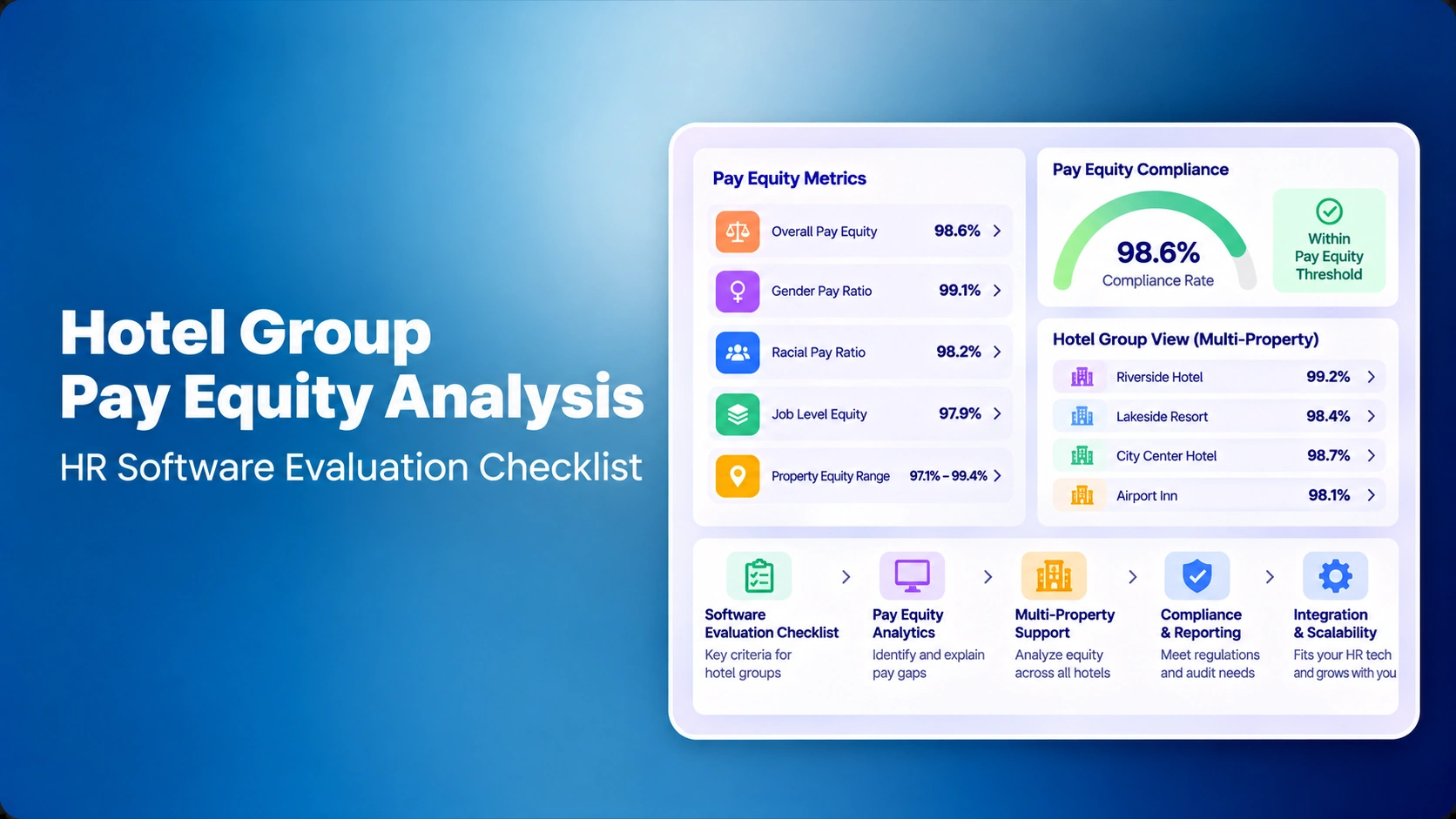





Hotel pay-band software should connect property-specific job definitions with validated market pricing, approved grades and salary ranges, effective dates, employee-impact review and permissions. Test two hotels with different service levels and one role whose responsibilities vary rather than watching generic band calculations.
A hotel operator cannot price every job from the same corporate salary table. Front desk, housekeeping, food and beverage, revenue management and property leadership differ in job scope and labor market. A useful hotel compensation platform lets HR compare relevant roles, manage bands by approved pay market, and review changes before a property acts on them.
For related guidance, see compensation management for hospitality.
Why hotel employee pay bands need property-specific review
Payscale's 2026 hospitality compensation materials report that 61% of hospitality organizations in its compensation-practices research identified balancing employee pay expectations and budgets as a major challenge. That is a survey-based observation about respondents, not a turnover-reduction claim or a prescribed hotel salary-band percentage. Guest services, housekeeping, food and beverage, revenue management and lodging leadership have different responsibilities and compensation components. Compare actual job scope before accepting a market benchmark.
For public labor-market context, the U.S. Bureau of Labor Statistics' accommodation-sector data distinguishes hotel desk clerks, housekeeping workers and lodging managers in its 2025 occupational series. These broader occupational statistics are useful for orientation, but they do not automatically represent the approved job family, property service level or recruiting market for a particular employee. Licensed survey job descriptions and internal evaluation records still require validation.
Four compensation platform checks for hotel HR buyers
Ask each vendor to demonstrate these controls using two fictional hotel properties, not just a generic corporate salary table. The system should distinguish a locally recruited guest-services job from a multi-property leadership role; allow survey and pay-zone decisions to be reviewed; preserve earlier range versions; and show which actions property managers can propose but cannot authorize.
Do job records capture the hotel service model?
A front-office manager at a limited-service property may have different responsibilities from a manager at a full-service convention hotel. Begin with job architecture and a consistent job evaluation process. Do not treat department labels or title matches as adequate evidence of scope.
Vendor test: Can HR review housekeeping manager, night auditor and front-office manager duties before accepting proposed grades?
Are peer pay comparisons appropriate for each property?
Compare the survey job, property type, geographic market, source date and pay component. The market benchmarking platform must allow analyst validation; the salary survey matching guide explains why a weak match requires caution. Ask what happens when the market sample is thin.
Vendor test: Does the tool disclose a poor match rather than inventing a precise median for an unsupported role?
Can approved ranges change without losing history?
HR should be able to compare current and proposed minimums, midpoints and maximums across chosen pay zones, inspect employee positions, and preserve effective dates. Link the review to salary structure management and range version control. A changed survey number is not automatic authorization to update every property.
Vendor test: Does the system record who approved the new range, when and which version it replaces?
Can property leaders see the implications before acting?
Property HR and Finance may review the same proposed action at different stages. Look for budgeted compensation planning and reported changes rather than a simple exportable salary table. Managers should not receive sensitive records for unrelated properties.
Vendor test: Can a manager request an above-range starting salary and see the authorized approval path?
What employee and property data must hotel pay-band software maintain?
Start with each property’s approved operating model, role descriptions and recruiting markets. A select-service front desk lead may cover guest check-in, reservations and night audit under a manager’s guidance; a full-service guest-services manager may direct multiple teams, escalation procedures and personnel decisions. A similar title does not establish the same grade, and service level alone is not a grading factor without evidence of different responsibilities.
Require a governed job record with hotel and employing-entity IDs, job family, approved level, relevant duties, reporting line, supervisory authority, employment basis, pay frequency, FTE or hours assumption, base pay, pay elements and effective dates. Keep local titles separate from enterprise job codes where the underlying duties are equivalent. A job grade and job level comparison can support consistent classification before a geographic pay decision.
Test a renamed role, an employee transfer between properties and a promotion. The vendor should preserve previous job and salary-range assignments rather than rewriting the history used for an earlier pay decision. Restrict property managers to permitted employee records while central HR and Finance retain their appropriate cross-property views.
Should each hotel property have its own salary band?
No single structure design fits every hotel group. Properties may share approved enterprise grades and geographic pay zones when job duties and relevant labor markets are comparable. A different location, service mix, staffing demand or collectively bargained arrangement may call for a separate range or policy, but it does not automatically require another grade. Conversely, roles with materially different recurring authority should be evaluated before the employer assumes one job-level match.
Use role-based market benchmarking with a documented survey year, comparator duties, geographic cut, pay component and source rights. The salary survey matching guide explains why title-only matches and thin samples should be challenged. Record whether a value is an approved benchmark, a provisional estimate or an unreviewed calculation. Do not automatically apply a national median to all front desks or let an emergency hiring premium redefine every salary band.
How should HR review range changes and employee impact?
A valid salary band record includes an approved minimum, midpoint and maximum, the job grade or pay zone to which it applies, the effective date and the approving authority. Preserve the old structure and identify employees who would become below minimum, above maximum or differently positioned after an update. The range version-control guide covers the historical decision requirement; a refreshed market number should not overwrite the prior approved band.
Two useful calculations: compa-ratio is current base pay divided by the relevant range midpoint. Range penetration is (base pay − range minimum) ÷ (range maximum − range minimum). The first compares the employee with the midpoint; the second shows position within the published range. Both must use compatible hourly or annual units and the correct version of the range. Neither calculation automatically determines whether someone is entitled to an increase.
What role should property managers, HR and Finance play?
Property leadership should submit a documented role or compensation request and receive only the employee context permitted by policy. Central HR validates job scope, survey matches, salary-band versions, equity and exception rules. Finance reviews current-year and recurring costs by property and employing entity. An authorized approver approves or returns the request, and the HRIS/payroll owner separately confirms execution.
Use a property-manager scenario that exceeds the current band. The platform should show the reason for the exception, competing proposed and approved amounts, effective date, whether funding is available and who has authority to finalize the pay decision. For example, a $1,000 annualized adjustment effective with exactly half a year remaining represents roughly $500 of in-year base salary, assuming a full-time salaried employee and excluding related employer costs. The annualized and actual-year amounts belong in separate Finance fields.
How should hotels separate base pay from tips and payroll rules?
Do not treat tips, service charges, overtime, shift premiums, bonuses and base wages as interchangeable components. A salary-band planning system can maintain a base-pay structure, but that does not make it a tipped-employee compliance tool or a payroll engine. The U.S. Department of Labor's Fact Sheet 15 describes federal rules for tipped employees and distinguishes tips from compulsory service charges. Some jurisdictions impose additional wage-and-hour obligations.
Ask whether employees are compared on an hourly-base or annual-base basis, which components are included in any total-compensation analysis, and how the proposed band relates to their legal pay treatment. Confirm the relevant payroll, tax, overtime and tip-credit rules with qualified personnel; a range approval cannot establish statutory compliance. A full-service hotel's variable service charges may require separate reporting even when its base salary ranges share an enterprise structure with another property.
Vendor Demonstration Scorecard
Use the following evidence-based checklist with each shortlisted vendor. The warning signs identify missing proof, not verified product failures. Record an observed result and its configuration requirements rather than assigning subjective numeric ratings.
| Evaluation | Proof to request | Warning sign |
|---|---|---|
| Role definition | Hotel service model and duties | Title-only job match |
| Market fit | Pay market, survey year and job coverage | One reference for every property |
| Range history | Approved version, proposed change and date | Previous range overwritten |
| Governance | Employee impact, budget and approver | Property manager can bypass review |
How should the hotel software demonstration be scored?
Use an institution-defined 0–2-point scoring method for each of the four vendor controls. Award 2 when the vendor completes the test with saved, retrievable evidence, 1 when additional configuration or a documented manual control is required, and 0 when it cannot be demonstrated. Maximum score: 8 points. Record the result, reviewer, remaining implementation work and whether the capability is native, configured, integrated or manual.
Mandatory gates: approved role and geographic-market definitions, recoverable prior salary bands, property-scoped access, authorization history and separation of approved range changes from employee payroll execution. A high numeric score cannot compensate for a property manager accessing unrelated pay records or silently replacing an active range.
Worked hotel scenario: compare two properties and one proposed band change
Use a fictional select-service hotel and a full-service city hotel with a guest-services coordinator role. For this first comparison, assume HR has confirmed substantially comparable recurring duties and the same enterprise grade; the differing ranges reflect hypothetical documented labor markets. A separate full-service guest-services manager with real supervisory authority would require its own job evaluation, not an automatic coordinator match. All figures are instructional, not real salary survey rates.
| Scenario field | Select-service hotel A | Full-service hotel B | Buyer check |
|---|---|---|---|
| Guest-services job | Coordinator, no staff supervision | Coordinator with comparable approved duties | Use the same grade only where job evaluation supports the match |
| Illustrative annual base band | $38,000 minimum / $44,000 midpoint / $50,000 maximum | $44,000 minimum / $51,000 midpoint / $58,000 maximum | Different illustrative market ranges; not actual survey observations |
| Illustrative employee base pay | $43,000 annually | $45,000 annually | Same pay basis and correct employee effective date |
| Compa-ratio | 97.73% ($43,000 ÷ $44,000) | 88.24% ($45,000 ÷ $51,000) | Compares each employee with their own active midpoint |
| Range penetration | 41.67% ($5,000 ÷ $12,000) | 7.14% ($1,000 ÷ $14,000) | Shows position between that range's minimum and maximum |
Now suppose Hotel B proposes to move its range to a $46,000 minimum, $53,000 midpoint and $60,000 maximum, without changing employee base pay. The illustrative $45,000 incumbent would become $1,000 below the proposed minimum. That identifies a possible policy or budget review, not an automatic $1,000 payroll increase. HR and Finance should validate the effective date, employee eligibility, other employees affected and whether the new structure itself has been approved.
- Validate the job family and level. Show approved position descriptions for both coordinators and the separate full-service manager. Challenge a title-based match using job grade and job level evidence; the manager's broader authority cannot be explained only by a different pay zone.
- Inspect and qualify market inputs. Ask the vendor to identify each survey comparator, geography, pay component, source date and rights to the imported data. Reject a weak match under benchmarking quality criteria and preserve the analyst's reason. Never present the fictional salary figures as observed market benchmarks.
- Model the range change and employee impact. Compare old and proposed minimums, midpoints and maximums, and review affected employees using compensation analytics. Check each employee's correct range version, compa-ratio, penetration and any below-minimum flags. Model the $1,000 possible correction separately from approval of the band.
- Return a property exception for authorization. Have the hotel manager request an above-range offer while another request proposes the minimum correction. Route both through approval controls, showing permitted manager access, HR and Finance review, recorded rationale, prior versions, approver, effective date and any separate payroll handoff.
Pass criterion: a different compensation analyst can reconstruct the internal job match, external data decision, old and proposed hotel ranges, employee impact, approved exceptions and what was actually implemented. Record any manual or integration-dependent step rather than assuming that every vendor delivers it natively.
Evaluate This Workflow With CompBldr
Bring representative employee and manager scenarios and ask the team to demonstrate the relevant controls.
Book a DemoSurvey permissions: an externally published compensation data methodology is not a license to import, reproduce or export proprietary observations. Confirm provider contracts and whether the software can display the approved geographic cut without exposing unauthorized data.
Historical integrity: preserve not only the current midpoint but also the prior job match, survey year, approved range, employee pay and reviewer decision. A single overwritten dashboard cannot explain last year's starting offer or promotion.
Role and data security: test whether property managers can see only employees they are allowed to review, whether central HR can manage cross-property structures, and how Finance receives cost scenarios. Verify import errors, data retention, HRIS and payroll ownership and the precise contracted integration rather than assuming a generic API connection is ready to use.
What implementation and compliance risks should hotel buyers verify?
Salary-band design software does not necessarily manage tipped wages, payroll, scheduling or overtime. The US Department of Labor's hotel wage guidance addresses separate statutory duties; any legal requirements should be reviewed with qualified advisers. Avoid describing range calculations as a compliance guarantee.
Request a written description of required data fields, user roles, supported imports or integrations, reviewer permissions and what happens when a file fails validation. Repeat one unfavorable test with each vendor; a purchasing decision should not rest on a perfect-path presentation. Include HR, Finance and the future system administrator in the evaluation.
Where CompBldr fits into hotel salary-band planning
CompBldr's published market benchmarking documentation describes job-architecture-linked matching, geographically segmented percentile analysis, reviewer overrides and versioned benchmark packages. Its compensation planning page documents employee range-position context, budget guardrails and approval history. Together with job records, salary structures and reporting, these are relevant evaluation points for hotel groups. Verify the exact property configuration, modules, survey licenses, permissions and approved integrations in the proposed contract; product-page descriptions do not guarantee a customer-specific setup.
Sources and methodology (reviewed November 14, 2026): Payscale's 2026 hospitality compensation survey provides sector respondent context; BLS's 2025 accommodation-sector occupational statistics provide broader labor-market context. U.S. Department of Labor guidance addresses separate tipped-employee payroll obligations. CompBldr's public benchmarking and planning pages describe product features to validate in a demo. All hotel salary bands, employee pay figures, range calculations, $1,000 possible correction and eight-point vendor scorecard in this article are fictional buyer-test examples, not confirmed local market rates or legal recommendations. Local policy, actual survey licenses and statutory compliance require authorized review.
What should hotel HR verify before choosing compensation software?
Agree on a small test dataset, confirm who owns each compensation decision and require the same demonstration from every shortlisted provider. Prioritize observed records, reproducible calculations and actual approval actions over a vendor's feature list. Keep the product claims, commercial scope and implementation assumptions written down for the final procurement review.
Discuss Your Compensation Software Requirements
Use a specific industry pay decision to evaluate CompBldr's job, market, range, approval and reporting capabilities.
Book a Demo