


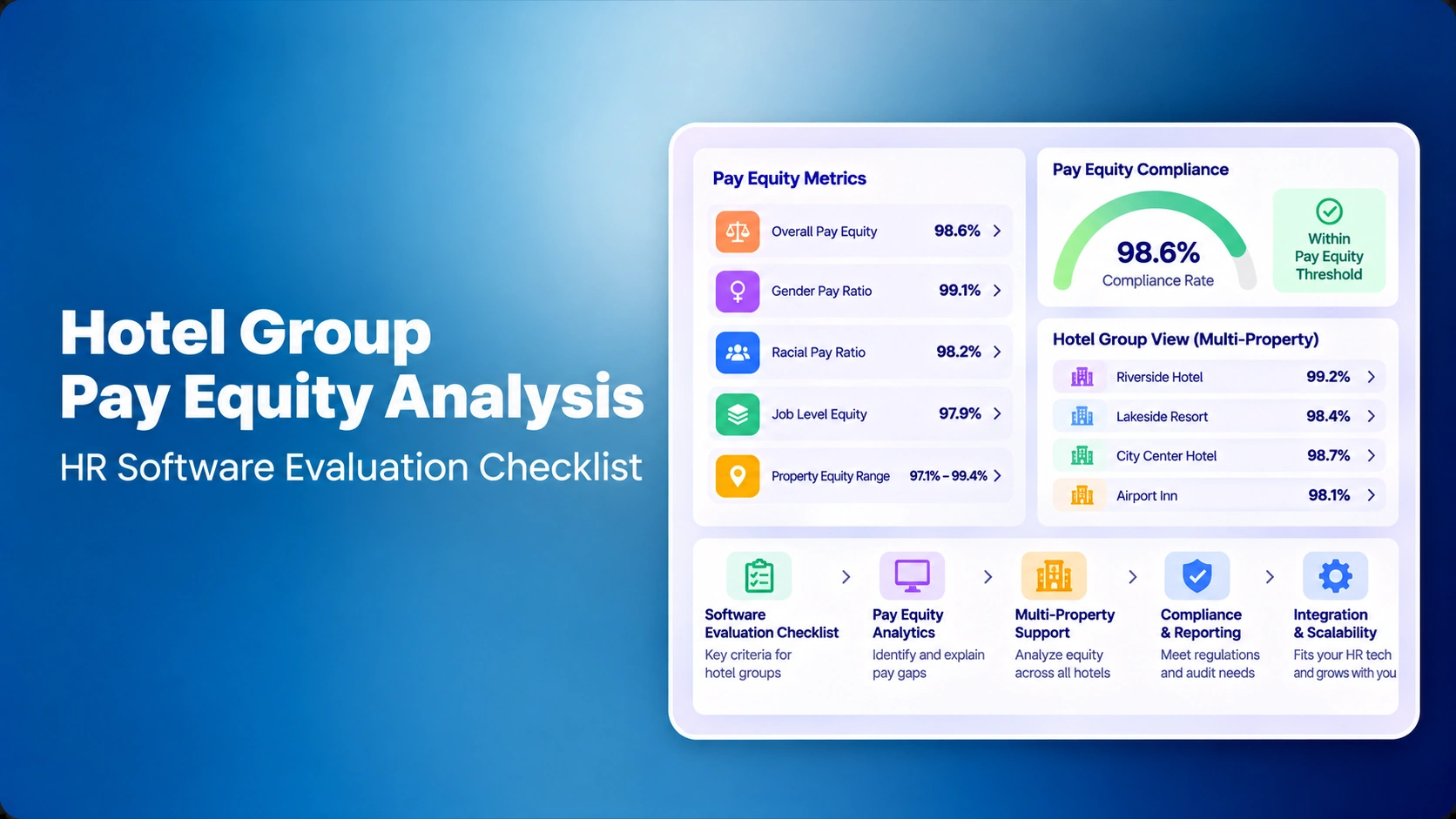

Choose software that reconciles employee data, defines legitimate job comparison cohorts, records analytic assumptions, limits access to sensitive findings and supports authorized remediation scenarios. A system should flag questions for review, not deliver an automatic legal verdict.
Hotel groups cannot interpret salary differences across properties without knowing whether job duties, pay components and local labor markets are comparable. An attractive pay gap dashboard may overstate a problem when one manager has multi-property responsibility or miss a concern when job codes are wrong. A software evaluation must start with validated comparison groups and controlled human review.
Why hotel groups need a distinct pay-equity review
Hotel organizations combine frontline hourly roles, tipped jobs, property management and regional leadership in a workforce that can span many locations. The U.S. Bureau of Labor Statistics' accommodation industry data reports separate occupational wage series for hotel desk clerks, housekeeping workers and lodging managers. Those distinct occupational populations show why comparing salaries by hotel employer name or department alone is inadequate; the BLS figures are labor-market context, not an employer-specific pay-equity test.
The U.S. Equal Employment Opportunity Commission (EEOC) emphasizes that actual job content, rather than job titles, matters for Equal Pay Act comparisons. Its broader discrimination guidance also explains why the relevant legal scope depends on the law and facts. Hotel HR should use the company's approved classification evidence and seek qualified review before concluding that a statistical gap is lawful or unlawful.
What hotel employee data should be validated before analysis?
Build a consistent employee extract for each property before using any compensation dashboard. Capture hotel or cost-center ID, management company and employing entity, primary job and assigned grade, property type, FTE or worked hours, base-pay basis, applicable shift and service-charge components, hire and promotion dates, performance or experience measures where appropriate, and every effective date. A regional manager recorded under one property's payroll code should not be treated as a comparable single-property supervisor.
Show missing and conflicting records rather than silently excluding them. In a demonstration, deliberately introduce a duplicate employee, an incorrect property identifier, a promoted employee with an outdated grade and a night-shift differential merged into base wages. Ask the vendor to identify these issues and retain the corrected values and original source evidence. Only staff with appropriate permissions should view sensitive employee-level findings.
Is the underlying hotel data comparable?
A property may report a salary for a corporate role under a local job code, while another uses a general manager label. Begin with data reconciliation and the governed job catalog. Ask the platform to show exclusions and missing values, not silently drop hard cases. Accurate compensation analysis is impossible when a stale job or pay record defines the cohort.
Vendor test: Can an auditor identify which cases were corrected, excluded or still unresolved?
How should hotel groups form defensible pay comparison cohorts?
Start with the actual job: a front-office manager at a select-service hotel, a full-service property operations manager and a regional operations manager may share similar working titles but hold different levels of supervisory, budget and multi-property authority. Compare essential duties, required skill, effort, responsibility and working conditions before defining legal or analytic comparison groups. EEOC compensation-discrimination guidance advises looking beyond department and title labels to the work performed.
For an operational screen, begin with consistent jobs and pay components within a property, then evaluate cross-property patterns as a separate diagnostic. Do not permanently exclude a protected group, atypical property or employee with incomplete data merely because it changes the result; disclose exclusions, resolve missing information where possible, and let qualified analysts decide the legally appropriate comparison population.
Does the product understand scope before grouping employees?
A single-property supervisor and a regional manager can share a misleading title. Use documented scope and grade-level distinctions to define meaningful comparisons. The system must support analyst review instead of assigning peers solely from title matching.
Vendor test: Can an authorized user revise cohort membership with a visible reason?
Can property location legitimately explain a hotel pay gap?
Local labor markets, property size, union rules, service complexity, shift coverage and job duties can affect compensation. An external salary survey or location-based range can help explain a pay policy, but the existence of a market premium does not by itself establish a lawful reason for an observed protected-group difference. Require HR to document the role match, recruiting geography, survey vintage, approved salary-range version and any location adjustment. Then ask legal or qualified statistical reviewers which variables belong in the actual pay-equity analysis.
Legal scope matters: the Equal Pay Act generally compares substantially equal work within an establishment, subject to specific circumstances in which multiple locations may be treated together. Title VII and other applicable discrimination laws can involve broader comparisons. Never make the vendor's convenient property filter the sole basis for a legal conclusion. State laws and contractual obligations may impose additional requirements.
Are location and market differences treated appropriately?
Hotel service levels and labor markets vary, but relevant market evidence is not a substitute for legal analysis. Review external market matches and approved salary bands to understand pay policy, then ask what statistical or legal review is required. The vendor should not declare that a market differential automatically explains any protected-group gap.
Vendor test: Can the reviewer show how assumptions affect findings, while avoiding unsupported conclusions?
How should hotel HR distinguish a pay flag from an equity finding?
A dashboard can display a raw or unadjusted pay gap, a narrow compensation-range outlier or a pattern worth investigating. None of these alone proves discrimination, and a flat average cannot establish that employees perform comparable work. A formal adjusted analysis may need qualified analysts to select appropriate comparison groups, compensation components, explanatory variables and statistical methods, with careful attention to sample size and omitted information. Software buyers should request a documented methodology, not presume the platform has delivered a defensible regression or legal audit.
Separate three records: the initial signal; the qualified investigation and explanation; and the authorized salary or policy decision. The system should show whether an alert was closed after review, escalated for formal analysis, or referred for an adjustment. Role-based permission boundaries and the organization's counsel-approved procedures should govern who sees protected information, investigation notes and potentially privileged material.
Can HR plan approved actions without exposing investigations?
A dashboard flag may lead to no change, further inquiry or a funded adjustment. Compare the restricted analytics view with controlled remediation budgeting. Our remediation planning guide explains why prioritization and decision ownership matter.
Vendor test: Can reviewers retain both a case closed with no action and one referred for a budgeted correction?
Which hotel pay components should the software compare?
Hotel payroll mixes hourly rates, annual salaries, overtime, shift premiums, tips or service charges, variable incentives and bonuses. Compensation teams should not mix these into a single unexplained “pay” field. A peer comparison can start with consistently defined base pay, while total compensation analysis requires all relevant compensation elements under the selected methodology and applicable law. The Equal Pay Act covers many forms of compensation, not just base salary, so excluding bonuses or benefits from every analysis would also be misleading.
| Hotel pay input | Comparable-basis check | Common source error | Requested vendor evidence |
|---|---|---|---|
| Base hourly wage | Same hourly component and effective date | Annual earnings treated as an hourly rate | Pay code, pay basis, source date and FTE or hours convention |
| Annual base salary | Same annualization policy and job scope | Part-time pay compared with full-time rate | Actual FTE, employment status and salary history |
| Shift, service charge or tips | Separate records before selecting total-pay definition | Shift differential merged into base wages | Component codes, treatment and inclusion rationale |
| Bonus and other compensation | Include when required by the selected analysis | Variable incentives omitted or double-counted | Plan rules, pay period and analyst-approved methodology |
A platform should display any annualization formula and the original components used. The appropriate comparison is defined by the employer's actual pay practices and the analyst's approved legal/statistical methodology—not by a universal software default.
Vendor Demonstration Scorecard
Use the following evidence-based checklist with each shortlisted vendor. The warning signs identify missing proof, not verified product failures. Record an observed result and its configuration requirements rather than assigning subjective numeric ratings.
| Evaluation | Proof to request | Warning sign |
|---|---|---|
| Data quality | Current job, salary, property and effective dates | Unexplained exclusions |
| Comparator groups | Scope, grade and analyst assumptions | Title-only grouping |
| Access | Role-based analysis permissions | All managers see sensitive findings |
| Action review | Cost scenario and authorized decision | Automatic pay adjustment |
How should HR score the vendor's review controls?
Score the four matrix criteria from 0 to 2: 2 for a complete demonstration with saved supporting records, 1 for a documented workaround or additional configuration, and 0 when the vendor cannot demonstrate the required control. Maximum score: 8 points. Record reviewer evidence, any external analysis requirements, and an implementation owner. This is an illustrative buyer scorecard, not an independent ranking of compensation platforms.
Mandatory gates: no automatic legal discrimination verdict; appropriately restricted access to sensitive case data; a recorded comparator-selection rationale; recoverable original and approved values; and separation of review findings from payroll execution. A high total cannot compensate for unrestricted sharing or an unexplained automated pay change.
Worked hotel group scenario: compare two Operations Manager roles
Use a fictional hotel operator with one Operations Manager assigned to a single full-service property and another responsible for three hotels and their managers. The single-property employee earns an illustrative annual base salary of $74,000; the multi-property role earns $80,000. The raw $6,000 difference equals 7.5% of $80,000. That arithmetic does not establish a pay-equity gap because the jobs may not be substantially comparable. Give all software finalists the same anonymized information.
- Validate employee and property records. Insert an incorrect property code, an outdated promotion date and a duplicate payroll record. Confirm how the vendor flags or corrects these errors through compensation-data reconciliation, while retaining original values and permission history.
- Compare role scope before drawing conclusions. Show which manager has delegated authority over a single hotel versus multiple properties, direct reports, budgets and operational accountability. Test the review against documented job evaluation criteria. The tool must not infer job equivalence from the shared title.
- Model—but do not automatically execute—a remedy. Suppose qualified reviewers identify a separate eligible group of four hourly employees for a hypothetical $1.25/hour adjustment. At 2,080 paid hours each, the annualized base-pay cost is $10,400, before taxes, benefits and actual-hours corrections. Require HR and Finance approval controls, an effective date, rationale and a pending implementation status.
- Restrict access and preserve the decision record. Have an unauthorized department manager attempt to open confidential investigation notes. Then demonstrate a redacted leadership summary, reviewer actions, version history, approved cost and later payroll reconciliation, consistent with controlled pay-equity reporting. The final report should distinguish raw flags, referred cases, approved remedies and executed changes.
Pass criterion: another authorized reviewer can reconstruct the comparison population, data corrections, analytical assumptions and approved actions without treating the raw $6,000 difference or the hypothetical adjustment as a finding of discrimination. If formal statistical or legal evaluation is required, the vendor must show the agreed handoff rather than claiming an unsupported in-platform legal audit.
Evaluate This Workflow With CompBldr
Bring representative employee and manager scenarios and ask the team to demonstrate the relevant controls.
Book a DemoHow should hotel groups cost and approve pay-equity remediation?
Keep the independent review and compensation execution processes connected but distinct. HR or counsel may determine that additional investigation is required, no adjustment is justified, or some employees warrant a reviewed correction. Finance needs a cost scenario showing the eligible employee population, wage or salary changes, effective dates, annualized run rate and the fiscal-year cash impact. Use actual expected hours and employer costs rather than a blanket 2,080-hour assumption for all part-time hotel workers.
For the fictional four-employee case above, $10,400 is a full-year base-pay estimate. If all four employees instead work 1,600 paid hours each, the corresponding simple annual cost is $8,000. Neither number prescribes the legally appropriate remedy. Payroll and the institution's authorized reviewers must validate each adjustment and the final employee record. The remediation planning guide covers how to prioritize and document those decisions.
What permissions should a hotel group require?
Separate a hotel general manager's routine compensation planning access from restricted pay-equity investigations, identifiable demographic records and legal-review notes. Test whether corporate HR can analyze broader groups, property leadership receives only approved action instructions, Finance can see cost scenarios without unnecessary protected data, and designated executives receive appropriately aggregated summaries. Confirm whether small-cohort reporting might inadvertently identify individual employees and how disclosure is controlled.
Ask about data retention, audit log export, administrator access, data processing agreements, integration encryption and whether employees can be removed from inappropriate comparison groups only with a recorded reason. Security and privilege requirements are organization-specific and may depend on counsel's instructions; never assume a generic “manager” role should see all findings.
Which pay-equity analysis and implementation limits must buyers verify?
This content is general software-selection guidance, not legal advice. Pay equity and discrimination analyses depend on applicable laws, defensible methods, protected information handling and expert review. No platform can guarantee compliance or replace legal judgment.
Request a written description of required data fields, user roles, supported imports or integrations, reviewer permissions and what happens when a file fails validation. Repeat one unfavorable test with each vendor; a purchasing decision should not rest on a perfect-path presentation. Include HR, Finance and the future system administrator in the evaluation.
Where CompBldr fits into hotel group pay-equity workflows
CompBldr's pay-equity software page describes compensation review in the context of governed job, grade, salary range and market records, followed by planning, approvals and versioned reporting. Its documented use cases include range adherence, outlier and pay-position review, with human interpretation of results. Formal statistical analysis, audit opinions and legal discrimination determinations are explicitly separate qualified-review activities. Buyers should verify the actual analytics, permissions, imported data, approved-action handoffs and contracted integration configuration before purchase.
Sources and methodology (reviewed November 14, 2026): EEOC guidance supplies the legal distinction between job-content comparability and different discrimination statutes. BLS accommodation-sector occupational data provide external labor-market context, not hotel-specific equity findings. CompBldr's published pay-equity product page documents its governed review and approval functions, not formal statistical or legal audit capabilities. All hotel roles, $74,000/$80,000 pay figures, 7.5% raw comparison, $1.25 hourly remediation costs and the eight-point scorecard are illustrative exercises, not actual employer results or compliance conclusions. Consult qualified reviewers before using analysis to determine legal remedies.
What should hotel HR verify before selecting a pay-equity platform?
Agree on a small test dataset, confirm who owns each compensation decision and require the same demonstration from every shortlisted provider. Prioritize observed records, reproducible calculations and actual approval actions over a vendor's feature list. Keep the product claims, commercial scope and implementation assumptions written down for the final procurement review.
Discuss Your Compensation Software Requirements
Use a specific industry pay decision to evaluate CompBldr's job, market, range, approval and reporting capabilities.
Book a Demo