

.svg)





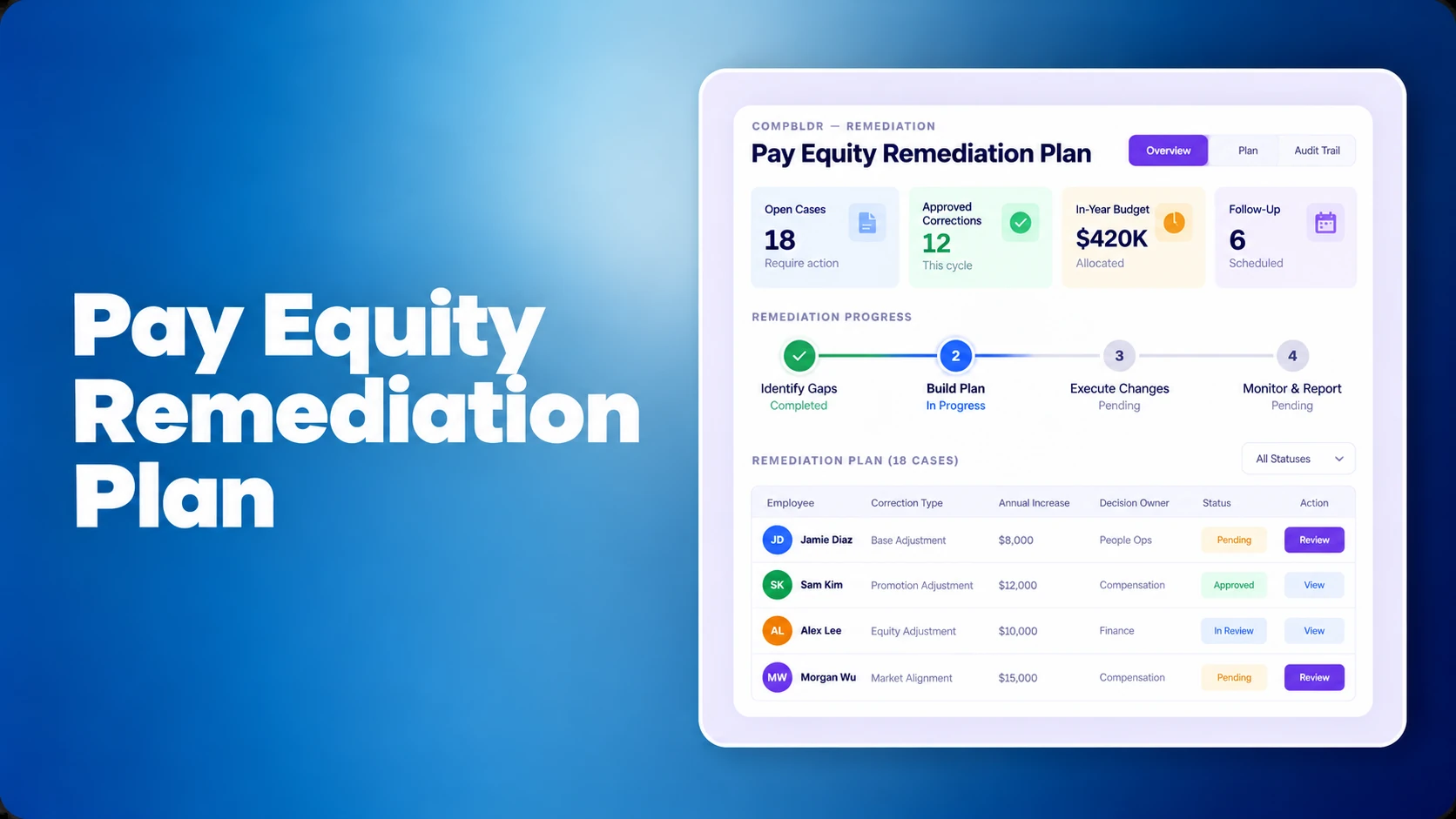

Four salaries have emerged from an annual pay equity review. Compensation has suggested new amounts. Finance only approved the general merit pool, and the CHRO wants to know which adjustments can wait. One case may also involve unlawful historical underpayment. Putting all four records into a single merit spreadsheet would conceal the most important distinction: a policy alignment choice and a legally required remedy are not the same decision.
A pay equity remediation plan specifies what happens after a finding has been examined: the employee or policy affected, evidence behind the response, proposed correction, funding source, approver, effective date, execution status, and follow-up review. Its quality is measured by decisions that can be reconstructed, not the number of red flags on a dashboard.
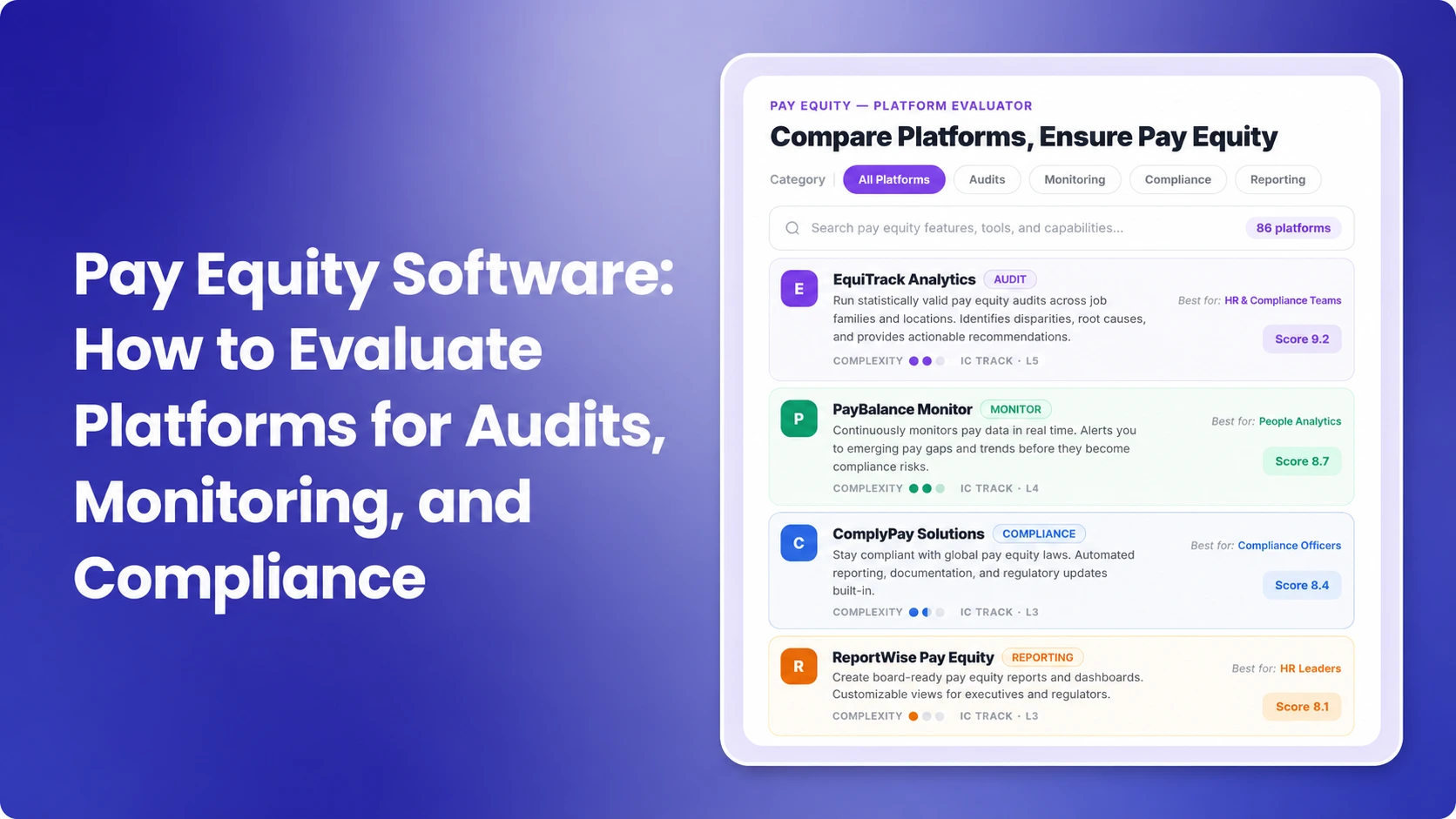
This begins where the existing pay equity audit process ends. That article owns audit methodology and initial findings. The separate pay equity software evaluation guide helps buyers select tools. Here the job is to translate appropriately reviewed findings into budgeted, authorized actions without confusing different legal and compensation questions.
What Belongs in a Pay Equity Remediation Plan?
A complete remediation plan has seven elements: validated finding, affected population, response classification, supported salary amount, cost model, accountable approver, and proof that the action was executed and re-tested. It should preserve the source-data date and distinguish an employee-level proposal from an employer-wide policy fix.
Do not multiply an unadjusted gap percentage by all employee salaries and call that a remediation budget. A raw group difference is not necessarily a substantiated individual pay disparity. The distinction between adjusted and unadjusted pay gaps matters, as does the underlying comparison methodology. Cases should be validated before pricing an employee's pay adjustment.
Step 1: Classify the Finding Before Assigning a Salary Amount
Sound pay equity remediation steps start with sorting findings by what is known. An apparent difference might stem from a wrong grade, stale employee data, a sufficiently supported pay distinction, a structural market problem, or evidence requiring specialist legal review. Each produces a different next action.
| Finding type | Next action | Cost treatment | Owner |
|---|---|---|---|
| Incorrect role or HRIS data | Correct record, then rerun analysis | No speculative salary adjustment | HRIS owner / Compensation |
| Unexplained difference | Investigate valid comparators and factors | Provisional model only; not a finalized remedy | Compensation / qualified analyst |
| Market or internal policy misalignment | Validate structure and authorized policy | Prospective adjustment if approved | Compensation / Finance |
| Potential or established unlawful disparity | Escalate for appropriate legal and leadership review | Calculate required relief separately, as determined by specialists | Legal / HR leadership |
Begin with actual responsibilities, not job title equality. Job Architecture supplies family and level definitions; Job Evaluation provides evidence for the grade; and job grades versus levels should be understood consistently before matching comparison groups. Correct bad source data before changing employee salaries.
The EEOC's equal-pay guidance explains that substantially equal jobs do not need identical titles. When unlawful pay discrimination is established, reducing higher-paid employees' compensation is not a valid way to equalize an unlawful wage differential. Legal remedies and timing should be determined by qualified counsel.
Step 2: Establish a Supportable Target for Each Case
A salary equity adjustment plan needs an individually supportable target, not one blanket increase for a group. Preserve current base salary, comparison population, grade and location, date of analysis, prior compensation actions, proposed target, and responsible approver. If new information changes an earlier recommendation, retain both versions.
- Use the correct salary range and effective date, including minimum, midpoint, and maximum.
- Check actual job value against job evaluation methodology, particularly where the assigned grade is disputed.
- Understand compa-ratio and range penetration as descriptive metrics, not legal equity tests.
- Review the organization's approved market pay evidence without assuming external rates excuse an internal pay concern.
- Identify prior merit, market, and COLA actions to prevent double counting.
- Refer unresolved statistical or legal questions to properly qualified reviewers and keep sensitive analysis restricted.
Two people assigned to the same grade can have different pay for legitimate documented reasons. Conversely, two differently titled jobs may involve substantially equal work. An analyst should be able to explain how those possibilities were evaluated before recording a proposed target.
Step 3: Calculate Proposed Salary Corrections With an Employee-Level Example
Consider a fictional four-person population in which qualified reviewers have completed the relevant internal examination and proposed the following prospective base changes. The table demonstrates cost arithmetic, not a lawful target-setting algorithm. Different facts or applicable legal duties may change each outcome.
| Employee | Current base | Reviewed proposed base | Annual increase | Illustrative reason |
|---|---|---|---|---|
| A | $78,000 | $82,000 | $4,000 | Policy alignment |
| B | $91,500 | $94,500 | $3,000 | Equity correction |
| C | $102,000 | $105,000 | $3,000 | Grade alignment |
| D | $87,000 | $89,000 | $2,000 | Policy alignment |
| Total | $358,500 | $370,500 | $12,000 | Four proposed increases |
Annual base cost increases by $12,000. That is the change in steady-state salary expense if all four changes are executed. It is not necessarily the employer's cash expense in the current year and it excludes employer taxes and benefits, any one-time payroll processing costs, and any potential historical underpayment or other legal remedies.
Before authorization, check the proposed new values for pay compression and unintended relationships with properly comparable employees. A raised base salary can affect future merit calculations and pay-position metrics. It should not automatically trigger unsupervised increases for everyone in the job family.
Step 4: Build a Pay Gap Remediation Budget in Separate Cost Lines
A sound pay gap remediation budget distinguishes the annualized pay run rate, current-fiscal-year cost, employer on-cost assumptions, possible historical relief, and any separate structural redesign. These cannot be merged into one unexplained total.
Suppose the four increases above become effective April 1 in a calendar-year budget, creating nine months of expense. Base salary cost during that year is $12,000 × 9 ÷ 12 = $9,000. Assume Finance applies a fictional 22% on-cost factor for payroll-related employer expense. That adds $1,980 for the remaining year. The 22% is strictly illustrative, not a published benchmark.
| Budget element | Calculation | Annualized | Current fiscal year |
|---|---|---|---|
| Base salary increases | Sum of four increases | $12,000 | $9,000 |
| Illustrative employer on-costs | 22% of base increase | $2,640 | $1,980 |
| Total prospective cost | Base plus modeled on-costs | $14,640 | $10,980 |
| Potential back pay, interest, benefits, other relief | Separate legal and Finance assessment | Excluded | Excluded |
| Wider range or grade restructuring | Separate approved program | Excluded | Excluded |
The $10,980 is only a prospective nine-month planning illustration. It cannot be presented as full relief for a case of unlawful historical underpayment. The EEOC's remedies guidance explains that relief may involve back pay, benefits and other items, depending on the case. Do not price those items through a generic salary percentage without appropriate specialist assessment.
Keep equity corrections identifiable even if approved changes are processed in the same period as the annual merit cycle. An annual merit budget is a performance-related allocation, not automatically the employer's allowance for correcting legally required underpayment. Separate approval paths, funding sources and reasons help HR and Finance reconcile both.
Turn Equity Findings Into Governed Compensation Decisions
Evaluate how CompBldr connects review evidence, salary recommendations, approval controls, and budget context.
Step 5: Prioritize Reviews Without Using Budget as a Legal Excuse
When leaders discuss prioritizing pay corrections, they often mix three different priorities: urgent legal assessment, decision-ready policy improvements, and incomplete cases needing investigation. Review resources can be triaged. Established legal obligations cannot simply be deferred because a discretionary pool is depleted.
| Lane | Trigger | Appropriate action | Timing principle |
|---|---|---|---|
| Urgent legal review | Potential discrimination or employee complaint | Obtain suitable legal and HR leadership response | Required relief is not postponed solely to fit budget |
| Approved policy alignment | Supported voluntary correction awaiting allocation | Authorize amount and effective date | Sequence under approved policy |
| Unresolved finding | Incomplete cohort or inconsistent employee record | Repair evidence, repeat analysis | Do not presume a pay remedy from a raw flag |
| Root cause prevention | Repeated hiring overrides or grade errors | Improve policy, structure, or approvals | Track as a separate prevention workstream |
Treat a provisional model differently from an approved pay action. An investigation may show no change is warranted, identify a different legitimate comparator, or require broader action. In the most consequential cases, Finance should escalate the funding decision instead of lowering the amount merely to make the figures fit.
Step 6: Give Every Adjustment a Decision Owner and Traceable Record
A case is more than an employee ID and an increase amount. Retain a restricted case reference, review population date, source inputs, methodology, rationale, current and approved salary, budget line, approving authority, effective date, and follow-up status. Appropriate legal review and privileged material should not be indiscriminately copied into a general manager-facing note.
| Action | Owner | Evidence to retain | When complete |
|---|---|---|---|
| Validate comparison | Qualified Compensation reviewer | Approved population, grade, analysis method | Finding classified |
| Determine legal response if applicable | Legal / authorized HR leadership | Applicable facts and requirements | Lawful response approved |
| Fund prospective action | Finance + Compensation | Annualized and in-year cost; assumptions | Budget authorization logged |
| Execute pay change | HR Operations / system owner | Final salary, effective date, transaction | HRIS or payroll value reconciled |
| Test for recurrence | Compensation governance owner | Follow-up date and findings | Issue closed or escalated |
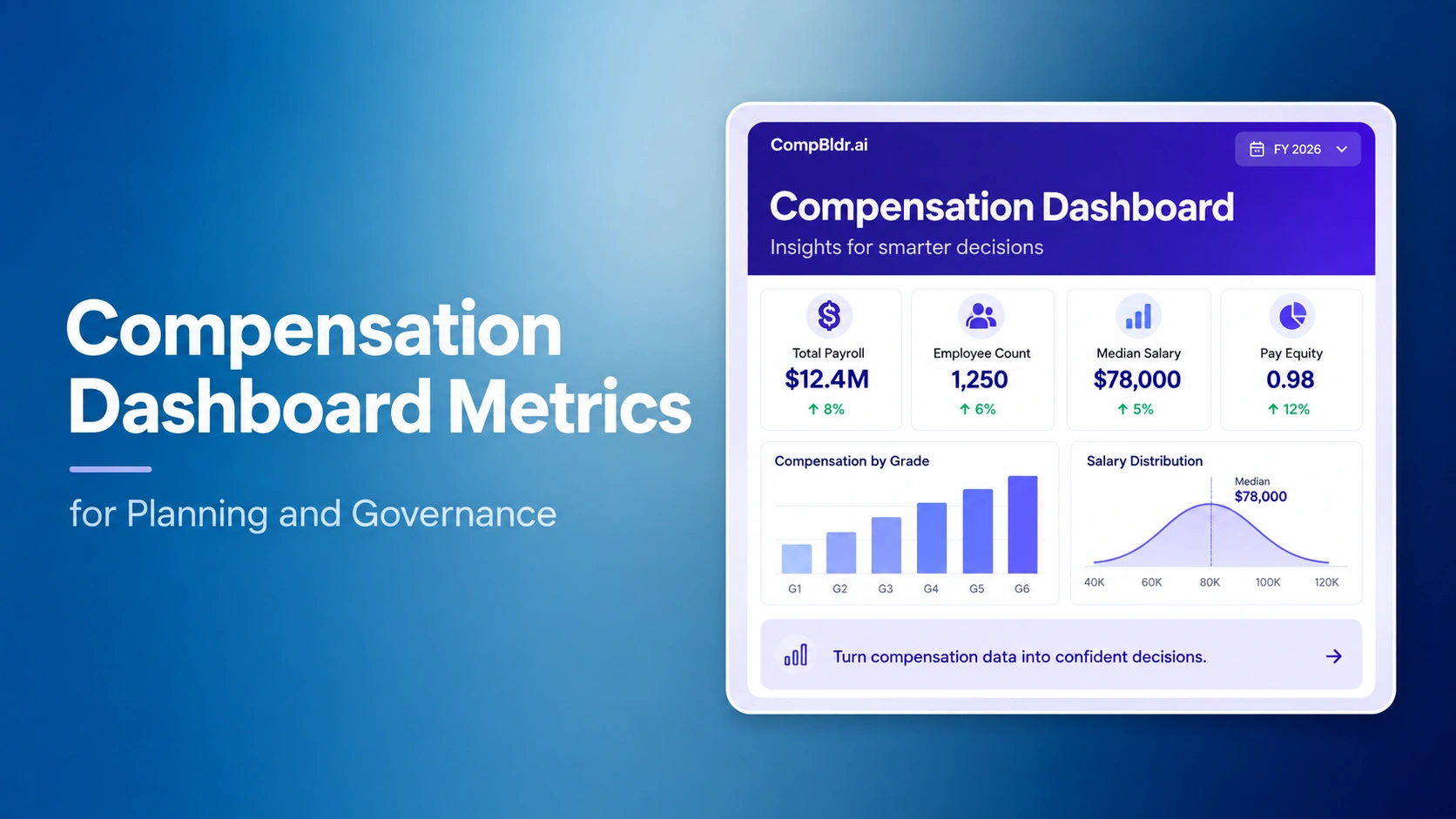
Use a governed compensation planning workflow to record proposed changes and approvals where the configuration supports it. The compensation governance guide describes decision ownership more broadly, and the dashboard metrics guide explains why status definitions matter. An “approved” field alone is not proof the employee was actually paid the new rate.
The EEOC's employer pay recommendations advise predetermined, consistently applied criteria and retaining appropriate records concerning raises, bonuses and other pay decisions. Record retention and confidentiality depend on applicable rules. A generic cloud audit trail should not be represented as automatically satisfying every obligation.
Step 7: Verify Payroll Execution and Recheck the Original Finding
After final approval, compare the authorized salary and effective date against the relevant HRIS or payroll record. An incomplete system integration can leave an increase approved in a planning tool but absent from the employee's actual pay. Preserve transaction references and a record of how exceptions were resolved.
- Reconcile approved salary, effective date and pay component to the executed record.
- Record whether the action was prospective, retroactive, or both, without using one number to stand for all relief.
- Rerun the appropriate pay analysis on updated data and record the population version.
- Monitor new offers, promotions and off-cycle changes, particularly where offer governance weaknesses created repeat exceptions.
- Use Compensation Reporting for reviewable outputs and Compensation Analytics for current decision context where configured.
Measure Closure, Not Just the Number of Adjustments Approved
The CHRO needs to know which issues were actually addressed and which need more work. A useful scorecard differentiates validated cases, recommended actions, approved adjustments, executed pay changes, unresolved urgent concerns and recurrence. These counts refer to different populations, so they should not be added together as if they represented independent cases.
| Metric | Definition | Owner and next decision |
|---|---|---|
| Actionable cases | Cases reviewed and classified for response | Compensation: prioritize review queue |
| Approved versus executed | Authorized changes matched to pay records | HR Operations: correct transaction failures |
| Cost by timing | Annualized run rate separated from partial-year cash cost | Finance: reconcile planned spending |
| Open high-risk cases | Matters requiring specialist escalation or required action | Authorized HR / Legal: escalate promptly |
| Repeat issue rate | New decisions exhibiting a previously addressed pattern | Compensation: address root cause |
For board reporting, connect this view to quarterly equity governance metrics, but retain the detail behind each case. A changed grade, new manager, or future merit proposal may create a new comparison scenario. The latest dashboard state should not overwrite the earlier decision record.
Stop the Same Problem Reappearing Next Quarter
A salary correction fixes an outcome; it may not fix its cause. If new hires repeatedly leapfrog established staff, review recruiter and offer approval rules. If a function repeatedly receives out-of-guideline merit increases, review the merit matrix. If grade inconsistencies keep appearing, investigate the evaluation method before rewriting salary bands.
In a smaller HR team, the owner may maintain a case log and a concise Finance approval record. A large employer may require multiple jurisdictions, access-controlled analyses, effective-dated grade history, separate compensation elements and legal oversight. The nonnegotiable feature is a traceable decision path, not a fixed number of sign-off steps.
Where CompBldr Fits Into Remediation Governance
CompBldr's Pay Equity Software supports compensation review and analysis in a governed environment. Compensation Planning supports configured salary recommendations, budgets, exception controls and approvals. Compensation Reporting can provide outputs for approved decisions, while TrAI offers AI-assisted review signals under human judgment.
Those product capabilities can support an employer's review and authorization process. They do not establish that the system calculates legal remedies, determines discrimination, or autonomously corrects pay. A useful buyer demonstration follows a fictional review finding to a supported salary adjustment, assigned budget, approval record, downstream execution check and follow-up report. Ask explicitly which steps are native, configurable, or external.
For broader system comparisons, see the pay equity software selection criteria. For current operational context, focus the demonstration on what a Compensation analyst and Finance approver can actually retrieve from the same case record.
References and Further Reading
- EEOC: Pay Tips: pay-decision criteria, documentation and recordkeeping.
- EEOC: Equal Pay / Compensation Discrimination: job comparability and correcting wage differences.
- EEOC: Remedies for Employment Discrimination: how possible relief extends beyond forward salary changes.
- CompBldr: Pay Equity Audit Process: how findings are identified and validated.
Review Your Pay Equity Remediation Workflow in CompBldr
Bring a fictional pay finding, a proposed correction budget, and your approval hierarchy. Explore how analysis, salary decisions, and follow-up reporting work together.
Book a DemoEditorial note: The example employees, salaries, reasons, cost rates, dates, and amounts are fictional. This article is general operational guidance, not legal, statistical, tax or accounting advice. Qualified counsel and specialists should determine legally required remedies and jurisdiction-specific duties.


.svg)

.svg)
.svg)

