


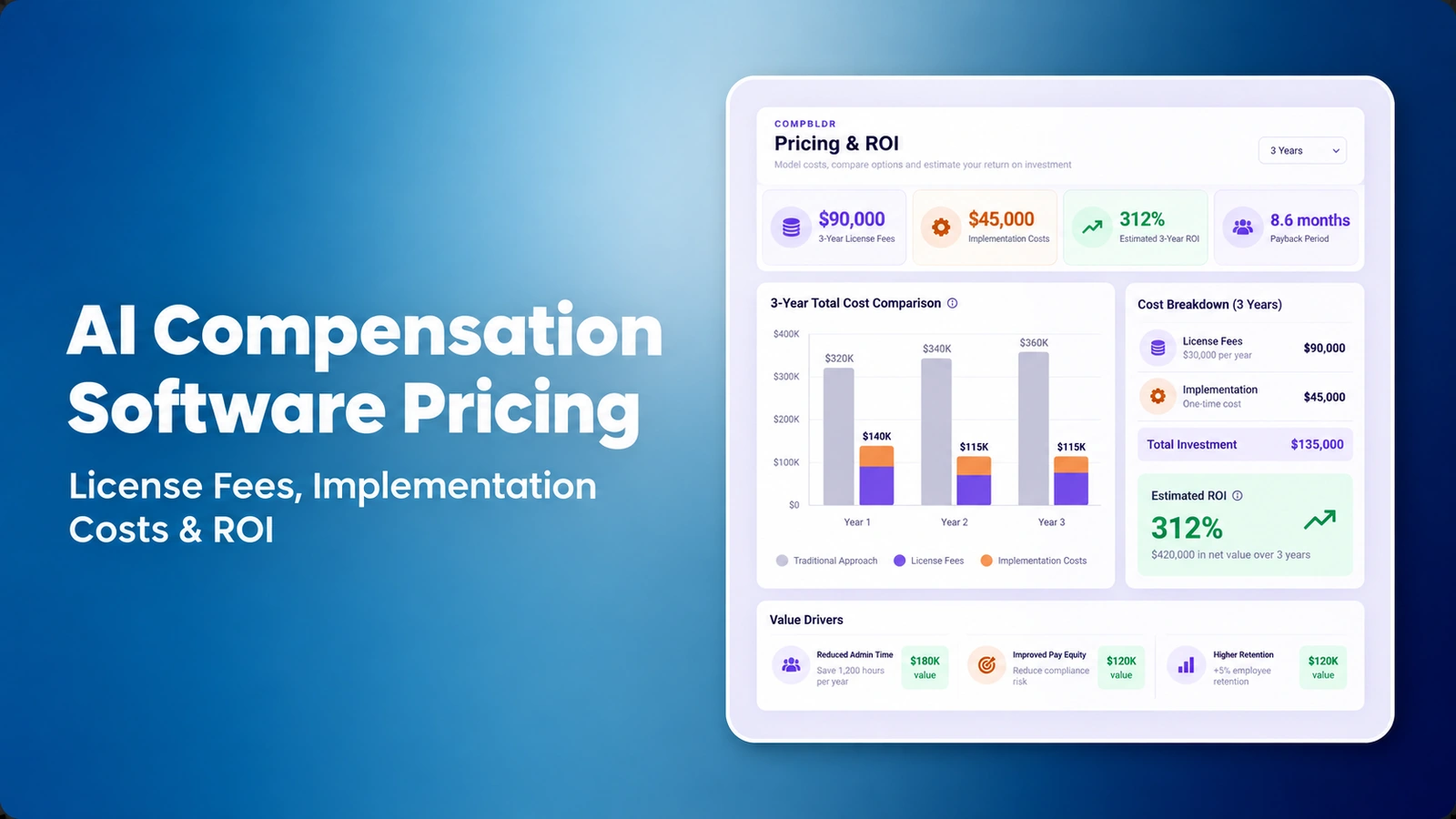

What does AI compensation software actually cost? There is no dependable universal per-employee price for a specialist compensation platform. The useful number for a US HR and Finance buyer is the three-year total cost of ownership, including licensed modules, employee or administrator counts, implementation, integrations, data rights, support and renewal changes. AI functions deserve their own scope and governance questions; a vendor's use of “AI” does not tell you what is included.
Consider two quotes. Vendor A advertises a low monthly price but excludes market-data licenses, data cleanup and a separate merit-planning module. Vendor B quotes more up front but includes the interfaces and approval workflow your team needs. The lower sticker price may not be the lower operating cost. Use CompBldr's configuration-based pricing page and the TrAI compensation intelligence overview to identify the product scope to verify; neither is a substitute for a signed commercial proposal.
How much does compensation management software cost in 2026?
Capterra's October 2026 pricing analysis reviewed five publicly priced products and identified an entry tier starting at $5 per employee per month, alongside base-plus-person and annual-plan pricing. That is a price observed in its particular sample, not a validated average for purpose-built job evaluation, salary structure, pay-equity or merit-planning software. Its comparison spans distinct HR, equity and commission products; buyers should not normalize those products as interchangeable compensation suites.
For the buyer, the first pricing question is not “How much per employee?” It is “Which employees, managers, analysts, countries, modules and data sources are included?” The answer determines whether a quote covers job evaluation, market benchmarking, compensation planning, total rewards statements, or only a narrower workflow. Enterprise platforms may use custom quotes instead of public price lists.
Which compensation software pricing model fits your workforce?
Every model can be reasonable for the right purchasing pattern. The problem is comparing different billing units as though they represented the same use case.
| Pricing model | What you pay for | Best buyer test |
|---|---|---|
| Per employee per month (PEPM) | Covered employees, often tied to a defined payroll or HRIS population | Ask whether inactive, seasonal, part-time and newly acquired employees count, and whether all modules are included. |
| Administrator or manager seats | Named users who configure plans, review pay or approve cycles | Map 20 decision-makers separately from 500 covered employees; verify viewer and audit-seat costs. |
| Base platform fee plus usage | A minimum annual or monthly charge, plus employee, seat or module fees | Request the minimum commitment, included population and price at each growth band. |
| Annual modular or enterprise agreement | Selected modules, regions, environments, support and services | Match module scope, term, renewal rules, implementation and exit rights across bids. |
Convert each written quote into an annual cost and an effective monthly cost per covered employee, but keep the underlying vendor billing unit beside the calculation. An effective PEPM is a comparison metric, not proof the vendor bills that way. If your organization expects acquisitions, confirm remeasurement dates and whether new entities trigger minimum fees.
What belongs in a three-year compensation software TCO?
Three-year TCO = all contracted recurring charges over 36 months + one-time deployment costs + expected data, integration, support and change expenses. It excludes forecasted benefits. Use year-by-year values rather than multiplying the first-year price by three when the contract includes a renewal uplift, ramp schedule or usage change.
Scope each line item explicitly. For subscriptions, list licensed modules and covered populations. For implementation, separate job and grade mapping, survey normalization, integration testing and manager training. A team that currently reconciles conflicting employee IDs across HRIS and payroll should budget the data-cleanup effort before expecting accurate compensation data reconciliation or reliable compensation analytics output. A salary-range import may also require effective-date and version controls that a basic CSV upload does not supply.
Ask who owns the rights to salary survey files, whether a market-data workflow accepts your licensed sources and what happens when a vendor contract ends. Survey fees paid to third parties are not automatically included in a software subscription. Job-to-survey matching can remain a separate recurring effort when data rights or matching rules prevent automated reuse.
Three-year TCO example: what does a $144,000 implementation really include?
The following fictional scenario represents one 500-employee organization evaluating one proposed scope. It is a calculator demonstration, not a CompBldr quote, a typical market price or a promised result. Assume no license uplift, headcount increase, separate survey subscription or change order. Add those if they apply to your actual contract.
| Cost item | Year 1 | Year 2 | Year 3 |
|---|---|---|---|
| Platform and modules | $36,000 | $36,000 | $36,000 |
| Implementation and configuration | $18,000 | $0 | $0 |
| Integration and initial testing | $6,000 | $0 | $0 |
| Recurring support | $4,000 | $4,000 | $4,000 |
| Total | $64,000 | $40,000 | $40,000 |
Three-year TCO = $64,000 + $40,000 + $40,000 = $144,000. At a constant 500 covered employees, the effective monthly equivalent is $144,000 / (500 × 36) = $8 per covered employee per month. That figure includes the one-time launch costs; it must not be confused with a vendor's monthly license price. If the covered population is actually 700 or if manager seats are separately charged, the denominator and commercial assumptions must change.
What implementation fees are easy to miss?
Start with the messy work between a demo and the first usable compensation cycle. Suppose HR owns eight job families but payroll uses inconsistent job codes. Someone must decide which record wins, how retroactive changes are treated and who signs off on exception handling. Buying software does not perform those governance decisions for you.
Ask for a statement of work that separates data extraction, cleansing, import validation, job architecture mapping, testing, payroll/HRIS integrations, production cutover and post-launch fixes. Clarify whether additional currencies, entities, data fields, business units or historical cycles are included. Also ask who creates the compensation budget workflow and whether audit-ready exports carry an extra fee.
Two costs are often missed in internal budgets: the time your own subject-matter experts spend on decisions and the cost of repeating a failed migration. Record internal staff effort as a project resource cost in the full business case, even when it is not a vendor invoice. Do not label a feature “included” until the contract defines the use case and acceptance test.
What should buyers verify when “AI” is included in the price?
AI-assisted analysis changes both the license question and the evidence requirement. Ask whether AI functions are included with an underlying module, separately licensed, metered by usage, available only in certain regions or subject to an external model provider's terms. A low-cost plan can become expensive when every analyst action, data connector or additional environment is metered.
CompBldr describes TrAI as a compensation-specific intelligence layer that reads governed job, grade, market and planning context, surfaces recommendations and retains human authorization. Those are product descriptions, not independent implementation testing. In a demonstration, require a reviewer to inspect the source data and rationale behind a flag, override it, and retrieve the recorded decision. Confirm whether this exact workflow is part of the quoted package.
For an AI module, request written answers on data retention and training use, authorized access, personal pay data, model change controls, explainability, human approval, audit logs, geographic processing and additional AI usage fees. A manager should be able to challenge a recommendation before it affects a pay action. Payscale's 2026 Compensation Best Practices Report identifies transparency and accuracy of AI output among the conditions compensation professionals associate with trust; that finding is a research observation, not evidence that any individual vendor meets a standard.
How should Finance calculate ROI without turning staff hours into cash?
Three-year net ROI (%) = [(validated three-year financial benefits − three-year TCO) ÷ three-year TCO] × 100. Count cash savings only if a contract, overtime cost or other budget line can actually be reduced. If software releases analyst time without reducing spend, describe it as capacity returned to the team, not automatic cash savings. Pay-equity confidence and clearer governance matter, but they cannot be converted into a guaranteed dollar return without a documented causal model.
Reuse the fictional $144,000 TCO above. The table below models two hypothetical annual hard-savings scenarios. They are not industry averages, customer case studies or a CompBldr ROI claim.
| Scenario | Verified annual cash savings assumption | 3-year cash benefit | 3-year net ROI |
|---|---|---|---|
| Conservative | $30,000/year from demonstrably retired outside services or direct expenses | $90,000 | −37.5% (($90,000 − $144,000) ÷ $144,000) |
| Higher verified benefit | $60,000/year from documented, removable expenses | $180,000 | +25% (($180,000 − $144,000) ÷ $144,000) |
| Capacity released, not cash | 400 hours/year of analyst time for other work (illustrative) | Not included in hard-cash ROI | Track hours and quality separately |
For each line, Finance should request the source invoice, baseline process or time log, an accountable owner, and the date when the saving becomes real. Do not count the same expense reduction twice under software consolidation and labor productivity. If benefits begin only after go-live in month nine, reduce year-one benefits accordingly. A downside case with delayed adoption is more valuable than a confident spreadsheet with unsupported retention savings.
Which pricing questions expose a misleadingly cheap software quote?
Ask every shortlisted vendor the same questions and retain the written answers with the cost model. Specific contract language is better than a checkbox on a feature page.
- Billing denominator: Are charges based on active employees, all HRIS records, administrator seats, managers, countries or data transactions?
- Module boundary: Which of evaluation, planning, reporting and pay-equity review are covered by this exact price?
- Market-data rights: Are survey licenses, vendor updates, exports and reuse of customer-owned survey files included?
- Implementation acceptance: Who fixes failed imports, wrong job mappings and rejected interfaces, and at what cost?
- AI entitlement: Is AI metered? Can the customer disable, review or override recommendations and retrieve audit evidence?
- Support and renewal: What is the included service level, the price-uplift formula and the next seat or entity threshold?
- Exit and portability: How will the organization retrieve employee, grade, job and approval-history data at termination, in what format and for what fee?
Keep feature-fit assessment in the separate compensation planning software buyer's checklist. This article is about the purchase economics and contractual scope, not ranking vendors by generic feature counts.
What can a CompBldr pricing conversation establish?
The CompBldr pricing page identifies configuration, selected modules and organization size as inputs to a tailored quote. It does not establish a universal CompBldr PEPM rate. Ask which foundation features, modules, employee populations, support levels and implementation services are included. Connect the cost line to a demonstrated workflow instead of assuming every capability shown on the website ships with every package.
A useful walkthrough begins with one real procurement problem. For example, show how an approved job record moves through job architecture, job evaluation, market context and compensation planning, then identify which stages are licensed in the proposed configuration. Ask how the reporting and audit trail and employee total rewards statements would be delivered. Where appropriate, test whether TrAI's flagged recommendations remain reviewable by the compensation team. Document anything that requires extra integration, advisory services or additional licensing.
What should the CHRO bring to a Finance approval meeting?
Bring a single page showing the business decision, not only the vendor presentation. Identify the current process, its documented cost, the proposed modules, 36-month cash commitments, in-house work required, and the conservative/likely/downside benefit cases. Separate project costs from recurring costs, and quantify any unresolved data migration risk. Compare the compensation leakage calculator with actual approved payroll records rather than presenting a marketing estimate as verified loss prevention.
For context, Payscale's 2026 research announcement reported that 51% of organizations it surveyed viewed balancing pay expectations with financial limits as a top challenge. That finding helps explain why cost discipline matters; it does not predict a specific company's software ROI. The approval package should clearly separate research, vendor claims, fictional calculations and your organization's validated data.
What are the important source and methodology limits?
Research checked October 31, 2026. Public-price context comes from Capterra's selected five-product October 2026 analysis, which mixes software categories and cannot establish a specialist-platform industry average. Compensation-team context comes from Payscale's 2026 report, based on 3,413 survey responses collected October–December 2025. The $144,000 TCO, the $8 effective PEPM and both ROI scenarios above are illustrations written for this article. They are not vendor quotes, market benchmarks or measured customer outcomes. Verify current pricing and the signed scope directly with each vendor.
Conclusion: choose a defensible three-year decision, not a cheap headline
Good compensation software procurement does not end when Finance agrees the subscription price. It ends when HR understands what will be delivered, who owns each data and approval handoff, which costs recur and what benefits can be independently measured. Normalize competing quotes to the same scope, insist on a demonstration with your process and keep unresolved charges visible before signing.