


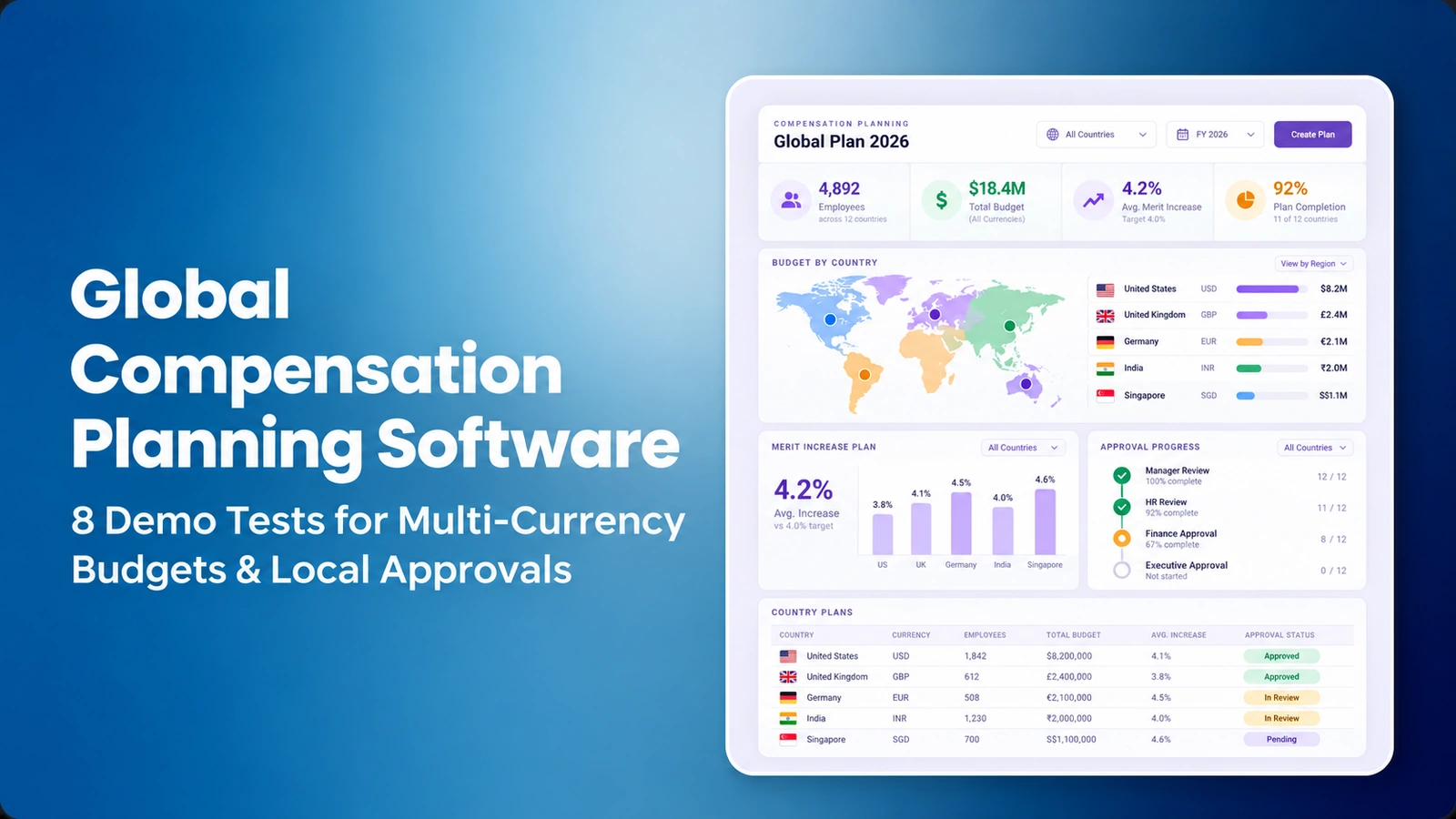

How do you evaluate global compensation planning software? Ask each vendor to preserve salary and merit-budget amounts in their local currencies while showing a reconciled group budget, versioned exchange-rate assumptions, country-specific guidelines, delegated approvals and accurate payroll handoffs. A system that displays USD, GBP and CAD is not necessarily one that governs a multi-country compensation cycle. The eight demonstration tests below make those distinctions observable.
Consider a US-headquartered employer preparing increases for US, UK and Canadian teams. UK managers have a fixed GBP allowance, headquarters reports in USD, and Canada follows a different eligibility cutoff. If the exchange rate moves after budgets are approved, Finance's translated report can change even though nobody has changed the legally approved local allocation. That is a reporting variance, not necessarily new spending capacity. Buyers should use compensation planning and budget management controls as product-context starting points, then test the exact countries and systems in the proposed contract.
Why is multi-country compensation planning harder than a domestic merit cycle?
A domestic cycle already needs accurate employee lists, salary-range context, budget limits and an auditable approval history. A global cycle also needs local pay currencies, reporting currencies, exchange-rate policies, legal-entity boundaries, country calendars, effective dates and authority delegated to regional HR. Payroll and statutory treatment are related processes, but compensation planning is not the same as global payroll.
Keep three types of data separate: pay currency (the currency of an employee's authorized salary), local budget currency (the unit in which managers are allowed to commit an increase) and group reporting currency (the translated view used by Finance). Sometimes pay and local budget currencies match; do not assume that is always the case. Use ISO 4217 currency codes such as USD, GBP and CAD rather than ambiguous symbols. Job architecture and grade mappings and country-appropriate market benchmarks inform pay decisions but do not replace currency governance.
What do 2026–2027 salary budget studies say about country planning?
Mercer's August 31, 2026 release summarizes a July survey of 1,001 US organizations. Participants projected average 3.2% merit increases and 3.5% total salary increases for 2027; the total includes promotions, cost-of-living and other adjustments. The study also reported that 87% of employers' 2027 budgets were preliminary at the time of fieldwork. These are forecasts for a US sample, not global compensation rules or a promise about final 2027 spending.
WorldatWork's 2026–2027 Salary Budget Survey contains results across 24 countries, with detailed coverage of the US, Canada, India and the UK. Its site reports 4,733 responses. A regional HR team should use the licensed country data that match the intended employee population and increase type, and should preserve whether each figure is a median or mean, projected or actual, and merit-only or total increase. Do not paste one US average into every entity's plan. Our merit budget planning guide covers a different domestic allocation intent.
For the software demo, load one distinct guideline for each country rather than asking vendors to demonstrate a single global 3.2% merit matrix. Record who set each local policy, when it takes effect and whether the system can warn reviewers about stale survey inputs.
Eight global compensation planning demo tests
Use the same synthetic employee file and approval scenario with every vendor. Test both the screen behavior and the exported evidence; a feature assertion without a repeatable action is not a pass. The table is a procurement script, not proof that any named vendor has already completed the tests.
| Test | Vendor action | Required evidence | Owner |
|---|---|---|---|
| 1. Currency identity | Load employee pay and local merit budgets in USD, GBP and CAD. | Original amounts, ISO currency codes, payroll source and effective dates stay intact. | HRIS + Compensation |
| 2. Versioned FX rates | Change one approved reporting translation rate, then reopen a prior report. | Date, owner, direction of conversion, precision and both old/new rates are retrievable. | Finance |
| 3. Country budget pools | Give UK and Canada different remaining balances; submit an over-budget request. | One country's unused funds cannot silently cover the other's proposal. | Regional HR + Finance |
| 4. Headquarters consolidation | Translate all approved country budgets into USD without deleting local balances. | Group total reconciles to original pools and rate assumptions; draft/approved spend is separated. | FP&A |
| 5. Local pay guidelines | Apply different merit matrices, eligibility cutoffs and promotion rules. | The correct country and effective rule version controls each test employee. | Total Rewards |
| 6. Delegated approvals | Have a local manager exceed policy and route to a second-level approver. | User permissions, rejection, exception reasons and approval timestamps are visible. | Local HR + IT |
| 7. Cross-border effective dates | Move a synthetic worker between legal entities during the merit cycle. | New and former entity ownership, payroll handoff and effective periods reconcile. | HRIS + Payroll |
| 8. Bad imports and exports | Feed a duplicate ID, missing currency and incorrect grade into the system. | Invalid rows are rejected, logged, corrected and retested without silent changes. | Integration owner |
Test 1: Can the platform preserve local salary and currency identity?
Load three synthetic employees paid in USD, GBP and CAD, including an approved salary, legal entity, country and payroll effective date. Ask the vendor to edit a reporting preference, then reopen the employee records. All original pay amounts must remain unchanged. A currency symbol without a reliable three-letter code or source reference is a warning sign, especially when the same symbol is used for different national dollars.
Ask whether bonuses, merit increases and base salary have separate currency and period fields. An annualized salary must not be mistaken for a one-time incentive. Test the total rewards statement output separately because employee-facing display and actual payroll obligations can differ.
Test 2: Can Finance change an FX assumption without rewriting a local budget?
Use a deliberately fictional GBP-to-USD reporting conversion: 1 GBP = 1.25 USD at the first reporting snapshot, then 1 GBP = 1.30 USD for a later snapshot. A locally approved UK merit pool of £200,000 should remain £200,000. The translated view changes from $250,000 to $260,000. These are arithmetic test inputs, not live market rates or a prescribed accounting method.
Make the rate source, rate date, direction of the pair, precision, rounding policy, owner and effective period visible. An auditor must be able to reproduce the earlier USD report from the stored GBP amount and earlier assumption. Compensation reporting should be assessed for versioned outputs, while compensation analytics needs testing for live-cycle changes. Neither page alone certifies a particular FX translation feature.
Worked example: reconcile local pools with a headquarters USD report
This three-country example is entirely hypothetical. Assume $400,000 in the US, £200,000 in the UK and C$300,000 in Canada. Keep the Canada translation unchanged at a fictional C$1 = US$0.74. Only the UK reporting rate is revised. A sound application can explain why the consolidated number moves by $10,000 without allowing UK managers to spend another pound.
| Country / pool | Locally approved budget | Assumed FX to USD | USD reporting value |
|---|---|---|---|
| United States | US$400,000 | 1 USD = US$1.00 | US$400,000 |
| United Kingdom, snapshot A | £200,000 | 1 GBP = US$1.25 | US$250,000 |
| Canada | C$300,000 | 1 CAD = US$0.74 | US$222,000 |
| Group total, snapshot A | Keep three original local balances | Snapshot A assumptions | US$872,000 |
| United Kingdom, snapshot B | Still £200,000 | 1 GBP = US$1.30 | US$260,000 |
| Group total, snapshot B | No extra local budget approved | Only UK reporting rate changed | US$882,000 |
Reconciliation: Snapshot A = $400,000 + ($200,000 × 1.25) + (C$300,000 × 0.74) = $872,000. Snapshot B = $400,000 + (£200,000 × 1.30) + (C$300,000 × 0.74) = $882,000. The $10,000 reporting difference is FX translation alone. Ask vendors to export the supporting rate table and source pool IDs, not just a dashboard total.
Tests 3 and 4: Can country budget limits roll into a reliable group total?
Assign different approved pools to the UK and Canada, then let a UK manager propose an increase that exceeds the UK's available budget while Canada has unused capacity. The system should stop the request or route it to an authorized approver; it must not silently move Canada's funds to the UK. Next, consolidate the budgets in headquarters currency and check that the report distinguishes approved, proposed, committed, spent and remaining amounts.
Ask for a source-to-report reconciliation, including cases with rejected or pending proposals. When a promotion adjustment and a merit action occur for the same employee, the reports should not count the same amount twice. Use our compensation scenario planning software checklist for wider scenario design and the data reconciliation guide for error-handling context.
Tests 5 and 6: Are local eligibility rules and approval rights truly separate?
Configure one merit eligibility date for the US and a different one for the UK. Then apply two distinct guideline matrices to the same synthetic role level. The vendor should show which version of each rule was applied, who approved the policy and how an exception is justified. A generic “country” dropdown without rule ownership is not enough.
Have a local manager request an above-guideline increase. Attempt approval under both an authorized regional HR user and an unrelated manager. The authorized path should retain the exception reason, reviewer, timestamp and outcome; the unauthorized path should be blocked. Verify that Finance sees the proposal's budget impact before it becomes final. The approval workflow demo criteria provides deeper tests for multi-level reviews, while pay equity analytics addresses a related but separate evaluation question.
Tests 7 and 8: Do transfers, payroll handoffs and bad records fail safely?
Schedule a future-dated increase for an employee moving between legal entities. The test must identify the source HRIS record, old and new employing entities, source and destination payroll fields, active salary currency, effective date and responsible approver. A change in reporting currency must not itself trigger a pay change or overwrite the prior employment history. For off-cycle changes, compare the different timing requirements described in our off-cycle compensation management guide.
Next, upload a second test file containing a duplicate employee ID, an invalid grade and a missing currency code. Require the system to reject or quarantine the affected rows, retain an error report, identify a correction owner and support a controlled retry. A successful screen toast does not prove payroll received the correct approved values. Ask for before/after files and a test export, then reconcile the record count. The salary range version-control guide is useful where entity transfers also change applicable grades and pay ranges.
How should HR score competing global planning software vendors?
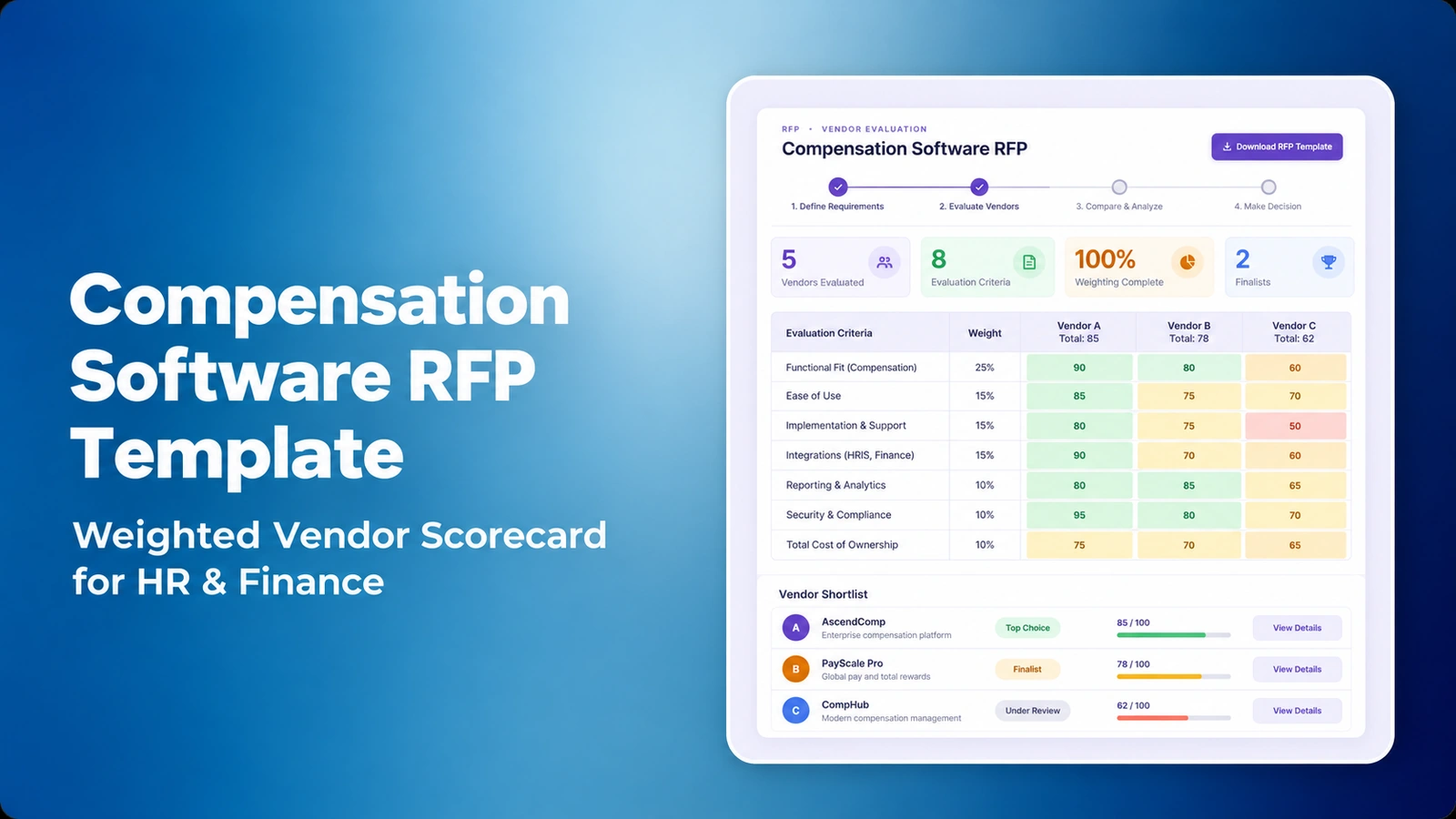
Establish the weights before opening vendor responses. An illustrative 100-point rubric places 20% on currency and FX, 20% on local budgets and consolidation, 25% on policies and approvals, 15% on effective dates, 10% on integration errors and 10% on implementation and documented geographic scope. This is an editorial decision model, not an industry-wide standard.
| Scoring dimension | Weight | Test evidence |
|---|---|---|
| Currency identity and FX history | 20% | Tests 1–2: original local amounts and replayable FX |
| Local budgets and consolidation | 20% | Tests 3–4: country controls and group reconciliation |
| Policy and approval governance | 25% | Tests 5–6: localized guidance and authorization |
| Effective dates and transfers | 15% | Test 7: cross-border entity changes and payroll readiness |
| Integration exceptions | 10% | Test 8: rejected imports, corrections and export handling |
| Implementation and written country scope | 10% | Contract commitments, responsible owners and pilot sign-off |
Score each test from 0 (not demonstrated) to 5 (repeatable in the agreed environment with evidence). Weighted points = (test score ÷ 5) × criterion weight. For example, a 4/5 in a 20-point currency category earns 16 points. Do not let a high composite score cancel a critical failure that could create unauthorized pay, expose confidential salary data or misstate payroll. Such gates need written pre-agreed handling.
Use the same eight scripts, reporting assumptions and time limit for all shortlisted vendors. The vendor should disclose which steps are included today, need configuration, require partner support, are on its roadmap or cannot be supported. Preserve demonstrations and commercial exceptions in the final evaluation record.
Which questions prove a vendor's geographic coverage?
Ask for named countries, supported currencies and legal entities within the exact quoted subscription, not the number of territories shown on a marketing map. Confirm whether a workflow is native, configured or integrated with a separate payroll provider. Ask who maintains local eligibility and approval rules, which roles can see employee pay, what is stored in the audit log and how the customer exports historical records. A tool may display multiple currencies while still needing manual country-by-country processing.
Global planning does not inherently provide worldwide tax compliance, statutory benefits, wage-law advice, payroll processing or data-residency guarantees. Get the relevant employment, privacy and data-transfer review from qualified advisers and written vendor documentation. Do not infer legal compliance from a demo. A shared job architecture can aid consistent role definitions, but local classifications and employment obligations still require review.
What can CompBldr demonstrate, and what still needs a scoped review?
CompBldr's public compensation planning page describes eligibility rules, budget tracking, manager proposals, configurable approvals, bonuses and documented approval history. Its budget management solution, reporting tools and analytics supply context for an HR/Finance evaluation. They should not be treated as proof of a specific currency policy, international payroll connector, data-residency arrangement or unlimited country coverage.
In a demo, ask CompBldr to attempt all eight tests, document which work as standard, identify country- or system-specific dependencies and provide a written scope. CompBldr's pricing information is not a quote for every international use case. Start from current salary files, current benchmarking sources, approval policies and HRIS integrations, then have the vendor specify where the implementation team must configure or validate those processes. For general positioning, see Why CompBldr.
What rollout sequence reduces global compensation planning risk?
Begin with one pilot country and one headquarters consolidation, then test a cross-border scenario before a full launch. Map source fields, local codes, effective dates, budget authorities and currency tables. Obtain HR, Finance, IT, Payroll and regional approvals for each acceptance test, and maintain an exception backlog with named owners and retest dates. A global dashboard is not ready for production until local users and Finance can independently reconstruct its figures.
For the first pilot, ask a country manager to demonstrate an authorized exception and a blocked unauthorized one. Have Finance replay a historical FX report, and have HRIS reconcile a corrected duplicate record. Finally, export the approval history and ensure the local salary remains correctly denominated. These checks are more valuable than a feature tour that never includes an error.
Research and methodology notes
Reviewed October 31, 2026. The Mercer figures are July 2026 US survey projections released August 31, 2026, not international compensation policy. WorldatWork's 2026–2027 report includes country-specific salary-budget findings; licensed underlying tables must be interpreted with each country's sample and metric definitions. All dollar, pound, Canadian-dollar and exchange-rate figures in the worked example are fictional test inputs, not actual vendor prices, live FX quotes, customer results or a validated exchange-rate policy.
Conclusion: prove local accuracy before trusting the global total
A credible international compensation planning system protects the local pay decision first, then translates and consolidates it in a way Finance can audit. Use all eight tests, retain the evidence for FX and approval changes, and keep country coverage and downstream payroll obligations explicit. Choose a vendor only after the product and contract match the locations, systems and controls your employer actually needs.