

.svg)





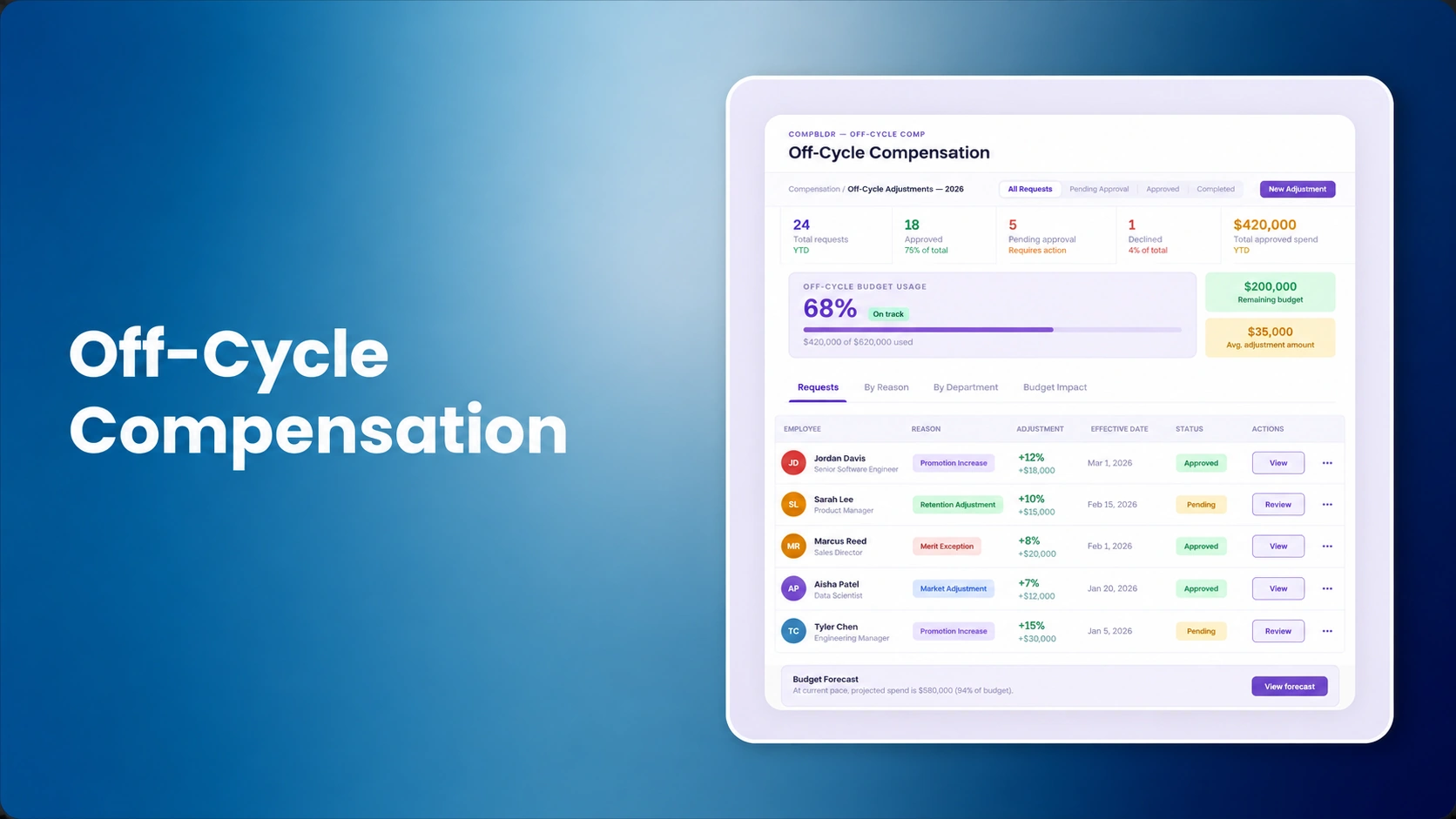

Off-cycle compensation is where well-designed annual processes often break. A promotion is approved in April. A critical employee receives a retention adjustment in June. A job is re-leveled in August. A market correction is needed in September. Each decision may be reasonable, but if they happen in separate spreadsheets, emails, and HRIS tickets, the organization loses visibility into cumulative spend and employee history.
Mercer's 2026 compensation planning research shows that overall salary budgets are relatively stable while employers are becoming more targeted in where they invest. Pave's compensation planning guidance also recognizes market, promotion, equity, and merit actions as distinct recurring compensation cycles. That makes off-cycle governance a core operating requirement, not an edge case.
What Counts as an Off-Cycle Compensation Action?
| Action | Trigger | Core evidence | Main control |
|---|---|---|---|
| Promotion increase | Employee moves to a larger job or level | Approved new role, level, range, current pay, policy | Separate job-change approval from pay amount approval |
| Market adjustment | External market has moved or current pay is materially misaligned | Market benchmark, range position, peer context | Do not substitute market adjustment for merit |
| Retention action | Credible flight risk or critical-skill concern | Role criticality, replacement difficulty, pay position, alternatives | Define duration and whether action is base or one-time |
| Equity or pay correction | Documented error, structural issue, or unexplained relationship | History, comparator review, approved remediation rationale | Preserve correction reason and effective date |
| New-hire adjustment | Offer or early-tenure pay decision requires correction | Hiring range, market data, internal comparators | Check compression before approval |
Do Not Treat Off-Cycle Pay as a Mini Merit Cycle
Merit, promotion, market, retention, and correction actions answer different questions. The market adjustment versus merit guide explains why external market movement should not be disguised as performance pay. The merit versus promotion guide makes the same distinction for job change.
The action type should remain visible through approval, payroll, and Compensation Reporting. If every adjustment ends up as "salary increase," leadership cannot reconstruct why spend occurred.
Start With the Current Job and Range
Before evaluating an amount, confirm the employee's current job, level, and salary range. If the role has changed, use Job Evaluation and the job leveling framework before deciding the increase.
A promotion request without an approved destination job can create range stretching. A market adjustment using the wrong job match can move the employee toward a benchmark that does not represent their work. Keep Job Architecture as the structural reference.
Evaluate the Employee's Current Position Before Choosing the Mechanism
Use compa-ratio, range penetration where appropriate, internal comparators, and market evidence. Review Compensation Analytics for compression or unexplained peer relationships before approving a change.
An employee below midpoint is not automatically underpaid. An employee above midpoint is not automatically overpaid. Range position is context, not the decision. Job scope, proficiency, market evidence, performance where policy permits, and internal relationships all matter.
Run Off-Cycle Pay Through the Same Governance as Annual Planning
Use CompBldr Compensation Planning to keep promotions, market adjustments, retention actions, and corrections visible against current ranges, budgets, and approval rules.
Build an Off-Cycle Approval Path That Matches the Risk
A $2,000 correction and a $40,000 retention adjustment should not require identical governance. Define thresholds by action type, amount, percentage, employee level, and whether the request sits inside or outside approved policy.
A useful workflow is:
- Request: manager or HR submits the action type and rationale.
- Validate structure: Compensation confirms job, level, range, and eligibility.
- Review evidence: market data, employee history, peers, performance context, and business case.
- Model cost: Finance sees immediate and annualized impact.
- Approve or return: the authorized decision-maker accepts, rejects, or requests more evidence.
- Execute: approved effective date and amount move to HRIS/payroll.
- Report: the action remains visible in employee history and budget reporting.
Use Separate Budgets for Predictable Off-Cycle Demand
Off-cycle does not mean unbudgeted. Organizations can reserve pools for promotions, market adjustments, retention, pay-equity remediation, or other known actions. The merit budget guide is focused on the annual cycle, but the same discipline applies: budget ownership, remaining spend, and action type should be visible.
If Finance only sees off-cycle spend after payroll posts, the compensation process is operating as a reimbursement ledger rather than a decision system.
Off-Cycle Decision Matrix
| Manager request | What Compensation should test | Likely path | What not to do |
|---|---|---|---|
| "We need to promote her now." | Has the job scope changed enough to support the new level? | Approve role/level first, then determine pay | Use salary as proof that a promotion is deserved |
| "The market moved." | Is there current, role-specific evidence and does the current range still fit? | Market adjustment or range review | Apply a general percentage to everyone in the function |
| "We cannot lose him." | Is the issue pay, role scope, manager, career path, or another retention driver? | Choose base, one-time, equity, or non-pay response deliberately | Convert every retention problem into permanent base salary |
| "Payroll entered the wrong amount." | What was approved and when should it have taken effect? | Correction with preserved audit history | Overwrite history without a correction reason |
| "Her pay is lower than peers." | Are peers genuinely comparable and is the difference explainable? | Equity review or targeted adjustment | Use one comparison without broader context |
Retention Actions Need a Different Standard
Retention decisions are often urgent, but urgency should not erase evidence. Review current pay, replacement difficulty, business impact, employee tenure, job scarcity, and whether the concern is actually compensation-related.
If a one-time issue is driving the risk, a time-bound or one-time mechanism may be more appropriate than permanent base salary. The sign-on and bonus guide provides a useful distinction between recurring and non-recurring rewards. Where scarce skills are the issue, the skills-based pay framework can help separate the skill layer from the job level.
Promotions Should Not Hide Job Architecture Problems
If managers repeatedly request promotions because titles are inconsistent or responsibilities no longer match the framework, the issue may be structural. Review the job grades versus job levels logic and the job leveling matrix.
A healthy off-cycle process should surface repeated patterns. Ten individual exceptions in the same job family may be evidence that the range, level, or architecture needs review.
Integrations Matter More Off-Cycle Because There Is No Cycle Freeze
Annual cycles often use a controlled employee snapshot. Off-cycle decisions happen while employees are changing managers, locations, jobs, and pay. That increases the risk of stale data.
CompBldr's Integrations page describes HRIS and payroll connections designed to move employee, job, and approved compensation data between systems. The real-time integrations article explains why off-cycle adjustments are particularly vulnerable to data lag.
Before execution, reconcile the approved decision with current employee status, current salary, current job, and current range. The action should not post against a record that changed after approval without a review.
Use Offer and Off-Cycle Governance Together
New-hire compensation and off-cycle employee adjustments often affect the same internal equity relationships. The offer compensation governance framework should feed the same salary-range and comparator logic used for existing employees.
If new hires repeatedly enter near the top of the range while incumbents remain lower, that can create pay compression that later appears as an off-cycle problem.
Metrics to Track Year-Round
- Off-cycle spend by action type, function, level, and month.
- Annualized versus one-time cost.
- Approval turnaround time.
- Exception rate and repeated exceptions by job family.
- Promotions outside the normal promotion window.
- Market adjustments by role and location.
- Retention actions that later become recurring structural issues.
- Employees moved above range maximum or remaining below minimum.
- Compression or equity reviews triggered by an action.
The compensation dashboard metrics article can help translate these measures into leadership reporting.
Failure Signals
- Managers choose the action type after the amount is already negotiated.
- Promotion and merit are combined into one unexplained percentage.
- Retention adjustments bypass internal comparator review.
- Finance has no live view of off-cycle spend.
- HRIS, payroll, and compensation history show different effective dates.
- Repeated exceptions do not trigger a structural review.
Illustrative Example: Promotion, Market Pressure, and Retention in the Same Quarter
The following scenario is illustrative and uses hypothetical values or events to show the decision process.
Assume a P3 cybersecurity analyst is promoted to P4 in May. The promotion is approved with a new salary based on the P4 range. In July, the market for the specialty moves and the company refreshes the relevant range. In August, the employee receives an external offer and the manager requests a retention increase.
Those three events should not be collapsed into one story about "keeping the employee competitive." The May increase reflects a bigger job. The July range change reflects market structure. The August request is a retention decision that should consider current pay, the refreshed market, internal comparators, replacement risk, and whether a one-time or recurring response is appropriate.
Keeping the events separate makes the final compensation history explainable. It also prevents the organization from accidentally paying for the same issue twice.
Set Service Levels for Off-Cycle Decisions
Off-cycle governance fails when every request is treated as an emergency. Define response expectations by request type. A payroll correction may require same-day handling. A promotion can follow a standard review window. A large retention exception may require senior approval and a deeper internal-equity review.
Track request age, time with each approver, and incomplete evidence. If decisions are slow because managers submit weak business cases, fix the intake requirements. If they are slow because every small adjustment requires executive approval, review the thresholds.
What Changes by Company Size?
Smaller organizations may use a single Compensation or HR approver but still need explicit action types and a controlled record. Mid-sized organizations usually need budget owners, thresholds, and function-level reporting. Large enterprises need delegated authority, local policy rules, and a common audit trail across regions and business units.
The operating model can scale. The evidence chain should not disappear as the company grows.
Manage Pay Decisions Between Merit Cycles Without Losing Budget or Governance
See how CompBldr keeps off-cycle actions connected to job structure, market data, salary ranges, employee history, approvals, and finance reporting.
Book a Demo

.svg)

.svg)
.svg)

