



What should a compensation management software RFP include? A useful request for proposal names the pay decisions the employer needs to control, assigns owners to those decisions, and asks shortlisted vendors to prove the same workflows. A weighted vendor scorecard, live test scripts, security pass/fail gates, documented three-year cost and implementation acceptance criteria make the selection defensible. An RFP should not be a list of 200 marketing features that nobody will test.
Consider a US employer with 800 employees, six job families and separate HRIS and payroll systems. Managers submit annual merit requests in spreadsheets; Finance checks budgets after the fact, and compensation analysts correct outdated grade codes by email. The vendor demo looks attractive, but none of that work is solved unless the system handles exceptions, permissions, effective dates and failed records. This article supplies a 30-question RFP template, a buyer-controlled scoring method and a repeatable demonstration script, not a ranking of actual vendors. For general product discovery, use our separate compensation planning software buyer's checklist.
What belongs in a compensation management software RFP?
Describe the scope before asking for pricing. Record covered employees, manager seats, countries, legal entities, salary survey entitlements, historical data, budget cycles and integration endpoints. Divide requirements into must-have for go-live, contracted later phase and optional. A vendor that can demonstrate a hypothetical future feature is not necessarily selling it in the proposed package.
Give stakeholders explicit authority: Compensation owns grade and pay methodology; HRIS owns employee and job master data; Finance owns budget and payroll reconciliation; IT/Privacy approve access and security; Procurement owns legal and commercial commitments. Define the evidence required for each answer. The job architecture workflow and job evaluation controls need different reviewers from a pay-equity analysis or merit planning cycle. A single RFP can cover them, but it should not assume every organization needs all modules.
How should an RFP score compensation management software vendors?
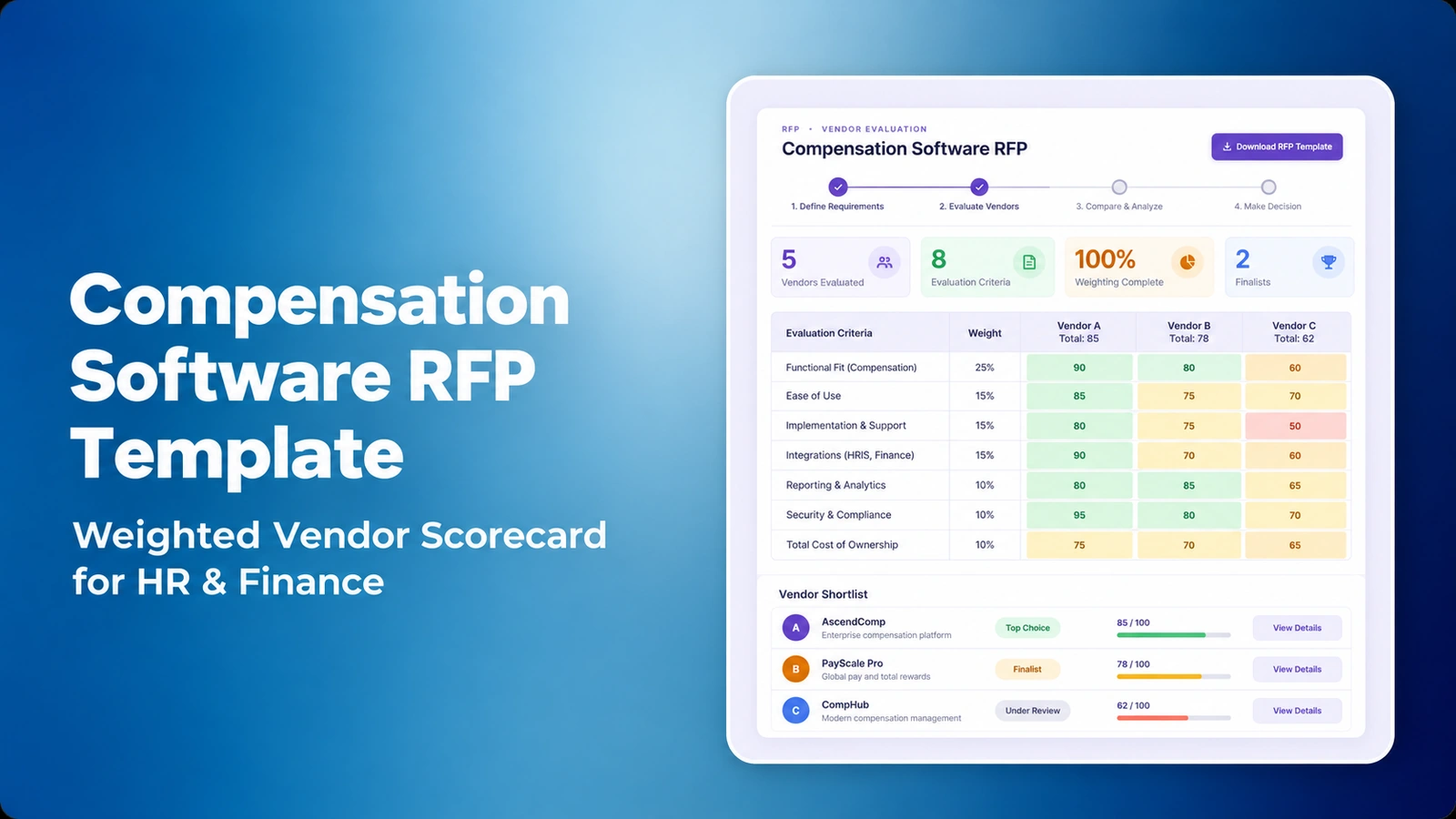
Agree on the weights before opening vendor responses. A workable illustration assigns 25% to compensation workflows, 20% integrations, 20% security and auditability, 15% three-year cost, 10% manager usability and 10% implementation. This sums to 100%, but it is not an industry standard. A multinational employer with complex statutory and currency requirements might place more weight on data and controls; an employer buying a focused salary structure tool may choose another mix.
| Requirement group | Weight | Required evidence | Accountable evaluator |
|---|---|---|---|
| Compensation workflows & approvals | 25% | Merit-cycle exception, multi-level approval and revision | Compensation Lead |
| HRIS, finance & payroll integration | 20% | Failing import, reconciliation and corrected payroll export | HRIS + Finance |
| Security, privacy & audit | 20% | Restricted record access, history and AI human override | IT Security + Privacy |
| Three-year ownership cost | 15% | Equivalent written quote with implementation and renewal | Procurement + Finance |
| Manager adoption & usability | 10% | A manager completes a realistic proposal unaided | HR Operations |
| Implementation & support | 10% | Migration rehearsal, named delivery owners and rollback | Project Owner + IT |
Use a 0–5 evidence scale: 0 = unsupported; 1 = assertion only; 2 = partial documentation; 3 = successful guided demonstration; 4 = repeatable test with retained evidence; 5 = repeatable test plus committed scope and acceptance criteria. Define the thresholds in the RFP and do not change them between vendors. Weighted contribution for a criterion = (vendor score ÷ 5) × criterion weight. Sum the contributions to get a 0–100 score. A written claim may help shortlist a vendor, but it should not earn a top evidence score.
Put non-negotiable gates above that total. Unauthorized salary exposure, inability to preserve material pay approvals, an unmitigated critical integration defect or unacceptable contractual data handling may disqualify a vendor irrespective of its attractive weighted score. IT and Legal should define these conditions and any exception process before demonstrations.
Compensation software RFP template: 30 questions to send every vendor
Copy the questions below into your procurement workbook. For each row, include Requirement ID, Criticality, Business Owner, Vendor Response, Included in Quote?, Evidence URL or File, Demo Result (0–5), Open Issue and Decision. Record the response date. The vendor should identify whether the capability is available now, requires configuration, is separately licensed, is on a roadmap or is unsupported.
Compensation workflow & Finance
| ID | Buyer question | Proof to request |
|---|---|---|
| C1 | Who can set merit eligibility and eligibility exceptions? | Show dated eligibility rules and an excluded employee. |
| C2 | Can Finance lock department and manager budgets, then see planned versus available amounts? | Demonstrate a rejected over-budget request. |
| C3 | Can HR route proposals through manager, HR and Finance approval without bypassing controls? | Show approvals with who, when and rationale. |
| C4 | How are off-cycle increases, overrides and rejected proposals recorded? | Reopen one rejected exception with its history. |
| C5 | Can a prior approved increase be corrected without deleting the earlier decision? | Export before/after values and effective dates. |
| C6 | Can Finance reconcile finalized changes to totals by entity and department? | Export a signed-off budget variance report. |
Jobs, Grades & Market Data
| ID | Buyer question | Proof to request |
|---|---|---|
| J1 | How are job IDs, families, levels and grades mapped to the HRIS? | Inspect a role whose title differs from its job family. |
| J2 | Can evaluators preserve the factor rationale and grade decision? | Show current and previous evaluation versions. |
| J3 | Can customer-licensed salary survey data be imported and reused within the license agreement? | Confirm contract rights and test one matching record. |
| J4 | How are weak or rejected market matches handled without silent overwrites? | Inspect mismatch and reviewer override evidence. |
| J5 | Can a future-effective salary range version be tested before activation? | Compare old and future ranges for one grade. |
Integrations & Data Quality
| ID | Buyer question | Proof to request |
|---|---|---|
| D1 | Which HRIS identifies the authoritative employee and job records? | Produce the approved field map and ownership rules. |
| D2 | What happens when two source rows share an employee ID? | Show a blocked import and exception log. |
| D3 | How are currency conversions, legal entities and effective dates controlled? | Reconcile one cross-entity test case. |
| D4 | Does the payroll feed reject invalid rows and notify the correct owner? | Show failed-record correction and re-export. |
| D5 | Can HR identify when a field changed and which integration caused it? | Show version, actor and timestamp for an import. |
Security, Privacy & AI
| ID | Buyer question | Proof to request |
|---|---|---|
| S1 | Can managers see only their authorized employee compensation records? | Attempt to view an out-of-scope employee. |
| S2 | Which single sign-on, multifactor and identity-provisioning methods are supported? | Supply configuration evidence and current policy. |
| S3 | How are historical pay records retained, exported and deleted by policy? | Provide written retention and deletion procedures. |
| S4 | What notification, escalation and recovery obligations are contracted? | Provide the relevant agreement and test process. |
| S5 | Can an AI suggestion be explained, challenged and overridden without auto-approving pay? | Show human review, override and retained decision. |
Implementation & Support
| ID | Buyer question | Proof to request |
|---|---|---|
| I1 | Who owns mapping, configuration, tests and go-live sign-off? | Request a named-owner responsibility matrix. |
| I2 | What cleansing, dry runs and source-to-target reconciliation are included? | See a failed migration rehearsal and remediation. |
| I3 | What training and sandbox access exist for typical reviewers? | Observe a non-admin manager completing a cycle. |
| I4 | Who handles cutover rollback and a failed payroll integration? | Obtain support SLA and rollback criteria. |
| I5 | Which repeatable tests must pass before final payment or go-live? | Record acceptance thresholds and owners. |
Pricing & Contracting
| ID | Buyer question | Proof to request |
|---|---|---|
| P1 | Are fees based on covered employees, managers, analyst seats or modules? | Show populations and tier thresholds in the quote. |
| P2 | What are the recurring fees, implementation, data licenses, support and integration charges? | Provide annualized itemized cost for years 1–3. |
| P3 | What escalation, seat true-up or new-entity charges apply at renewal? | Provide written uplift and change-order rules. |
| P4 | How and at what cost can we export history, grades and approved pay changes? | Show contractual extraction rights and sample export. |
The 30 questions above span six accountable domains. Do not let a vendor answer a security question with a general product brochure, or a cost question with a feature demonstration. Ask the designated reviewer to check each supporting artifact. A compensation reporting workflow may look excellent in a demo yet still fail to reconcile the totals Finance expects.
Worked example: why the highest weighted score may still lose
Take two fictional vendors, Alpha and Beta, with the weights shown above. Both present the same sample dataset. Alpha scores 4/5 for workflows, 3/5 for integration, 5/5 for security, 3/5 for cost, 4/5 for usability and 4/5 for delivery. Its weighted result is 77/100. Beta earns a higher 82/100 but exposes a compensation record outside a manager's assigned team during a live access test. The example is illustrative and does not describe any real software provider.
| Group | Weight | Vendor Alpha | Vendor Beta |
|---|---|---|---|
| Compensation workflow | 25% | 4/5 | 5/5 |
| Integration | 20% | 3/5 | 4/5 |
| Security and audit | 20% | 5/5 | 2/5 (gate fail) |
| Three-year cost | 15% | 3/5 | 5/5 |
| Manager adoption | 10% | 4/5 | 4/5 |
| Implementation | 10% | 4/5 | 5/5 |
| Weighted score | 100% | 77/100 | 82/100, not eligible |
Do not award Beta simply because 82 is larger than 77. The pre-agreed security gate is triggered at 2/5 and by the observed data exposure, so Beta is not eligible unless a documented risk-resolution process explicitly allows and verifies remediation. Alpha may still need written commitments to fix integration gaps before award. This is the difference between an evidence-based decision and scorecard theater.
Which live demonstrations should follow the RFP?
Give every finalist the same synthetic, anonymized records, approved test script, expected result and allotted time. Use no real employee salaries. Review the actual output, not a prerecorded feature video. Record the tester's name, environment, time, source file, outcome and screenshot or export. A guided demo that succeeds only because the vendor's consultant changes configuration halfway through needs to be documented as such.
| Test | Live action | Pass evidence | Reviewer |
|---|---|---|---|
| 1. Merit approval breach | Manager requests an increase beyond the team's approved budget | Clear block or authorized escalation, no silent approval | Finance + compensation |
| 2. Grade and range change | A job changes grade on a future effective date | Prior approved grade and salary range remain traceable | Compensation + HRIS |
| 3. Integration failure | Duplicate employee ID and rejected payroll row in synthetic file | Failure count, corrective action, owner and rerun evidence | HRIS + payroll |
| 4. Restricted data access | Manager attempts to access another department's salaries | Denied access with appropriate audit event | IT security |
| 5. AI recommendation challenge | Reviewer asks what data drove a suggested pay action | Source/context, human override and recorded approval | Compensation + privacy |
For advanced workflows, add compensation approval testing and a salary-range version-history scenario. The selected tests should reflect the purchase: market benchmarking buyers may require evidence of match governance and salary survey entitlements, while total rewards statements buyers may prioritize secure employee access and delivery. Do not treat an unrelated module as a mandatory gate.
What should IT and Privacy check in the vendor security response?
Compensation systems may contain confidential salaries, performance inputs, managers' recommendations and historical employment records. Require least-privilege access, identity controls, relevant logging, defined retention and export rights, incident responsibilities and an authenticated recovery procedure. NIST's Cybersecurity Framework 2.0 is useful for structuring vendor-risk questions, including supplier assessment and access-control practices. It is voluntary guidance, not a product certification, and the applicable contract and legal requirements must be established separately.
For AI-assisted pay recommendations, ask which records and data providers feed the model, whether employee data are used for model training, where data are processed, how errors are found and whether a human reviewer can reject a result before payroll action. NIST's AI Risk Management Framework Playbook provides recommendations for documenting oversight, overrides and audit evidence. Avoid claiming that following the playbook certifies a vendor or eliminates bias.
US pay-equity obligations need a separate legal review. EEOC guidance on compensation discrimination explains why job content and substantially equal work matter; an RFP checkmark or job-scoring tool alone does not establish compliance. Have counsel determine the relevant federal, state and local obligations. This article is purchasing guidance, not legal advice.
How should Finance compare three-year compensation software pricing?
Require three separately priced contract years using the same covered workforce, manager count, modules, entities, survey-data rights and integration scope. Include one-time migration and configuration, ongoing support, premium security needs, renewal escalators and possible extraction fees. Normalize each vendor's written proposal to a single cost worksheet without presenting a fictional per-employee number as an actual supplier price. The separate AI compensation software pricing and three-year TCO guide provides a worked ownership-cost model.
Ask for three sources of truth: the commercial proposal, the scope-of-work document and the test evidence. If a feature appears in a demo but not the implementation scope, it should not receive full commercial credit. CompBldr's pricing page provides vendor context, but the included modules, customer data rights and integration costs still require a quote. A third-party salary survey contract should appear separately in the model if it is not included.
How can HR and Finance resolve conflicting vendor scores?
Reopen the evidence, not the weighting. Suppose HR rates an interface 5/5 because the vendor's API supports payroll export, while Finance rates it 2/5 after one incorrect employee record appears. They observed different aspects of integration: technical connectivity and business reconciliation. Have both reviewers rerun the same invalid-row scenario and record a single agreed outcome. Mark any remediation as an open condition with a responsible owner and acceptance date.
The decision meeting should separate must-pass gates, weighted preference, price, implementation effort and unresolved legal commitments. Compensation signs off on pay methodology, HRIS validates the data model, Finance approves TCO and downstream totals, IT approves security exceptions, and Procurement confirms the contract reflects every required remedy. Do not silently average away a critical failure.
What should the final RFP workbook contain?
A practical workbook can have six tabs: 01 Scope & Owners, 02 Questions & Vendor Responses, 03 Live Demo Tests, 04 Weighted Scoring, 05 Three-Year TCO, and 06 Decision & Risks. Each question needs its unique ID, priority, response, evidence, reviewer, rating and sign-off. Freeze the original weights before demos and retain dated versions of the answers. The questions and model on this page are usable without downloading a file; there is no separate downloadable workbook attached here.
To make the RFP auditable, write down who owns the final decision, what happens if a vendor fails a gate, and what must be accepted before go-live. For source data, use the compensation data reconciliation checklist. For audit outputs, evaluate compensation analytics and compensation reporting on the actual scope rather than assuming that dashboard availability equals Finance-ready reporting.
Why this RFP matters to HR leaders in 2026
Payscale's 2026 Compensation Best Practices Report found that 75% of surveyed organizations received executive requests for compensation reporting occasionally or frequently. The survey gathered 3,413 responses in October–December 2025. That finding supports testing reporting and governance when they matter to your employer; it does not tell any company how to weight its RFP or prove a vendor's performance.
Procurement should also distinguish promotional materials from independently testable capabilities. CompBldr's product overview describes an integrated compensation platform, including workflows such as job evaluation, planning and reporting. Ask for a product demonstration, implementation scope and written commitments before awarding points. For AI functionality, confirm the named TrAI capability against the exact quoted configuration instead of assuming every AI-supported action is licensed.
Conclusion: select on verifiable decisions, not vendor promises
A compensation management software RFP succeeds when it gives decision-makers the same evidence, exposes unresolved risks and makes the total cost of ownership comparable. Start with the 30 questions, run common tests, score observed results and require an accountable response to every material failure. Keep general feature exploration in the buyer's guide and use this RFP to make a procurement decision that HR, Finance, IT and leadership can explain later.