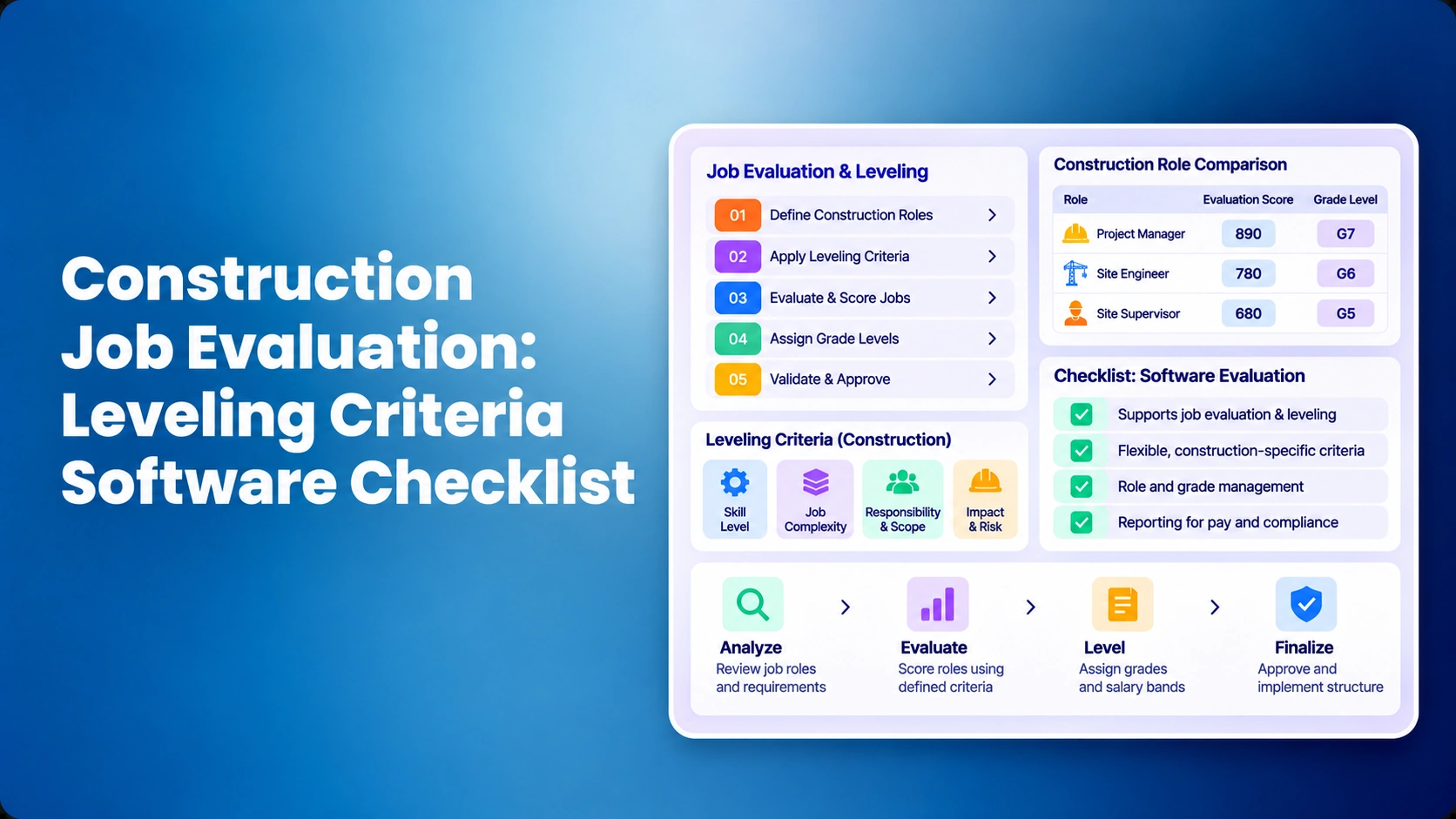



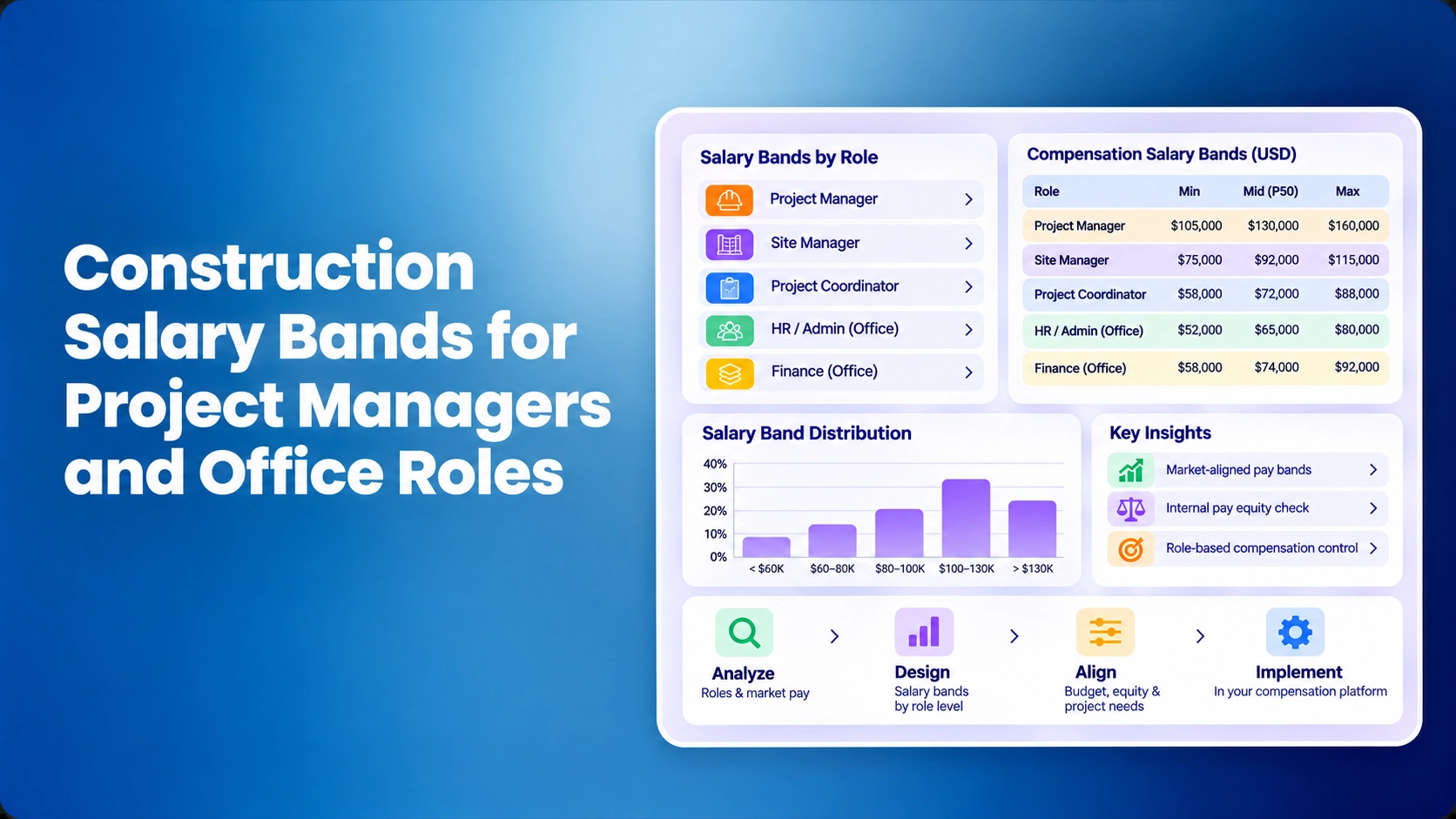

Build construction salary bands from evaluated job scope, comparable base-pay data, and a documented recruiting market. Set a minimum, midpoint, and maximum for each approved range, then model employee and budget impact before setting an effective date.
A project manager who delivers a single tenant-improvement project may have different authority from one who owns a commercial portfolio. An estimator or contract administrator may recruit from a different labor market again. Start with the work each role is accountable for, then decide which jobs can share a range.
Which construction roles can share a salary band?
A contractor may have two project managers with identical titles but different operating responsibilities. One manages a single small tenant-improvement project under a senior manager; another owns multiple projects, customer escalation, subcontractor coordination and a larger contract portfolio. The salary-band question is not which employee is paid more today. It is whether the roles have the same evaluated level, whether their relevant labor markets differ and whether current pay falls within an approved structure.
Start with job architecture and a job inventory spanning project management, estimating, scheduling, procurement, safety, accounting, human resources and office administration. For each position capture project size and complexity, delegated contracting or budget authority, number of projects, supervisory scope, travel expectations and the operating region. Use construction job evaluation criteria to distinguish internal grades from job levels. A senior estimator and a project manager may have comparable internal job value but different external markets and pay mixes; equal grades need not mean identical survey matches.
Do equal construction job grades require identical pay ranges?
Not necessarily. A job grade describes evaluated internal responsibility, while a salary band sets the pay range under the employer's compensation policy. A senior estimator and a project manager may have similar internal job value but compete in different labor markets. The company might use one graded structure with different job-family ranges, or separate geographic structures when documented recruiting evidence supports them. Keep the internal grade, market match, pay-policy decision, and eventual employee action as separate records.
Do not grade from salary alone: a project manager's title or existing pay does not establish higher accountability. Use approved role scope, independent decision authority, project complexity, financial limits, and supervisory responsibility before assigning a level. If the evaluated job changes, review the construction job evaluation checklist before changing its pay range.
A sample structure for contractor professional roles
| Illustrative profile | Accountability signal | Possible band question | Required evidence |
|---|---|---|---|
| Project coordinator | Maintains project documentation and scheduling | Individual contributor or specialist level? | Independent decisions and work complexity |
| Project manager | Delivers assigned project scope, budget and subcontractor coordination | Single-project or multi-project accountability? | Authority matrix and recent project portfolio |
| Senior project manager | Directs multiple complex projects and mentors managers | Higher specialist level or broader management role? | Risk authority, client accountability and supervision |
| Regional operations manager | Owns a portfolio, staffing decisions and operating results | Enterprise or regional leadership band? | Delegated financial and people authority |
| Senior estimator | Owns assumptions and reviews complex bids | Does the technical track share a grade with project delivery? | Bid sign-off limits and review responsibility |
| Contract administrator | Tracks contract changes and documentation | Does the role administer changes or authorize them? | Contract workflow and signing authority |
| Office manager | Owns office operations and may supervise staff | Does the grade apply across branches? | Staffing, budget authority and recruiting geography |
This table is for testing a role architecture, not a universal grading recommendation. General contractors, civil contractors and specialty subcontractors may weight project complexity differently. If a company uses distinct operations and technical career tracks, show how roles at similar evaluated levels can maintain different accountabilities.
What evidence should HR collect before setting a construction pay band?
- Approved job record: job family, grade, version, primary duties, level, and delegated project or office authority.
- Market definition: actual recruiting geography, employer type, construction segment, and relevant survey-job comparison.
- Pay basis: base salary, effective date, target bonus or incentive, allowances, and any temporarily assigned premiums kept distinct.
- Range policy: proposed minimum, midpoint, maximum, adjacent-grade overlap, location rules, and approval owner.
- Financial impact: anonymized employee salaries, below-minimum and above-maximum flags, hiring exposure, expected employer costs, and implementation date.
Use the same evidence pack for project managers, estimators, and office personnel, but do not force them into the same survey title or recruiting market merely because their grades match.
Worked example for a project manager salary band
In this fictional example, the current annual base-pay range is $90,000 minimum, $110,000 midpoint, and $130,000 maximum. An employee earning $105,000 has a compa-ratio of 95.5% ($105,000 ÷ $110,000) and range penetration of 37.5% (($105,000 − $90,000) ÷ ($130,000 − $90,000)). Use salary-band methodology to set the range and range overlap analysis to check adjacent grades.
Suppose approved market evidence supports a proposed range of $95,000 to $135,000 with a $115,000 midpoint. The same employee’s compa-ratio becomes 91.3% and range penetration becomes 25%. Their pay stays at $105,000. A second employee earning $92,000 would sit $3,000 below the new minimum. If HR proposes bringing that employee to minimum, Finance models a $3,000 annual base-pay increase, then adds applicable employer costs and prorates for the effective date. These figures are illustrative.
Compare Two Construction Salary Ranges
Bring a project role and an office role. Ask to see the current and proposed ranges, the employees who fall outside them, and the assumptions behind the cost estimate.
Book a DemoHow are compa-ratio and range penetration calculated?
Compa-ratio = employee annual base salary ÷ assigned range midpoint × 100. It measures pay relative to the midpoint. Range penetration = (salary − range minimum) ÷ (range maximum − range minimum) × 100. It measures placement between minimum and maximum. These are different metrics: the first compares to one reference point; the second shows a position inside the full range. HR Source's compensation guidance documents both calculations.
For the article's fictional $105,000 employee, the current compa-ratio is 95.5% and penetration is 37.5%. Under the proposed $95,000–$135,000 range, both figures change because the range changes; the employee's $105,000 salary does not. Neither metric, on its own, justifies a raise or a new grade.
Finance example: one employee at $92,000 would be $3,000 below the proposed $95,000 minimum. An approved adjustment to minimum would add $3,000 in annualized base pay for that employee, before employer payroll costs. If the change takes effect halfway through a 12-month fiscal year, the illustrative base-pay cost for that remaining half-year is $1,500. The final impact depends on the actual effective date and employer-cost assumptions.
How do you benchmark project and office pay?
Compare base salary with base salary. Record target bonuses, project-completion incentives, vehicle allowances, and reimbursed travel separately. Use the recruiting geography for the job. A traveling project manager may recruit nationally, while a branch office manager may recruit locally. Use survey job-matching criteria and review geographic pay zones before adopting separate ranges.
The 2026 Pearl Meyer AEC Construction Compensation Survey lists construction/project manager, field superintendent, contract administrator, and cost/estimating engineer positions among its 37 roles. For office manager, accounting, administrative, and HR roles, check the separate 2026 AEC Support Services Survey, which lists 86 support job titles. These are different survey products, and the published catalogs are not substitutes for licensed underlying compensation data. Baker Tilly's 2026 Construction Industry Salary Report describes salary and bonus information with differences by revenue size and geographic region. Check the survey definition, reference date, and usable sample for your job. Where the best local cut is thin, document the alternative source and why it fits using the regional construction market-pricing tests. BLS profiles for construction managers and cost estimators help distinguish the work covered by broad occupational groups.
Can project and office salary bands vary by location?
Yes, when the employer's documented pay policy and comparable market evidence support a location difference. A project executive recruited nationally, a project manager hired regionally, and an office administrator recruited from the local commuting area may require different market cuts. Record the actual candidate-sourcing evidence and avoid applying one blanket regional percentage to every construction job.
For external context, the U.S. Bureau of Labor Statistics reported a May 2025 national median wage of $114,990 for construction managers, while cost estimators had a May 2025 median of $78,740. These are broad national occupational figures, not role-specific contractor salary bands or a prescribed difference between grades. Check job scope, respondent mix, pay definitions, and geographic coverage before using any figure in a proposal.
How to approve range changes without surprising Finance
- HR compensation: documents job scope, grade recommendation and proposed market reference.
- Operations: validates project responsibility and whether a role is truly comparable across regions.
- Finance: reviews incumbent distribution, expected hiring cost and ongoing base-pay exposure.
- Authorized leadership: approves the range and effective date, or records an exception.
- HR operations: coordinates job-code, offer-template and payroll-system changes after approval.
A salary structure should not silently change because an executive approved one counteroffer. Treat individual pay exceptions and permanent range design as separate actions. Use salary-range version history to retain the selected midpoint, rationale, approver, and effective date. Review incumbent placement in compensation analytics and record the approved budget through compensation planning.
What should Finance approve before new ranges take effect?
Build an impact report covering current and proposed range minimums, midpoints, maximums, out-of-range employee counts, below-minimum correction options, new-hire offers, projected recurring base-pay cost, employer taxes and benefits where applicable, and the effective date. Present the current structure alongside the proposal. Keep rejected versions and comments so reviewers can explain why the final band changed.
Approval of a salary structure is not approval of individual salary changes. HR and Finance should separately authorize any corrections, merit decisions, promotions, or exceptions according to policy. No range recalculation should overwrite a payroll rate merely because a benchmark or midpoint changed.
What should vendors demonstrate before you approve a range?
Give each finalist the same anonymized roles, licensed survey excerpts, and current range file. Include two project managers with different scope, an office administrator with a weak local survey match, and an incumbent who falls below the proposed minimum.
| Evaluation | Expected evidence | Warning sign |
|---|---|---|
| Job design | Project scope and separate office families | Title-only market mapping |
| Market fit | Construction role and region | Unrelated wage dataset |
| Range policy | Minimum, midpoint, maximum and effective date | Automatic unsanctioned update |
| Employee effect | Out-of-range position and modeled cost | No approval before implementation |
- Show the evaluated grade, market source and effective date. Flag the weak survey match and record why the reviewer accepts or rejects it.
- Show the old and proposed range side by side. Identify affected employees and export an itemized cost estimate with its assumptions.
- Reject the first proposal, revise it, and approve the second version. Ask another analyst to retrieve both versions and explain the difference. Confirm what the reporting workflow can export.
Where short-term project demand drives an exceptional offer, compare the individual offer with the current band and record the exception, owner, and review date. Check project-specific wage determinations separately using the U.S. Department of Labor’s Davis-Bacon guidance.
How should buyers score the four vendor tests?
Use a suggested 0–2-point scale for each of the four evaluation areas: 2 means the vendor demonstrates the task with your anonymized sample and a retrievable decision record; 1 means a documented workaround or configuration dependency is needed; 0 means the task cannot be demonstrated. The maximum is 8 points. Record the evidence, prerequisites, and reviewer comments rather than ranking vendors from presentation quality.
Mandatory gates: source permissions, approval traceability, retention of prior range versions, and separation of proposed ranges from approved employee pay actions. A high numerical score does not cure a failed mandatory control.
Prevailing-wage boundary: construction salary bands for professional and office jobs do not replace applicable prevailing-wage determinations on covered contracts. The U.S. Department of Labor's Davis-Bacon FAQs address legally required wage rates and fringe benefits for covered classifications. Assess covered work and worker duties separately; confirm requirements with the contracting agency or qualified counsel.
What to verify in a CompBldr demo
CompBldr’s salary structure workflow documents linking governed jobs and grades with market targets, range minimums, midpoints, maximums, and employee impact. Ask how the market benchmarking workflow carries accepted survey evidence into a proposal for your construction compensation program. Confirm reviewer permissions, survey licenses, available exports, and any HRIS data exchange in the proposed configuration.
Review Your Construction Pay Bands
Bring one proposed range change and ask the CompBldr team to walk through the market reference, employee impact, and approval record.
Book a DemoSources and methodology (reviewed November 14, 2026): The job comparisons and range amounts in this article are illustrative, not observed salary survey medians or contractor pay recommendations. May 2025 BLS figures are broad national occupation medians. Pearl Meyer and Baker Tilly links establish survey coverage and published descriptions, not licensed job-level pay values. The buyer's 8-point software assessment is an editorial template. Verify implementation and local compliance requirements before adopting any compensation change.