


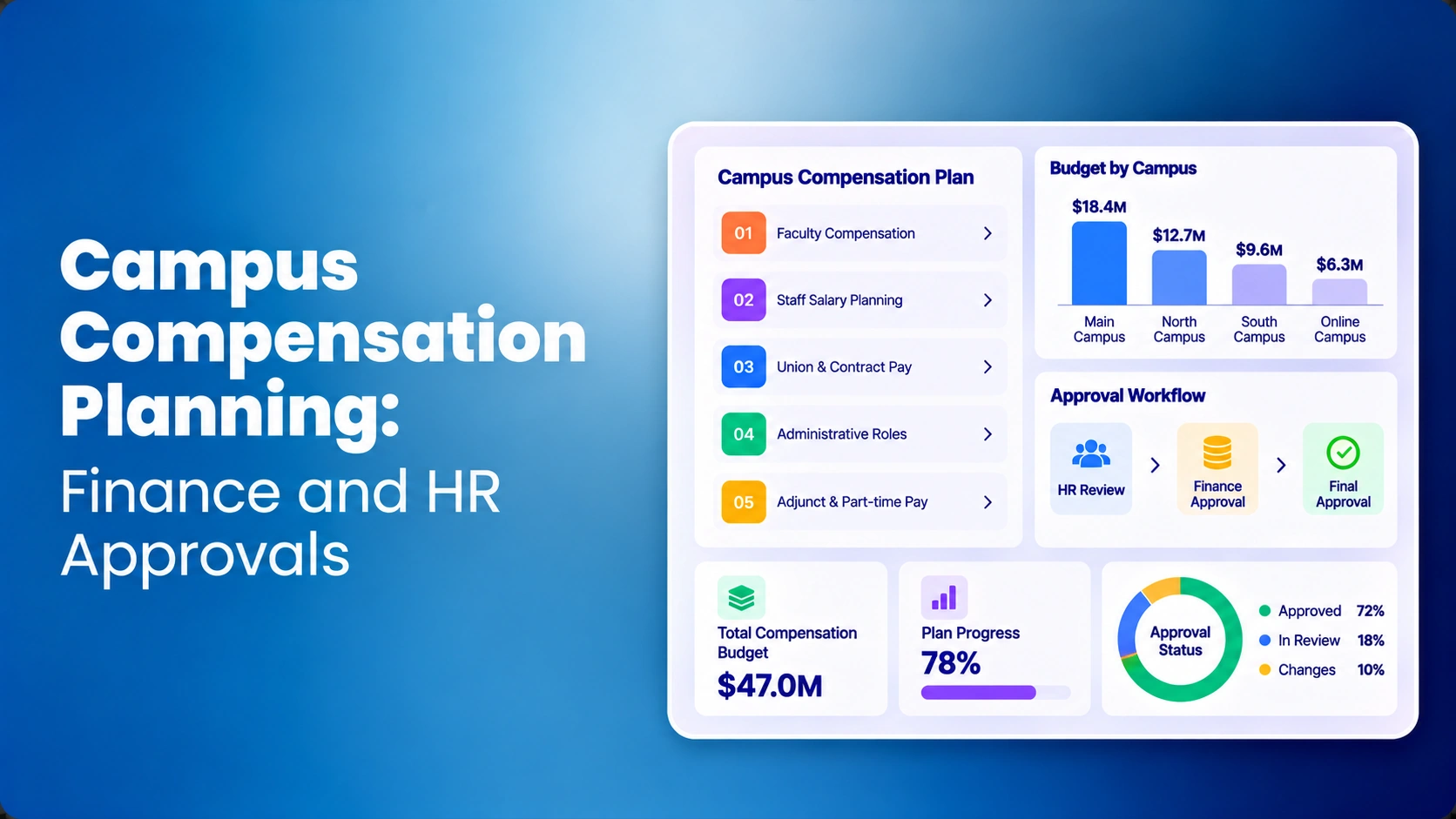

Campus compensation planning software should allow non-faculty departments to propose pay actions within defined authority, show approved salary structures and budget context, route exceptions to HR and Finance, and preserve the full decision history. Test a conflicting department request and a restricted approval role.
A department may request compensation changes for hard-to-fill staff positions while central HR protects grade policy and Finance controls the available budget. On a university campus, the decision involves different units with overlapping responsibilities. A software workflow that simply routes a spreadsheet for signature cannot resolve mismatched job codes, out-of-range proposals or unclear approval ownership.
Four campus compensation planning controls to test
The University of Colorado Boulder's published compensation roles and oversight framework shows central HR responsibility for university staff classifications, range reviews and pay-setting processes, with campus leadership involved in annual decisions. It is one institution's practice, not a universal procurement requirement. CU Boulder’s compensation roles and oversight.
Who may initiate and authorize a salary proposal?
A hiring department can supply job information, but that does not mean it owns the grade or the final pay decision. Link position records to planning access controls. The software should identify the person proposing a change, the HR reviewer verifying policy and the Finance leader confirming funds. A delegated signature should not become unrestricted editing of compensation data.
Vendor test: Try submitting a proposal from a department manager account that lacks central approval rights.
Are compensation actions classified correctly?
A promotion, revised job evaluation, market adjustment and annual merit proposal may have different approval conditions. Check grade decisions and the distinction between market and merit increases. HR should be able to reject a category chosen merely to make an over-limit request pass an approval rule.
Vendor test: Ask the system to handle a promotion and an off-cycle retention proposal with different rationale fields.
Can Finance review the actual salary and budget effect?
An institutional department budget may be controlled differently from a campus-wide merit pool. Verify which funding constraints the software can represent, rather than assuming restricted-fund or grant accounting is included. Use salary ranges and budget reporting as the evidence for proposed and approved costs.
Vendor test: Create a fictional department budget shortfall and require a visible escalation before approval.
Is the history defensible after a department reorganizes?
Reporting lines, cost centers and job codes can change. Approval records should remain tied to effective-dated salary and job records. Compare employee analysis with approval workflow review so later HR teams can identify the rule used at decision time.
Vendor test: Move a staff employee between units, and ask for the original and final reviewer sequence.
Which salary survey sources should campus HR use?
Campus HR should select external salary evidence by job family and recruiting market. CUPA-HR’s 2025–26 Professionals in Higher Education Survey includes roles in information technology, student affairs and fiscal affairs; the separate Staff in Higher Education Survey includes primarily nonexempt office, technical, service and skilled-craft jobs. These are distinct survey populations, not interchangeable job-title lists or publicly available licensed salary cuts.
CU Boulder’s published staff compensation FAQs describe its use of peer institutions, CUPA-HR and labor-market data, but the specific choice remains an institutional decision. HR should document the job match, source year, geography and survey permissions before approving a market-adjustment proposal. For a campus IT analyst, compare the actual duties and job level, rather than using the pay of an unrelated administrative title.
Who owns each campus compensation decision?
A campus compensation request often crosses several authorities. A department head may identify retention risk. Human Resources assesses the job, salary range and policy. Finance checks the funding source and the recurring obligation. A vice president or other delegated official may authorize an exception. Software cannot resolve an unclear policy simply by adding another approver. Map who may request, recommend, review, approve and execute each type of pay action before configuring the workflow.
Separate merit increases, market adjustments, promotions, reclassifications, equity corrections and one-time payments. Each can have a different justification, effective date, budget source and approval threshold. A retention proposal that is described as merit can bypass the evidence expected for a market adjustment and distort next year's reporting. HR should require the correct action type and supporting rationale at submission.
What evidence belongs in a campus salary request?
Require an approved staff job record and grade, current base salary, requested action type, proposed amount and effective date, the department's rationale, the applicable pay range and the funding unit. HR must be able to review job and market evidence while Finance reviews the fiscal period and recurring cost. Record who may propose, recommend, authorize and implement the change; a manager's submitted proposal is not permission to alter campus salary structures.
- Department: retention, workload or role-change rationale and requested amount
- HR: grade, salary-range position, market or internal equity evidence and policy checks
- Finance: identified cost center or fund, current-year cash cost, next-year run rate and restrictions
- Approver: final approved amount, exceptions, effective date and implementation owner
Illustrative request: a campus IT retention adjustment
Suppose a department requests a $5,000 annual base-pay increase for an IT systems analyst earning $80,000. This is an illustrative scenario, not a recommended pay change. The increase equals 6.25% of current base pay. If the new rate takes effect halfway through the fiscal year, the simple current-year base-pay impact is approximately $2,500, before on-costs and depending on actual payroll dates. The recurring next-year base-pay obligation is $5,000. Finance needs both figures and must identify a sustainable funding source.
| Review step | Evidence required | Question to resolve |
|---|---|---|
| Department proposal | Role, current pay, retention rationale and requested effective date | What problem is the increase meant to solve? |
| HR policy review | Approved grade, range position, internal comparisons and action type | Is this market, merit, promotion or an exception? |
| Finance review | Current-year cash effect, recurring run-rate and funding source | Can the department sustain the obligation? |
| Final approval | Recommendation, rejected alternatives and authorized amount | Who has delegated authority? |
| Implementation | Effective date, HRIS/payroll handoff and manager communication | Was the approved action actually executed? |
The workflow should retain each version of the request. If the department asks for $5,000 and Finance authorizes $3,000, later reports must not present the original amount as approved. The platform should make the approved amount and the implementation status distinguishable.
Partial-approval math: In the fictional $80,000 salary example, a $5,000 raise is 6.25%. If Finance authorizes only $3,000, the approved annualized increase is 3.75%, not 6.25%. With exactly six months remaining, the illustrative base-pay cost is $1,500; the recurring full-year cost is $3,000, excluding any employer on-costs. Record the actual effective date and FTE before moving the estimate to Finance.
Handle multiple sources of funds without pretending they are interchangeable
Universities may use unrestricted operating funds, restricted grants, auxiliary budgets or position-specific allocations. A department can have available cash today but lack authority to commit an ongoing salary increase to a restricted source. Treat grant eligibility, donor restrictions and institutional policies as externally governed decisions, not automatic outputs of compensation software. Require the request to show the funding unit, approved funding source, budget period and whether a proposed increase creates a future-year obligation.
For the same employee, a one-time retention award and a permanent base increase may have different budget consequences even when they have the same current-year cash cost. Build a case where HR proposes both alternatives. Request an audit trail showing which choice Finance supported, which was approved and what remained unresolved. If the tool shows only a single salary number, the university will still need a separate approval workbook.
Federal-award boundary: For applicable federal awards, 2 CFR 200.430 requires salary costs to meet allowability and recordkeeping requirements, including records that accurately reflect work performed. A compensation proposal approved by HR and Finance does not, by itself, prove a grant salary charge is allowable or correctly allocated. Confirm the needed sponsored-programs and accounting controls in the university's system of record.
What should managers, HR and Finance be allowed to see?
A department chair needs a clear view of their requested actions, reasons for any returns, and remaining authority. Central Compensation needs range, job evaluation and peer-context visibility. Finance needs budget and funding dimensions across departments. A final approver needs concise decisions, exceptions and documented rationale. Test permissions using actual campus roles, not just a generic “administrator versus employee” split. Unauthorized visibility into employee pay is a serious implementation risk.
Ask the vendor to show a request moved from department to HR, returned for missing market evidence, routed to Finance, partially approved, and exported for implementation. The demonstration should reveal where comments and files are stored, how version conflicts are handled, and whether rejected requests remain searchable after the cycle closes.
How should annual merit and off-cycle adjustments differ?
Annual merit planning is usually a structured allocation exercise with budget rules, employee eligibility dates and fixed decision windows. Off-cycle adjustments are individual cases that may happen after the budget is approved. A system may handle one well and the other poorly. Test the off-cycle workflow alongside the regular cycle. Ask whether a midyear adjustment flows into the next cycle's salary baseline correctly and whether a department can inadvertently spend the same funds twice.
Use two financial views: annualized run-rate and cash cost within the current planning period. Add employee benefit or payroll on-cost assumptions only when the institution supplies them; avoid blanket burden percentages. For partial FTE and midyear changes, record the calculation convention so Finance can reproduce it.
What should a campus approval workflow demonstration prove?
- Create one standard merit proposal within a department's allocation.
- Create one market adjustment needing supporting survey evidence.
- Return a proposal to the manager for more documentation without losing the initial version.
- Partially approve an exceptional request and preserve both requested and authorized amounts.
- Export the authorized action with effective date and reconcile it against the HRIS import outcome.
Ask to see exception reports, overdue approvals, delegated approvers, and a final cycle report that differentiates submitted, approved and implemented actions. The strongest outcome is a controlled decision record, not the number of buttons in the manager interface.
Campus compensation software evaluation scorecard
Use this table to compare demonstrated evidence, not untested product claims. The institution should agree which failures are unacceptable before requesting vendor demonstrations.
| Decision | Proof | Failure |
|---|---|---|
| Roles and access | Department proposer, HR reviewer, Finance approver | One user can approve everything |
| Compensation rules | Grade, band, action type and exception | Proposal silently bypasses policy |
| Funding review | Amount and approved budget authority | No proof of available funds |
| Record retention | Dates, comments, approvals, original values | Only final amount remains |
How should HR and Finance score a vendor demonstration?
Use an institution-defined 0–2 scale for each of the four matrix controls: 2 for a completed, reproducible test with saved evidence, 1 for a documented workaround or required configuration, and 0 when the vendor cannot demonstrate it. Maximum score: 8 points. Record reviewer observations, implementation dependencies and failed controls instead of relying on sales presentations.
Mandatory gates: authorized department access, HR and Finance approval rules, recoverable original and final amounts, and separation of approval from payroll implementation. A high total score cannot compensate for missing approval history or unauthorized access.
Worked campus example: resolve two competing salary requests
Use one fictional university scenario to test how a compensation system handles conflicts. Department A requests an above-range retention increase for an IT specialist. Department B requests a market adjustment for an office employee, but Finance has not confirmed whether its funding source can cover the ongoing cost. Give each vendor the same anonymized employee and policy records, then work through these four checks.
- Validate the job and funding records. Verify both employees' approved job codes, grades, current salary ranges and assigned departments against the source records. Flag Department B's funding as unverified instead of treating a budget field as approval. Ask the vendor to show how mismatches are recorded and corrected through data reconciliation.
- Classify each request and apply the right rules. Mark Department A's proposal as an off-cycle retention request, and determine whether Department B's request meets the institution's market-adjustment policy. Show the rationale, exception threshold, reviewer permissions and required evidence. The off-cycle approval workflow should not silently borrow approval rules from the annual merit cycle.
- Model salary and budget impact before approval. HR should show whether Department A's proposed pay exceeds its approved range using compa-ratio and range penetration. Finance should view current-fiscal-year cost, annualized future cost, the proposed effective date and the unresolved funding issue for Department B. Test a partial approval and confirm that the approved amount is not confused with the original request.
- Close the decision and reconcile execution. Have the authorized approver approve or return Department A's exception with a recorded reason, and hold Department B's action until funding is verified. Retrieve the original and revised decisions, approver, effective date and effective-dated salary structure history. Then compare the authorized action with the HRIS or payroll record; do not treat approval alone as proof of implementation.
Pass criterion: another reviewer can reconstruct who proposed each action, which policy and funding checks applied, why it was approved or held, and whether the final approved amount reached the system of record. If the platform cannot complete a step directly, ask the vendor to demonstrate the documented integration or manual control instead.
Evaluate University Staff Workflows
Use representative campus staff job, range and approval questions to evaluate what CompBldr supports.
Book a DemoWhich campus software limits need verification?
CompBldr should not be presented as a grant accounting, payroll, tenure or collective-bargaining system without verified evidence. University Finance must validate any requested funding restrictions and ledger integrations. Legal and institutional policy decisions remain with authorized professionals.
Require clarity about data sources, job populations, access controls, approved institutional policy, migration tests and what requires custom implementation. Ask the vendor to repeat one unfavorable test case. A promise about a feature on the roadmap is not the same as a demonstrated capability.
Where CompBldr fits into campus compensation planning
CompBldr joins job records, evaluation, approved ranges, HR-led pay planning and reporting. Ask for a demonstration using the university's actual approval roles and verify which departmental budget features are configurable.
How do approved pay actions reach HRIS and payroll?
The compensation decision is not complete when the final approver clicks Approve. A campus still needs the correct effective date, employee record, salary amount and funding instructions to reach the appropriate system of record. Ask who checks that the authorized action was implemented and how a discrepancy is resolved. A spreadsheet export sent to payroll, for example, can introduce a new error even when the original compensation planning process was controlled.
In a pilot, authorize an illustrative $3,000 annual increase effective on a future date. Then simulate an HRIS record that shows $2,500 on the wrong effective date. The workflow should let the team distinguish the approved recommendation from the implemented amount and identify the unresolved reconciliation. Do not represent the scenario as an automated integration capability unless the vendor demonstrates that exact connection. A defensible process can also use a manual reconciliation, provided the owner and evidence are explicit.
Finish each planning cycle with a report of requests submitted, returned, rejected, approved, implemented and awaiting reconciliation. Finance should be able to compare approved annualized cost with the actual changes posted to employee pay, while HR can investigate exceptions using individual records under appropriate access rules. That closeout becomes the baseline for the next cycle and prevents stale requests from appearing as approved budget commitments.
Sources and methodology (reviewed November 14, 2026): CU Boulder is a documented campus-specific example, not a universal compensation policy. CUPA-HR describes its separate higher education salary-survey populations; 2 CFR 200.430 applies to allowable personnel costs on covered federal awards. The campus IT salary amounts, two-department scenario and eight-point vendor scorecard are illustrative, not observed institutional results. Confirm product capabilities, access controls, funding conditions and payroll integration in a configured demonstration.
Next step: require a real campus approval demonstration
Bring one representative staff position, its current grade, a relevant market source and an exception requiring approval. Document what the system actually does and what the university team must still control manually. Agree on acceptance criteria before reviewing price.
Book a CompBldr Evaluation
Use representative campus staff job, range and approval questions to evaluate what CompBldr supports.
Book a Demo